
The way most students “plan” a health policy elective is backwards. They scramble for a placement, then try to invent goals on day one. That is how you turn an incredible opportunity into a forgettable checkbox.
You’re going to do it differently. Six months out, week by week, you’ll build the skills, connections, and clarity to walk in as someone useful, not just “the med student shadowing policy people.”
Below is your 6‑month preparation timeline: what to do, when to do it, and what you should have in hand at each point.
Overview: 6 Months Out – What This Actually Looks Like
Before we zoom into the weeks, see the big arc. A solid prep plan has four phases:
| Phase (Months Out) | Primary Focus |
|---|---|
| 6–5 months | Clarify goals, map options, basic literacy |
| 4–3 months | Secure elective + logistics, deepen knowledge |
| 2 months | Skill-building, ethics framework, pre‑reading |
| 1 month–Elective | Project planning, communication, final prep |
Now let’s walk it chronologically.
Month 6: Decide What Kind of Policy Elective You Actually Want
At six months out, your job is not to email every “policy” person you’ve heard of. At this point you should be ruthless about what you want from this month and where you fit.
Weeks 1–2 (6 Months Out): Define Your Targets and Constraints
At this point you should:
Clarify your goal in one sentence.
Examples:- “I want to understand how state Medicaid decisions are actually made.”
- “I want hands‑on experience with hospital quality metrics and value‑based care.”
- “I want to work on advocacy for reproductive health policy at a national level.”
If your goal takes a paragraph, you don’t know it yet. Rewrite until it’s tight.
Pick 1–2 policy “domains” you care about.
For example:- Payment & financing (Medicare, Medicaid, private insurance, ACOs)
- Public health (infectious disease, environmental health, injury prevention)
- Social determinants (housing, food policy, incarceration)
- Ethics & regulation (bioethics, privacy, AI in medicine, research oversight)
Clarify your hard constraints.
- Dates you can actually be away from clinical duties.
- Location flexibility (local only vs. ok with remote vs. willing to relocate).
- Whether it must count as a formal elective for credit.
Write these on one page. This isn’t busywork. This is what you send to mentors and potential preceptors.
Weeks 3–4 (5.5 Months Out): Build Basic Policy Literacy
At this point you should not be emailing program directors saying “I’m passionate about health policy” while you can’t define “CMS.” Spend two weeks fixing that.
Minimum reading/learning list:
- One health policy overview book or equivalent. Pick one:
- “Health Policy Issues” (Bodenheimer & Grumbach)
- “Understanding Health Policy” (Bodenheimer & Grumbach – classic for med students)
- One current newsletter or outlet:
- KFF Health News, STAT Health Policy, Health Affairs blog.
Then:
- Spend 3–4 evenings (1–2 hours each) reading targeted topics:
- How U.S. health care is financed.
- Who actually makes policy: Congress, agencies (CMS, CDC, FDA), state legislatures, boards of health, hospital boards.
- Basic terms: fee‑for‑service, capitation, value‑based care, prior auth, HEDIS, block grants.
By the end of Month 6 you should be able to explain, in plain language, who makes decisions that affect your clinical patients and how a policy idea turns into something real.
Month 5: Map Opportunities and Start the Quiet Recon
This month is about intel, not applications. You are trying to see what’s realistic.
Week 5 (5 Months Out): Inventory Existing Options
At this point you should:
Review your school’s elective catalog.
- Look for: “health policy,” “advocacy,” “quality improvement,” “population health,” “bioethics,” “public health practicum.”
- Note prerequisites and whether these can be taken off‑site.
Check established national options. Examples (these change, so confirm):
- AMA Government Relations internships.
- APHA policy internships.
- State medical society policy electives.
- Rotations with your country’s ministry/department of health.
- Major health systems with policy/quality rotations (e.g., VA, Kaiser, academic centers).
Create a shortlist of 5–10 possible sites or models:
- 2–3 internal (your institution).
- 3–5 external (government, NGOs, professional orgs).
- 1 “stretch” option (competitive, but worth a shot).
Week 6 (4.5–5 Months Out): Talk to Humans, Not Just Websites
At this point you should start quiet networking:
Identify 3–5 people to talk to. Examples:
- A resident who did a CMS or state health department elective.
- Your med school’s health policy interest group faculty advisor.
- Someone from your hospital’s quality department or office of population health.
- A bioethics attending who sits on a hospital ethics committee.
Send short, targeted emails.
Something like:I’m a [M3/M4] planning a health policy elective about [your domain] around [month]. I’m trying to understand what’s feasible and how to make it useful to the host site. Could I get 20 minutes to ask you what you’ve seen work well?
During each conversation, get specific:
- What did you actually do each day on your policy elective?
- What made it great vs. a waste of time?
- Which sites or mentors do you recommend or avoid?
- What would you prepare, if you could redo it?
You’re not begging for a spot. You’re gathering actionable intel and names.
Month 4: Lock Direction and Start Applying
By now you should have a clear picture of the type of elective and a few promising routes. This month is where ideas become actual applications.
Week 7 (4 Months Out): Choose Your Top 2–3 Paths
At this point you should decide:
- Primary plan: e.g., State Department of Health policy elective in Medicaid.
- Secondary plan: e.g., Hospital quality improvement & value‑based care rotation.
- Backup plan: e.g., Faculty‑designed local elective with your own project.
You want redundancy. Policy rotations fall through all the time. Elections change. Funding disappears. Someone “forgets” to file paperwork. I’ve seen students get burned when they only had one plan.
Week 8–9 (3.5–3 Months Out): Prepare Application Materials
Most structured electives (especially external) will want:
- CV (tailored toward policy/leadership/service).
- Brief statement of interest (½–1 page).
- Proposed dates and duration.
- Possibly a letter of support from your school.
At this point you should:
Rewrite your CV for policy.
- Move anything remotely policy-/public‑health‑related up:
- QI projects.
- Community health work.
- Ethics committees.
- Any research with population, systems, or social determinants angle.
- Cut fluff that screams “I just need to fill space.”
- Move anything remotely policy-/public‑health‑related up:
Draft a 3–4 paragraph interest statement. Hit:
- What you’ve seen clinically that drives your interest in policy.
- What domain you care about and why (with at least one concrete example).
- What skills you bring (writing, data, languages, prior advocacy).
- What you hope to produce (e.g., policy brief, white paper, QI proposal).
Confirm elective credit requirements with your school.
- Forms for external electives.
- Deadlines for approval.
- Whether there’s a required deliverable (paper, presentation).
Week 10–11 (Just Under 3 Months Out): Submit Applications / Make Direct Asks
At this point you should actively secure something:
- For structured programs: follow their formal application process.
- For custom/site‑created electives:
- Identify the specific office or person (e.g., “Chief Medical Officer for Medicaid,” “Director of Population Health”).
- Send a tight email with:
- Who you are.
- Your target dates.
- What you’re hoping to do.
- How you could be useful (research, writing, lit reviews, stakeholder mapping).
- A 1‑page “draft elective description” attached (saves them work).
If you’re creating an elective with a local faculty mentor, at this point you should co‑write:
- Working elective title.
- Learning objectives (4–6, clearly worded).
- Activities: meetings, committees, shadowing, independent project.
- Assessment: what you’ll deliver and how you’ll be evaluated.
Get that into your school’s system now, not four weeks before.
Month 3: Logistics + Deeper Knowledge
At three months, you’re shifting from “Do I have a spot?” to “How do I walk in ready?”
Week 12–13 (3 Months Out): Lock Down Logistics
At this point you should:
- Confirm:
- Exact dates.
- Primary supervisor.
- Whether in‑person, hybrid, or remote.
- Any onboarding requirements (background checks, confidentiality forms, IT access).
- Handle basic life stuff:
- Housing if away.
- Commuting.
- Time‑off approvals from your Dean’s office or program.
Do this now so you’re not printing immunization records at 11 p.m. the week before.
Week 14–15 (2.5 Months Out): Study the Specific Policy Context
Generic health policy knowledge is fine. Your host site cares about their world.
At this point you should:
- Ask your preceptor (or coordinator):
“What 3–5 documents or websites would you recommend I review before starting?”
Then actually read them. Typical items:
- Recent strategic plan of the department/agency/organization.
- Latest relevant legislation (e.g., bill summary, final rule).
- Recent reports to the legislature or board.
- Past policy briefs from the office.
- For hospital‑based policy/QI:
- Current quality metrics dashboards.
- Previous QI reports in your topic area.
Keep a running document where you:
- Note key acronyms and players.
- Summarize 3–5 active policy questions or debates in that space.
- Flag data sources commonly used (claims data, registry data, EHR reports).
Month 2: Build Skills and Your Ethics Backbone
This is when you stop being “interested” in policy and start being useful.
Week 16–17 (2 Months Out): Get Practically Useful Skills
At this point you should invest 6–10 focused hours in skills that pay off immediately:
Policy brief writing basics.
- Read 3–5 actual briefs (e.g., from KFF, RAND, your state’s legislative research service).
- Notice structure: problem, background, options, recommendations, implications.
- Practice turning one journal article into a 1‑page brief. Time yourself. Aim for 90 minutes or less.
Data literacy refresher.
- Quick review of:
- Interpreting basic health services research: odds ratios, confidence intervals, difference‑in‑differences, simple regressions.
- If your elective is QI or analytics heavy, spend a weekend with:
- A basic R or Stata tutorial, or
- Even just sharpening Excel skills (pivot tables, basic charts).
- Quick review of:
Meeting skills. Yes, really. Most policy electives are meeting‑heavy.
- Practice taking structured notes using:
- Who was there.
- Decisions made.
- Follow‑ups assigned.
- Learn to write a 1‑page meeting summary within 24 hours.
- Practice taking structured notes using:
Week 18 (Just Under 2 Months Out): Ethics and Power Dynamics
Policy work is ethics and power, dressed in bureaucracy.
At this point you should:
- Revisit your school’s professionalism and ethics content, but focus on:
- Conflicts of interest.
- Resource allocation (who gets what, and why).
- Dual loyalties (patient vs. public vs. institution).
- Read at least one piece on:
- Structural racism in health policy (e.g., redlining, Medicaid expansion disparities).
- Disability rights in health policy decisions.
- Reflect—briefly, in writing—on:
- Where your own biases and assumptions sit.
- How you’ll handle being in rooms where decisions hurt some patients to help others.
You’re going to see ethically messy stuff. Better to walk in with your eyes open than realize halfway through that you’re rubber‑stamping something you’re not comfortable with.
Month 1: Final Prep, Project Design, and Communication
Now you have the spot, the logistics, and the context. The last month is about alignment and expectations.
Week 19–20 (1 Month Out): Clarify Expectations With Your Preceptor
At this point you should set up a pre‑elective call (30–45 minutes) with your supervisor.
Go in with a 1‑page prep document including:
- Your:
- Background (2–3 lines).
- Policy interests and prior experience (bulleted).
- Proposed learning objectives (4–5 bullets).
- Ideas for potential projects (2–3 options).
On the call, ask very direct questions:
- What does a typical day look like for someone in this office?
- What concrete outputs would be most helpful for your team?
- Are there ongoing projects I could plug into?
- What meetings/committees should I try to attend?
- How will my performance be evaluated?
Listen carefully for constraints. If they say, “We’re extremely short‑staffed,” that means your job is to make their life easier, not invent complicated new work.
Week 21 (3 Weeks Out): Lock in a Realistic Project
At this point you should finalize a primary project and, optionally, a backup. Examples:
- Drafting a policy brief on a pending state bill affecting Medicaid coverage for a specific service.
- Analyzing hospital readmissions data and drafting a QI proposal.
- Mapping stakeholders and drafting an advocacy strategy for a public health campaign.
- Reviewing evidence and ethics for implementing a new triage policy.
Use this rule:
If you cannot describe your project in one sentence with a verb and deliverable, it’s not defined enough.
Bad: “Learn more about Medicaid expansion.”
Good: “Produce a 3‑page memo summarizing the impact of Medicaid expansion on rural hospital closures in [state], with 2–3 policy options for stabilization.”
Share that sentence with your preceptor and get explicit buy‑in.
Week 22–23 (2 Weeks Out): Pre‑Reading and Calendar Setup
At this point you should:
- Ask for:
- A tentative meeting schedule for the first week.
- Any pre‑reading for key meetings you’ll attend.
- Create a simple calendar structure:
- Time blocked each day for:
- Meetings.
- Project work.
- Reading / reflection.
- Time blocked each day for:
- Set up your note‑taking system:
- Separate docs for:
- Meeting notes.
- Project working draft.
- “Lessons learned / reflections” (helps later for evaluations and personal statements).
- Separate docs for:
Also, prep your introduction script. You’ll repeat it 50 times:
I’m [Name], a [year] medical student from [school]. I’m here for a [duration] elective focusing on [topic], working mainly with [preceptor]. I’m especially interested in [brief interest], so I’m excited to learn how your team approaches [relevant activity].
Short. Specific. Professional.
Final Days Before the Elective: Last-Mile Adjustments
Week 24 (Final Week): Clean-Up and Mental Recalibration
At this point you should:
- Confirm:
- Start time and location (physical or virtual).
- Dress code (err on the professional side).
- Any required IDs or parking info.
- Print or locally save:
- Your project one‑liner.
- Your learning objectives.
- Key reference documents (or at least bookmark them).
Then, do one more thing most people skip:
- Spend 30 minutes writing:
- What you hope to see.
- What you hope to contribute.
- One ethical tension you’re curious to explore (e.g., cost vs. access, security vs. privacy).
This becomes your anchor when the month feels like a blur of meetings and memos.
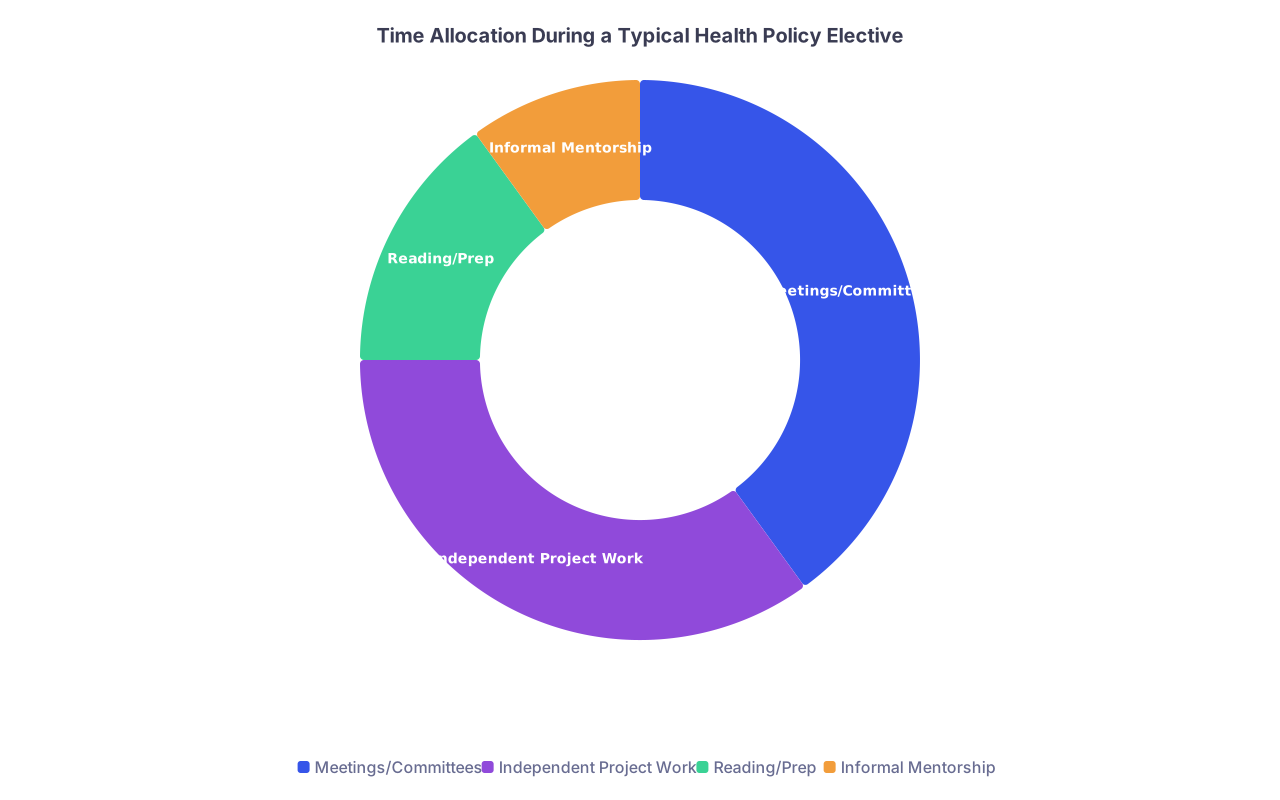
| Category | Value |
|---|---|
| Meetings/Committees | 40 |
| Independent Project Work | 35 |
| Reading/Prep | 15 |
| Informal Mentorship | 10 |
During the Elective: How This Prep Actually Pays Off
You didn’t ask for an in‑elective timeline, but your prep shapes how you spend the month.
With this 6‑month run‑up, you walk in already able to:
- Track complex meetings and send crisp summaries.
- Identify where your project plugs into real decisions.
- Raise thoughtful (not naive) questions about ethics and trade‑offs.
- Produce something your host site might actually use—rather than a “for school only” reflection paper.
You stop being “extra work” and start being leverage.
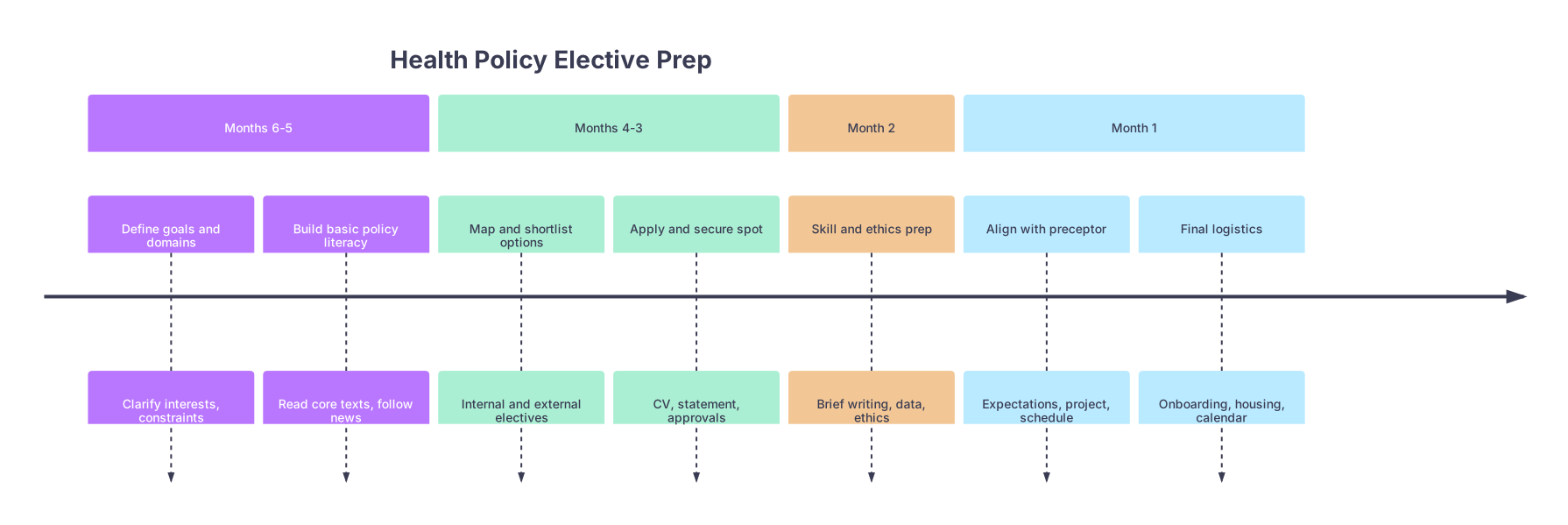
| Period | Event |
|---|---|
| Months 6-5 - Define goals and domains | Clarify interests, constraints |
| Months 6-5 - Build basic policy literacy | Read core texts, follow news |
| Months 4-3 - Map and shortlist options | Internal and external electives |
| Months 4-3 - Apply and secure spot | CV, statement, approvals |
| Month 2 - Skill and ethics prep | Brief writing, data, ethics |
| Month 1 - Align with preceptor | Expectations, project, schedule |
| Month 1 - Final logistics | Onboarding, housing, calendar |
Today, do one concrete thing: draft your one‑sentence goal for the elective and your top two policy domains, then email one person who can sanity‑check it. Do not wait. That single email starts your 6‑month clock.