
The worst thing a physician can do in an election year is stay “neutral” by staying silent.
If you want to impact public health, you need a plan that starts months before Election Day and runs past inauguration. This isn’t about becoming a politician. It’s about using your clinical credibility at the right times, in the right ways.
Below is a time-anchored checklist: what to do 6–9 months before, 3–6 months before, final 8 weeks, Election Week, and the 3 months after. At each point, you’ll see: at this point, you should… and exactly how to execute.
6–9 Months Before Election Day: Build Your Base and Your Boundaries
At this point, you should stop pretending this is “too early.” It isn’t. By the time campaigns heat up, you’ll either have a foundation or you’ll be scrambling.
1. Clarify your red lines and your scope (Week 1–2)
At this point, you should:
- Decide what you care enough to speak about:
- Vaccine policy
- Reproductive health access
- Firearm injury prevention
- Climate and health
- Mental health funding
- Medicaid/insurance coverage
Pick 1–3 priority issues. If everything is your issue, nothing is.
- Define your professional boundaries:
- Will you:
- Ever mention specific candidates by name?
- Only address policies, not parties?
- Join issue-based coalitions but not campaigns?
- Where will you not discuss politics?
- Patient visits
- Certain social media accounts
- Within your supervisory relationships
- Will you:
Write this out in a one-page “advocacy compass” for yourself. Yes, literally. If you don’t define this now, you’ll make rushed, emotional decisions later.
2. Audit your knowledge and fill the gaps (Week 2–4)
At this point, you should know the policy basics as well as you know the treatment guidelines you quote every day.
- Identify 3–5 core facts for each of your issues:
- Example (vaccine policy):
- State vaccination exemptions and current rates
- Recent outbreaks and hospitalization data
- Existing school-entry requirements
- Example (Medicaid):
- Current eligibility in your state
- Number of people in your county on Medicaid
- Pending bills that could change coverage
- Example (vaccine policy):
Create a simple one-page brief for each issue. Base it on:
- State health department data
- CDC, NIH, or WHO reports
- Your state medical society’s legislative briefs
You’re building your data backbone so you do not rely on vibes when the pressure hits.
3. Understand your institutional rules (Week 3–4)
At this point, you should know exactly what your employer and your licensing board allow.
- Read:
- Your hospital’s or practice’s social media policy
- Any political activity or “use of logo/name” policies
- Your specialty board’s or state board’s recent statements about physician advocacy
Ask your risk management or compliance office one direct question:
“If I speak about [issue] in public, as a physician, what do I need to avoid to keep us all out of trouble?”
Get that answer in writing (email is fine). I’ve seen people disciplined for using the hospital logo in a partisan tweet. Do not be that story.
5–6 Months Before: Build Your Platform and Your Network
At this point, you should stop doing this alone. Lone wolves burn out and get ignored.
4. Clean and segment your public presence (Month 2)
At this point, you should:
- Decide what each channel is for:
- LinkedIn – professional identity, policy commentary, op-eds
- Twitter/X – fast commentary, health policy threads
- Facebook/Instagram – community-facing education, local groups
- Clinic or department website – neutral educational content and your credentials
Clean up obvious landmines:
- Remove:
- Old partisan memes
- Snarky comments about “idiot voters” or “those people”
- Add:
- A short, clear bio: “Pediatrician in [city] focused on vaccine policy, school health, and community prevention.”
You’re not scrubbing your humanity, just aligning your public persona with your current mission.
5. Join at least two organized structures (Month 2–3)
At this point, you should be in rooms where strategy already exists, not inventing everything from scratch.
Minimum:
One professional group (pick one):
- State medical society advocacy committee
- Specialty society (e.g., ACP, AAP, ACOG) health policy group
- Hospital system’s government affairs or community benefits committee
One community or civic group:
- Local public health coalition
- School health advisory council
- Community-based organization (e.g., faith-based health ministry, harm reduction group)
Your goal by the end of Month 3:
- Be on one email list where people send action alerts
- Know the name of at least one policy staffer or public health officer you can text or email directly
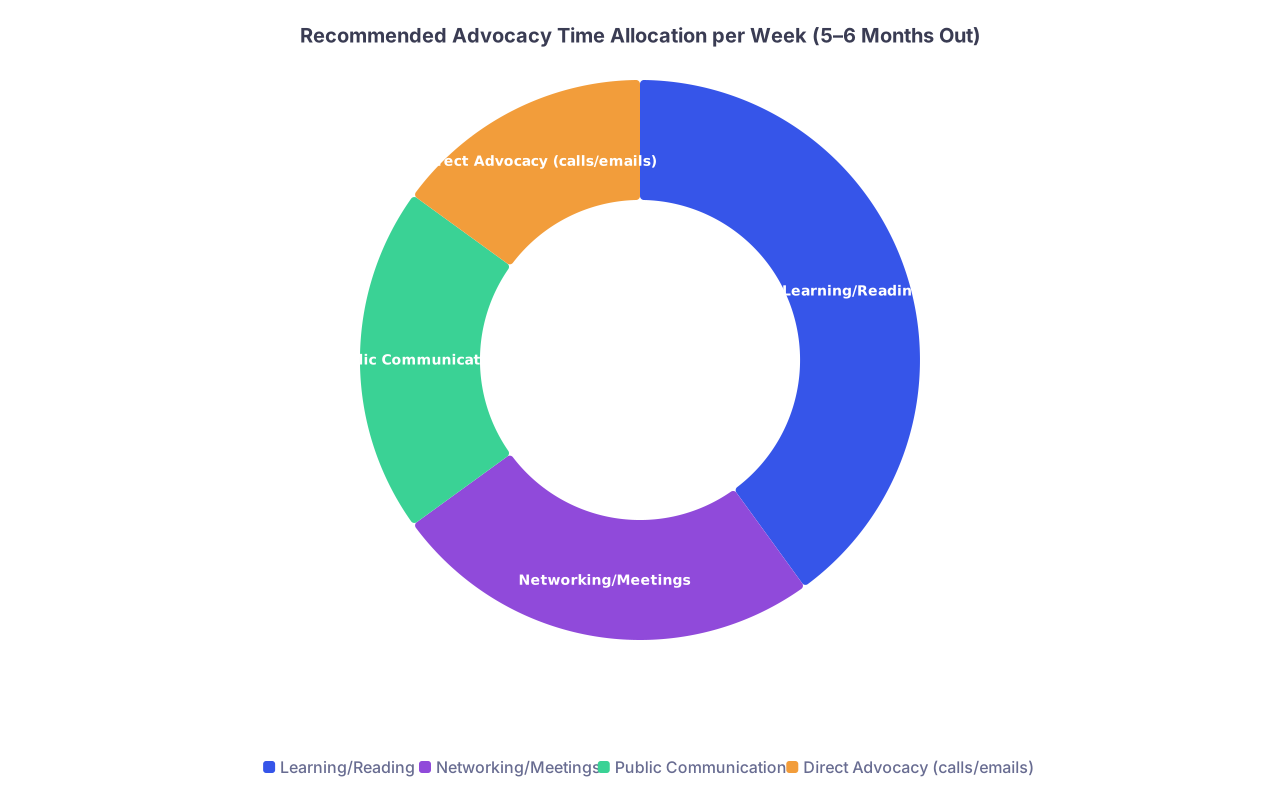
| Category | Value |
|---|---|
| Learning/Reading | 40 |
| Networking/Meetings | 25 |
| Public Communication | 20 |
| Direct Advocacy (calls/emails) | 15 |
3–4 Months Before: Produce and Position, Not Just React
Now you shift from preparation to production. At this point, you should be visible in at least one channel.
6. Create 2–3 “evergreen” pieces of content (Month 3–4)
You’re going to be asked the same questions repeatedly. Pre-build your answers.
Create:
One short op-ed or blog (600–800 words)
Topic example: “What [Issue] Means for Patients in [Your City] This Election”.
Publish in:- Local newspaper opinion section
- Hospital blog
- Medium/Substack/LinkedIn article if the others won’t take it
One patient-facing FAQ (1–2 pages)
For example:- “Common Questions About Vaccines and School Requirements”
- “Your Health Coverage and This Election: What Might Change?”
One 5–7 minute talk
Script it with:- A 1-minute story from your practice (de-identified, obviously)
- 3 data points
- 2–3 specific actions people can take (register to vote, attend a local forum, read a guide)
That talk becomes your backbone for panels, town halls, and media interviews.
7. Set explicit ethical guardrails (Month 3–4)
This is the “don’t lose your license or your integrity” step.
At this point, you should adopt a simple internal code. Example:
I will:
- Be transparent when I’m speaking on my own behalf vs on behalf of my institution
- Distinguish evidence from my opinion
- Avoid discussing specific candidates in clinical encounters
- Never threaten or pressure patients about votes
I will not:
- Discriminate in care based on political beliefs
- Share patient stories without rigorous de-identification and, when in doubt, explicit consent
- Exaggerate evidence to fit my preferred policy outcome
Write this somewhere you’ll see it. During a heated news cycle, your future self will thank you.
2–3 Months Before: Engage Locally and Get in the Room
Now the campaign noise ramps up. At this point, you should stop being primarily online and start being physically present where policy is made and debated.
8. Plan one clinic- or hospital-based education effort (Weeks 9–12)
Notice: this is education, not partisan campaigning.
Pick something realistic:
- A poster or flyer in waiting rooms:
- “How to Register to Vote in [State]”
- “Questions to Ask Candidates About Health Policy”
- A QR code to:
- Your state’s nonpartisan voter information site
- A reputable guide explaining a major public health ballot measure
Check with clinic leadership first. Use neutral language and official resources.
You’re not telling patients how to vote. You’re making it easier for them to understand the health implications and participate.
9. Show up where candidates and policymakers are (Weeks 10–12)
At this point, you should have attended at least one of the following:
- Local candidate forum or debate
- City council or county board meeting on a health-related issue
- School board meeting discussing health curriculum or safety
- State legislature hearing livestream or in-person session
Your checklist for each event:
- Read the agenda beforehand
- Bring one printed page:
- 3–5 bullet points with:
- Local stats
- A brief patient story
- Exactly what you want them to support or oppose
- 3–5 bullet points with:
- If there’s public comment:
- Plan a 1–2 minute statement
- After the meeting:
- Introduce yourself to at least one official or staffer
- Hand them your one-pager
- Get a contact email
You’re building the reputation of “the doctor who shows up with data, not drama.”
Final 8 Weeks: High-Impact, Time-Boxed Advocacy
This is where people either burn out or go silent. Don’t do either. At this point, you should have a scheduled advocacy rhythm, not a constant fire drill.
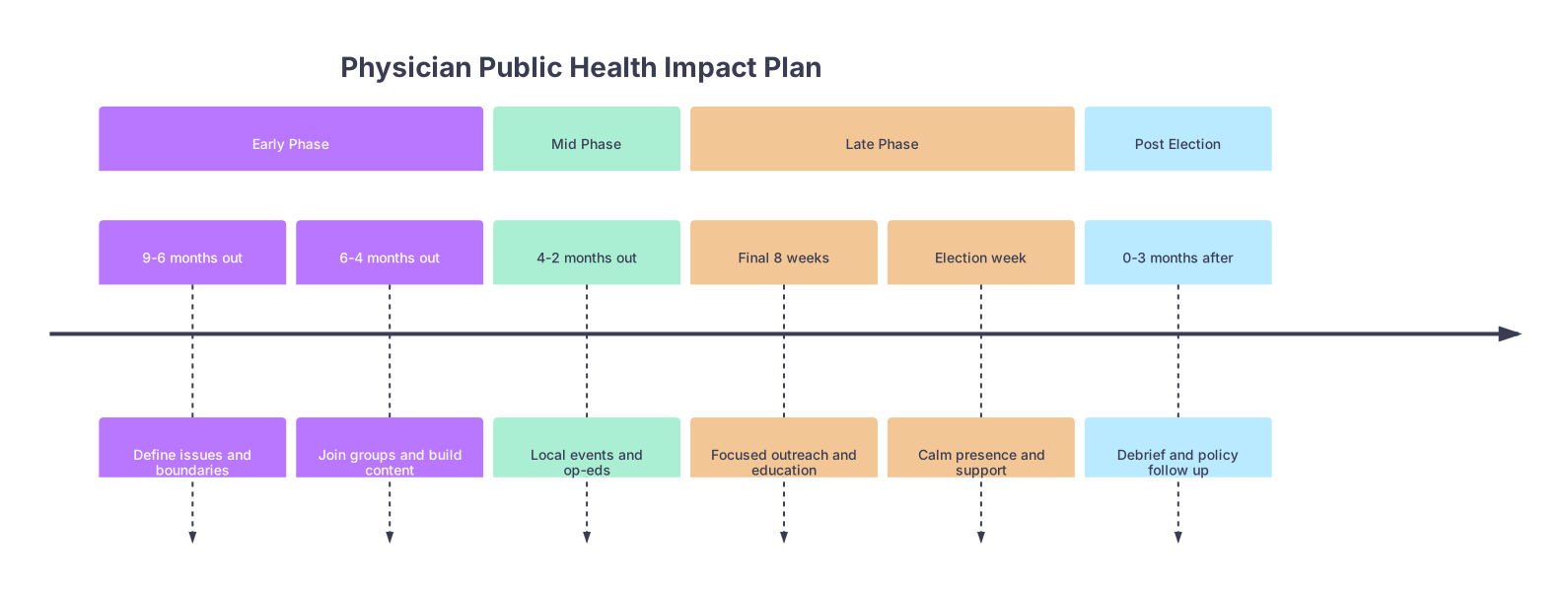
| Period | Event |
|---|---|
| Early Phase - 9-6 months out | Define issues and boundaries |
| Early Phase - 6-4 months out | Join groups and build content |
| Mid Phase - 4-2 months out | Local events and op-eds |
| Late Phase - Final 8 weeks | Focused outreach and education |
| Late Phase - Election week | Calm presence and support |
| Post Election - 0-3 months after | Debrief and policy follow up |
10. Lock in a weekly advocacy schedule (Weeks 8–5 before)
Pick 2–3 time blocks per week, 30–60 minutes each. Protect them like clinic time.
Example weekly plan:
Monday evening (30 min):
- Scan 2–3 trusted policy newsletters or state medical society updates
- Flag any calls to action
Wednesday lunchtime (30–45 min):
- Send one email to a policymaker or campaign about a specific issue
- Or draft a short social media post/LinkedIn article
Saturday morning (60 min):
- Attend a local event, community meeting, or virtual webinar
- Or batch-record 2–3 short educational videos (reels, TikToks, YouTube shorts) on your issues
Consistency beats heroic, once-a-year efforts.
11. Coordinate with aligned organizations (Weeks 6–4 before)
At this point, you should not be reinventing the wheel.
Reach out to:
- Your state medical society or specialty chapter:
- Ask: “What are your top 2 public health priorities this election, and how can I help amplify them?”
- Local public health department:
- Ask: “Do you have voter education or public health ballot measure materials clinicians can use?”
- Nonpartisan civic groups (e.g., League of Women Voters):
- Ask: “Any health-focused events where a physician perspective would help?”
Offer one specific thing:
- “I can do a 5–10 minute overview on [topic] at your next meeting.”
- “I can fact-check a one-page explainer about [issue] from the clinician perspective.”
Final 4 Weeks: Focus, Don’t Flail
The temptation now is to try to do everything. You’ll end up doing nothing well. At this point, you should narrow down to two primary actions.
12. Pick your top two election-adjacent actions (Weeks 4–2 before)
Choose only two of these, and do them well:
Host or join a community forum:
- Topic: “How This Election Could Affect Health in [City]”
- Partner with: library, faith community, school, or community center
- Format: 20-minute overview + 40-minute Q&A
- Ground rule: no candidate endorsements; focus on issues and questions to ask
Write a “what’s at stake” piece for your local paper or institutional newsletter
- Use concrete local data
- Include a short story from your practice
Record a clinic-wide video or message for staff and patients:
- “How to find reliable information on health-related ballot issues”
- “How changes in coverage might affect your medications or appointments”
Do targeted outreach to high-risk patient groups:
- Seniors who depend on Medicare
- Patients on Medicaid
- Patients with chronic illnesses tied to environmental policy
Use your patient portal or clinic newsletter for purely informational messages—no partisan content.
Election Week: Be the Calm, Not the Noise
This is the week when emotions are high, misinformation spikes, and people look to physicians for reassurance.
At this point, you should dial down new advocacy and dial up support and clarity.
13. In the clinic: How to handle questions without crossing lines
Expect:
- “Doc, who are you voting for?”
- “Is it true that if X wins, they’ll take away my meds?”
- “What’s going to happen to my insurance?”
Your default script:
- Acknowledge the anxiety:
- “A lot of people are worried about that.”
- Shift to issues, not candidates:
- “Here’s what’s actually on the table regarding [Medicaid, drug pricing, coverage].”
- Provide concrete steps:
- “Here’s where you can read a nonpartisan breakdown.”
- “No matter who wins, this is how we’ll make sure your care continues.”
If you’ve drawn your own red line against candidate discussion, stick to it.
14. Online: Zero new fights, high signal only
At this point, you should:
Avoid:
- Arguing in comments
- Posting predictions
- Sharing unverified rumors
Share or reshare only:
- Your pre-built educational content
- Official state election information and deadlines
- Clarifications when misinformation is clearly circulating in your community
Your role: stabilizer, not provocateur.
0–3 Months After Election Day: Translate Votes into Policy
Most physicians disappear after Election Day. That’s like leaving the OR right after incision. The real work is in the follow-through.
15. Debrief and decompress (Weeks 1–3 after)
At this point, you should:
- Take one honest inventory:
- What did you actually do this cycle?
- What worked?
- What was a waste of time?
- Where did you overstep or feel ethically uneasy?
Write down:
3 wins (even small):
- “Spoke at one school board meeting”
- “Got one op-ed published”
- “Built a relationship with one city council member”
3 lessons for next time:
- “Start content earlier”
- “Avoid arguing on Twitter”
- “Coordinate more with [specific group]”
Then take a week off from advocacy. Yes, really. Burnout helps no one.
16. Convert election results into an action plan (Weeks 3–8 after)
Now the dust settles. At this point, you should be moving from campaign noise to policy reality.
For each of your 1–3 core issues:
Identify:
- Which candidates won in your district
- What they said they’d do on your issues
Send one concise message to each relevant official:
- Congratulate them
- Reintroduce yourself as a physician in their district
- Offer:
- “I’d be happy to be a resource on [issue] when you and your staff are working on health-related legislation.”
Track one concrete policy:
- A specific bill
- A local ordinance
- A budget item
Your goal in the next 3 months: show up once in a way that directly touches that policy:
- testify (even in writing),
- meet with staff,
- or mobilize colleagues to sign onto a letter.
| Target Level | Example Contact |
|---|---|
| Local | City council or school board |
| County/Regional | Public health department lead |
| State | State legislator or senator |
| Federal | Congressional health staffer |
| Institutional | Hospital government affairs |
3 Months After and Beyond: Make This a Professional Habit
At this point, you should decide: are you a one-cycle advocate or is this part of your ongoing professional identity?
17. Institutionalize your advocacy
Pick one:
- Join a standing health policy or ethics committee at your institution
- Take an official role in your state or specialty society advocacy arm
- Build a small physician advocacy group in your city:
- 4–8 clinicians meeting monthly
- Focused on one issue
- Sharing tasks (one writes, one speaks, one organizes)
Then set a long-term cadence:
- One major advocacy action per quarter:
- Testimony
- Op-ed
- Community forum
- Policy meeting
That way, when the next election cycle hits, you’re not starting from zero. You’re just turning up the volume.
Do This Today
Open your calendar and mark the date of the next Election Day. Then block one 60-minute slot in the next 7 days labeled:
“Public Health Election Impact – Step 1”
In that hour, do exactly two things:
- Write down your top 1–3 public health issues you’re willing to speak about.
- Email one professional or community organization and ask, “How can I plug into your election-year public health work?”
That’s it. Start the clock now.