
The biggest lie about physicians testifying at legislative hearings is that it’s primarily about “informing policy with science.” It’s not. It’s about power, narrative, and who can keep their composure while being used as a prop on live stream.
You want to know what really happens when doctors testify at the capitol? I’ll walk you through what your attendings and faculty talk about behind closed doors, after the cameras turn off and the “thank you, Doctor” politeness disappears.
How Physicians Actually End Up in the Hot Seat
There’s a fantasy that the “best expert” gets invited. That the legislature combs PubMed and says, “We need the person who wrote the NEJM piece.”
Let me tell you how it really works.
You usually get there through three routes: organized medicine, advocacy groups, or political staff. Not merit. Not objectivity. Relationships.
A typical pathway looks like this:
You’re an OB‑GYN with a decent social media presence, you did a couple of media interviews about abortion restrictions, and your state medical society suddenly “discovers” you. The society’s lobbyist calls:
“Doc, we desperately need someone like you. The committee wants to hear from frontline clinicians. Can you do Thursday at 9 a.m.?”
Translation: They already primed the committee chair, they need a white coat at the table, and you’ve been chosen because you’re articulate, reasonably camera‑friendly, and aligned with their position.
Or you get pulled by an advocacy nonprofit. Gun violence, harm reduction, trans care, vaccination policy—same playbook. Policy director calls, tells you you’re “the perfect voice,” sends you a draft of “possible talking points” that looks suspiciously like a script, and asks you to add “your own stories.”
They didn’t pick you because you’re the world’s leading expert. They picked you because your personal story, demographics, clinical niche, and geography match the narrative they want the committee—and the evening news—to see.
One more path: staffers. Sometimes a committee staffer remembers you from a prior Zoom briefing or op‑ed. They call you directly:
“We’re working on a bill; our members are getting hammered with complaints. Could you come explain how this actually works in practice?”
If you’re naïve, you think this is a neutral request for help. It’s not. That staffer already knows which members want you there and why. You’re being slotted into a choreography.
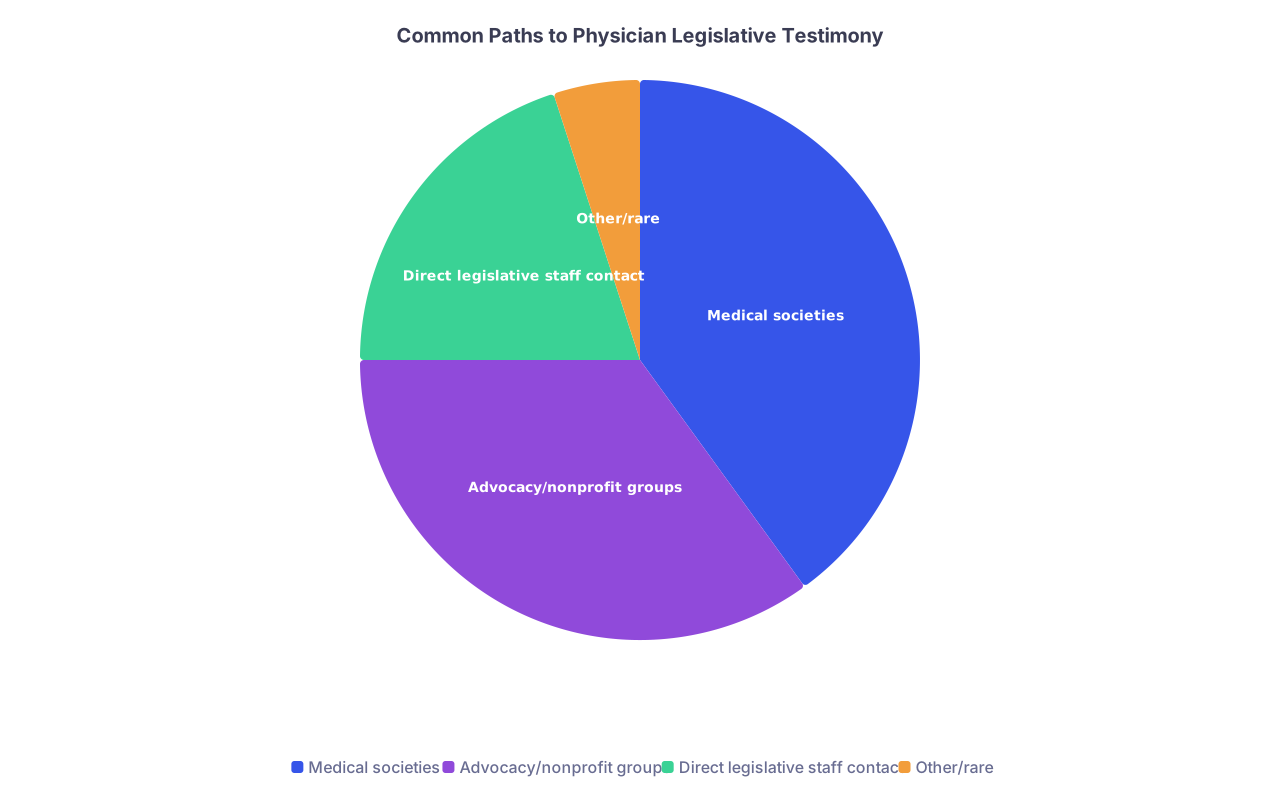
| Category | Value |
|---|---|
| Medical societies | 40 |
| Advocacy/nonprofit groups | 35 |
| Direct legislative staff contact | 20 |
| Other/rare | 5 |
The Prep: You Think You’re Writing Your Testimony. You’re Not.
A lot of first‑timers sit down and start obsessing over citations, p‑values, and guideline language. They write like they’re submitting to JAMA.
Behind the scenes? The lobbyists and policy people are re‑writing you.
Here’s the real prep process when it’s done professionally:
First, you get a “pre‑brief” call. It’s never just “tell us what you think.” It’s:
“Here’s where the votes are. Here’s who’s gettable. Here’s what we need to land in the room:
– One strong, simple message.
– Two or three short stories.
– One clear ask.”
They talk about “messaging discipline.” That’s code for: Don’t freelance. Don’t chase every hypothetical. Don’t answer every hostile question the way you would in grand rounds.
Then they coach you on language. You’ll hear things like:
- “Swap ‘mortality reduction’ for ‘lives saved’.”
- “Don’t say ‘standard of care’—that triggers litigation anxiety. Say ‘medically accepted practice’.”
- “Avoid ‘denial of care.’ Use ‘barrier to necessary treatment’—polls better.”
You’re not just a doctor; you’re a vector for tested language and framing.
Experienced physician‑advocates know this and lean into it. They come with one laminated page: three bullets, two numbers, one story; everything else is supporting material if asked. The residents I’ve seen crash and burn came in with six pages of single‑spaced prose and tried to read all of it in three minutes.
The other unspoken prep? Opposition research.
Your side will tell you: Here’s who will oppose you. Here are their talking points. Here’s the one “gotcha” line they love to use. And if your CV has any potential landmine—prior affiliation with pharma, controversial research, old tweets—someone will quietly warn you or, if they’re smart, they’ll scrub you before putting you in front of cameras.
If nobody digs into your background ahead of time? That means they’re amateur, or you’re expendable.
The Room: Nothing About It Is Neutral
If you think a legislative hearing is like a hospital committee meeting, you’re going to get eaten alive.
The layout is designed for power: lawmakers on a raised dais; you literally lower than them, facing them, under time pressure, with microphones that pick up every tremor in your voice. Big clock counting down. Cameras pointing straight at you.
The chair controls everything. Who speaks, how long, who gets follow‑up questions. A sympathetic chair will pad your time, rephrase your points for emphasis, and throw you friendly softballs. A hostile chair will let you talk just long enough to seem “heard,” then bury you under rambling “questions” that are really speeches.
You’re not testifying to “the legislature.” You’re testifying to individual members with very different agendas:
- Some want your data, but only if it supports a pre‑set position.
- Some want a clip for their campaign ad—either “standing with doctors” or “standing up to elitist experts.”
- Some are clock‑watching and thinking about lunch.
And then there’s the audience that isn’t in the room: media, lobbyists, donors, and your own institution.
I’ve watched hospital executives sit in the back of the room, arms folded, silently evaluating whether their employed physician on the mic is strengthening the hospital’s relationship with the majority party—or making life harder.
Very few doctors walk in understanding they’re simultaneously performing for:
- Lawmakers
- Committee staff
- Lobbyists
- Reporters
- Their employer
- Their patients
- And the future opposition researcher who will pull their quote out of context three years later
When you stand up, you think you’re just “telling the truth.” Everyone else knows they’re generating future ammo.
The Performance: Science Takes a Back Seat to Story
Let me be blunt: Data alone does not move legislative votes. If it did, public health policy would look completely different.
On the record, everyone talks about “evidence‑based policy.” Off the record, I’ve heard committee members say some version of: “I know what the data says. I just cannot vote for that and survive my district.”
What actually lands in the room is story, framed by just enough numbers to feel credible.
The most effective physician testimony I’ve seen all has the same anatomy:
First, a concise identity hook. “I’m a pediatric intensivist. I care for the sickest children in the state.” One sentence. Human plus authority.
Then a simple framing line: “This bill will make it harder for me to keep kids alive.” Or: “This policy will tie my hands when minutes matter.”
Then a story. Not a 10‑minute war story. A 45–90 second, tightly chosen, anonymized patient vignette. The kind that catches on video. The kind that makes a legislator stare at their desk for an extra beat.
Only after that do they drop 1–2 numbers. “In the last year, we saw 300 kids with X. We lost 27. This bill would push that number higher.”
If you open with “A 2018 meta‑analysis of 27 randomized controlled trials showed…”, you might impress the one former lawyer on the committee who likes footnotes. Everyone else is just waiting for their cue.

Now, the dark side: manufactured stories and selective omission.
Most advocacy operations will tell you to be truthful, but they will absolutely nudge you toward the “cleanest” stories. The ones where the policy is the unmistakable villain. Complex, messy cases where patient behavior, systemic dysfunction, and policy all intertwine? Those rarely make it into the three‑minute opening.
And you will be pressured—sometimes subtly, sometimes directly—to not volunteer nuance that complicates the message. Like:
- “In most situations, we can still do X, but it will be slower and riskier.”
- “There are some rare cases where this might help Y, but they’re outweighed by harms.”
That nuance is scientifically honest and ethically decent. It’s also political kryptonite, because your opponents will clip the one sentence that sounds like partial agreement.
The physicians I respect the most in these hearings are the ones who refuse to omit critical nuance, even when they know it will blunt the advocacy impact. They still craft their story, but they will not paint policy as the only villain when it isn’t.
You will not be rewarded for that in the moment. But it’s what keeps you from becoming just another mouthpiece.
The Questioning: It’s Not a Q&A, It’s a Trap‑Setting Exercise
Once your prepared remarks are done, the hearing turns into something that looks like Q&A but actually isn’t.
Let me decode what’s going on.
There are three main types of questions you’ll face:
Genuine clarifying questions. These usually come from the few members who actually care about getting the policy right: “How often does that scenario occur in your practice?” “What would be a safer alternative?” Treat these like real conversations. They’re rare but important.
Friendly set‑ups. Your allies on the committee will ask questions designed to give you space to repeat your talking points and generate clips. “Doctor, can you explain again what happens if this bill passes?” They’re not fishing for information. They’re producing content.
Hostile cross‑examination. This is where inexperienced physicians get shredded.
Hostile members are not trying to understand your point. They’re trying to:
- Force you into an absolute (“So are you saying this bill always kills patients?”)
- Get you to say something that sounds dismissive of lay concerns (“So you do not trust parents to make decisions for their own children?”)
- Paint you as partisan (“Isn’t it true you’ve publicly opposed [Governor / President]?”)
- Undercut your expertise (“You’re not an economist, are you? So how can you speak to cost?”)
They want a moment where you look arrogant, angry, or uncertain on camera.
The most sophisticated committees will coordinate. One ally makes you look like the compassionate expert. Then an opponent steps in to try to make you look like a biased activist. Back and forth. Same witness, two different edits for two different audiences.

| Step | Description |
|---|---|
| Step 1 | Physician Prepared Statement |
| Step 2 | Supportive Questions |
| Step 3 | Hostile Questions |
| Step 4 | Reinforce Narrative |
| Step 5 | Clip For Opposition |
| Step 6 | Media and Social Media Use |
Here’s a detail people don’t tell you: sometimes your own side wants you to lean into conflict. Advocacy pros know that a clip of a physician calmly absorbing a nasty question and responding with measured, human language is gold. If you cry, or your voice cracks at the right moment? That clip will be used for years.
But if you snap, get sarcastic, or start arguing data at a level the room can’t follow, you’ve just turned a win into a liability.
My rule of thumb, which I coach residents with: answer the question you wish had been asked, not the one that was weaponized. Briefly acknowledge, gently reframe, go back to your message. Do not follow them down every side tunnel.
The Hidden Pressures: Employer, Licensing, and Safety
Here’s where it gets truly uncomfortable.
Physicians love to talk about their “ethical obligation to advocate.” Very few talk honestly about the institutional and personal risk.
Your employer is watching. If you’re testifying against a bill that your hospital system quietly supports because of reimbursement or liability reasons, you’re in danger. It may not be explicit. It usually isn’t. It shows up as:
- “We’d prefer you didn’t identify yourself as representing the hospital.”
- “You need to run any public comments about legislation through our government relations office.”
- Mysterious schedule changes when hearings come up.
I’ve seen physicians get told, straight out: “If you speak against this, it will damage our relationship with the majority party.” They’re not threatening your license; they’re threatening your career trajectory, your leadership opportunities, your research funding.
State medical boards enter the picture in more controversial arenas. If your testimony touches abortion, gender‑affirming care, harm reduction, COVID measures—anything that’s already a political flashpoint—you may end up with complaints filed against your license by people who watched you online and decided to punish you.
Usually these are nuisance complaints. But nuisance complaints still cost you time, anxiety, sometimes legal fees. A few boards have been openly weaponized. You know which states I mean.
And then there’s security. When you testify on anything that stirs up strong emotions (guns, reproductive care, trans care, vaccines), you’re not just stepping into a hearing. You’re stepping into the internet’s rage machine.
It’s not hypothetical. I’ve seen:
- Doxxing after testimony clips went viral
- Threats left on clinic voicemail
- Social media pile‑ons, sometimes encouraged by elected officials themselves
Most advocacy groups don’t prepare you for that. They prep your three‑minute statement and then disappear when the trolls arrive. If you’re going to put your face and name on contentious policy, you need to think through security before you walk in, not after.
The Ethical Tension: Advocate, Scientist, or Both?
Let me be clear: physicians should be in those rooms. Health policy without clinicians is how you get unworkable, harmful laws. But you need to be honest with yourself about the ethical tradeoffs.
You’re not writing a review article. You’re doing political communication. There’s an inherent tension between simplifying for impact and representing the full complexity of the evidence.
I’ve seen three basic archetypes of physician witnesses:
The Purist. Refuses to omit nuance, refuses talking points, gives a balanced mini‑lecture. Ethically pristine, politically weak. Lawmakers thank them, then vote how they had planned.
The Partisan Hammer. Comes in swinging for one side, cherry‑picks data, ignores counter‑evidence. Politically effective in the short term, but corrodes public trust in physicians as independent experts.
The Honest Advocate. Chooses a clear position, uses real stories, but explicitly acknowledges limits and grey zones. “Here’s what we know, here’s what we don’t, here’s what this will mean in my exam room.” Less flashy than the hammer, more impact than the purist.
The trick is staying in that third lane.
That means:
- Declaring your role upfront: “I’m here as a clinician who cares for these patients every day, not as a political strategist or economist.”
- Being crystal clear about where the evidence is strong vs. weak. “We have solid data on X; we have less on Y, but clinically we’re already seeing…”
- Correcting your own side when they oversimplify in their favor, at least in your own testimony.
You will feel pulled to exaggerate. You’ll be told, “If you don’t say it strongly, they won’t hear it.” That’s where your ethics either hold or crack.
Because here’s the real cost: once physicians as a group are viewed as just another partisan interest bloc, your credibility in that room evaporates. And it is very, very hard to get back.
How to Walk Out With Your Integrity Intact
If you’re going to do this—and I think more of you should—do it with your eyes open.
Before you agree to testify, ask yourself a few blunt questions:
- Am I being asked because of my expertise, my story, my identity, or my willingness to say what they want? Usually it’s a mix. Know the mix.
- Do I truly understand the bill, including the parts that cut against my position? If you don’t, you’re a prop.
- What’s my red line? What nuance will I not omit, even if my advocates wince? Decide that before you sit down.
- Who has my back if this goes sideways? Employer? Union? Specialty society? If the answer is “no one,” think twice.
Then, write your testimony with three layers:
- The public statement you can defend under oath, in front of any audience.
- The deeper evidence base you could explain in detail if asked by a genuine questioner.
- The personal ethical reason you’re doing this, which no one can argue you out of.
If you’re clear on those, you’ll walk out of that hearing sweaty, probably frustrated, maybe a little shaken—but not ashamed.
Because yes, you are being used when you testify. By everyone in that room. The question is whether you’re also using the moment to tell the truth in a way that might, in some small way, protect your patients.
That’s the deal. Take it or leave it. But don’t go in thinking it’s just about “educating lawmakers.”