
It’s 6:40 a.m. You just finished a brutal night shift. You’re halfway through a lukewarm coffee when your hospital’s comms person rushes in:
“Can you do a quick spot with Channel 7 on the new Medicaid changes? They’re here now. It’ll only take five minutes.”
You say yes.
Ten hours later, you’re getting texts: “Dude, why did you say primary care doesn’t need more funding?” Another: “Your quote is on Twitter. People are pissed.”
You watch the clip. The segment sliced your three-minute answer into one sentence that sounds arrogant and politically biased. Exactly what you tried to avoid.
This is how it happens. Not because you are careless, but because talking policy with the media is a different skill set than talking medicine with colleagues. And most physicians only learn the hard way.
Let me walk you through the biggest mistakes I’ve seen physicians make when they step into public health policy conversations on camera, on radio, or with print reporters—and how to not be the cautionary tale.
Mistake #1: Forgetting You’re Not in Grand Rounds
You’re used to:
- Dense context
- Nuance
- Long explanations
- A sympathetic, informed audience
The reporter is not your chief resident. The viewer is not your co-fellow.
The classic error: answering a narrow policy question with a five-minute lecture on pathophysiology, reimbursement structures, and CMS history. The editor then grabs the one provocative line out of that monologue and cuts everything that made it reasonable.
Typical version of this mistake:
- Reporter: “Do you think this new law could put patients at risk?”
- You (internal monologue): “Well, it depends. The literature says… there are multiple stakeholders… unintended consequences…”
- You (out loud, after 90 seconds of jargon): “…so yes, some people are going to die.”
Guess what airs? Exactly that last line.
How to avoid it:
Lead with the headline.
- First sentence: simple, plain-language statement.
- Then, if there’s time, add one sentence of context.
- Example:
- “Yes, I’m worried this law will hurt low-income patients.”
- “The details are complicated, but the bottom line is that it will make it harder for them to see a doctor when they need one.”
Use “one point per answer.”
Do not cram in everything you know. Pick:- 1 key point
- 1 clear example
- 1 sentence linking it to patients
Stop there.
Translate, don’t teach.
You are not trying to get them through boards. You’re trying to help them understand:- Who is helped
- Who is harmed
- What changes in their real life
If you find yourself mentally starting a lecture, that’s your warning sign. Cut it in half, then in half again.
Mistake #2: Acting Like a Partisan Operative Instead of a Physician
This one ruins reputations fast.
You go in to talk about vaccination policy, prior authorization, or gun violence. The anchor pushes:
“So are you saying Senator X doesn’t care about patients?”
You get irritated. You bite.
Congratulations, you are now a political talking head instead of a clinician advocate.
The problem is not having political views. You’re human. The problem is losing your professional identity on camera.
What gets physicians into trouble:
- Using party labels (“this is typical Republican policy,” “Democrats always do this”)
- Mocking specific politicians
- Using culture-war buzzwords that instantly polarize the audience
- Making it sound like your medical opinion is perfectly aligned with one party’s platform
Once you do that, half the audience turns off. More importantly: your credibility as an honest broker in public health policy drops.
How to avoid it:
Anchor yourself in values, not parties. Use language like:
- “From a patient safety perspective…”
- “As a physician who treats these patients every day…”
- “Looking at this through a public health lens…”
Aim your criticism at policy outcomes, not personalities. Bad:
- “This governor clearly doesn’t care about people with disabilities.”
Better: - “This policy will make it much harder for people with disabilities in our state to get the home care they rely on.”
- “This governor clearly doesn’t care about people with disabilities.”
Refuse the bait. Out loud if needed.
- “I’m not here as a political commentator. I’m here as a physician to talk about how this affects patient care.”
Repeat that if they push. Let viewers see that you’re trying to stay in your lane.
- “I’m not here as a political commentator. I’m here as a physician to talk about how this affects patient care.”
Decide your red lines before you go on air. For example:
- You will not call any specific politician by name unless strictly necessary.
- You will not guess about motives. Only outcomes.
- You will not endorse or oppose candidates on camera in your white coat.
Once you’re perceived as a partisan soldier, it’s hard to walk that back.
Mistake #3: Speaking Beyond Your Real Expertise
Another common trap: getting pulled from “what you know” into “what you’ve heard.”
You’re an ICU doc who’s been asked about ventilator allocation policy. Solid. Then they pivot:
“What do you think will happen to the national economy if this passes?”
You wing it. You think it sounds smart.
Now your name and title appear below a quote where you sound like an economist. Or worse, you say something naive and it gets fact-checked.
Here’s the rule:
The media will happily let you speak outside your lane. They are not responsible for your credibility. You are.
Where this usually goes wrong:
- Clinical experts speculating about legal nuances of a law they haven’t read
- Local physicians making sweeping claims about national trends they’ve never studied
- Specialists pontificating on unrelated specialties’ policy issues (“as a cardiologist, I think we do need to cut psychiatry funding…”)
How to avoid it:
Define your lane explicitly. Say it early:
- “I’m an emergency physician in a busy urban hospital, so my comments are from that perspective.”
That sentence gives you permission to stop when they go beyond it.
- “I’m an emergency physician in a busy urban hospital, so my comments are from that perspective.”
Use boundary phrases.
Keep these ready:- “That’s outside my area of expertise.”
- “I’d defer that to a health economist / legal expert / epidemiologist.”
- “What I can tell you, from the bedside, is…”
Switch from authority to observation when you must answer. Instead of:
- “This will definitely reduce national mortality rates.”
Try: - “In my practice, when we’ve had more resources for preventive care, we’ve seen fewer emergencies. I’d expect similar patterns more broadly, but I’ll let the public health researchers quantify that.”
- “This will definitely reduce national mortality rates.”
Do not guess about legal details. Ever. Saying “yes, this bill will absolutely override state law” when you haven’t read it is how you look foolish in tomorrow’s follow-up story.
Your title follows your words. Don’t lend it to things you don’t actually know.
Mistake #4: Ignoring Conflict of Interest Landmines
Nothing destroys trust like the post-hoc reveal:
“Dr. Smith, who criticized drug price caps in our segment, received $50,000 last year from pharmaceutical companies.”
A lot of physicians think:
- “Everyone in my field consults for industry.”
- “It’s not directly related to this policy.”
- “The reporter didn’t ask.”
The public does not care about that nuance. They care that you had a financial relationship and didn’t disclose it.
Conflicts are not just money, either. You can have:
- Leadership roles in advocacy groups
- Ties to hospital or insurer leadership
- Political appointments or campaign work
How to avoid it:
Make a simple disclosure part of your script. Example:
- “I should mention I serve on the advisory board for X, but I’m speaking here in my capacity as a clinician.”
Even if they cut it for time, you did your ethical duty.
- “I should mention I serve on the advisory board for X, but I’m speaking here in my capacity as a clinician.”
Keep your own COI list updated. Once a year, write down:
- Industry payments
- Board positions
- Paid speaking gigs
- Grants related to what you’re asked about
If a conflict is big and directly related, consider declining. If you’re being paid by an insurer and they want you to comment on insurance regulation? Maybe pass it to a colleague without that tie.
Don’t hide behind technicalities. “The payment was to my LLC, not to me” is not a clean defense. Patients see through that.
If you feel a tiny twinge of “should I mention this?” you already have your answer.
Mistake #5: Forgetting Every Word Is Quotable
You think you’re “just chatting” before the formal interview starts. The mic is clipped. Camera’s pointed somewhere else. You relax.
Then the reporter says, “Off the record, what’s really going on with these overdose deaths?” You vent. You say something blunt about “people who just don’t want help.”
Guess what shows up, paraphrased, in the article.
You do not control what is on or off the record. And even when phrases technically don’t appear as direct quotes, they absolutely shape the story.
Common pitfalls:
- Sarcasm that doesn’t translate to print
- Dark humor (the kind we all use internally to cope) shared with a reporter
- Sharing sensitive or identifying details, thinking they’ll surely “clean that up”
How to avoid it:
Assume the mic is always on. Always.
If you wouldn’t want to see it as a pull-quote with your name and title, don’t say it in that context.Use “safe default” language under stress. If you’re tired or angry, lean on structured phrases:
- “This is incredibly complex.”
- “We see a lot of suffering in the ED around this.”
- “I want to be careful not to oversimplify.”
Never share case details that could identify a patient. HIPAA is not suspended because a camera is nearby. Change ages, genders, details, and say you are doing so:
- “I’m combining details from several patients here to protect privacy…”
Clarify when you’re moving off the record—but don’t depend on it. Real talk: “off the record” is not a law. It’s a relationship. Only use it with reporters you truly know and trust, and still assume it could shape the story.
You protect yourself by behaving like anything uttered in that space might appear somewhere.
Mistake #6: Being Vague, Hedgy, or So “Balanced” You Say Nothing
Some physicians overcorrect in the other direction. They’re so afraid of controversy that every sentence turns into mush:
- “There are definitely pros and cons on all sides, and the data is mixed, so it’s really hard to say.”
That might be technically accurate. It’s also useless.
When you’re too vague:
- The editor cuts you.
- Or worse, they cherry-pick the one semi-strong phrase you used, without your nuance anyway.
The public does not need you to pretend certainty where none exists. But they do need clarity.
How to avoid it:
State what you know clearly, then label the uncertainty.
- “We know this law will reduce access to clinic visits in rural areas. What we don’t know yet is exactly how that will affect hospitalization rates.”
Use “I’m more concerned about X than Y” instead of “it’s complicated.”
- “I’m much more worried about the impact on mental health services than on elective procedures.”
Give a bottom-line recommendation when appropriate.
- “If lawmakers do move forward, I strongly recommend they build in funding for community health workers. Without that, we will see more preventable crises.”
Avoid weasel phrases that mean nothing. Cut or minimize:
- “Raises important questions…”
- “It remains to be seen…”
- “At the end of the day…”
You can be honest about complexity without being paralyzed by it.
Mistake #7: Using Jargon That Sounds Like Code Words
Physicians forget that common terms in policy and medicine sound like alien code to normal people.
When you say:
- “Utilization management”
- “Value-based care”
- “Social determinants of health”
- “Population-level outcomes”
…most viewers hear static. Even if they nod along.
The deeper issue: jargon lets harmful policy hide behind pretty words. If you repeat those words uncritically, you help that happen.
Example:
- You say, “We need better utilization management.”
- Hospital admins hear: “Thank you for endorsing our prior auth system.”
- Patients hear: “More bureaucracy, I guess?”
How to avoid it:
Force yourself to define policy terms in plain language.
- “When I say ‘prior authorization,’ I mean when insurance companies make you get special permission before prescribing a medication.”
Follow jargon with a human example.
- “’Social determinants of health’ sounds abstract. Practically, it means the kid with asthma whose family can’t afford to move away from the moldy basement.”
Avoid using industry language to defend the indefensible. If you catch yourself saying:
- “Right-sizing care delivery…”
Ask: would I say this to a patient’s face? Or am I sanitizing something that’s actually harmful?
- “Right-sizing care delivery…”
Ask the reporter if they need you to rephrase. Some are too intimidated to interrupt you. Give them permission:
- “If I say anything too ‘doctor-y,’ feel free to stop me. I don’t want to lose people.”
If a reasonably smart non-medical friend wouldn’t understand your sentence, fix it.
Mistake #8: Not Preparing Three Core Messages Beforehand
The worst time to decide what you think about a policy is while a camera light turns red.
Most physicians go in “cold,” trusting their intelligence and training. That’s how you end up with rambling, contradictory quotes and sound bites that don’t match your true view.
Media interviews are not orals exams. They’re an editing battlefield.
If you do not decide your three take-home messages in advance, the editor will decide them for you.
How to avoid it:
Before any policy interview, grab a scrap of paper and write:
One-sentence “bottom line”
- “This law will make it harder for low-income patients in our city to get insulin.”
Two supporting points
- “It adds paperwork for clinics that are already stretched thin.”
- “It cuts funding for community programs that help people manage diabetes at home.”
One human example
- “I’m thinking of a composite patient—someone working two jobs, whose insulin already eats half their paycheck…”
Now, during the interview:
- Keep steering your answers back to those three things.
- If you drift, you can end with: “But the big thing I want people to remember is…” and restate your bottom line.
This feels repetitive to you. It is not repetitive to viewers who will only hear two sentences of you at 6:17 p.m. between ads for pickup trucks and pizza.
Mistake #9: Confusing Advocacy with Self-Promotion
There’s a subtle, ugly version of this: turning every policy discussion into a commercial.
You’ve seen it:
- “In our clinic—[long description of clinic features].”
- “At Big Brand Hospital, we pride ourselves on…”
The story was about Medicaid cuts. Somehow, you spent half your airtime praising your institution. You think leadership will be pleased. The audience hears spin.
Or you plug your book, your podcast, your startup. Constantly. It makes your policy positions look like marketing strategy.
How to avoid it:
Mention your institution once, then talk about patients.
- “I work at City General Hospital, a large safety-net hospital. What we’re seeing among our patients is…”
Ask yourself: “Who benefits if I say this?” If the honest answer is mostly “me” or “my employer,” be careful.
Separate policy messaging from brand messaging. Your LinkedIn can talk about your great clinic. Your media quote should be about:
- Access
- Outcomes
- Equity
- Ethics
Physicians already fight skepticism about motives. Don’t give viewers more reasons to doubt you.
Mistake #10: Ignoring the Ethical Layer
Policy isn’t just finance and logistics. It’s ethics in disguise.
Too many physicians talk about policy like it’s a budgeting exercise:
- “We need to reduce inappropriate utilization.”
- “We have to make the system sustainable.”
Those might be real concerns. But if you forget to discuss:
- Justice
- Autonomy
- Beneficence
- Non-maleficence
…you sound like a bureaucrat, not a healer.
How to avoid it:
Name the ethical tension explicitly.
- “There’s a real fairness question here: who gets access to these limited mental health beds?”
- “We’re balancing individual freedom with community safety.”
Admit when resource limits force tradeoffs. Instead of pretending:
- “Everybody will get everything they need.”
Say: - “We do have limited ICU beds. That means, in a crisis, we need transparent criteria for who gets them. That’s ethically painful but necessary.”
- “Everybody will get everything they need.”
Refuse to dehumanize any group, even subtly. If you hear yourself saying:
- “Frequent flyers.”
- “Noncompliant patients.”
Stop. Rephrase: - “People who keep coming back because we haven’t solved the underlying problem.”
- “Patients who are struggling to follow complex treatment plans.”
You are there to keep the human stakes visible. If you sound like a spreadsheet, you’ve lost the plot.
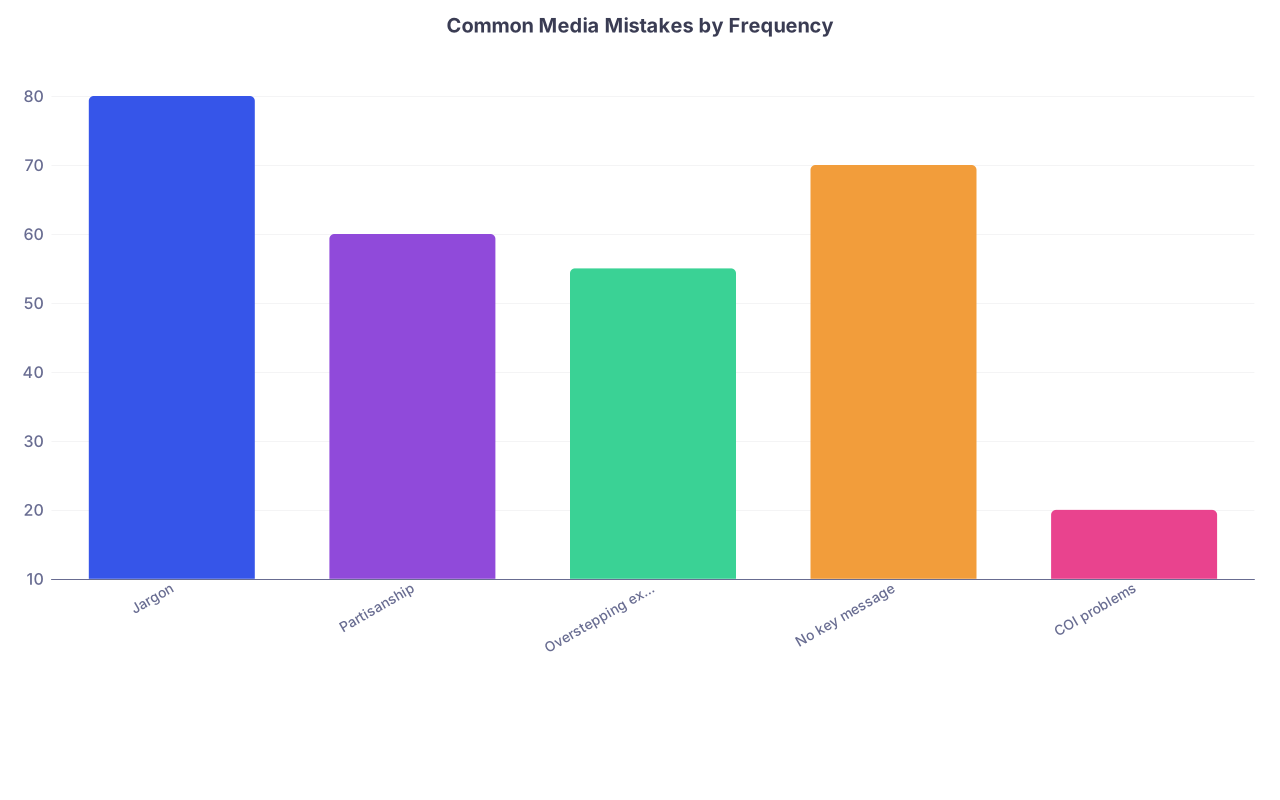
| Category | Value |
|---|---|
| Jargon | 80 |
| Partisanship | 60 |
| Overstepping expertise | 55 |
| No key message | 70 |
| COI problems | 20 |
Mistake #11: Not Debriefing or Learning from the Experience
Last thing. Most physicians treat media hits like one-off events.
You survive it. You cringe a bit at the clip. Then you move on.
That’s a mistake.
Media work is a skill. And like any skill, you get better by:
- Reviewing
- Getting feedback
- Adjusting
When you don’t:
- You repeat the same phrasing that sounded bad.
- You never learn where you rambled or lost the audience.
- You keep making preventable errors with policy nuance.
How to avoid it:
Watch or read your own appearance. All of it. Look for:
- What did they actually use?
- Which lines sounded clear vs. confusing?
- Where did you look uncomfortable or defensive?
Ask one trusted colleague for a blunt critique. Give them explicit permission:
- “Tell me what sounded off or risky. I don’t need compliments. I need the problems.”
Keep a short “media log.” After each appearance, jot down:
- 2 things you’ll keep doing
- 2 things you’ll never do again
Over a year, that’s how you quietly become the person reporters keep coming back to.
If you really stepped in it, own it. A short, honest clarification on your professional channels beats silent defensiveness:
- “In my recent interview, I used a phrase about addiction that was stigmatizing. I regret that choice of words. Here’s how I should have said it…”
Self-protective, not performative. You’re safeguarding your long-term credibility.

| Step | Description |
|---|---|
| Step 1 | Media request |
| Step 2 | Suggest colleague |
| Step 3 | Define 3 key messages |
| Step 4 | Review COI |
| Step 5 | Decide red lines |
| Step 6 | Interview |
| Step 7 | Watch clip |
| Step 8 | Debrief and adjust |
| Step 9 | Is this your lane |
Your Next Step (Do This Today)
Don’t wait for the 6:40 a.m. ambush outside the ED.
Today, take 10 minutes and do this:
- Pick one current policy issue you care about—prior auth, abortion laws, gun violence, Medicaid cuts, whatever is real in your practice.
- Write down:
- One-sentence bottom line
- Two supporting points
- One patient-centered example (de-identified)
- Then write one sentence you’d use to set your lane:
- “I’m a [specialty] physician at [setting], and I’m speaking from that experience.”
That scrap of paper is your safety net. The next time someone from media or your hospital’s comms office calls, you’re not starting from zero. You’re starting from clarity instead of panic.
Open a blank document right now and draft those four sentences. That’s how you stop being the physician who accidentally becomes the headline—and start being the one who shapes it without burning yourself or your patients in the process.