
You’ve just finished another absurdly long clinic day. Two prior auths denied. A kid’s insulin delayed because of pharmacy “formulary issues.” On your way home, you read a crude, oversimplified op-ed on health care in a major paper—written by someone who’s never touched a patient.
You think: “I could write something better than this.”
Here’s the part nobody tells you: you can. But if you do it the usual “doctor way,” your piece will either never get published, or if it does, it’ll vanish without a ripple.
Policy op-eds have their own ecosystem. Editors have rules. Advocacy shops have rules. Your hospital has rules. None of them are written down in one place. I’m going to give you the version you hear behind closed doors—when program directors, department chairs, and editorial board members talk honestly about which physician voices they amplify and which ones they quietly delete.
Rule #1: Editors Don’t Want Your Story. They Want a Policy Weapon.
You’ve heard the advice: “Tell a patient story.” Half-true.
An editor at a major newspaper said this bluntly to a group of physicians:
“We don’t run narratives. We run ammunition.”
What he meant: your story is only there to make a policy argument emotionally unavoidable. If you send in a beautiful “I saw a patient who changed how I think about X” reflection, with no hard policy ask, it dies in the slush pile.
A publishable policy op-ed from a physician usually has this skeleton:
- One sharp, vivid clinical moment (1 paragraph, maybe 2).
- A clearly named policy problem (not “the system,” something concrete and fixable).
- 1–3 specific, realistic policy changes.
- A closing that makes it feel urgent to act now.
That’s it. If you’re spending more than a third of the piece on narrative, you’re probably writing for JAMA’s “A Piece of My Mind,” not for the op-ed page of a general outlet.
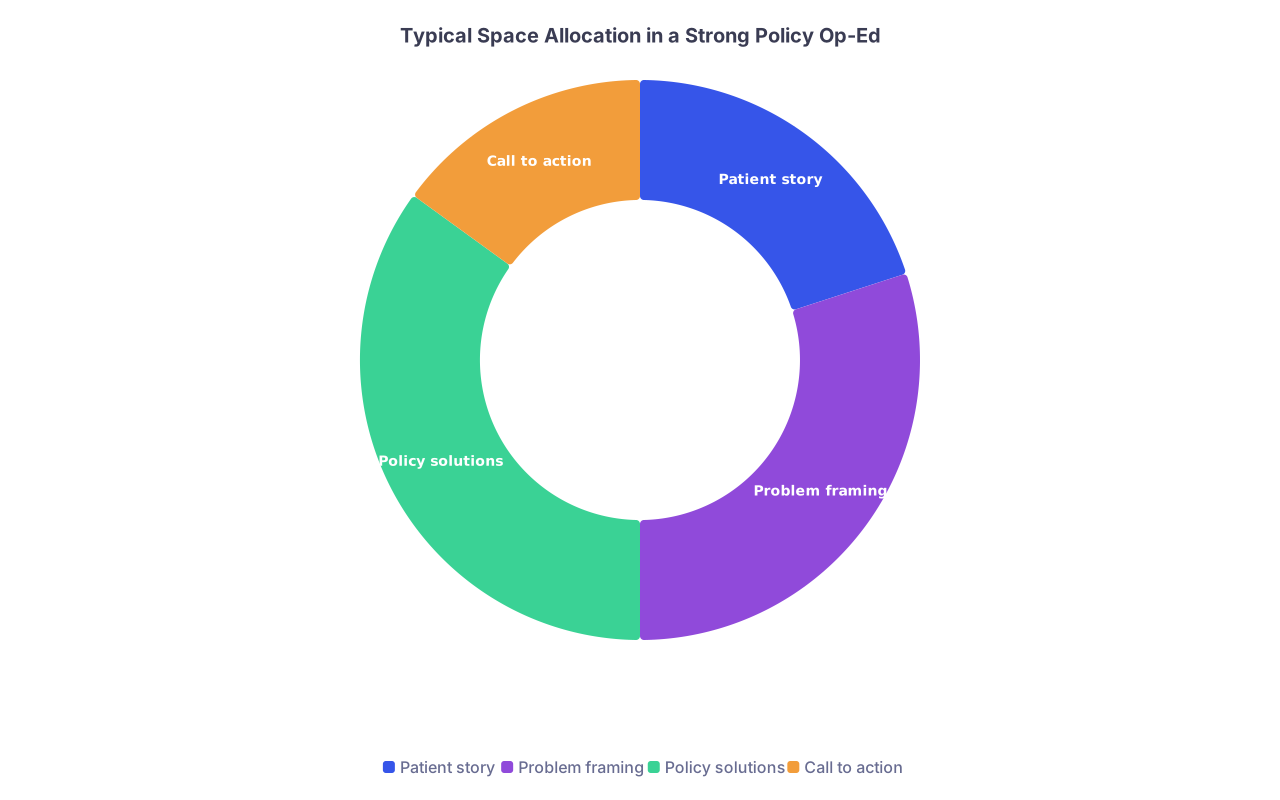
| Category | Value |
|---|---|
| Patient story | 20 |
| Problem framing | 30 |
| Policy solutions | 35 |
| Call to action | 15 |
Behind-the-scenes truth: policy-oriented editors are actively hunting for physician pieces that line up with current legislative fights, budget cycles, or regulatory changes. They’re not waiting around for timeless meditations on suffering.
So before you write, ask yourself:
“If this ran tomorrow, what policy process—budget vote, rulemaking, upcoming hearing—would this actually touch?”
If you can’t answer that, your odds of placement just dropped by half.
Rule #2: “As a Physician” Is a Scalpel, Not a Sledgehammer
You think your MD automatically makes your argument stronger. To a point. Then it backfires.
Editors and policy people roll their eyes at “As a physician, I believe…” when it shows up in every other paragraph. It reads as credential flexing. And lawmakers who’ve been yelled at by doctors for years are hypersensitive to condescension.
Use your role like this:
– Once, early:
“As an emergency physician at a county hospital, I…”
or
“As a primary care doctor in a rural clinic…”
– Then demonstrate expertise by concrete detail, not repeated title-dropping.
What program directors and department chairs whisper about but rarely say out loud: they worry you’ll sound like “that attending” who lectures everyone. You know the type. If you write like you talk to interns on rounds, your op-ed will grate on the same nerves.
Insider nuance: some identities carry more weight in certain policy debates. A Medicaid-heavy pediatrician talking about CHIP funding. A critical care doc talking about ICU capacity. A community OB-GYN talking about maternal mortality. Editors love that alignment.
If you’re a dermatologist writing about national defense spending? They’re already skeptical. Doesn’t mean you can’t write it. It means you need to work twice as hard to ground your authority, show your policy literacy, and avoid the “I have an MD, therefore I am correct about everything” vibe.
Rule #3: Hospitals Say They Support Advocacy. They Mean “Safe, Bland Advocacy.”
Some of your biggest constraints are not editorial; they’re institutional.
Your academic center’s public affairs office has one core job: protect the brand and the funding streams. That means:
– Not pissing off major donors.
– Not antagonizing state legislators who control Medicaid rates.
– Not embarrassing partner health systems or insurers.
Where this hits you:
Write a hard-hitting piece about your state’s Medicaid bureaucracy harming patients, and your institution’s PR people may suddenly want to “review” anything that mentions your affiliation.
I’ve seen this happen:
Attending submits a brilliant op-ed on the racial impact of local hospital closures. Editor loves it. PR office sits on the institutional approval because one of the closures involves a “strategic partner.” Op-ed loses timeliness. Dies.
So, some unspoken survival rules:
– Decide in advance: do you need your institutional affiliation in print?
You can absolutely publish as “a practicing pediatrician in [state]” without naming the hospital. That gives you more freedom and fewer awkward meetings with the dean.
– Know your institutional “third rail” topics.
In some places it’s reproductive health. In others, it’s unionization, single-payer, or naming a specific insurer. You’ll learn this quickly by listening to how cautiously senior people talk in public.
– If you’re a trainee, be careful with inside baseball.
Calling out your own hospital’s unsafe workflows in the New York Times will make you famous. It will also make your PD’s phone explode. There are strategic ways to address system failures without doxxing your own floor.
Ethically, you have a duty to speak up about harm. But don’t be naïve about power. Choose fights that move policy, not just generate heat in your own department.
Rule #4: The Real Gatekeeper Is Not the Editor. It’s the First 2 Sentences.
Opinion editors work through hundreds of pitches per day. They don’t read your whole email “to be fair.” They read the subject line and the first lines of your pitch or draft. That’s it.
I’ve watched an editor scan 50 physician pitches in 10 minutes. The decision process was brutal:
– Subject line vague or whiny? Delete.
– Opening about your personal journey in medicine? Delete.
– Opening with “The American healthcare system is broken…”? Delete. (They’ve published that piece 10,000 times.)
You need to open with something that grabs hard and lands in a live policy debate. For example:
Weak:
“The healthcare system in our state is facing numerous challenges, particularly with regard to mental health.”
Stronger:
“Last week, a 14-year-old waited 96 hours in our emergency department for an inpatient psychiatric bed. She is not an outlier. She is our new normal—and it’s a direct result of how our state funds children’s mental health.”
See the difference? The second one:
– Has a concrete, uncomfortable fact.
– Signals a policy culprit (state funding).
– Feels timely, even if it’s not pegged to a specific bill yet.

If you want to write op-eds consistently, build a habit: keep a running list on your phone of “sharp opening moments” from your week. Not chart note language. Real language:
– “We had seven hallway stretchers again today.”
– “I had to tell a patient their cancer scan was delayed because their insurer changed imaging vendors.”
These become the hooks. Then you bolt policy onto them.
Rule #5: You Think You’re Being “Balanced.” Editors Think You’re Being Mushy.
Physicians are trained to hedge. “On the one hand…on the other hand…” That’s a problem in op-eds.
You have 800–1,000 words. If you spend half of them anxiously signaling that you’re “fair to both sides,” you end up saying nothing.
Program directors and faculty who actually care about your career will quietly tell you: when you write for the public, you need to pick a lane. It does not mean you lie or ignore nuance. It means you take a position:
– “Medicaid work requirements should be rejected.”
– “The new resident work-hour proposal is dangerous.”
– “Our state must fund community health workers at scale.”
Then you defend it. Directly. Without apologizing for having an opinion.
If you’re worried about ethics (and you should be), use precision, not mush. Say:
“Here’s what we know from data X, Y, Z. Here’s what I see in clinic. Given that, I believe we should do A, not B.”
That’s intellectually honest and still decisive. Ethics committees, program directors, and your chair will respect that more than a foggy “we must do better” conclusion that risks nothing.
Rule #6: Policy People Can Smell When You Haven’t Done Your Homework
This is where most physician op-eds quietly fail: they’re medically brilliant and policy-illiterate.
You diagnose correctly: prior auth is harming patients. Telehealth access is unequal. Maternal mortality is obscene.
Then you say: “Congress must act.” Or “We need more funding.” Or “We should fix the system.”
That’s not policy. That’s complaining.
Here’s the insider bar: serious outlets expect you to at least know the names of the levers you're pulling. If you want to be taken seriously:
– Learn the actual agency or body that controls the thing you’re mad about (state Medicaid agency vs CMS vs private insurers vs hospital boards).
– Name at least one real proposal, law, bill, or rule (even if you don’t get into numbers).
– Show you understand tradeoffs (“This will cost money; here’s why it’s still worth it.”).
| Aspect | Weak Version | Stronger Version |
|---|---|---|
| Actor | “Lawmakers must act” | “The state Medicaid agency should…” |
| Mechanism | “Increase funding” | “Raise Medicaid rates for primary care by 20%” |
| Evidence | “Studies show” | “A 2023 JAMA study of 2,000 patients found…” |
| Timeline | “As soon as possible” | “Before the next budget cycle in July” |
| Accountability | “We need to do better” | “Legislators should vote no on HB 142” |
Policy staffers actually read op-eds. They circulate them internally with comments like, “This doctor understands our constraints,” or, “This is totally detached from how this works.” Guess which group gets invited to testify, to serve on workgroups, or to join advisory boards.
If you want to play long-term in this world, learn their language. It’s not rocket science. It just takes a bit of humility and curiosity.
Rule #7: You Are Always Two Steps Away from a Conflict-of-Interest Problem
Ethically, this is where physicians get burned. Not because they’re evil. Because they’re sloppy.
Ask yourself, ruthlessly, before you write:
– Do I or my institution get money from the policy I’m advocating?
– Am I on an advisory board, speakers bureau, or grant related to this?
– Does my group own equity in any solution I’m praising?
I’ve watched a very respected subspecialist get shredded on social media because they wrote a rousing pro-innovation op-ed and “forgot” to mention they’d been paid six figures by a device company in that exact space. Their department knew. Their hospital knew. Suddenly everyone was pretending to be shocked.
Your readers are not stupid. Journalists and advocacy groups will dig.
The ethical move:
– If your conflict is material, disclose it simply and directly in a line at the end if the venue allows, or in your author bio.
– If the conflict is so entangled that your piece will look like an ad? Don’t write it. Or write about a different angle where you’re not financially entangled.
One more quiet truth: academic promotion committees are paying more attention to public writing. They’re also getting more skittish about COI. You do not want to be the test case that makes them clamp down.
Rule #8: Timing and Target Matter More Than Literary Genius
I’ve seen mediocre op-eds go viral because they hit the right moment in the right outlet. And beautifully written ones vanish because they were mis-aimed.
Pick your outlet strategically:
– If you want national policy influence: think NYT, Washington Post, STAT, major magazines, high-end online outlets.
– If you want state-level change: the largest newspaper in your state is often more powerful than any national venue. Governors and legislators actually read their clips.
– If you want institutional change (your hospital, medical school, or health system): trade publications or local outlets sometimes work better. Senior leadership hates to be called out in Becker’s or the local business journal.
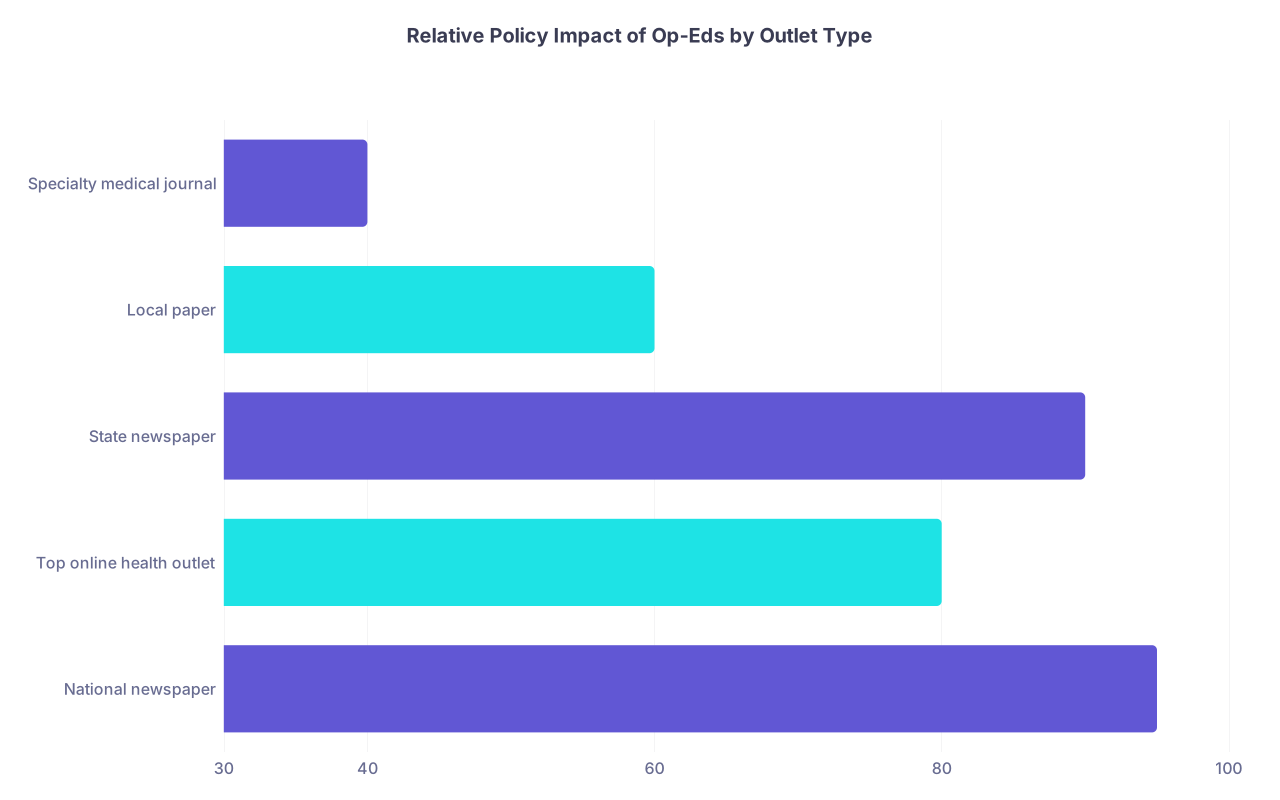
| Category | Value |
|---|---|
| National newspaper | 95 |
| Top online health outlet | 80 |
| State newspaper | 90 |
| Local paper | 60 |
| Specialty medical journal | 40 |
Then think about timing like a policy staffer:
– Big Supreme Court decision? Everyone is pitching reproductive health or healthcare rights pieces that weekend. An okay but timely piece will win over a brilliant but late one.
– State budget season? Great time for Medicaid, public health infrastructure, workforce funding op-eds.
– Legislative recess? Expect less attention and fewer fast accepts, unless you’re pegged to breaking news.
In other words, don’t sit on a time-sensitive idea for three weeks trying to make every sentence lyrical. Policy attention is a moving spotlight. You either get under it, or you write something more evergreen.
Rule #9: Protect Your Patients. No, Really.
HIPAA is the surface layer. Any halfway competent physician knows to change ages, dates, and identifying details. But public ethics goes further.
I’ve seen this scenario:
Resident writes an op-ed about an “anonymous” patient with a very rare condition and highly specific social situation. The local community instantly knows who it is. The patient sees it. Feels exposed. Complains. Now you have an ethics investigation and possibly a licensing headache.
So build some internal guardrails:
– Combine elements from multiple patients into a composite that still reflects the reality but shields any single person.
– Get explicit consent if there is any real chance the patient or their family would recognize themselves—and even then, anonymize further.
– Avoid giving enough context (dates, exact location, rare diagnosis details) that a small town could triangulate.
And remember: you can often make your point using a generalized pattern instead of a single vivid case. Not always as punchy, but sometimes safer. Something like:
“In the past month alone, I’ve had three patients…”
Ethics committees and your own moral compass will sleep better.
Rule #10: Your Colleagues Will Judge You. Some Quietly, Some Loudly.
Here’s the social cost nobody mentions. Inside your hospital halls:
– Some people will think you’re brave.
– Some will think you’re reckless.
– Some will be jealous.
– Some will be relieved you said what they can’t say.
The nastiest critics are often the ones who secretly want the same platform. Do not over-index on their snark. Do pay attention to feedback from people who’ve been in this space longer than you and still have functioning careers.
Program directors, especially in competitive specialties, worry about “the resident who loves media too much.” They’ve had experiences with people whose appetite for visibility exceeds their judgment. So you need to show three things if you’re in training or early career:
- You still do the work. Show up. Patients seen. Notes done. Colleagues not covering for you because you’re “writing another piece.”
- You can separate personal venting from public argument. You’re not just laundering burnout into the Washington Post.
- You’re educating, not grandstanding. Your writing feels grounded in patient care, not in your ego.
If you manage that, the same skeptical attendings will start forwarding your work and saying to their networks, “One of ours wrote this.”
How to Actually Start (Without Wrecking Your Life)
Let me make this concrete. Here’s a sane on-ramp that I’ve watched work for physicians who became respected policy voices:
– Step 1: Pick one issue you genuinely care about and see weekly. Not “healthcare” in general. Something like “prior auth for cancer drugs in my state” or “pediatric mental health boarding.”
– Step 2: Spend one evening reading 2–3 recent, good op-eds on similar topics in outlets you respect. Reverse-engineer their structure.
– Step 3: Draft a 700–900 word piece in one sitting. Don’t overthink. Hit story → problem → policy → urgency.
– Step 4: Have one trusted colleague with policy interest read it, not for grammar but for: “Is this clear? Is this honest? Any land mines?”
– Step 5: Decide if you’re using institutional affiliation. If yes, quietly ask your chair or PD what the informal process is. (Every place has one, even if they pretend they don’t.)
– Step 6: Pitch 1–2 outlets. Short email, 3–4 sentence pitch, paste the op-ed in the body. If no response in 48–72 hours for a timely piece, move on.

| Step | Description |
|---|---|
| Step 1 | Notice recurring clinical problem |
| Step 2 | Clarify policy angle |
| Step 3 | Draft op-ed 700-900 words |
| Step 4 | Informal review by colleague |
| Step 5 | Check with chair or PR |
| Step 6 | Submit to chosen outlet |
| Step 7 | Revise if needed |
| Step 8 | Published or move to next outlet |
| Step 9 | Use institution name |
And here’s the thing you need to internalize: your first piece will not be your best. It might not get placed. That’s fine. Editors remember physicians who pitch smart, concise, on-target ideas—even if the first one doesn’t land. You are building a relationship, not chasing a one-off ego hit.
FAQs
1. Will writing strong policy op-eds hurt my chances at fellowship or promotion?
If you write recklessly or constantly attack your own institution by name, yes, it can absolutely hurt you. But thoughtful, well-grounded advocacy that’s clearly patient-centered usually helps, especially in fields like public health, primary care, peds, EM, and psychiatry. Committees increasingly like “public scholarship.” The trick is to avoid personal vendettas, avoid blindsiding your leadership, and show that you still function as a reliable clinician.
2. Do I really need my institution’s permission to publish an op-ed?
Legally, you have the right to speak as a private citizen. Practically, if you mention the institution by name or your official title, many academic centers expect at least a heads-up, sometimes a brief review. This is more about risk management than censorship, though it can blur. If you want maximum freedom, publish as “a physician in [city/state]” and keep institutional identifiers vague.
3. Should I use a ghostwriter or PR firm to help?
For your first pieces, no. You need to learn how to think and write in this format yourself. A savvy communications staffer can help you tighten language or frame things better, but if someone else is essentially writing your arguments, you’ll get exposed when people invite you to panels, hearings, or TV. Long-term credibility depends on you actually owning the ideas and the words.
4. How political is “too political” for a physician op-ed?
Naming specific policies, bills, or agencies? Acceptable and often necessary. Endorsing a specific candidate or engaging in pure partisan brawling? That’s where institutions, licensing boards, and some patient groups start to get twitchy. Anchor your writing in patient outcomes and ethics, not party loyalty. You can be sharp and critical without turning your op-ed into campaign copy.
5. How often can I write without getting labeled as “that media doc”?
If you’re in full-time clinical work, a few strong, targeted pieces per year is plenty to build a reputation. More than that and people start asking whether you ever see patients. The exception is if your role is explicitly policy, public health, or advocacy. Quality matters more than volume. One op-ed that genuinely influences a state policy conversation is worth ten that just collect likes on Twitter.
Three things to walk away with:
- Policy op-eds are tools, not diary entries. Use your clinical stories to drive specific policy asks.
- Your MD is a powerful amplifier, but only if you pair it with real policy literacy and ethical clarity.
- Play the long game—protect your patients, protect your credibility, and build a voice that lawmakers and editors actually seek out, not just tolerate.