
You’re sitting in the call room between pages, half-scrolling through your email, half-staring at your CV draft. On one side: clerkship evaluations, a QI project, maybe a poster. On the other: years of health policy work, community organizing, advocacy groups, op-eds. And this awful little thought keeps creeping in:
“Are programs going to think I’m an activist who doesn’t actually like medicine?”
Or worse: “Are they going to think I’m not ‘serious’ clinically because I spent time on advocacy instead of drowning myself in more research and extra electives?”
You can already picture some residency selection committee member rolling their eyes: “Another social justice warrior. But how are their FUNDAMENTALS?”
Let’s walk through this like we’re both lying on the floor staring at the ceiling, catastrophizing—but then actually sorting it out.
The ugly fear: “They’ll think I care more about politics than patients”
Let me just say the quiet, anxious part out loud: you’re scared your advocacy makes you look like a “distraction” hire.
That someone on a committee will see “health policy,” “advocacy,” “community organizing,” “legislative visits,” and immediately file you under: talks a lot, tweets a lot, probably can’t manage a DKA on their own.
Here’s the truth I’ve seen over and over: advocacy does not hurt you. Uncontrolled advocacy does. Meaning: when it’s not framed, not grounded in patients, and not balanced by clear clinical competence.
Programs don’t get scared off by:
- “I worked on housing policy because I watched my patients bounce in and out of the ED due to homelessness, and I couldn’t pretend it was purely a ‘medical’ problem.”
- “I spent a summer on Medicaid waiver policy and then watched how it literally showed up in which meds my patients could get.”
(See also: I’m Burned Out but Feel Guilty Stepping Back from Activism—Is That OK? for guidance.)
They do get a little wary of:
- “I did a ton of advocacy, don’t really like wards, and my comments about ‘traditional medicine’ come off like I resent the entire clinical system I’m joining.”
You’re not wrong that some attendings still have the mentality: “Just learn the medicine first, save the world later.” That bias exists. I’ve heard it said. In exactly that condescending tone. But they’re not the only voices in the room anymore, and especially in public health–leaning places, your work is a feature, not a bug.
The line you need to walk is very specific: advocacy as a tool of being a better doctor, not a substitute for being one.
Where advocacy actually helps you (when programs are being honest)
Let me flip your nightmare script for a second.
Picture a PD at a safety-net internal medicine program, or peds, or psych, or EM, reading your application. They see you’ve:
- Organized a medical-legal partnership clinic screening.
- Worked on syringe service program policy.
- Done research on eviction and health outcomes.
- Testified at your city council about lead exposure in housing.
If your clinical stuff is solid (and that’s a big “if,” but we’ll come to that), they’re not thinking, “Ugh, unserious.” They’re thinking, “This person already understands why my patients keep coming back.”
Because here’s what programs actually get burned by:
- The resident who’s technically sharp but has zero systems thinking and constantly gets blindsided by reality.
- The one who can list rare causes of hematuria but has no idea how to get their patient meds because they’ve never thought about insurance or prior auths.
- The person who freezes every time social determinants crash into their clean little differential.
Advocacy done right teaches you:
- Systems thinking: how policies turn into clinic chaos.
- Communication: talking to legislators, community partners, media, boards.
- Prioritization: you’ve balanced classes, rotations, and advocacy events without totally imploding.
- Resilience: you’ve been ignored, dismissed, and still showed up again.
Residency cares a lot about those things. They may not label it “advocacy” in their evaluation forms, but they absolutely notice who understands that “follow up with PCP” is not a real plan for someone without transportation or insurance.
But yes, there are real ways advocacy can hurt you (if you ignore this part)
Let’s not sugarcoat it. There are scenarios where time spent on advocacy can make people question your seriousness. Not because advocacy is bad, but because medicine is punishingly narrow-minded about what “serious” looks like.
The red flags I’ve seen:
Clinical metrics are weak, advocacy is strong.
Step/COMLEX low and not improved. Shelf exams barely passing. MSPE with language like “needs more independence” or “benefits from close supervision.” And then pages of advocacy.
The narrative becomes: they had time for all this other stuff, but not for mastering the core clinical work.
Advocacy feels disconnected from your patients.
Everything reads like generic politics:
- Vague “health justice” work.
- Big language, no specific populations, no outcomes.
- No link back to the actual kind of doctor you want to be.
That starts to feel like a brand, not a calling.
You come across as contemptuous of clinical medicine.
This one’s subtle, but selection committees are very sensitive to it.
Application language like:
- “I became disillusioned with the narrowness of clinical medicine…”
- “Hospitals are sites of oppression…”
- “Physicians are complicit unless they…”
I get what you’re trying to say. I’ve felt all of it at 3 a.m. after watching social failure masquerade as “noncompliance.” But programs will read any whiff of disdain for clinical work as a giant red warning label.
You sound like you’re too busy to actually be present in residency.
If your application sells you as someone who is constantly leading three national task forces, on six boards, organizing weekly rallies, and planning to keep doing all of it at the same intensity in residency… they’ll question whether you understand how brutal PGY-1 is.
They’re not wrong. You can’t be a full-time organizer and a full-time intern. You will break.
How to talk about advocacy so you don’t get labeled “not serious”
This is where you actually have control.
Your fear isn’t just “I did advocacy.” It’s “I don’t know how they’re going to interpret it.” So you need to pre-interpret it for them. Explicitly.
The core story you want your app to tell is: “My advocacy work is a direct extension of taking good care of patients.”
Every time you describe an advocacy activity, answer these silently:
- What specific patient, population, or clinical frustration pushed me into this?
- What did I actually do, not just what meeting I attended?
- What did I learn that makes me a better clinician?
- How did I balance it with my other responsibilities?
Then you bake that into your language. For example:
Instead of:
“I co-founded a national coalition focused on reproductive rights and health justice.”
Try:
“After seeing patients lose care due to changing reproductive health laws, I co-founded a coalition that worked with local clinics to maintain access to evidence-based care, while coordinating patient education materials used in three community health centers.”
Now it sounds less like generic politics, more like: this person sees a problem affecting patients, organizes around it, and actually executes.
You can also be very blunt in your personal statement or essays:
“I worried at times that my advocacy work would be seen as separate from, or even a distraction from, clinical medicine. What I’ve realized is that they’re inseparable for me. I’m at my best clinically when I understand the policies and systems shaping my patients’ options, and my advocacy is best when it’s grounded in the reality of the wards.”
That kind of sentence heads off the “not serious” narrative before anyone else writes it for you.
The quiet non-negotiables: what you must have if you’re heavy on advocacy
This is where your anxiety is actually useful. You’re right to ask: “What are the program directors looking at while they side-eye my policy stuff?”
If you’re going into residency with a big advocacy footprint, you need your core clinical signals to be clearly competent. Not perfect. Just unambiguously solid.
| Area | What Programs Look For |
|---|---|
| Exams | Step 2/COMLEX 2 in safe range for specialty |
| Clerkships | Honors/High Pass in core rotations or clear upward trend |
| MSPE language | No “red flag” wording about reliability or professionalism |
| Letters | At least 2 letters emphasizing clinical excellence and work ethic |
| Research/QI | Doesn’t have to be massive, but something showing curiosity and follow-through |
If a PD sees:
- Strong Step 2 for your specialty range.
- Good or improving clerkship grades.
- Letters that say things like “works hard,” “excellent fund of knowledge,” “outstanding team member,” “handles high acuity with composure.”
Then your advocacy reads as “and on top of that, they also do this.”
If they see:
- Barely passing exams.
- Inconsistent evaluations.
- Letters that are lukewarm, or coded concern.
Then your advocacy reads as “and they spent a lot of time on something that isn’t the core job.”
Brutal, but that’s exactly how some people will frame it. The safest move: shore up your clinical side as much as you can, then talk about advocacy confidently, not apologetically.
Specialty matters more than people admit
Let’s just say it: how your advocacy is perceived depends a lot on what you’re applying into and where.
In some spaces, it’s a huge asset. In others, you need to be more careful in how you dress it up.
Very broad strokes (not universal, but real patterns):
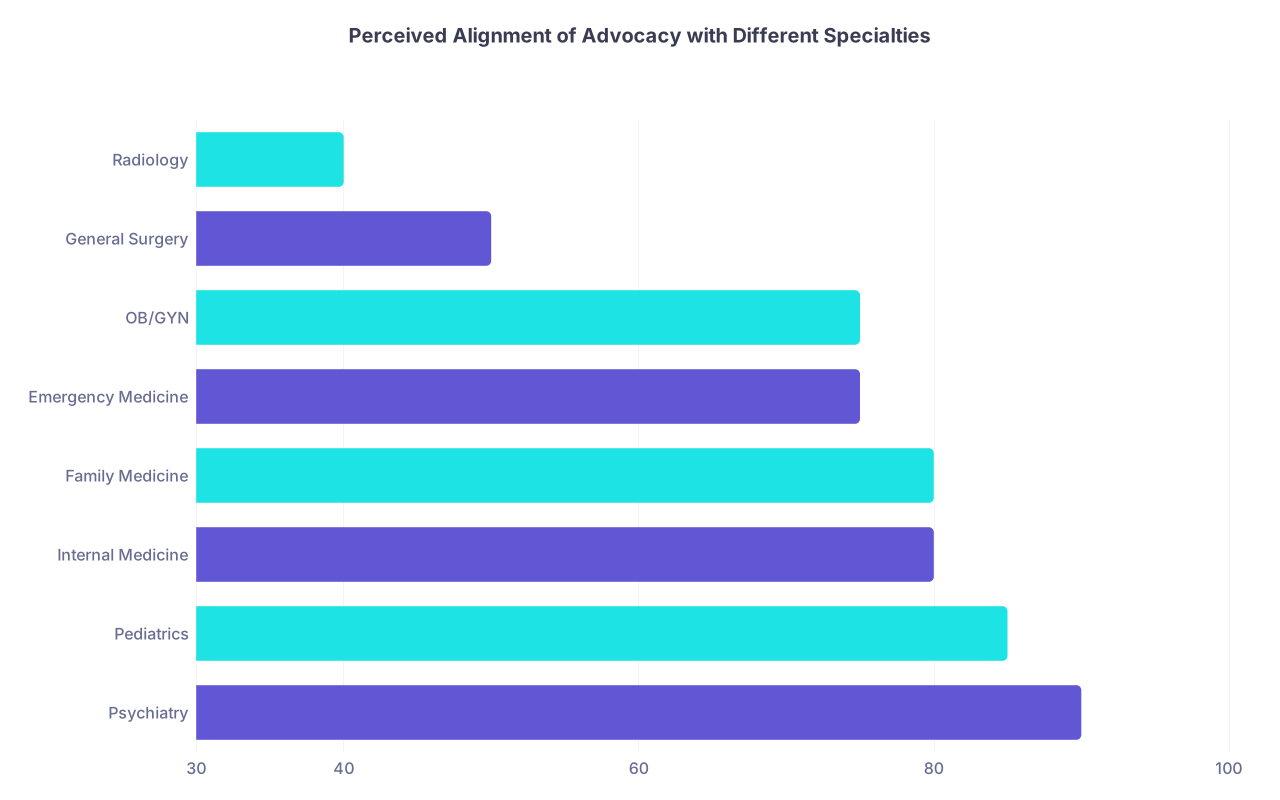
| Category | Value |
|---|---|
| Psychiatry | 90 |
| Pediatrics | 85 |
| Internal Medicine | 80 |
| Family Medicine | 80 |
| Emergency Medicine | 75 |
| OB/GYN | 75 |
| General Surgery | 50 |
| Radiology | 40 |
Those numbers aren’t from a paper; they’re the “feel” you get watching who gets praised for advocacy vs. who gets gently told to “focus on the medicine.”
If you’re going into psych, peds, IM, FM, EM, OB/GYN—especially safety-net or academic centers with public health lean—you’re in friendlier territory. They live in policy failure daily.
If you’re going into something like ortho, radiology, derm, certain surgical subspecialties, you have to do a bit more translating:
- “I worked on disability access in imaging” lands better than “I organized three climate marches.”
- “I researched prior authorization delays in post-op rehab” reads more on-brand than a generic “health justice” statement.
Do you have to contort yourself? No. But if your anxiety is screaming “are they going to get this?” the answer is: only if you tie it explicitly to their world.
The time question: “Did I waste time on advocacy I should’ve spent being more ‘hardcore’?”
This is the 3 a.m. spiral: “If I’d spent those hours doing bench research, would I be more competitive? Did I choose wrong?”
Here’s the harsh truth: yes, if your only goal was to optimize pure match statistics at the most hyper-competitive programs, there is a universe where more traditional research might have bought you a few more looks.
But that’s the kind of thinking that eats away at you and ignores who you’d become in the process.
You didn’t do advocacy because it was easy. You did it because you couldn’t not. Because some policy or injustice or gaping system hole got under your skin enough that you showed up again and again, unpaid, while exhausted.
That’s not fluff. That’s a signal about what kind of physician you’re going to be when faced with the same systems grinding your patients down.
Can that path close some ultra-conservative doors? Possibly. Can it open others—public hospitals, academic departments that care about community engagement, population health–oriented programs? Absolutely.
The key is: don’t put advocacy on your app like a guilty pleasure you’re asking them to forgive. Put it there like a deliberate choice you’ve already integrated with your identity as a clinician.
How to protect yourself from the worst-case scenario you’re imagining
The nightmare you’re picturing is: “I don’t match because they think I’m not serious.”
If that happens, by the way, the reason on paper will almost never literally say “too much advocacy.” It will be “Step score,” “limited interviews,” “too top-heavy list,” “weak letters,” “red flag,” “not enough programs applied,” “bad fit perception.” Advocacy may be a story you tell yourself about the failure, but it’s almost never the single cause.
There are a few moves that seriously lower your risk:
Make sure at least 2–3 letters come from people who barely mention advocacy and rave about your clinical work ethic and judgment. You want both voices in your file.
In your personal statement, explicitly connect the dots: “Taking care of X patient on Y rotation pushed me toward Z advocacy.” Make it linear. Cause-and-effect. And always end back at the bedside.
Don’t over-index your activities list to advocacy. If 80% of your “most meaningful experiences” are policy, you’re feeding the narrative. Include tutoring, ward-based leadership, QI, research, anything that says: I care about the day-to-day of patient care too.
On interviews, when someone asks about advocacy, don’t sound defensive or martyr-y. Something like:
“My priority in residency is to become the strongest clinician I can be. I see advocacy as something that rides alongside that—scaled to what’s realistic during training. I don’t plan to be at the legislature every week as an intern; I plan to take great care of my patients and contribute to existing projects when it fits.”
You’re basically telling them: I have perspective. I know residency will own my life. I’m not naïve.
One more hard thing: some people will never get it—and you don’t want to train with them anyway
There are attendings, PDs, and programs who see advocacy and immediately file you under “troublemaker” or “distracted.” They exist. I’ve heard them make snide comments about “the social justice cohort” like it’s a joke.
You will not change their minds during one interview cycle.
The question is: do you actually want to spend the most exhausting years of your life training under people who roll their eyes at what you care about most deeply?
If your answer is yes because “prestige,” that’s your call. But be honest: is that anxiety (“I must prove myself to the harshest judges”) or is that actually what will sustain you?
You’re allowed to choose places where your advocacy is seen as seriousness. As rigor. As commitment to the whole picture of health, not as a hobby that threatens your “productivity.”
Quick reality check before you spiral again
Let me condense this, because your brain will come back to the same loop at 2 a.m.:
Advocacy by itself does not make you look less serious clinically. Weak clinical signals + advocacy can make committees question your priorities. So shore up the basics.
The way you frame your advocacy matters. Tie it tightly to patients, systems, and your growth as a clinician. Say explicitly that residency clinical training comes first while advocacy remains a grounded, realistic part of who you are.
You will not be the right applicant for every program. That’s not a failure. That’s the point. The programs that light up when they see your advocacy are the ones where you won’t have to spend three years apologizing for caring about more than just the next lab value.
You’re not unserious. You’re just serious about things some people don’t bother to look at. Don’t erase that to make yourself easier to slot into someone else’s idea of what a “real” doctor cares about.
You just have to prove—on paper and in person—that you can do both. And if you’ve already been juggling advocacy and med school without totally falling apart? You’re closer to that than your anxiety is telling you.


| Step | Description |
|---|---|
| Step 1 | Clinical Fundamentals Solid |
| Step 2 | Stronger Application |
| Step 3 | Raises Questions |
| Step 4 | Programs See Serious Clinician |
| Step 5 | Programs Unsure of Priorities |
| Step 6 | How to Present Advocacy |