
Last week, a fourth-year I know stared at her ERAS activities list for two hours, stuck on one line: “Organized white coat die‑in for police violence protest.” She kept hovering over the delete button, wondering if this one sentence was going to tank her entire application.
You already know the question that was hanging in the air: “Is this going to make me look ‘too political’… and get me quietly blacklisted?”
Let me just say it out loud: you’re not crazy for worrying about this. The line between “social justice” and “too political” in medicine is blurry, constantly shifting, and way more dependent on who’s reading your application than any of us want to admit.
The ugly truth: yes, some people will see it as “too political”
Let’s rip the bandage off first.
There are absolutely program directors and faculty who will see certain phrases—“abolitionist,” “defund the police,” “anti‑capitalist,” “occupy,” “direct action,” “militant union organizing”—and immediately tense up. Not because they’re necessarily against what you did. Sometimes just because they’re tired, risk‑averse, or worried how you’ll “fit in” with the hospital’s branding, donors, or leadership.
And some will be against what you did. Full stop.
I’ve heard versions of:
- “I’m not interested in training activists; I’m interested in training clinicians.”
- “We don’t want residents organizing protests on hospital property.”
- “This language is too polarizing for our patient population.”
Is that fair? No. Is it reality? Yes.
But here’s the part your anxiety keeps steamrolling past: the same advocacy that makes some screeners nervous makes other programs sit up straight and think, “We need this person.”
Public health policy and social medicine–heavy programs? They care. Community‑oriented family med, safety‑net IM, some EM, med‑peds, OB/GYN with strong reproductive justice focus? They don’t just tolerate this; they actively look for it.
Your social justice advocacy isn’t automatically a liability. It’s a signal. The real question is: what is it signaling, to whom, and how loudly?
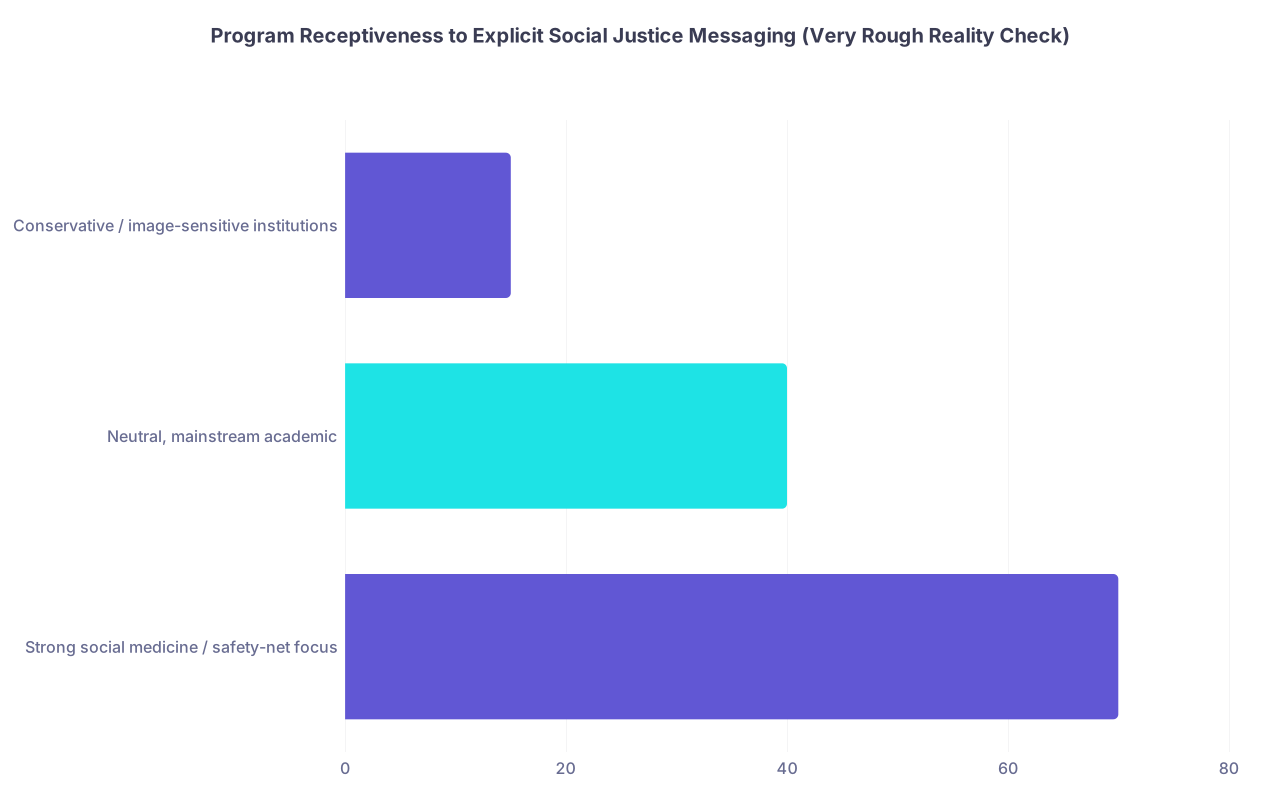
| Category | Value |
|---|---|
| Strong social medicine / safety-net focus | 70 |
| Neutral, mainstream academic | 40 |
| Conservative / image-sensitive institutions | 15 |
Numbers here aren’t scientific, obviously. But that’s the vibe. There are places where your advocacy is a huge plus, places where it’s neutral if framed well, and places where it’s a problem no matter what you write.
So the question becomes less “Will anyone see this as too political?” and more “Am I okay not being wanted by programs misaligned with my values—and am I presenting this in a way that programs who would value it can see the substance beneath the slogans?”
Where the line usually gets crossed (and how you’re probably imagining the worst)
The pattern I’ve seen: most programs don’t freak out because you care about social justice. They get tense when they see one of three things:
You look inflexible or dogmatic.
If your application reads like: “Anyone who doesn’t support X is morally bankrupt” or “I refuse to work with people who disagree with me,” people start worrying about how you’ll handle attendings, nurses, or patients who don’t share your politics.You attack specific groups you’ll have to collaborate with.
For example, “all cops are [insert extreme language]” paired with “I want to work at a trauma center that partners with law enforcement.” They see “walking HR complaint” flashing in red.You talk only in ideology, not in outcomes.
Pure slogans with no mention of actual community health outcomes, policy change, or patient impact make it sound like you care more about being right than being effective.
You’re probably imagining that a single mention of protesting, organizing, or advocacy equals automatic rejection. It doesn’t. I’ve seen people match extremely well with things like:
- “Led a White Coats for Black Lives chapter; coordinated hospital‑wide demonstration about police violence and health inequities.”
- “Organized residents and nurses around safe staffing ratios; participated in unionization drive.”
- “Advocated at the state capitol for Medicaid expansion and immigrant health coverage.”
The ones that blew up? They weren’t about what the person did. They were about how it was framed. Hostile, dismissive of colleagues, no mention of reflection or patient impact, just anger and ideology.
So no, the problem usually isn’t “you did social justice work.” It’s “you sound like you might be more interested in fighting than in caring for whoever is in front of you at 3 a.m.”
And I know—that’s not you. But your application has to prove it.
How to talk about your advocacy without getting yourself silently filtered out
Here’s the part you actually control: framing.
You don’t have to sand off all the edges of what you did. But you do have to translate it into language that program directors, hospital lawyers, and risk‑averse faculty can live with.
1. Anchor everything to patient and community outcomes
If your advocacy doesn’t connect clearly to health, they’ll call it “too political.” If you make that connection explicit, it’s suddenly “population health” or “health systems improvement.”
Compare:
- Weak / ideological: “I organized protests against police brutality because I believe the police are inherently violent and must be abolished.”
- Stronger / anchored: “I helped organize a white coat demonstration about police violence after seeing how repeated exposure to brutality and incarceration contributed to PTSD, chronic disease, and distrust of the medical system among our Black patients.”
Same event. Different framing. One triggers politics alarms. The other screams “this person understands structural determinants of health.”
2. Show you can work with people who disagree
Program directors worry about conflict on teams way more than they worry about your politics. If you can reassure them your advocacy made you better at collaboration, not worse, that goes a long way.
For example:
“I led a coalition that included students, nurses, and security staff with very different views about policing. I learned to listen first, find narrow areas of agreement—like mental health resources and de‑escalation training—and build around those.”
That line does two things: confirms you’re serious about the issue, and proves you’re not a walking grenade in team meetings.
3. Swap loaded slogans for specific problems and solutions
You don’t have to erase what you believe. But you also don’t have to lead every paragraph with your most polarizing phrase.
Instead of:
“I worked on abolitionist, anti‑carceral approaches to health care.”
Try:
“I worked on alternatives to incarceration for patients with substance use disorders, focusing on treatment access instead of punishment.”
Same value system. Less likely to trip someone’s “too political” alarm before they even understand what you did.
4. Own your growth, not just your outrage
If everything you write about social justice is just anger—no reflection, no humility—people worry you’re still in your most reactive phase.
Talk about what changed in you:
- “At first, I saw this as a simple ‘good vs bad’ issue. After meeting with community organizers and hospital leadership, I realized how complex the trade‑offs were…”
- “I used to think anyone who didn’t support our campaign didn’t care about patients. Then I talked with an older attending who’d seen failed reforms before and helped me think more strategically.”
This makes you sound like someone who can mature into a thoughtful advocate, not someone permanently locked into first‑year‑on‑Twitter mode.

Strategy: tailor your application instead of trying to please everyone
Here’s something most anxious applicants forget: you do not want every program to love your application.
If you care deeply about social justice and public health policy, there are programs that will make you miserable. Where you’ll be “the problem resident” for asking why security is called on Black patients more often. Where your advocacy will always be something you’re told to do “on your own time, off hospital grounds, please, and maybe don’t tweet about it.”
You’re allowed to decide you don’t want those places ranking you highly.
That said, you can be smart about how loud you turn the volume up or down:
- For explicitly social‑medicine, safety‑net, or public health–oriented programs, you can be bolder and more explicit. Name the work clearly.
- For more traditional or unknown‑culture places, keep the focus tight on health outcomes, systems change, and collaboration. Let your values show through the substance, not slogans.
- If a program’s website screams “nonpolitical,” “neutral,” or avoids any mention of disparities, you should assume your most radical language won’t land well there.
You can also split the difference with where you place things.
Your personal statement doesn’t have to carry every piece of your advocacy. You can move some of the spicier details into an activity description, a secondary essay for a program that clearly values this, or a supplemental where they ask directly about health equity.
Red flags: things that really will look too political to almost everyone
Your brain is probably making everything feel radioactive right now, so let’s narrow down what’s truly risky:
- Direct insults or contempt toward patients, police, administrators, older clinicians—any group you’ll interact with.
- Describing unlawful actions that clearly crossed professional or ethical lines (e.g., doxxing people, property destruction in your white coat, refusing to care for certain patient groups based on politics).
- Framing your core identity as “I fight the system” with zero mention of patient care, humility, or listening.
- Writing like you’re campaigning for office instead of applying to be a trainee who still has a lot to learn.
If you’re not doing those things, you’re probably not “too political.” You’re just living in a profession that still pretends it’s apolitical while making decisions that shape life and death for marginalized groups.
You’re not the problem. The system’s discomfort with being called out is.

| Step | Description |
|---|---|
| Step 1 | You include social justice advocacy |
| Step 2 | Advocacy is a strong asset |
| Step 3 | Framing matters a lot |
| Step 4 | Advocacy seen as liability |
| Step 5 | Likely neutral or mild positive |
| Step 6 | Increased concern |
| Step 7 | Program culture |
| Step 8 | Your tone |
The part nobody tells you: your advocacy is also a filter for you
You’re scared of being filtered out. Fair. But your advocacy is also doing you a favor you won’t fully appreciate until you’re on the wards at 2 a.m.
If a program look at your clearly framed, patient‑centered advocacy and says, “Too political, no thanks,” that’s not just a rejection. That’s a preview.
You were never going to be allowed to do meaningful policy or community work there. You were going to spend three to seven years biting your tongue in morbidity and mortality conferences while everyone politely ignored that the “non‑compliant” patient couldn’t afford their meds.
There is a real cost to self‑erasing. I’ve watched residents who hid this part of themselves to “get in anywhere” burn out hard when they realized they’d committed the next half‑decade to an institution that wanted their labor, not their voice.
You don’t have to light your application on fire with manifesto‑level language. But you also don’t have to pretend you don’t care about public health policy and justice.
You can say: I care about this deeply. I’m learning how to do it well. I can work with people who disagree. And if that scares you, maybe we’re not a fit.
Because you’re not just trying to match. You’re trying to match somewhere you can live with yourself.
FAQ (exactly 6 questions)
1. Should I delete all references to protests or direct action from my application?
No. Deleting everything sends you into bland, generic territory and hides a big part of who you are. Instead, keep the events but change the language: focus on why you were there (health impact, structural inequities) and what you learned. If there are details that are truly inflammatory or could be misread as endorsing violence or harassment, those can go. But “I helped organize a peaceful demonstration about X health issue” is not automatic poison.
2. Is it safer to move my social justice work out of the personal statement and into activities only?
Sometimes, yes. If your advocacy is central to why you chose medicine or your specialty, it probably belongs in the personal statement in some form. But if it risks overshadowing your entire narrative, you can strike a balance: use the personal statement to ground your values and one or two concrete examples, then use the activities section to go into more detail. That way, a single PD who hates your cause doesn’t instantly write you off before seeing anything else.
3. Can I mention controversial phrases like “defund the police” or “abolition” explicitly?
You can, but you need to be very strategic. Those phrases are lightning rods. If you use them, immediately ground them in specific health‑related goals: reallocating funds to mental health crisis teams, reducing carceral exposure that worsens chronic disease, etc. If your stomach drops thinking about a very traditional PD reading that line with zero context, consider describing the underlying work without leading with the slogan. The ideas can stay; the branding can soften.
4. Will programs Google me and find my activist social media or news coverage?
Some will. Not all, but some. If your name is attached to articles, petitions, or posts, assume there’s at least a chance someone will see them. That doesn’t mean you sanitize your whole life. It does mean you should scroll your public profiles like a skeptical PD: anything that looks like harassment, threats, HIPAA issues, or explicit refusal to care for certain groups is a serious problem. Angry but thoughtful advocacy? Less of a problem than you think, especially if your application shows maturity and reflection.
5. How do I answer interview questions if they push back on my advocacy?
Don’t get defensive, and don’t backpedal into pretending you don’t care. Something like: “I care a lot about how policy and policing affect patient health. I also know good people can disagree on solutions. My goal isn’t to fight colleagues—it’s to advocate for safer, healthier communities while still taking excellent care of every patient in front of me.” Then give one example where you collaborated with someone who disagreed. They’re testing your temperament more than your politics.
6. Could my advocacy actually help me match in public‑health‑oriented programs?
Yes. In some places, it’s one of the strongest assets you can bring. Programs that take social medicine seriously are tired of people writing generic “I care about health equity” lines with no receipts. If you show up with sustained, substantive work—policy briefs, community partnerships, organizing around Medicaid, reproductive justice, immigrant health—that can set you apart in a good way. The key is framing: show depth, humility, outcomes, and an understanding that you’re joining a profession, not just a movement.
Key points: your social justice advocacy isn’t automatically “too political,” but sloppy, slogan‑heavy framing can make it look that way. Anchor everything in patient and community health, show you can work with people who disagree, and be honest about where you’d actually want to train. If a place rejects you for caring about justice thoughtfully, they’re rejecting the real you—and that’s not the worst thing that can happen.