What if a single angry tweet about abortion laws makes a program quietly blacklist me on Match day?
Let me just say the thing we’re both scared of: you post about abortion bans, gender-affirming care, vaccines, or physician strikes… and somewhere, some bitter program director screenshots it, sends it to the committee, and you never even know that’s why you didn’t match.
That thought? It’s miserable. And not crazy.
You’re not wrong to worry that controversial public health posts can hurt your residency chances. They can. But not in the cartoon way your brain is probably imagining. It’s more subtle. And more under your control than it feels at 2 a.m. when you’re doomscrolling and drafting rage threads.
Let’s tear this apart honestly.
How bad can this get at the absolute worst?
Here’s the nightmare version most of us catastrophize:
You post a thread supporting abortion rights, calling a specific state’s ban “barbaric” and saying “I would never work with an OB in [State] who enforces this trash.”
Months later, you apply to OB/GYN programs, including some in that state. They find your post, decide you’re “unprofessional” and “a bad cultural fit,” blacklist you, talk to their friends at other programs, and suddenly your application quietly dies everywhere.
Is that exact chain common? No. Is some version of it possible? Yes.
Let me be blunt:
Residency programs absolutely look at social media. Not always. Not systematically. But often enough that you can’t pretend your accounts are invisible.
Comments I’ve heard (or heard of) in selection meetings:
- “Did you see their Twitter? Lot of aggressive political stuff.”
- “I’m fine with advocacy, but I don’t want someone who calls other clinicians ‘killers’ online.”
- “If they talk like that on a public account now, what happens when a patient makes them mad?”
Notice something:
It’s not the position that usually kills you. It’s the tone, targets, and judgment they read into it.
You can be strongly pro-abortion access or strongly critical of vaccine mandates and still match. But if your posts look:
- hateful
- unprofessional
- contemptuous of patients, colleagues, or vulnerable groups
- reckless with patient info
…then yes, you are absolutely putting your Match chances at risk.
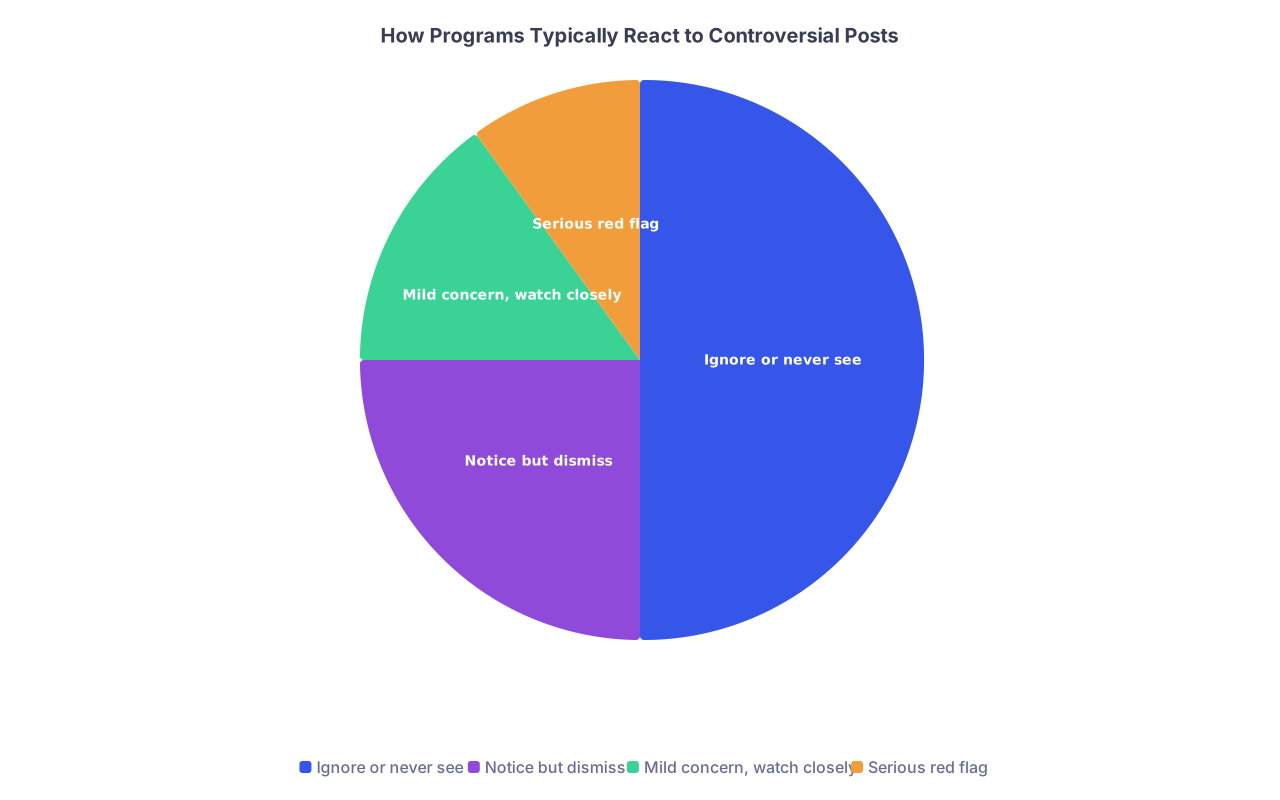
| Category | Value |
|---|---|
| Ignore or never see | 50 |
| Notice but dismiss | 25 |
| Mild concern, watch closely | 15 |
| Serious red flag | 10 |
What actually triggers programs — and what usually doesn’t
Let’s separate your fear into two piles: “real threat” vs “your brain being mean.”
Stuff that really can hurt you
This is the part nobody sugarcoats behind closed doors:
Attacking groups of people
- “Anti-vaxxers are idiots who don’t deserve hospital beds”
- “Religious people who oppose abortion are evil”
- “Trans people are mentally ill and should be treated as such”
That’s the kind of thing that gets brought up as a professionalism concern. It screams poor judgment, poor empathy, and potential patient complaints.
Attacking specific clinicians / institutions by name
- “Dr. X at [Hospital Name] is dangerous and should lose their license.”
- “Avoid [Program Name] — they don’t care if their patients die.”
That’s defamation-adjacent. Programs hate this.
Anything that hints at HIPAA issues Even if de‑identified, if you’re describing a case in a way that could be recognized locally, and pairing it with “look how stupid this patient was,” that’s a massive red flag. They will picture you doing that to their patients.
Unprofessional tone, regardless of stance Caps-lock rants. F-bomb threads about “these moron legislators.” Memes that treat vulnerable patients like jokes.
You can be furious about a law and still not look like a loose cannon.Posting while clearly identifying your institution “MS3 at [School], future EM doc, tweets are my own (lol)”
Then you go off on judges, nurses, nurses unions, rural patients, religious groups. Programs see risk and reputation problems.
This is the stuff that can get your application quietly moved to the “no” pile.
Stuff that usually doesn’t tank you (if done thoughtfully)
On the other hand, there’s a big middle ground where your brain is probably catastrophizing:
Thoughtful advocacy with evidence
- “Here’s how abortion bans are affecting OB training and maternal mortality in my state, sources below.”
- “Restricting gender-affirming care is increasing mental health crises among teens; as future physicians, we should care about this.”
Programs may disagree with you politically, but many will still respect well-argued, professional advocacy.
Policy disagreements framed as concern, not contempt
- “I strongly disagree with this law because…” vs “Whoever wrote this law is a clown.”
The first shows you’re engaged and thoughtful. The second reads hostile.
- “I strongly disagree with this law because…” vs “Whoever wrote this law is a clown.”
Content that’s clearly educational / academic Thread on abortion safety data.
Summary of vaccine trial outcomes with critique of rollout strategy.
That tends to be seen as “professional identity building,” not “troublemaker.”Private accounts with tight follower control Is anything online truly safe? No. But a locked account with no obvious real-name link, small follower list, no school or hospital tagging? Much lower risk than your full legal name + MD2026 + hometown + open tweets.
Reality check: yes, they can find you — but they’re not the NSA
You’re probably envisioning committees running full background searches on every applicant. That’s not how it usually works.
Here’s what I’ve seen and heard:
- Some programs never look at social media. At all. Zero capacity, too busy.
- Some will Google you if something already feels off.
- Some let one faculty member or chief resident “scan for red flags” on public platforms.
- Very few are systematically scraping your entire internet history like a security clearance.
So what shows up fast?
Try it yourself. Open a browser in incognito and Google:
- Your full name + “MD”
- Your name + med school
- Your name + city
- Your name + Twitter / Instagram / TikTok / Reddit / LinkedIn
If your policy rants pop up on page one, they are not hidden.
If your controversial posts are under an obvious handle like @DrFutureAnesth and your real name is all over the bio? Also not hidden.
But if your political takes are on a locked account with a username that has no connection to your real identity (and you’ve never cross-posted or linked)? The odds of a random PD finding it are much lower.
Not zero. But lower than your brain is screaming.

| Step | Description |
|---|---|
| Step 1 | Post about controversial health law |
| Step 2 | Low risk |
| Step 3 | Moderate risk |
| Step 4 | High risk |
| Step 5 | Program sees red flag |
| Step 6 | Quietly down-rank or reject |
| Step 7 | Content tone |
| Step 8 | Visibility |
But what about programs in states with laws I hate?
This is the brutal tension:
You care about public health and ethics. You’re furious about certain laws. And you might have to train in those same states.
So now the fear is:
“If I criticize this law publicly, will programs in that state automatically reject me?”
Some might. Especially if your posts directly attack people who live there, or clinicians who follow the law but are trying to help within constraints.
But here’s the nuance nobody tells you:
Many physicians in restrictive states quietly agree with you.
They just can’t say it out loud the way you want to.-
- Will this person follow the law while they’re here?
- Will they treat our patients with respect, even if they dissent?
- Will they bring drama to our door?
If your posts read like:
- “Any doctor who practices in [State] is complicit and unethical,”
then you’re telling every PD in that state: “I think you’re immoral.” That’s a problem.
- “Any doctor who practices in [State] is complicit and unethical,”
You can say, “I’m deeply worried about the impact of [Law] on maternal mortality,” without saying, “Anyone who trains there is trash.”
That difference really, really matters.
| Post Type | Example Snippet | Relative Risk |
|---|---|---|
| Evidence-based critique of law | "This ban increases unsafe abortions; data shows..." | Low |
| Emotional but respectful disagreement | "I’m angry and heartbroken about this law’s impact…" | Moderate |
| Personal attack on lawmakers or clinicians | "Whoever wrote this is a monster and should rot." | High |
| Mocking patients or groups | "These idiots who don't vaccinate deserve what they get." | Very High |
What you can safely do today without nuking your Match
You don’t have to become a spineless robot to survive residency selection. But you do need to be strategic.
Here’s the calm, boring, but honestly protective approach:
Audit your online footprint. Hard. Scroll back years. Old Facebook, Instagram captions, Twitter, TikTok, Reddit comments under your real name or identifiable username.
Ask yourself for each post:
“If this was screenshotted on the projector at rank meeting with my real name underneath, would I feel sick?”
If yes, consider deleting. Or at least archiving.Separate “professional advocacy” from “emotional venting.” Use your real-name or easily-linked accounts for:
- Policy analysis
- Evidence-based arguments
- Thoughtful commentary
Save raw anger for private group chats, DMs, or genuinely anonymous corners. Not perfect safety, but much safer than public threads.
Stop tagging your institution when you’re being spicy. Don’t combine:
- med school name
- hospital name
- PGY year
- specialty
with raw, inflammatory political content. That’s asking to get flagged.
Check your bio language. Bios can absolutely send signals:
- “Future abortion provider and reproductive justice advocate” — bold, but coherent with OB/GYN apps, probably fine in many places.
- “I will never work for any institution that complies with [Law]” — that’s basically telling some programs not to rank you.
Ask yourself: advocacy or identity? If a random PD only knew you from your last 30 posts, would they see:
- A future physician advocating for patients, or
- A person who lives for outrage and fights?
They’re picking a coworker, not a pundit. That’s the lens they use.
What if I’ve already posted some borderline stuff?
This is the part that keeps replaying in your head:
“It’s too late. I already ranted last year after Roe fell. Programs are going to find it and I’m doomed.”
Take a breath.
Here’s the honest situation:
Most of your posts will never be seen by a program. The internet is big. They’re busy. You’re not as important to them as you are to you.
You’re allowed to grow. If someone does find an older, more reactive post, it’s not automatically fatal if your overall pattern is mature and professional now.
Deleting isn’t a crime. You’re not obstructing justice. You’re curating your professional identity. Everyone sanitizes to some extent.
If you’re really anxious about specific posts:
Delete or archive anything that:
- Attacks a group, program, or clinician
- Swears aggressively at named people or institutions
- Could be read as hostile to patients or vulnerable groups
Going forward, change your standard from “Would my friends understand what I meant?” to “Would a conservative 60-year-old PD who doesn’t know me at all read this as risky?”
It sucks, but that’s the game.
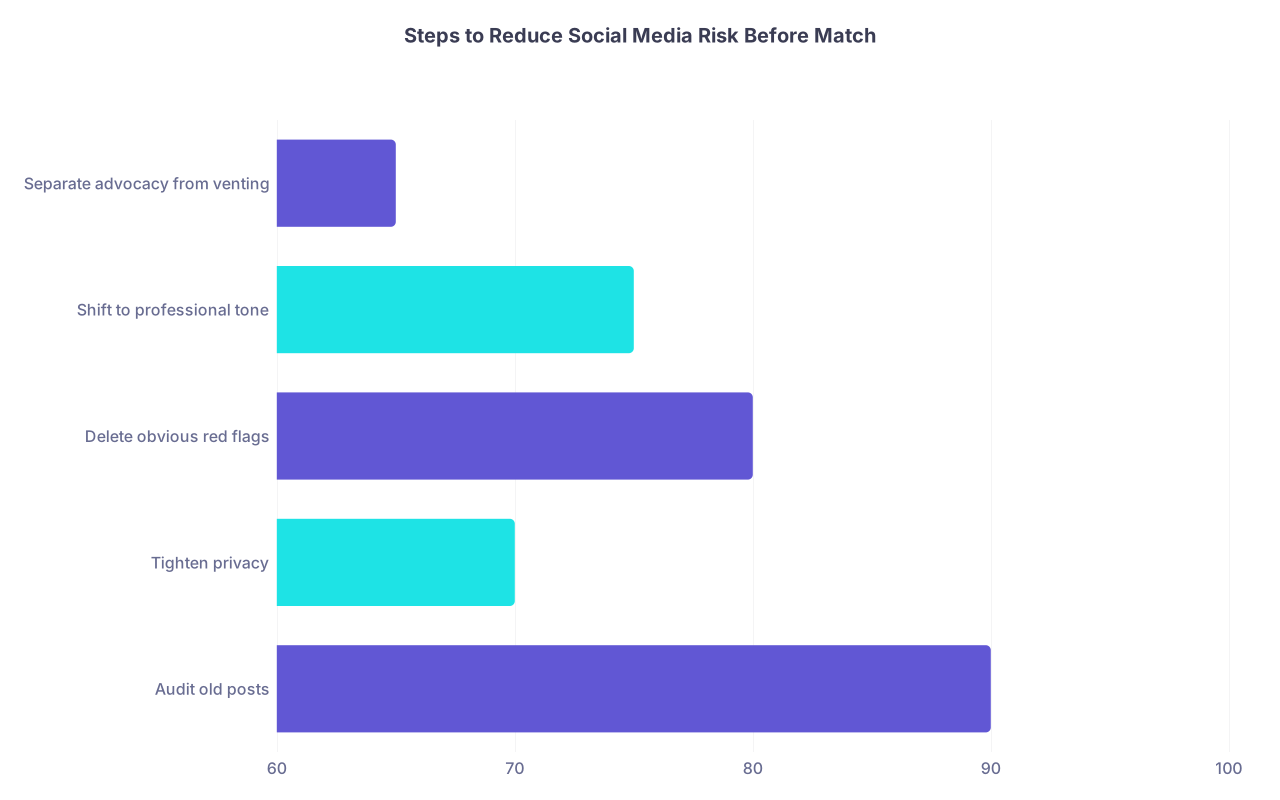
| Category | Value |
|---|---|
| Audit old posts | 90 |
| Tighten privacy | 70 |
| Delete obvious red flags | 80 |
| Shift to professional tone | 75 |
| Separate advocacy from venting | 65 |
You don’t have to choose between ethics and employment — but you do have to be smart
This is the awful tradeoff everyone in medicine is quietly making right now:
Be silent and “safe,” or speak and risk being seen as “difficult.”
You can still speak. You can still care. You can still be firmly, visibly on the side of what you think is right in public health policy.
But if you want to protect your Match chances, shape that advocacy like a professional, not like a Twitter brawler.
Programs mostly aren’t rejecting you because you care about contested issues. They’re rejecting people who, on paper or online, look like they could:
- embarrass the institution,
- harm trust with patients, or
- bring constant conflict to the team.
Make sure your online footprint says:
“I will fight hard for patients and ethical care”
not
“I will fight anyone, anywhere, and I love a public battle.”
You can thread that needle. It just takes some uncomfortable honesty with yourself.
FAQ (exactly 6 questions)
1. Can I openly say I support abortion rights or gender-affirming care and still match?
Yes. Tons of residents and attendings are openly supportive of these issues and matched just fine. The danger isn’t the stance itself. It’s the way you express it. “I support abortion access because…” with data and empathy is very different from “Anyone who opposes this is evil and shouldn’t be a doctor.” Programs are watching for judgment, not just opinions.
2. Are programs more likely to screen social media for “controversial” specialties like OB/GYN or psych?
Some are. Especially in fields where public controversy is high or where patient trust is fragile. I’ve heard OB/GYN and psych selection folks mention social media more often, yes. But even in IM or surgery, if your name is unusual and your Twitter is loud, it’s not hard to find. Don’t assume “I’m going into radiology, nobody cares.” People talk. Screenshots travel.
3. Is making my account private enough to protect me?
It helps, but it’s not bulletproof. A private account is like closing the blinds, not soundproofing the walls. Followers can still screenshot. People can still connect dots if your username, bio, or mutuals give away who you are. Treat “private” as “lower risk,” not “invisible.” Still avoid posts that would horrify you if they were leaked.
4. What if a program directly asks about my advocacy or social media in an interview?
Don’t panic and don’t lie. You can pivot it into a strength: “I care deeply about how laws affect patient care, so I’ve shared evidence-based commentary online. I’ve learned to be very intentional about tone and to focus on education and respect, even when I strongly disagree.” They’re listening for maturity and self-awareness, not perfect political alignment.
5. Could a single bad post really make me go unmatched?
Alone, probably not. As part of a pattern? Yes. Think of it like a Step score that’s a bit low. One red flag can be survivable if everything else is strong. But if you pair a questionable post with mediocre letters, average scores, and a weak interview, that post can tip a borderline file into the “no” pile. Don’t give them an easy reason to say no.
6. Should I just stop posting about health policy until after I match?
If your anxiety is sky-high, honestly, pausing public hot takes until Match is a very reasonable move. But you don’t have to completely silence yourself. A more strategic option:
- Stop posting in real time when you’re angry.
- Draft, sleep on it, edit for professionalism.
- Focus on sharing data, stories with consent, and thoughtful reflections.
You can still build an advocacy profile—just do it like someone who knows PDs might be watching.
Open your main social media account right now and scroll back 12 months. Pick the spiciest post about a controversial health law. Ask yourself, out loud: “Would I be okay if my top-choice PD read this in committee?” If the answer is anything less than a confident yes, fix that post today.