
The fastest way to blow up your residency career is to pretend power dynamics don’t exist.
Let me just say that up front, because all the “speak your truth!” Instagram nonsense does not apply the same way inside a hospital hierarchy.
You’re probably thinking what I’ve heard from a hundred residents and students:
“I see unsafe stuff.”
“I see unethical policies.”
“I see things that hurt patients and residents.”
And then the panic thought: If I speak up, will I get labeled ‘unprofessional’ and destroyed on my evals?
You’re not crazy for worrying about that. You’re actually paying attention.
I’m going to walk through what’s “risky,” what’s actually career-ending, what’s survivable, and where you have more power than you think—but not as much as the wellness committee flyer says you do.
The Real Risk: You’re Not Imagining It
Let’s start with the worst-case scenarios our brains love.
No, it’s not an urban legend. Residents can be:
- Quietly blackballed as “difficult” or “not a team player”
- Scored down on vague professionalism metrics
- Left off opportunities (chief, letters, electives)
- Subtly frozen out in the program culture
And often not because they were wrong—just because they crossed an invisible line.
The line is rarely about what you criticize. It’s about:
- Who you call out
- Where you do it
- How you do it
- Whether you look like a “solution-focused professional” or an “angry troublemaker”
Is that fair? Not even a little.
Is it real? Yes.
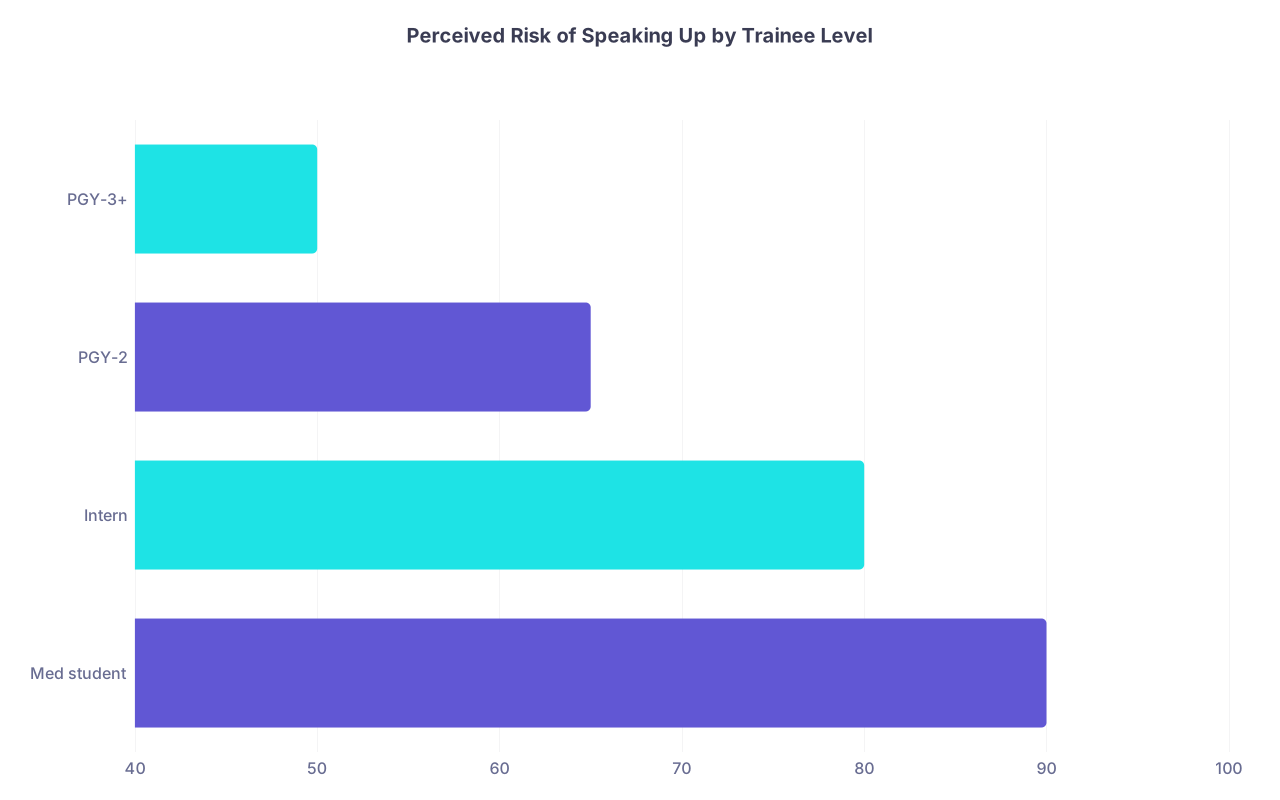
| Category | Value |
|---|---|
| Med student | 90 |
| Intern | 80 |
| PGY-2 | 65 |
| PGY-3+ | 50 |
That’s what I see: the more senior you are, the safer you feel. As an M3? Everyone feels like they’re one “wrong” comment from getting a professionalism narrative in their dean’s letter.
What’s Actually “Too Far”? Concrete Red Lines
People talk about “professionalism” like it’s some mystical vibe. I’m going to make it less mystical.
Here’s what really gets people in trouble when criticizing policy:
Public shaming of individuals
Calling out your attending or program director by name on Twitter/X/IG/Reddit.
Or even obliquely, when it’s obvious who you mean:
“Some people in leadership at [my hospital] care more about Press-Ganey than patients.”
That stuff travels. Screenshots live forever.Accusing bad intent without proof
Saying things like:- “Admin doesn’t care if patients die.”
- “Our PD is retaliating against anyone who speaks up.”
Even if it feels true, once you make it into a statement of fact, you’re in defamation/insubordination territory if anyone wants to push it.
Ignoring internal channels completely
Going straight to the media, or posting viral threads, before you’ve tried:- Your chief residents
- Program leadership
- GME office
- Institutional ombudsperson / compliance / safety reporting
When programs can say, “They never even brought this up internally,” you look less like a whistleblower and more like a bomb-thrower.
Making it personal, not about the system
“My PD is incompetent.”
vs
“Our call schedule leads to X unsafe situations; I’d like to propose Y.”
One of these gets you labeled “mature and thoughtful.”
The other gets you a quiet “concerns about professionalism” email.
The Safer Zone: What You Can Criticize (And How)
You’re not supposed to be a compliant robot. Ethical physicians are obligated to identify unsafe and unjust systems. The trick is staying within a defensible lane.
Safest target: Systems, not individuals
Good:
“This discharge policy pushes unstable patients out too early. Here are three cases from this month and outcomes we documented. Can we review this process?”
Risky:
“Attending X just wants the beds open, that’s why this is happening.”
Safest style: Curious, not combative
Use language that sounds like quality improvement, not a rant:
- “I’m concerned that…”
- “I’ve noticed a pattern where…”
- “I worry this may be affecting patient safety when…”
- “Can we look at the data on…”
- “Is there a way we can adjust…?”
Yes, I know this sounds fake and diplomatic. But it works. It signals: “I’m trying to help,” not “I’m here to fight.”
Safest forum: Right room, right people
Rough rule of thumb:
Best:
- Private conversation with chief or trusted attending
- Scheduled meeting with PD
- Safety/quality committee channels
- Anonymous or semi-anonymous institutional reporting
Medium risk:
- Group emails with multiple attendings & residents
- Town halls (if you speak in measured, non-personal terms)
High risk:
- Social media identifying your hospital or program
- Public comment sections
- Off-the-record chats with journalists that aren’t really off-the-record
If your heart rate spikes just imagining saying it where you’re planning to say it—that’s your body giving you a risk assessment.
Internal vs External Whistleblowing: The Nuclear Option Problem
The nightmare scenario in your head is this:
You speak up about something actually unsafe.
They call you “disruptive.” You get thrown under the bus.
Here’s the ugly part: sometimes that does happen.
There’s a difference, though, between:
- Internal advocacy (still in the “I’m on the team trying to fix this” lane)
- Full-blown whistleblowing (I’m going outside the system because the system is the problem)
Internal advocacy looks like:
- Reporting unsafe practices through institutional safety systems (e.g., RL solutions, M&M, QI committees)
- Documenting facts clinically: “Patient left in hallway for X hours because no staffed beds; vital signs abnormal; delay in imaging.”
- Following up in writing on prior concerns:
“As we discussed on 3/4, I remain worried that the overnight coverage setup is unsafe when we have more than X ICU patients.”
Internal advocacy is much harder to attack as “unprofessional” because it’s exactly what hospitals claim they want: “see something, say something.”
External whistleblowing looks like:
- Contacting media or regulators about your hospital
- Posting specific internal issues publicly with identifiable details
- Sharing internal emails/policies/screenshots outside the institution
Is it sometimes necessary? Yes.
Is it safe for a resident? Almost never.
Not because you’re wrong, but because you’re disposable in the hierarchy. You’re on a time-limited contract with fragile references. Leadership has 10 ways to hurt you that never show up as “retaliation” on paper. Sudden concerns about “communication style.” Vague remarks about “fit.”
So if your brain is fantasizing about going full viral-thread journalist on X:
Pause.
Ask: “Have I exhausted internal channels?”
And: “Am I ready to risk my training spot over this?”
That’s not rhetorical. Sometimes the answer genuinely is yes. But you should be clear that you’re not playing a small game anymore.
How to Speak Up Without Getting Destroyed (As Much)
You want the real strategy? It’s not “be brave.” It’s “be tactically smart.”
Let me unpack that with practical moves.
1. Don’t go in alone if you don’t have to
Whenever possible:
- Find at least one co-resident who sees the same problem
- Or a chief who’s not a complete coward
- Or an attending with a history of having a spine
“Several of us have noticed…” reads very differently than “This one resident has concerns…”
2. Be boringly factual
Your emotional reality can be intense. Don’t bring all of that into the written record.
Bad email:
“This policy is insane and unethical. People are going to die and no one seems to care.”
Better:
“Under the current boarding policy, ICU patients are remaining in the ED for greater than 24 hours without consistent nurse staffing ratios. In the last week, we had:
– Patient A: missed dose of vasopressor due to lack of assigned nurse
– Patient B: delay of intubation due to no available respiratory therapist after midnight
I’m worried this pattern creates avoidable risk. Is there a way we can review or adjust this process?”
You still sound human. Just not like a lawsuit waiting to happen.
3. Separate what you criticize from who you blame
Aim all your fire at:
- Processes
- Workflows
- Resource allocation
- Scheduling structures
- Policy language
Avoid direct blame of:
- Named people in leadership
- Specific individuals in writing (unless you’re in formal reporting or legal territory)
You can still think “Admin doesn’t care.” Just don’t make that the official record.
4. Protect yourself quietly
If you’re raising something big:
- Save copies of relevant emails (to your personal drive, carefully, de-identified if possible)
- Document your concerns and the date you raised them
- Keep a simple log: date, issue, who you spoke with, their response
Not to weaponize it immediately. Just so that if, six months later, someone suggests you’re “overreacting” or “this was never brought up,” you’re not gaslit into oblivion.
5. Recognize retaliation patterns early
Signs your advocacy is not welcome:
- Sudden shift in tone from leadership after you speak up
- New, vague comments in evals about “attitude,” “teamwork,” or “resistance to feedback” with no prior history
- Being excluded from emails/meetings you would normally be part of
- Out-of-proportion escalation: you send one concerned email, suddenly you’re in a formal professionalism meeting with 4 people
If that starts, you’re no longer just in “I’m raising a concern” mode. You’re in “I need help” mode: union (if you have one), GME ombuds, legal counsel, or at least a trusted senior faculty member outside your direct chain.
What About Social Media? (The Career Landmine Field)
Let’s be blunt: the safest default as a resident is to criticize systems in general, not your specific employer on social media.
General:
“Many hospitals push early discharge metrics that clash with patient safety. We need to rethink how we measure ‘efficiency.’”
Riskier:
“At [Large Urban Hospital] where I work, they make us discharge people who clearly aren’t ready just to clear beds.”
Extremely dangerous:
“Look what my hospital did today – patient in room 12 left on the floor for hours. [Photo]”
Anything that:
- Names your institution
- Shows identifiable spaces / badges / logos
- Mentions your exact role and program
- Could be linked easily to a specific incident
…is basically handing your leadership a loaded professionalism gun.
Unfair? Sure. Real? Absolutely.
When You Should Ignore the Risk
I’m not going to pretend there are no lines you should be willing to cross even if it costs you.
There are a few categories where, frankly, you might have to accept some personal risk:
- Clear, immediate patient harm that leadership refuses to address
- Serious legal/ethical violations (fraud, discrimination, harassment, abuse)
- Retaliation against you for using appropriate internal channels
In those cases, “keep your head down” isn’t just cowardly—it’s complicity.
If you get there, don’t do it impulsively. Get advice:
- Union rep (if available)
- Institutional ombuds / ethics office
- A lawyer who understands employment and health law
- A national organization (sometimes specialty societies have guidance)
And be honest with yourself: “Yes, this might cost me. I’m still going to do it.” That’s very different from stumbling into that level of risk without realizing you’ve crossed the line.
| Situation | Safer Approach | Riskier Approach |
|---|---|---|
| Unsafe discharge practices | Internal email with cases & data | Public tweet naming hospital |
| Excessive workload for residents | Discuss at program meeting with proposals | Rant in group text that gets screenshot |
| Questionable admin decision | Ask clarifying questions privately | Accuse admin of bad intent in writing |
| Poor call schedule | QI-style proposal with alternatives | Email: “This schedule is abusive and illegal” |
FAQ (The Stuff Keeping You Up at 2 a.m.)
1. Can I actually get kicked out of residency just for criticizing policy?
Not usually for just criticizing policy—programs know that looks bad. But they can repackage it as “chronic unprofessionalism,” “poor communication,” or “not receptive to feedback” if they want you gone. The criticism becomes the excuse, not the official reason. That’s why tone, forum, and documentation matter so much.
2. Is anonymous reporting really anonymous, or will they know it’s me?
Anonymous systems are…semi-anonymous. If only one resident was on that shift, or only one person knows those details, people can guess. I’d assume “anonymous” means “not explicitly tagged with your name,” not “impossible to infer.” Still use them, just don’t put things in there you wouldn’t stand behind if it somehow pointed back to you.
3. What if my attendings tell me privately they agree, but won’t say anything publicly?
That’s common and infuriating. Senior physicians often have golden handcuffs—mortgages, kids, reputation. They’ll nod in the hallway and go silent in the meeting. Take their support, but don’t mistake it for protection. “Off-the-record support” doesn’t save you if leadership turns on you.
4. How do I know if I’m being “too sensitive” vs there’s a real systemic issue?
Patterns. Single bad shift? Maybe noise. Repeated, predictable harm or near-harm from the same policy? That’s real. If multiple residents independently say, “Yeah, this is unsafe,” you’re not just imagining it. You don’t need it to be catastrophic to take it seriously.
5. Could this hurt me when I apply for fellowship or jobs later?
It can—if you get the “difficult” label and it bleeds into letters. Most of the time, if you stay measured, solution-oriented, and not publicly explosive, it won’t follow you. If you go full whistleblower, yes, some programs may quietly avoid you. That’s why you should be intentional: if you’re going to risk that, do it consciously, not by accident.
6. Is it ever okay to just shut up and do the job, even if something feels wrong?
Yes. You’re not morally obligated to fight every flawed policy you see. You have finite emotional and career capital. Pick your battles: clear patient harm, major justice issues, things that keep you up at night if you say nothing. It’s not selling out to let some annoying-but-not-dangerous policies go. It’s survival.
Bottom line:
- You’re not paranoid—criticizing hospital policy is risky as a resident, but it’s not off-limits if you’re strategic.
- Keep your fire aimed at systems, use internal channels first, and document like someone might misremember later.
- Save the nuclear options for issues that are truly worth potentially burning your career capital over—and if you go there, do it with your eyes open, not by accident.