
No, you do not need to be a policy expert to influence health reform. In fact, waiting until you “know enough policy” is one of the most effective ways to guarantee you never influence anything.
Let me be blunt: the current health policy ecosystem is already full of “experts.” Economists who have never rounded on a night float. Lawyers who have never had to discharge a homeless patient with a new insulin regimen. Consultants who can tell you the marginal cost of an MRI but could not interpret one to save a life. And yet, we still have a system that burns out clinicians, bankrupts patients, and underserves entire communities.
So clearly, more policy expertise is not the missing ingredient.
The Myth of the Policy Expert Gatekeeper
Here’s the story you’ve probably absorbed, especially if you’re a clinician, trainee, or public health worker:
- To affect health reform, you need formal training in health policy, law, or economics.
- You should not speak publicly until you can cite randomized trials, CBO scores, and line items from the ACA.
- Real influence comes only from people on blue-ribbon commissions, at think tanks, or with “DrPH/MPH/MPP/MD, PhD” soup after their names.
That story is wrong.
When you actually look at how health policy shifts in the real world, three patterns jump out:
- Lived experience routinely moves legislators more than white papers.
- Organized voices beat “perfect expertise” almost every time.
- Clinicians and community members often spark reforms that policy experts later codify and claim credit for.
Let me give you some concrete examples.
Who Actually Moves the Needle?
- Needle-exchange and harm reduction policies in multiple U.S. cities didn’t start because someone finished a PhD in health economics. They started because frontline clinicians, outreach workers, and people who use drugs kept showing up with data on HIV outbreaks and stories of preventable deaths.
- Safe-staffing legislation in several states wasn’t launched by policy centers. It was pushed by nurses who were sick of working chronic double shifts and documenting near-misses. They brought log sheets, emails, and patient stories to statehouses.
- COVID-19 school policy, masking, and occupational safety rules? Legislators didn’t sit down with a single meta-analysis and call it a day. They were lobbied—hard—by teachers, parents, nurses, and local health officers, some of whom couldn’t define “regression discontinuity” if you paid them.
You see the pattern: expertise matters, but it rarely starts the fire. It refines it, directs it, sometimes dilutes it. The spark usually comes from people living the problem.
If you’re in medicine or public health and feel shut out of “policy” because you’re not an expert, you’re misunderstanding your actual value. Your value is that you’re not an expert. You’re a witness.
What the Evidence Actually Shows About Influence
Let’s talk data, because “just get involved!” is as useless as it sounds.
Political science, advocacy, and public health research all converge on a few uncomfortable truths for the cult of expertise.
1. Direct constituent contact beats white papers
Studies on legislative behavior consistently show that:
- Personal stories from constituents, especially when combined with even modest local data, are among the most influential inputs on many legislators.
- Mass emails and auto-petitions get ignored; tailored, specific outreach does not.
- The majority of legislators are not policy scholars; they rely heavily on simplified narratives from people they perceive as credible.
Who do they find credible on health issues?
Physicians, nurses, local public health workers, and patients. Over and over. Not because these groups are policy experts, but because they’re close to the consequences.
2. Organized voices matter more than solo experts
There’s evidence across multiple domains that organized collective action—professional associations, coalitions, unions, patient advocacy groups—shapes policy outcomes more reliably than lone experts waving data.
Look at who actually shows up at hearings:
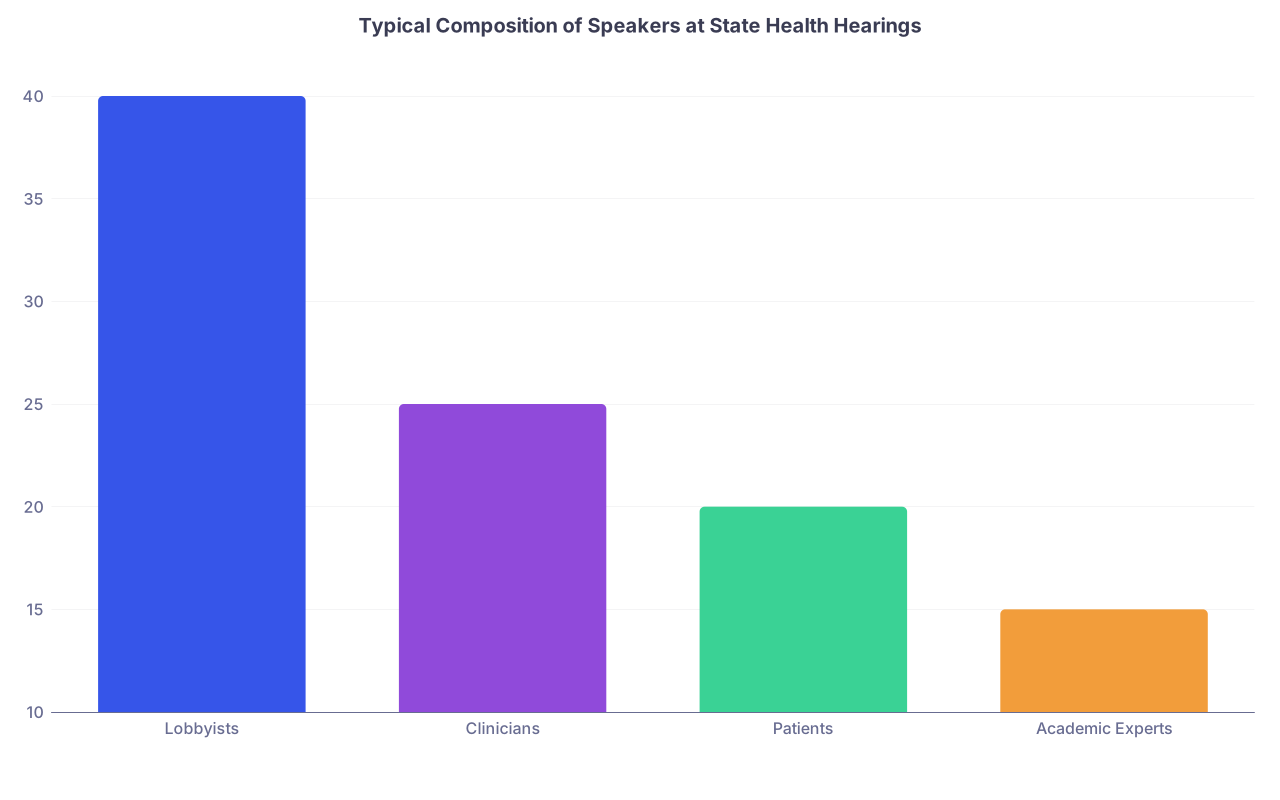
| Category | Value |
|---|---|
| Lobbyists | 40 |
| Clinicians | 25 |
| Patients | 20 |
| Academic Experts | 15 |
That chart is stylized, but it reflects a common pattern reported in state-level analyses: paid lobbyists dominate; clinicians and patients are a minority; academic experts are an even smaller fraction. Yet when legislators recount “what changed my mind,” they often reference a nurse’s testimony, a parent describing medical debt, or a local doctor showing how prior authorizations delayed cancer care.
The myth is that you need to become the academic expert in the room. The reality: you need to show up at all, preferably with a coalition.
3. Narrative plus “good enough” data beats technical perfection
Health policy is not an R01 application. You do not get graded on methodological purity. You get judged on coherence, plausibility, and political viability.
Research on persuasion shows that:
- Narrative + a few well-chosen statistics tends to beat dense technical argumentation in legislative and public settings.
- Overly technical presentations can reduce trust if the audience feels you’re “talking down” or hiding something in the complexity.
- People are more likely to support policies when they can visualize the human impact, not just the effect size.
You already know how to tell a clinical story:
“Middle-aged patient, type 2 diabetes, three missed appointments because bus routes were cut, ended up admitted to the ICU with DKA. Those bus cuts saved the city money on paper. They cost us an ICU bed and a near-death.”
That’s policy testimony. You just don’t call it that on rounds.
What You Actually Need (Spoiler: It’s Not a Policy Degree)
You don’t need a second graduate degree. You need three things: clarity, a basic grasp of process, and minimal evidence literacy.
1. Clarity on the problem and the ask
Most “non-expert” advocates fail not because they lack knowledge, but because they’re vague.
“I want health care to be better” is not actionable.
“I want fewer uninsured patients” is still too broad.
Try something like:
- “I want my state Medicaid program to reimburse for telehealth at parity for behavioral health visits.”
- “I want this hospital to stop sending low-income patients to collections for under $250.”
- “I want our residency to have a formal rotation in correctional health.”
Specific target, specific lever. Suddenly you’re not hand-waving “reform.” You’re pushing one identifiable change.
2. Basic process literacy, not expertise
You should know the rough answers to:
- Who controls this thing I want changed? (Hospital board? State legislature? City council? Insurer? Federal agency?)
- How do they make decisions? (Public hearing? Internal committee? Regulatory rulemaking? Contract negotiation?)
- When are those decisions made in the calendar year?
You do not need to memorize Title XVIII of the Social Security Act. You do need to know, for example, that prior auth policies are often set at the insurer level and sometimes influenced by state insurance commissioners—so screaming at your hospital CMO about it might be emotionally satisfying but strategically dumb.
If you want a quick and dirty way to understand a process, there’s an easy hack:

| Step | Description |
|---|---|
| Step 1 | Identify Specific Problem |
| Step 2 | Ask Who Decides |
| Step 3 | Find Similar Change Elsewhere |
| Step 4 | Talk to One Local Insider |
| Step 5 | Confirm Decision Timeline |
| Step 6 | Plan Your Intervention |
That’s it. One or two conversations with people who’ve been around the block (a hospital administrator, a senior nurse, someone in the county health department) will shortcut months of “policy research” that many trainees think they need.
3. Evidence literacy, not authorship
You do not have to be the person who ran the study. You do need to be able to say things like:
- “Three separate systematic reviews have shown that housing-first models reduce ER use and inpatient days.”
- “State X implemented similar staffing ratios; their quality and retention data improved over five years.”
- “The CDC’s own data show overdose deaths dropping where syringe services are available.”
That’s just basic reading and synthesis. The same skills you use when deciding whether to trust a new trial in NEJM.
If you can interpret relative risk, confidence intervals, and basic study design, you have all the “expertise” you need to support a modest policy request.
Ethical Responsibility: Silence Is Not Neutral
Now we hit the uncomfortable part: if you work in health care or public health and stay out of policy because you “aren’t an expert,” you’re not being neutral. You’re ceding the field to people whose primary expertise is making sure nothing threatens their revenue.
The ethics literature has been moving in this direction for years:
- The idea of “structural competency” explicitly calls on clinicians to recognize and respond to institutional and policy determinants of health, not just individual behavior.
- Professional codes—from the AMA to nursing associations—explicitly include advocacy for systems that support health as part of your ethical duty, not an optional hobby.
- Bioethics has shifted from purely bedside dilemmas to include “macroethics”: resource allocation, coverage decisions, and legal frameworks that shape clinical reality.
You can’t meaningfully talk about beneficence and nonmaleficence while ignoring the prior auth policy that delays chemo, or the zoning ordinance that makes fresh food inaccessible.
Ethically, the bar is not “become an expert.” The bar is:
- Recognize when harm is being caused at a systems level.
- Refuse to pretend it’s a purely individual, clinical problem.
- Add your voice, with appropriate humility, to efforts to fix it.
Sitting out because you’re scared of not sounding smart enough is, frankly, self-protective, not patient-protective.
Practical Ways to Influence Health Reform Without Being a Policy Pro
Let’s stop philosophizing and get concrete. Here are non-glamorous, high-yield ways normal clinicians and trainees have actually shifted policy.
1. Case-based pattern documentation
Instead of just complaining about how “the system is broken,” document patterns.
Three months of:
- Every time a prior auth delayed care and changed outcome.
- Every time a lack of interpreter services created a safety risk.
- Every time a patient was discharged to the street on oxygen.
Then summarize:
| Problem Type | Time Frame | # of Cases | Outcome Impact |
|---|---|---|---|
| Prior auth delays | 3 months | 27 | 6 worsened outcomes |
| Interpreter gaps | 3 months | 14 | 3 near-misses |
| Unsafe discharges | 3 months | 9 | 2 readmissions |
This is not an RCT. It is not “publishable.” It is irrefutable as a local reality check. Hospital leadership and local media understand numbers like this, especially when paired with anonymous stories.
You don’t need to be a policy expert to say, “This is happening, here, right now, and it’s not acceptable.”
2. Join or bend an existing structure
Every institution already has structures that interface with policy, even if the word “policy” never appears:
- Quality improvement committees
- Ethics committees
- Community advisory boards
- Residency councils
- Union or professional society chapters
These bodies:
- Set internal policies (which are still “policy,” by the way).
- Feed into external comment letters, lobbying agendas, or state-level working groups.
- Need people who actually see patients or communities, not just executives.
You’re not storming Congress here. You’re making sure your hospital doesn’t adopt a visitation policy that punishes low-income families, or that your department’s “social determinants” project doesn’t become a shallow PR campaign.
And often, these internal policies are the quiet precursors to future law. When enough hospitals in a state already do X, legislators feel much safer turning X into a statewide standard.
3. Leverage professional societies without worshipping them
No, you don’t need to chair a national committee. But:
- You can show up to your specialty society’s advocacy day and tell three specific stories that illustrate why one of their “policy priorities” actually matters.
- You can email the policy staffer there and say, “We’re seeing this pattern in our safety net clinic—are you tracking this anywhere?”
- You can help local colleagues understand what those abstract “priorities” look like in human terms.
Most policy staffers at these organizations are desperate for grounded stories and local examples. They already know the statutes. They often have no clue what 36 hours in your ICU during respiratory virus season actually looks like.
4. Public commentary and local media
A lot of health policy gets shaped by narrative in local media long before it reaches a committee hearing.
You don’t need to be Atul Gawande. You need 600 coherent words:
- A specific problem you’ve seen repeatedly.
- A concrete, bounded solution that’s actually within local control, not “fix U.S. health care.”
- One or two pieces of evidence that this solution has worked elsewhere.
- A clear ask of a specific body: “The city council should…”, “The hospital board must…”, “The state Medicaid director can…”
Local op-eds, radio interviews, or even being quoted once in a news piece can be enough to put an issue on an agenda. I’ve seen a single ICU nurse’s quote about ventilator scarcity during COVID turn into a statewide equipment review. That nurse had zero policy training. She had credibility.
5. Micro-level reforms that add up
If “health reform” sounds too big, good. It is. Start small.
Examples that real clinicians and trainees have pushed through without any policy titles:
- A county jail agreeing to continue MAT (medication-assisted treatment) for opioid use disorder instead of forced withdrawal.
- A medical school adding a required rotation in community health centers, which then feeds more graduates into primary care access.
- A hospital implementing a policy against surprise facility fees for low-acuity ED visits redirected to urgent care.
None of these individually “fixes” health care. But they are health reform. Local, specific, measurable.
You don’t need to be an expert to say, “Why do we stop buprenorphine at the jail gate when we know it increases overdose deaths on release?” You just need to be willing to be annoying in the right rooms.
The Real Skill: Translating Lived Reality into Actionable Demands
Let me strip this down so there’s no mystique left.
Influencing health reform without being a policy expert comes down to four steps:

| Step | Description |
|---|---|
| Step 1 | See a Pattern of Harm |
| Step 2 | Describe It Clearly |
| Step 3 | Identify Who Can Change It |
| Step 4 | Gather Simple Evidence |
| Step 5 | Make a Specific Ask |
| Step 6 | Repeat With Allies |
That’s it. That’s the backbone. Everything else—jargon, acronyms, technical models—is secondary.
You already do 70% of this daily:
- You see patterns of harm.
- You describe them on rounds or in team meetings.
- You gather informal evidence (“I’ve had four of these this week”).
- You suggest changes (“Maybe we should change this order set”).
Policy is the same process, just at a different altitude and with slightly more formal mechanisms.
The people who end up having outsized influence aren’t always the smartest or most credentialed. They’re the ones who:
- Stop waiting to feel “ready.”
- Are willing to be a broken record about one issue.
- Learn just enough about process to be strategically annoying instead of randomly loud.
- Stay tethered to reality—actual patients, actual communities—while everyone else chases abstract frameworks.
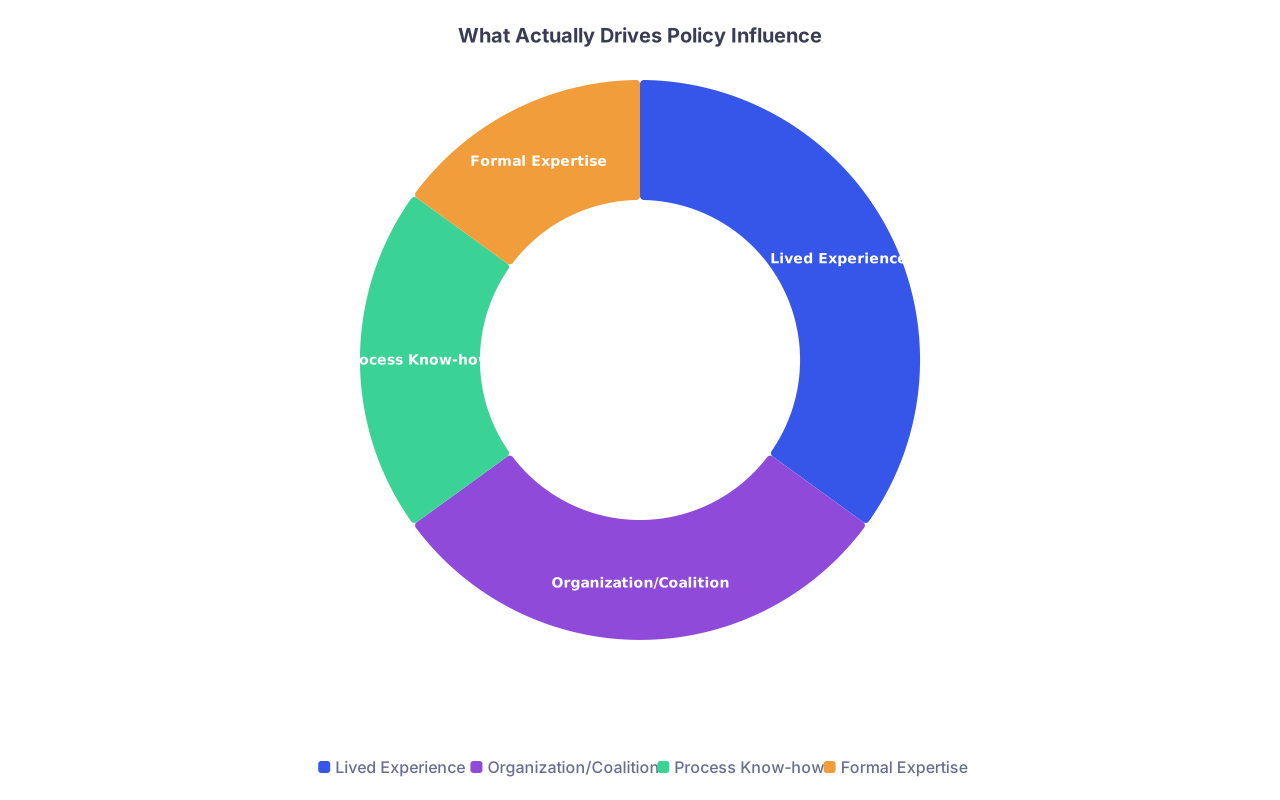
| Category | Value |
|---|---|
| Lived Experience | 35 |
| Organization/Coalition | 30 |
| Process Know-how | 20 |
| Formal Expertise | 15 |
The system currently overvalues the last slice—formal expertise—and undervalues the first three. You can help rebalance that.

If You Remember Nothing Else
Three takeaways:
- Expertise is overrated as a prerequisite and underrated as a support tool. You do not need to be a policy expert to start influencing health reform; you need clear problems, specific asks, and basic process literacy.
- Your proximity to patients and communities is exactly what most policy discussions are missing. That’s not a weakness. It’s your comparative advantage.
- Ethically, staying silent because you “aren’t a policy person” just hands the microphone to people whose main skill is defending the status quo. You can do better than that—and you don’t need another degree to start.