Why Health Policy Is Not Just About Insurance Coverage and Reimbursement
What if I told you that two ZIP codes, five miles apart, can have a 10–20 year difference in life expectancy—and no change in insurance coverage will fix that gap on its own?
People hear “health policy” and immediately think: premiums, copays, Medicare billing rules, RVUs, prior authorizations. The finance layer of medicine. And then they stop thinking.
That’s the first mistake.
Insurance and reimbursement are the exhaust pipe. They’re downstream. The real engine of health policy is much bigger, and frankly, way more uncomfortable to look at.
Let’s dismantle the myth that health policy = “who pays for the MRI.”
Because that myth is not just wrong—it’s dangerous. It keeps clinicians and trainees narrowly focused on fight-the-denial battles while the structural drivers of illness roll on, untouched.
Myth #1: “If Everyone Has Insurance, We’ve Basically Solved Health Policy”
No. Not even close.
Universal coverage matters. It lowers financial barriers, reduces catastrophic medical debt, and improves access to basic services. But look at what happens when we zoom out.
The data that kills the “insurance is everything” story
The classic figure most public health people know: medical care accounts for maybe 10–20% of modifiable health outcomes. The rest? Social determinants, behavior, environment, and structural factors.
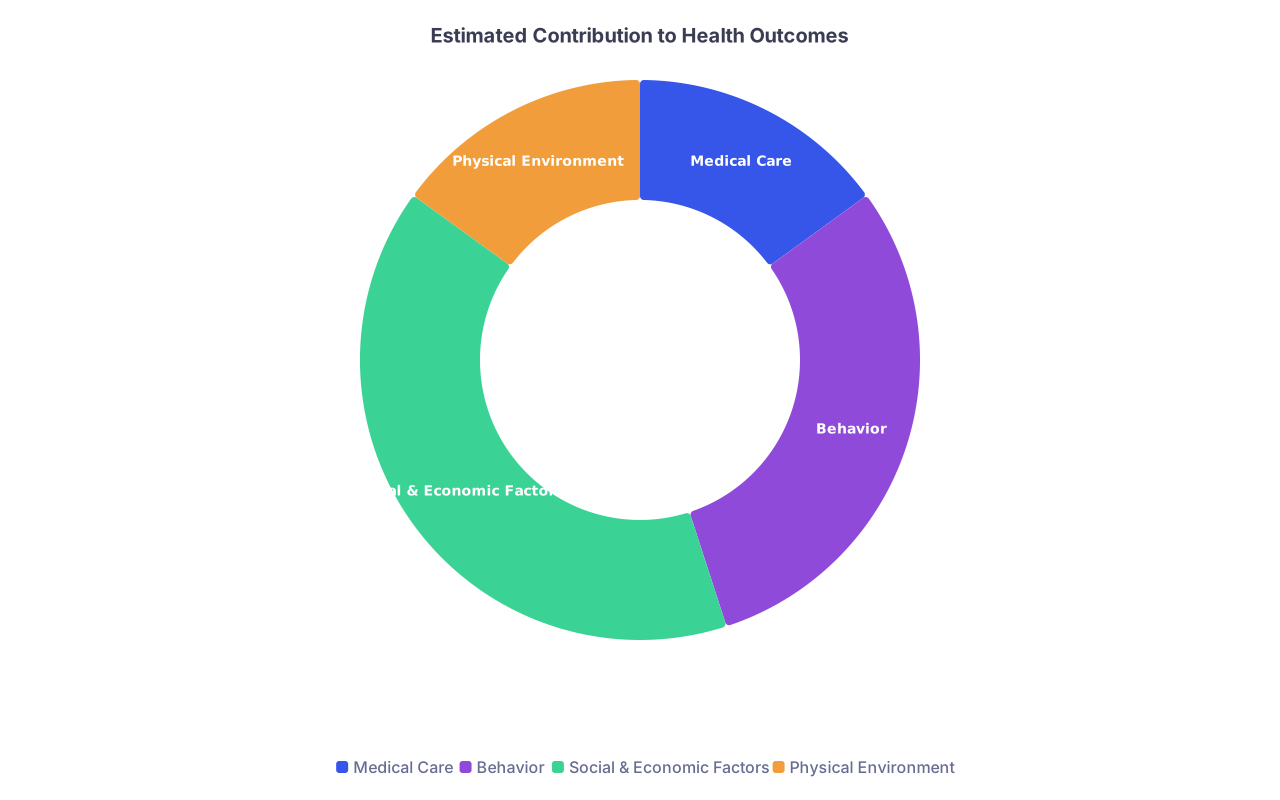
| Category | Value |
|---|---|
| Medical Care | 15 |
| Behavior | 30 |
| Social & Economic Factors | 40 |
| Physical Environment | 15 |
You can quibble with exact percentages, but the direction is rock solid across multiple models: health insurance is necessary, but wildly insufficient.
Examples:
- The U.S. spends more per capita on healthcare than any other high‑income country.
- Yet we have lower life expectancy, higher maternal mortality, and worse chronic disease outcomes than peers like Japan, Germany, or Canada.
Those other countries have different payment systems, yes. But they also have:
- More robust social safety nets
- Stronger labor protections
- Different housing and transportation policies
- Less income inequality
Those are health policies, too. Whether or not the Ministry of Health wrote them.
Medicaid expansion: helpful, but not magic
There’s good evidence that Medicaid expansion under the ACA:
- Reduced uninsurance
- Improved access to primary care
- Lowered some mortality measures
- Reduced medical debt and evictions
Good. But look closer.
States that expanded Medicaid didn’t suddenly erase racial mortality gaps. They didn’t eliminate differences in preterm birth rates by neighborhood. They didn’t fix overdose deaths, which are deeply tied to economic distress, zoning, incarceration policy, and the drug supply.
Insurance expansion gives people a ticket into the clinic.
Health policy, properly defined, includes everything that determines whether the person ever had a fair shot at health before they got sick enough to need the clinic.
Myth #2: “Reimbursement Rules Are the Core of Health Policy”
Reimbursement shapes how clinicians behave. I’m not minimizing that.
You pay more for procedures, you incentivize procedures. You starve mental health and primary care, you get exactly what the U.S. has: overbuilt hospitals and underbuilt prevention.
But if you think “health policy work” means memorizing CMS billing codes and hospital DRG tweaks, you’re playing in the kiddie pool.
Follow the outcomes, not the billing manual
Look at outcomes we claim to care about:
- Life expectancy
- Infant mortality
- Diabetes amputations
- Overdose deaths
- Asthma hospitalizations
- Gun injuries
Now ask: which policies move those numbers most?
It is usually not:
- Raising reimbursement for CPT 99214 by 2%
- Tweaking telehealth coverage rules
- Adding a new prior auth requirement
It is much more often:
- Air quality regulations (asthma, COPD, cardiovascular disease)
- Tobacco taxes and flavor bans (lung disease, cancer, cardiovascular deaths)
- Housing policies (asthma, injury, lead, mental health)
- Food environment rules (diabetes, obesity, cardiovascular disease)
- Workplace safety rules (injuries, occupational exposures)
- Criminal justice and drug policy (overdose, trauma, infectious disease, mental health)
If there’s no CPT code involved, physicians tend to stop calling it “health policy.” That’s a professional blind spot, not a conceptual truth.
What Health Policy Actually Is: The Full Stack
Think of health policy as a stack, like software. Insurance is one layer. Not the OS.
| Layer | Example Policy Area |
|---|---|
| Upstream structure | Housing, labor law, zoning |
| Social environment | Education, criminal justice |
| Physical environment | Pollution, transport, urban design |
| Service delivery | Workforce, clinic design, scope |
| Financing | Insurance, reimbursement, benefits |
Insurance/reimbursement sits at the bottom row. Important, but it mostly decides who pays for the consequences of everything above.
Let’s walk through some of the other layers people conveniently ignore.
Structural Policy: The “Non-Health” Rules That Decide Who Gets Sick
Housing policy as health policy
Redlining maps from the 1930s still predict health outcomes today. That’s not a metaphor; multiple studies have shown:
- Higher rates of asthma
- More gun violence
- Worse birth outcomes
- Higher chronic disease burden
in historically redlined neighborhoods, even after adjusting for some socioeconomic factors.
This didn’t come from an ICD code revision. It came from:
- Mortgage lending rules
- Zoning that concentrated highways and industry in certain neighborhoods
- Disinvestment driven by racist policy
Those are health policies. They just weren’t written by a health department.
Same story with eviction. When states passed stronger eviction moratoria during COVID, excess deaths dropped. You could pretend that’s “housing law,” but functionally it was life‑or‑death health policy.
Labor and income policy
Talk to any night‑shift nurse about what rotating shifts do to blood pressure, sleep, and mood. Now scale that to millions of low‑wage workers with zero schedule control, no paid sick leave, and minimal job security.
Policies about:
- Minimum wage
- Scheduling protections
- Paid sick leave
- Unemployment insurance
- Worker classification (gig vs employee)
all show measurable effects on things like mortality, mental health, and self‑rated health in the literature.
Yet in medical school and residency, that’s all filed under “social stuff we can’t control.” Which is lazy. Doctors have historically had a lot of political and social capital—they just often choose to spend it arguing about RVUs instead of labor protections.
Physical Environment: Your ZIP Code as a Risk Factor
You know what does not care about your insurance plan?
Particulate matter. Lead in water. Traffic speed. Urban heat islands.
Air and water regulation
Regulations from the Clean Air Act have been estimated to prevent hundreds of thousands of premature deaths per year in the U.S. The EPA is arguably one of the most effective “health agencies” on the planet, even though most clinicians barely think about it.
Lead abatement policies correlate with lower crime rates and higher educational attainment years later. Lead screening as a covered benefit is fine; preventing exposure in the first place is where the real power is.
Urban planning and transportation
Look at pediatric pedestrian injury maps in many cities. The hot spots correlate with:
- High‑speed roads cutting through residential areas
- Few crosswalks
- Poor lighting
- Lack of traffic calming
Transportation decisions—bike lanes, bus routes, road design—are health policy. They determine who can safely walk, bike, or access clinics, jobs, and healthy food without a car.
And yet, when city councils debate a new bus rapid transit line, most white‑coat “health advocates” are silent. But they’ll pack a hearing room over a 1% cut in hospital reimbursement.
You see the mismatch.
Service Delivery: How We Organize Care, Not Just How We Bill
Even inside the clinical system, we over‑fixate on payment and under‑focus on structure.
Workforce policy
The number of primary care doctors in rural America is not mainly a reimbursement problem. It’s:
- Training location policy (where residencies are funded)
- Visa and licensing rules for international medical graduates
- Loan repayment program design
- Scope‑of‑practice laws for NPs and PAs
- Maldistribution of GME funds
You can increase reimbursement for a rural clinic all you want. If there’s no one to work there, patients are still out of luck.
Care model design
Policy decisions about:
- Team‑based care
- Community health workers
- Integration of mental health into primary care
- Telehealth scope and interstate licensure
- Data sharing and privacy rules
all shape whether care is accessible, continuous, and culturally competent.
Yes, reimbursement intersects with all of that. But the underlying rules of the game—what’s allowed, what’s mandatory, what’s staffed—are policy choices independent of any single CPT rate.
Personal Development: What This Means for You as a Clinician or Trainee
If you’re in medical school, residency, or practice and you think “health policy” means “maybe I’ll learn some Medicare rules someday,” you’re voluntarily shrinking your influence.
Stop outsourcing “policy” to administrators and lobbyists
You see the consequences at 3 a.m. on call:
- The asthmatic kid from the apartment next to the freeway
- The older adult with CHF who can’t afford air conditioning
- The gunshot wound from a neighborhood redlined 80 years ago
- The unhoused patient with frostbite because shelter policy is a security theater disaster
You’re already doing health policy. You’re just doing it at the end of the chain, one crisis at a time.
If you want to actually change upstream conditions, you need to:
- Learn how zoning, labor, housing, and environmental policy work
- Read bills and regulations with the same attention you give to UpToDate
- Show up in rooms where “health” is not in the meeting title but health is clearly on the line
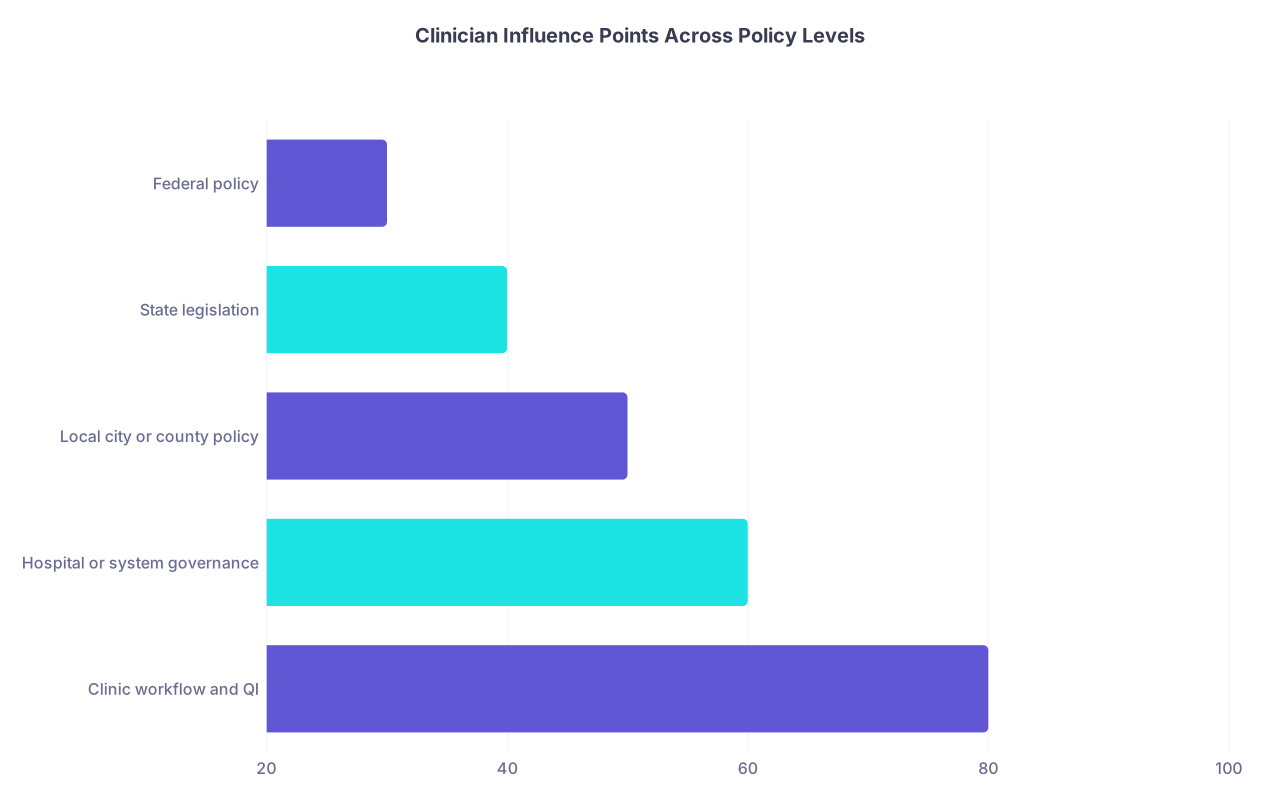
| Category | Value |
|---|---|
| Clinic workflow and QI | 80 |
| Hospital or system governance | 60 |
| Local city or county policy | 50 |
| State legislation | 40 |
| Federal policy | 30 |
This isn’t perfect data, but the pattern is real: clinicians have the most direct influence in the micro‑systems they work in, and less (but still real) leverage as they move outward. Pretending your only job is inside the EMR is a choice, not a law of nature.
Ethics: You cannot be neutral about upstream harm
Medical ethics training loves tidy cases: “Should I withdraw life support?” “How do I manage confidentiality?”
Meanwhile, giant structural decisions are quietly doing violence in bulk:
- Approving a polluting plant near a low‑income neighborhood
- Cutting public transit routes to hospitals
- Criminalizing substance use instead of funding treatment
- Allowing predatory lending and eviction practices
If you call yourself an ethical professional and never engage with those, you’re like a firefighter who only debates hose technique while arsonists rewrite the building code.
Ethics isn’t just bedside. It’s also budget hearings, zoning meetings, and legislative sessions.
How to Actually Think Like a Health Policy Person
Let me make this painfully simple.
When you see a bad health outcome pattern—say, higher amputation rates among Black patients with diabetes—do not stop at:
- “We need better coverage for podiatry and endocrinology.”
Ask, in sequence:
- What upstream social and economic policies are feeding this?
- What environmental or neighborhood features are involved?
- How is our service delivery structure amplifying or mitigating it?
- How do financing and insurance rules nudge behavior on top of that?
Only at step 4 do you get to reimbursement. Not step 1.

| Step | Description |
|---|---|
| Step 1 | Identify health problem |
| Step 2 | Ask about structural causes |
| Step 3 | Examine social and economic policies |
| Step 4 | Analyze environment and neighborhood |
| Step 5 | Assess care delivery structure |
| Step 6 | Review insurance and reimbursement |
| Step 7 | Design multi level policy response |
If your “policy solution” lives only in box F, you’re patching leaks in a collapsing dam.
Three Things to Remember
- Insurance and reimbursement are the billing department of health policy, not the brain. They matter, but they’re not the main driver of population health.
- The biggest health levers live in so‑called “non‑health” policy: housing, labor, environment, transportation, education, and criminal justice. Ignore those, and you’re just re‑arranging deck chairs.
- As a clinician or trainee, you already see the fallout of bad upstream policy. You can either keep mopping the floor—or start walking upstream and turning off the tap.