The idea that you either “do clinical care” or “work on structural determinants of health” is a false choice. A convenient myth. And it quietly lets a lot of clinicians off the hook.
The Fake Either/Or: Clinic vs “The System”
You’ve heard this in some version:
- “I’m a real doctor, I treat patients. I’m not a policy person.”
- “Public health is big-picture; we just do what we can with the person in front of us.”
- Or the reverse: “Clinical care is a distraction from the real work: housing, racism, labor policy.”
All wrong. Or at least dangerously incomplete.
If you actually look at the data, the split between “clinical” and “structural” work is mostly administrative fiction, not reality. Health outcomes don’t respect your job description.
Here’s the usual talking point: “Medical care only counts for 10–20% of health outcomes; the rest is social and structural determinants.” You’ve seen some version of this pie chart in a lecture.
The nuance most people skip: that 10–20% is not evenly distributed. For people who are already structurally disadvantaged, clinical care is often the only reliably accessible intervention they’ll see this year. Your “tiny slice” of the pie may be their only slice at all.
And on the other side: structural interventions already operate through clinical systems all the time—disability determinations, prescribing housing vouchers, linking patients to food benefits, writing work notes that determine someone’s income stability. If you think you’re “just doing clinical care,” you’re probably doing policy by proxy. You’re just not calling it that.
What The Evidence Actually Shows About Structure vs Care
Let’s pull this out of ideology and into numbers.
1. The “social determinants” vs “health care” pie is oversimplified
Those famous pie charts (McGinnis, Schroeder, etc.) separating “behavior,” “social circumstances,” “genetics,” “health care” have been used to scold clinicians for focusing on the wrong things. The problem is they’re built on very rough causal attribution exercises, not clean randomized data.
They also ignore interaction effects. Hypertension treatment works very differently in a stable, insured patient with a car and a quiet home versus someone working night shifts, living in a shelter, and drinking to cope with trauma. Same pill. Completely different real-world effect.
Clinical care and structural context multiply each other. If either one is zero, your outcome approaches zero.
2. Structural interventions are powerful—but often delivered through clinics
Take a few classic examples:
- Housing First for chronically homeless individuals with mental illness and substance use disorders.
- SNAP and WIC in the U.S. for food insecurity and child nutrition.
- Conditional cash transfers (e.g., Mexico’s Prospera) linked to health visits.
- Lead abatement, smoking bans, air pollution regulation.
Many of the highest impact interventions use clinical systems as the front door. Primary care clinics doing housing referrals. Pediatric clinics screening for food insecurity. OB clinics connecting patients to paid leave.
You cannot operationalize these programs at scale without clinicians, charts, ICD codes, and appointment schedules. The “structural” solution often runs through the “clinical” pipe.
3. Even pure clinical interventions can be structurally meaningful
Look at what actually reduces disparities when applied aggressively:
- Tight control of hypertension and diabetes in safety-net systems.
- High-quality prenatal care for low-income and marginalized groups.
- Harm reduction–oriented addiction treatment (buprenorphine, methadone, naloxone access).
- Effective HIV treatment plus prevention (U=U, PrEP).
When these are targeted to those structurally disadvantaged, they become structural interventions in practice—because they counteract the distribution of risk created by housing, racism, education, and labor policy.
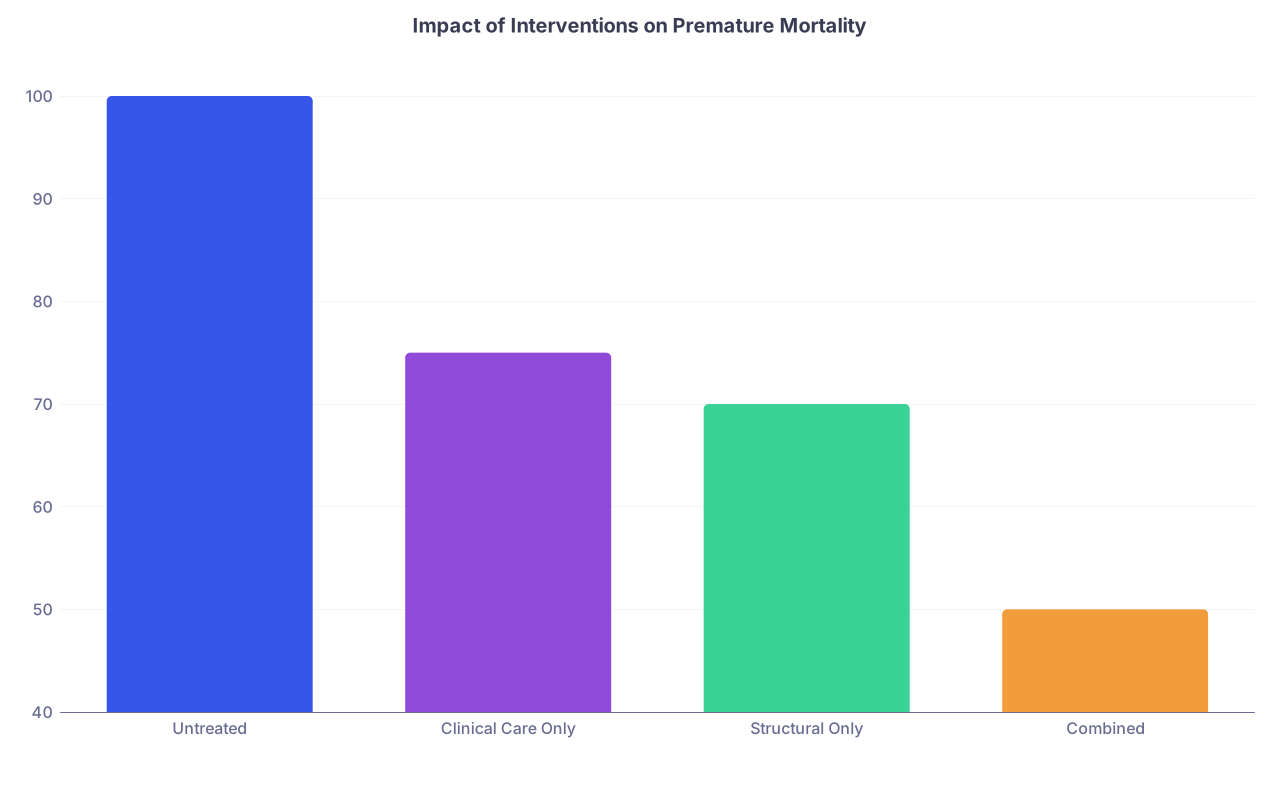
| Category | Value |
|---|---|
| Untreated | 100 |
| Clinical Care Only | 75 |
| Structural Only | 70 |
| Combined | 50 |
Is that chart simplified? Of course. But the pattern repeats in the literature: combined structural plus clinical interventions outperform either alone, both in average outcomes and in equity.
The Moral Cop-out Hidden in the Divide
There’s an ethical problem here too. The split between “clinical” and “structural” work is often an excuse—on both sides.
Clinicians say: “I don’t do politics; I just treat whoever comes through the door.”
Policy folks say: “I don’t want to get bogged down in face-to-face care; my work is upstream.”
Meanwhile, the patient with uncontrolled asthma is sleeping in moldy public housing, working two jobs, and seeing you in the ED every month for nebulizers and steroids. If you walk in thinking, “My role is the inhaler; housing is someone else’s turf,” you’ve already accepted a morally lazy division.
I’ve watched residents proudly crush guideline-based management, then document “noncompliance” when the patient doesn’t pick up meds because their phone was shut off and the pharmacy text never came through. That “noncompliance” label? It follows the patient for years. That’s a structural intervention, whether you like it or not. A negative one.
How the Divide Is Constructed (Not Discovered)
The split is baked into how we train and pay people, not how disease actually behaves.
- Medical school and residency: teach pathophysiology and pharmacology in isolated compartments; social context gets one “health disparities” lecture at the end of a block.
- Reimbursement: CPT and RVUs reward procedures and face-to-face visits, not calls with landlords or letters to employers.
- Research silos: clinical trials rarely measure outcomes like eviction, incarceration, or food insecurity; policy research rarely measures blood pressure control or A1c.
So you end up with:
- Clinicians who feel incompetent or powerless to address anything beyond the prescription pad.
- Public health folks who think the clinic is just a leaky bucket to work around, not a lever to pull.
None of this maps onto reality. It maps onto organizational charts.

| Step | Description |
|---|---|
| Step 1 | Patient Life Context |
| Step 2 | Structural Exposures |
| Step 3 | Symptoms |
| Step 4 | Clinical Encounter |
| Step 5 | Clinical Decisions |
| Step 6 | Health Outcomes |
| Step 7 | Documented Labels |
| Step 8 | Access to Resources |
The key node that people pretend is isolated? “Clinical Encounter.” It’s not. It both reflects structure and feeds back into it.
What A Clinician Actually Controls (More Than You Think, Less Than You Pretend)
Let’s be precise. No, a physician cannot single-handedly fix redlining or redesign Medicaid. But look at the levers clinicians do control on a daily basis:
- Diagnoses you choose (and which ones you leave off).
- Words in your notes (“noncompliant” vs “barriers to adherence due to unstable housing and work schedule”).
- Who you refer to, and how hard you push.
- Which form you fill out—disability certification, FMLA, work restrictions, letters for housing accommodations.
- How you design your panel management: who gets outreach, who gets same-day slots, who gets telehealth.
These might sound small. They aren’t. They determine whether your patient keeps their job, avoids eviction, qualifies for benefits, or can take time off to attend dialysis without being fired.
| Clinical Action | Structural Effect |
|---|---|
| Disability form wording | Income stability, housing |
| Diagnosis coding choice | Insurance coverage, resources |
| Visit scheduling pattern | Ability to keep employment |
| Language in chart notes | Bias in future care, policing |
| Referral persistence | Access to housing/food/legal aid |
I’ve seen a single well-worded letter from a primary care doc stop an eviction. I’ve seen a vague, rushed disability form denied, pushing someone back into unsafe work and re-injury. That’s structural health intervention, delivered in 15 minutes of “clinical care.”
Structural Competency Isn’t an Add-On; It’s Just Competency
There’s this fashionable term, “structural competency,” that makes people think it’s a specialty niche like interventional cardiology. It should have been named something else. Because what it’s describing is… basic competence for any clinician who wants to claim they practice ethical medicine in the real world.
Structural competency in practice isn’t about giving stirring lectures on capitalism. It’s about:
- Recognizing when the “problem” is context, not character. (The person with diabetes who “fails lifestyle changes” while working nights and living in a food desert.)
- Knowing the actual resource map where you work: housing navigators, legal aid, medical-legal partnerships, food pharmacies, transportation vouchers.
- Writing documentation that aligns with how agencies and insurers make decisions, not just how you were taught to phrase things on rounds.
- Understanding that racism, gender discrimination, immigration status, and carceral involvement are not abstract “risk factors” but active processes that your clinical decisions can reinforce or disrupt.
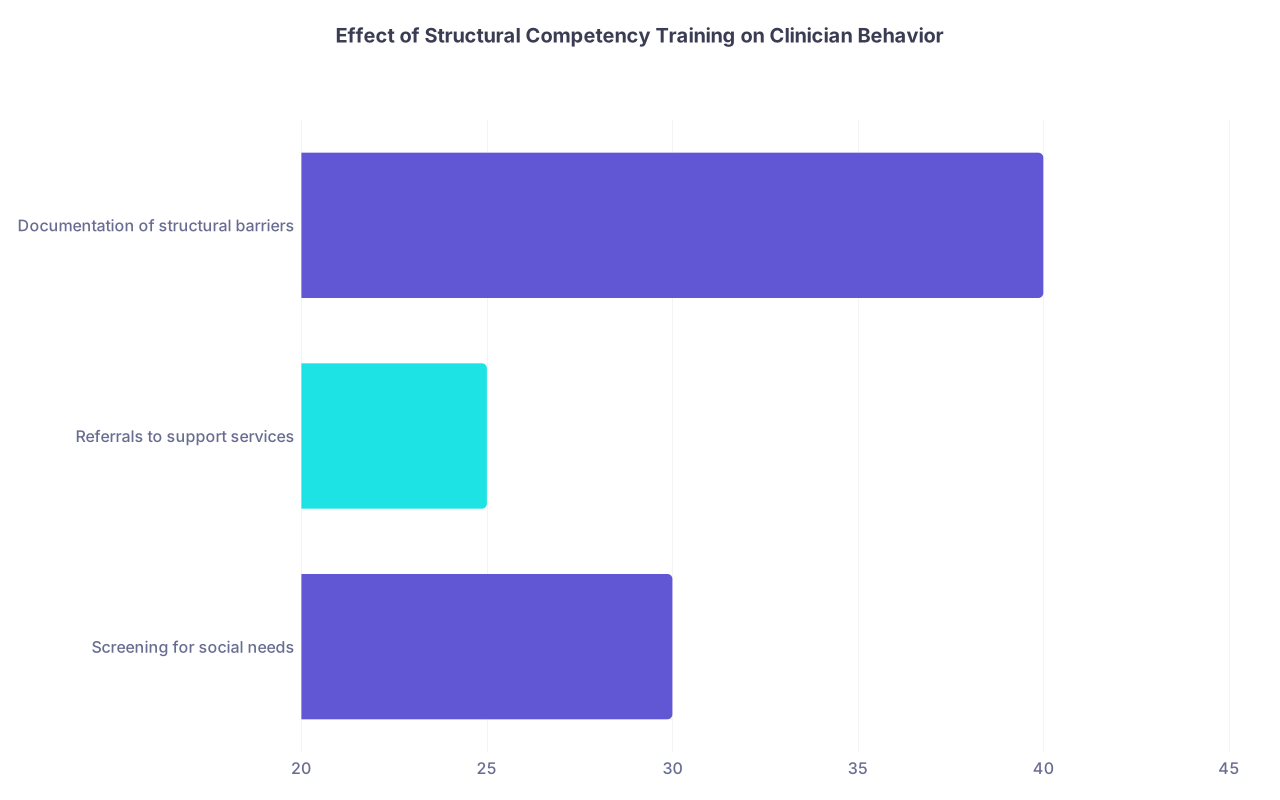
| Category | Value |
|---|---|
| Screening for social needs | 30 |
| Referrals to support services | 25 |
| Documentation of structural barriers | 40 |
Numbers like these are typical: training and system prompts lead to big jumps in structural actions. Translation: this isn’t fixed; it’s trainable.
The Trap of the “Upstream Only” Purist
On the other side, there’s a growing chorus that says: if you aren’t changing zoning laws or federal tax policy, you’re just rearranging deck chairs. This is the performative “upstream or bust” stance.
Here’s the uncomfortable truth: patients are drowning right now. Telling a patient in sickle cell crisis that you’re mainly focused on “changing systems” is ethically absurd.
You need both:
- High-quality, humane, and context-aware care for the person in front of you today.
- Relentless pressure on the policies and structures that keep that person coming back sicker than they should be.
One does not excuse skipping the other.

You don’t need to be a full-time policy analyst. But if you never show up to the hospital committee deciding on charity care rules or never sign your name to a letter about Medicaid access in your state, then yes, you are opting out of structural work you’re uniquely qualified to influence.
Practical Integration: What This Looks Like When Done Right
Let’s bring this down from theory.
Example 1: Uncontrolled asthma
Old script: prescribe an inhaled steroid, give “trigger avoidance” handout, blame patient when they come back.
Integrated script:
- Ask three specific questions: housing quality (mold, pests), smoking in home, cost of meds.
- Document: “Asthma exacerbations likely related to substandard housing with visible mold; patient has limited control over environment.”
- Refer to: medical-legal partnership or housing navigator; provide letter supporting reasonable accommodation or re-housing.
- Adjust medications to what’s on their insurance formulary and available as 90-day refills.
- When you see three similar cases from the same complex? Raise hell with local housing authority, your institution’s community benefit office, or local media.
Same patient, same clinic. Completely different level of structural engagement.
Example 2: Chronic back pain and work
Old script: NSAIDs, maybe PT, off-work note for a week, then frustration when they “keep coming back.”
Integrated script:
- Understand job demands concretely: lifting, standing, schedule, employer flexibility.
- Use diagnosis and documentation to support modified duty or partial disability if warranted.
- Connect to worker’s comp or legal support if employer is retaliating.
- Document explicitly that “returning to unrestricted heavy lifting likely to worsen condition” instead of vague language that insurers love to twist.
- At a higher level, your clinic tracks which employers show up repeatedly as sources of injuries and advocates for inspections or policy scrutiny.
Again: this is structural work. Done through clinical actions.
What This Means For Your Own Development And Ethics
If you’re early in training or practice, you’re probably getting hit with two contradictory messages:
- “Stick to medicine; don’t be political.”
- “Health is political; you must address structural determinants.”
You can ignore the rhetoric and focus on a simpler ethical question:
Does how you practice change your patients’ exposure to harmful structures, even a little?
If the answer is yes—and it is—then pretending that “structural stuff” is someone else’s domain is an abdication, not neutrality.
Concrete ways to build this into your own development:
- In every rotation, identify: What are the top two structural barriers your patients face here? Transportation, housing, paperwork, immigration, language? Then ask: Where in this clinic/hospital do those get addressed, if anywhere?
- Learn the forms. FMLA, disability, housing letters, school accommodation. Boring? Yes. High leverage? Absolutely.
- Police your own documentation language. Ban “noncompliant” from your notes unless followed by “…due to [specific structural barrier].”
- Show up at one institutional committee that decides something about access: scheduling, charity care, telehealth, financial assistance. You’ll see how “neutral” policies quietly reproduce inequity.
- Partner with public health colleagues instead of treating them like a different species. Co-design quality improvement projects that include structural outcomes (evictions prevented, work days saved) alongside blood pressures and A1cs.

Stop Pretending The Line Is Real
The supposed divide between clinical care and structural health interventions is mostly an artifact of billing codes, training silos, and people’s desire to avoid feeling responsible for things they cannot fully control.
Here’s the reality, stripped down:
- Clinical encounters are structural events. Every note, code, form, and phrase you use can either buffer or amplify the effects of housing, labor, and legal systems on your patient.
- Structural interventions depend heavily on clinical systems to reach people. If clinicians opt out, the “upstream” work never reaches the ground.
- Ethically serious practice in 2026 requires owning both sides: doing excellent, evidence-based clinical care while deliberately using your role to blunt harmful structures when you can.
You’re not “just a clinician” or “just a policy person.” If you’re in health care at all, you’re already both.
The only real question is whether you’re doing it on purpose.