
Why do thousands of physicians keep signing open letters on gun violence, abortion, climate change, and pandemics… when most of them suspect the letter will vanish into the void?
Let’s stop pretending this is a mystery. We actually have data on whether petitions and open letters work in public health and medical policy. It’s just uncomfortable, because it exposes a lot of performative nonsense on both sides: from idealistic med students collecting signatures like Pokémon, and from jaded attendings who sneer “nothing ever changes” while doing exactly zero.
So let’s dismantle the myths.
Myth #1: “Petitions are useless virtue signaling”
This is the default cynic line. You’ve heard it in call rooms: “Another open letter? Great, that’ll fix structural racism.” Delivered with a smirk.
The reality is more nuanced. Most petitions and open letters are functionally useless. Some are not. The difference is not the number of signatures. It’s the context, the target, and the strategy around them.
Start with what’s actually been studied.
Political science and social movement research (think Klandermans, Tarrow, Meyer, etc.) has looked at petitions for decades. The finding, boiled down:
- Petitions alone rarely cause major policy change.
- Petitions sometimes influence agenda-setting (what gets discussed, what becomes “on the table”).
- Petitions are much more effective when tied to other pressure: media, lobbying, legal threats, electoral pressure, or institutional leverage (e.g., hospital staff threatening non-cooperation).
Now plug in physicians.
Doctors aren’t just “random citizens.” They’re perceived as technically competent, relatively trustworthy, and socially prestigious. For health policy–related questions, that matters. Survey data across the US, UK, and EU repeatedly shows that physicians rank near the top in public trust—far above politicians, journalists, or corporate leaders.
So when physicians sign an open letter on a health issue, they don’t just add numbers. They add epistemic weight. Evidence credibility. “These people know what an ICU looks like.”
But. And it’s a big but.
That weight only matters when:
- The letter is visible (media amplification, social media traction, or institutional circulation), and
- There’s a concrete decision point: a pending regulation, a board vote, a funding decision, a court brief, a corporate policy.
No decision point, no leverage. You’re just yelling into the void with nice stationary.
Myth #2: “Numbers are everything — get as many signatures as possible”
This one’s especially popular among students and residents organizing for the first time. The thought process: “If we hit 10,000 signatures, they’ll have to listen.”
Data from petition platforms (e.g., Change.org internal analyses, plus academic work on online mobilization) shows something else: after a modest threshold, who signs matters more than how many sign.
In physician advocacy, that’s even more true.
Ask yourself: which of these is more likely to move a hospital board, a university, or a legislator?
- 12,000 signatures from a mix of trainees, random clinicians, some retirees, no clear institutional roles
- 120 signatures that include: the chair of medicine, heads of ICU, chief of surgery, nursing leadership, and two former state health commissioners
In real life, I’ve watched a “small” letter from department heads kill a proposed cost-cutting policy that would have slashed nurse staffing. I’ve also seen a “massive” petition from hundreds of housestaff about call room conditions get politely ignored, then buried.
Why? Power and risk.
Leaders respond when signatories:
- Control key services (your ICU director is not easily replaced).
- Can create operational pain (e.g., united anesthesiology group objecting to unsafe OR policies).
- Have reputations that matter to external stakeholders (national society presidents, respected researchers, prominent local figures).
That doesn’t mean you ignore broad participation. Broad signatures help with media framing: “Over 3,000 physicians sign…” plays well to the public. But if your strategy is media pressure, say so. Don’t pretend raw volume compels internal decision-makers.
If you’re serious, you need both: credible power signatories for insiders, plus numbers for optics.
Myth #3: “At least it raises awareness”
This is the comfort blanket phrase for ineffective action.
“Raising awareness” can be real, but it’s also how people justify busywork. The question is always: awareness among whom, leading to what change?
We actually have data on awareness campaigns in public health—smoking, HIV, safe driving, vaccines. The ones that work pair messaging with a specific behavioral target, structural change, or policy.
Open letters from physicians can raise awareness in three useful directions:
- Among journalists – giving them an expert-backed angle and quotable lines.
- Among other physicians – shifting what’s considered mainstream vs fringe within the profession.
- Among policymakers – providing cover: “The medical community supports this.”
But that only happens if:
- The letter is timed to a news hook or policy moment.
- It says something concrete and specific, not “we condemn bad things and support good things.”
- Someone is actively feeding it to the press, not just posting a PDF on an obscure website.
Otherwise, “raising awareness” means “we emailed this to ourselves.”
To put it bluntly: an unread Google Doc signed by 800 doctors is not awareness. It’s therapy.
What the successful cases actually look like
Let’s walk through patterns where physician petitions and open letters did contribute to real outcomes. Not as sole causes—policy doesn’t work like that—but as meaningful levers in a larger system.
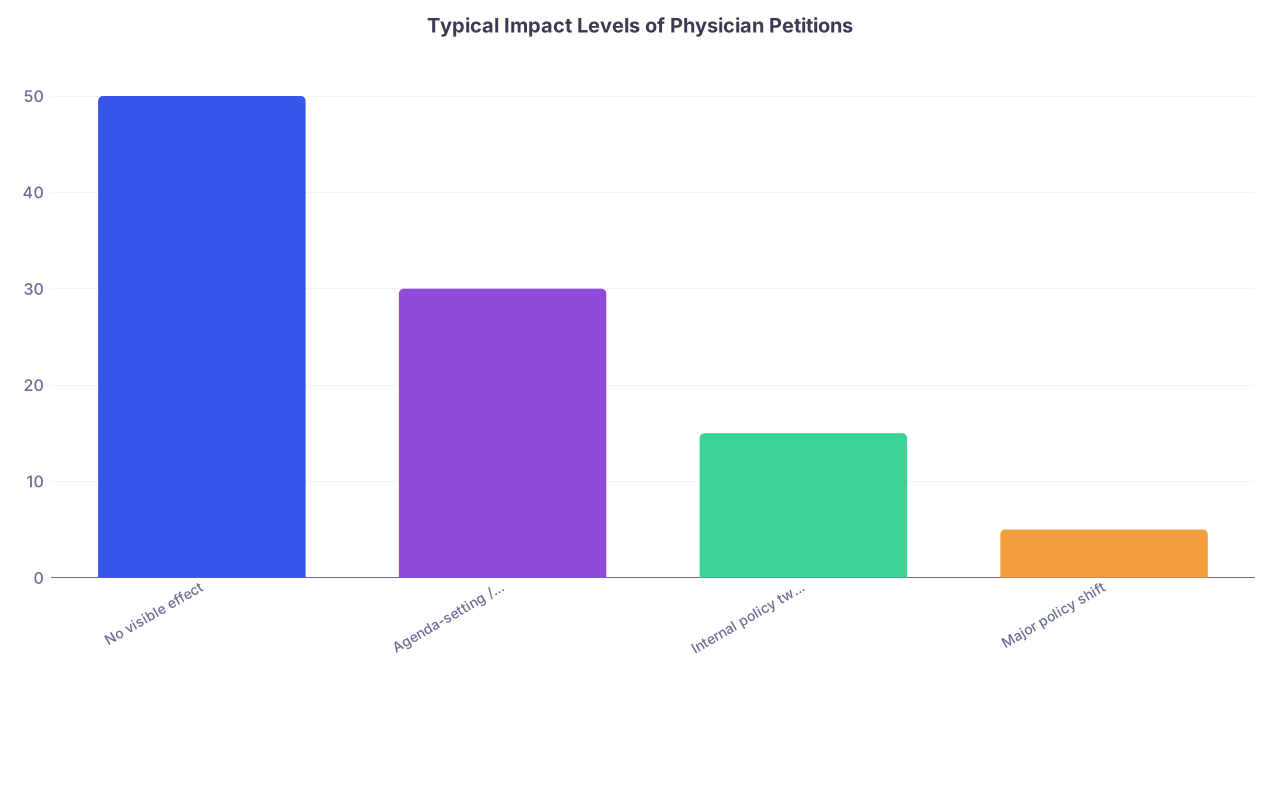
| Category | Value |
|---|---|
| No visible effect | 50 |
| Agenda-setting / media | 30 |
| Internal policy tweaks | 15 |
| Major policy shift | 5 |
Those numbers are illustrative, but they match the qualitative pattern: most do little; a minority move the needle a bit; a smaller minority drive real change.
Common features of the ones that matter:
1. They’re tied to a clear decision point
Examples you’ve probably seen versions of:
- A state health department drafting COVID triage guidelines receives a coordinated letter from critical care leaders across the state, outlining specific criteria and legal/ethical risks. The draft gets revised.
- A hospital board considering closing an OB unit in a rural area gets a letter from local physicians, backed with outcome data and transfer risks, and a credible threat of bad press. The closure is delayed or modified.
- A medical school planning to keep a known harasser in a leadership role receives an open letter, signed by faculty and trainees, circulated to donors and alumni. Suddenly, the “indispensable” leader becomes dispensable.
These work not because signatures are magical, but because decision-makers are already balancing trade-offs. The letter shifts the perceived risk calculus—legal, reputational, ethical, operational.
2. The letter is paired with other pressure
Successful campaigns rarely stop at “send and hope.”
You see combinations like:
- Coordinated op-eds in local or national outlets by signatories.
- Media briefings: “Physicians call on X to do Y.”
- Parallel engagement: private meetings with policymakers plus a public letter as the visible tip of the iceberg.
- Backing by professional societies or unions, who can mobilize members and lobbyists.
Petitions and letters are cheap. That’s their strength and their weakness. Cheap signals are easy to ignore unless you stack them with more expensive ones: time, relationships, professional reputations, legal action.
3. The demands are specific, measurable, and feasible
Vague: “We call for an end to systemic racism in health care.”
Concrete: “We demand the hospital publicly release equity metrics by department within 12 months, commit to a transparent pay equity review, and cease cooperation with local law enforcement in non-mandatory disclosure situations.”
Guess which one can be negotiated, tracked, and verified.
Policymakers and administrators are used to vague moral language. They can absorb it without changing anything. But specific asks force a yes/no/modify decision.
I’ve watched administrators try to dodge with “we share your values” until someone points to the bullet list in the letter and says, “Which of these will you commit to, and by when?” That’s when the room gets quiet.
Myth #4: “If it doesn’t directly change law, it failed”
This is the perfectionist trap, usually weaponized later as an excuse for inaction.
Policy is rarely linear. Open letters and petitions often matter indirectly by:
- Shaping who gets invited to the table (signatory lists double as rosters of invested experts).
- Moving the Overton window inside the profession: what’s now “basic duty” vs “radical activism.”
- Giving cover to more radical or targeted actions (strikes, lawsuits, whistleblowing) by establishing broad professional concern.
A classic example: physician advocacy around smoking didn’t “end smoking” with a single letter. It created decades of professional consensus that eventually justified taxes, ad bans, smoke-free laws, and litigation. Each statement, resolution, or petition helped make it professionally embarrassing to be the doctor defending tobacco.
Same pattern with gun violence as a public health issue. Early statements were dismissed; repeated, coordinated messaging from major medical societies shifted the baseline. We are not fully where we need to be, but the rhetorical terrain is different now.
If your expectation is, “We’ll sign this letter and Congress will immediately fix it,” yes, you will be disappointed. That’s not how complex systems move.
So when should you sign or organize one?
Let’s stop pretending every letter is sacred. Some are strategically worthless or even counterproductive. Others are exactly the right tool.
Here’s a contrarian but practical way to think about it: treat your signature like a finite resource. You’re lending your professional credibility to whatever you sign. Act accordingly.
Ask four questions before you attach your name:
Is there a clear target and decision point?
Not “dear society,” but “to the state health commissioner about regulation X,” or “to the hospital board before vote Y.”Is there a real strategy beyond this letter?
Are people coordinating media, meetings, follow-up? Or is this where they plan to stop and declare moral victory?Does this use physicians’ unique credibility?
Would this letter be equally persuasive if signed by 500 “concerned citizens”? If yes, maybe your MD isn’t the leverage here.Are the asks specific, and are you prepared to do something if they’re ignored?
If you sign and nothing happens, what then? Another letter? Or escalation—whistleblowing, public testimony, boycotts, or internal pressure?
If you can’t answer those with something better than “well, at least it shows we care,” you’re in feel-good territory. That might be fine. Just do not confuse it with strategy.
The ethical side: is it performative or professional duty?
Public health ethics does not require you to become a full-time activist. But it does impose some responsibilities when you know harm is occurring and you have expertise that could prevent it.
There’s a spectrum:
- At one end: total disengagement. “I just see my patients; politics isn’t my lane.”
- In the middle: targeted, evidence-based advocacy on issues directly tied to your expertise and your patients’ welfare.
- At the far end: constant public pronouncements on every social issue, with weak data and inflated moral claims.
The middle is where I’d argue physicians have an ethical duty to operate. And petitions/open letters are one of many tools there.
They become ethically dubious when:
- They’re sloppy with evidence but heavy on slogans.
- They claim unanimous “medical consensus” where none exists.
- They’re used to suppress debate rather than inform it (“no real doctor disagrees”).
- Organizers know they’re not tied to any realistic path to change, but still sell them as “this will make a difference” to well-meaning trainees who don’t know better.
I’ve heard attendings tell residents, “Sign this, it will force the administration’s hand.” They knew it wouldn’t. That’s not ethics. That’s manipulation.
Be honest with yourself and others about what a given letter can and cannot do.
How to make your effort actually matter
If you’re going to invest time in organizing or supporting a petition or open letter, at least play the game like you’re trying to win.
Two concrete recommendations:
| Feature | Weak Letter | Strong Letter |
|---|---|---|
| Target | Vague public | Specific person/board |
| Timing | Random | Aligned to decision |
| Ask | Moral stance | Concrete actions |
| Signers | Random crowd | Key power holders + breadth |
| Follow-up | None | Planned meetings/media |
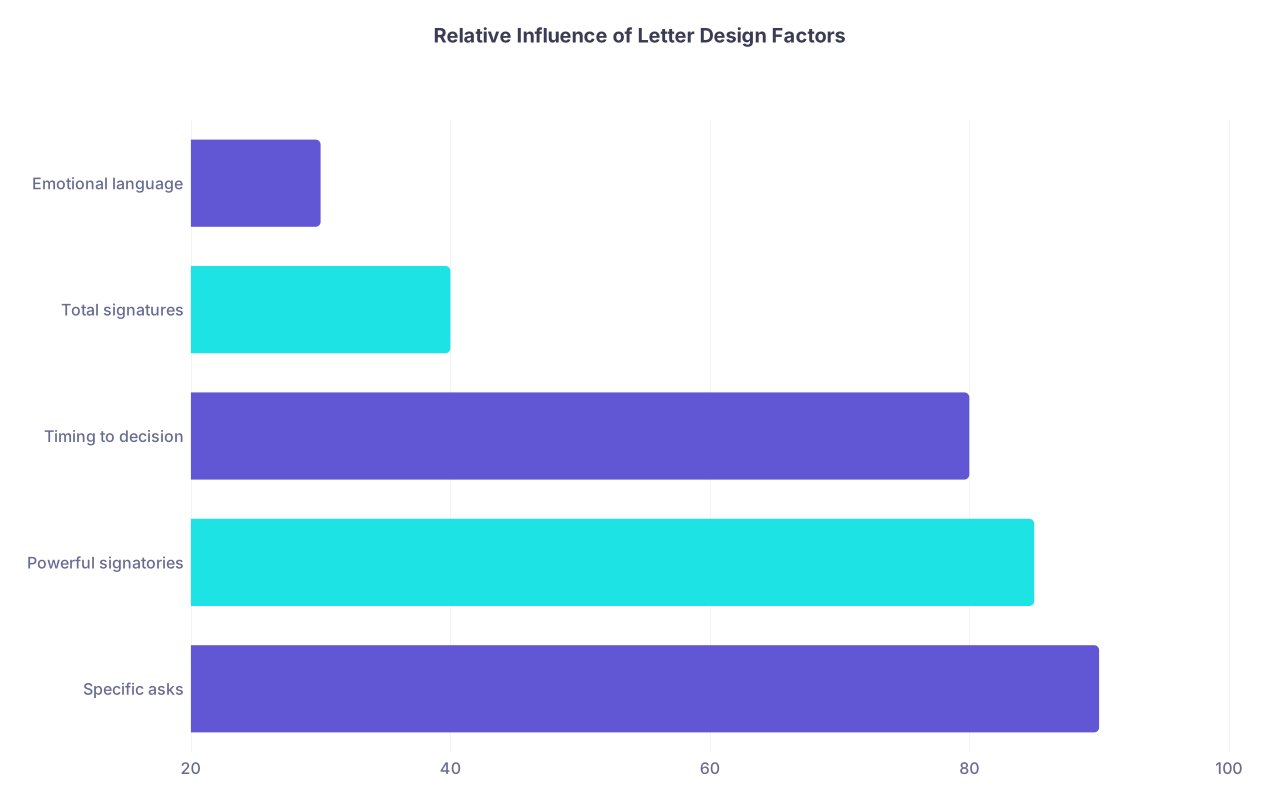
| Category | Value |
|---|---|
| Specific asks | 90 |
| Powerful signatories | 85 |
| Timing to decision | 80 |
| Total signatures | 40 |
| Emotional language | 30 |
Those are qualitative scores, but the ranking aligns with how administrators and policymakers actually respond.
Notice what’s at the bottom: total signatures and emotional language. Those are the things people over-focus on. Because they’re easy to generate.
Spend your energy on the hard, high-yield pieces: building a coalition of credible signers, getting the timing right, drafting precise asks, and lining up your next moves if the letter is ignored.
Bottom line: do physician petitions and open letters ever work?
Yes—but not the way most people imagine.
They rarely function as magic wands that rewrite laws overnight. They’re more like pressure valves and signal flares. Sometimes they relieve anxiety without changing anything. Sometimes they signal seriousness and help trigger real shifts.
If you remember nothing else, keep these three points:
- Petitions and open letters from physicians are weak tools alone, but can be powerful when timed to real decisions, backed by credible signers, and integrated into broader strategy.
- Signature count is overrated; specific, measurable demands and power signatories are underrated.
- Ethically, your responsibility is not to sign everything, but to engage thoughtfully where your expertise and voice can meaningfully reduce harm—without pretending that symbolic acts are sufficient.