
42% of graduating U.S. medical students report participating in health policy, social justice, or advocacy work—yet many still hide it on their residency applications.
They are not imagining that fear. I have literally heard program directors say in meetings: “Is this applicant going to be around to do the scut, or are they going to be at protests every weekend?” The concern exists. But the leap from “some people worry about this” to “advocacy kills your chances” is where the myth starts.
Let’s pull this apart with data instead of paranoia.
What Programs Actually Screen For (Hint: It’s Not “No Opinions Allowed”)
The National Resident Matching Program (NRMP) surveys program directors regularly about what matters. If you’ve never read those PDFs, you’re making decisions in the dark.
Across specialties, the top factors are boringly consistent:
- USMLE/COMLEX scores (or Pass with some context now that Step 1 is pass/fail)
- Grades in required clerkships
- Letters of recommendation
- MSPE/Dean’s letter
- “Perceived commitment to specialty” and professionalism
Advocacy, “activism,” or anything like it does not appear as a negative factor in those reports. Not once.
It shows up indirectly as:
- “Leadership qualities”
- “Humanistic qualities”
- “Volunteer/extracurricular involvement”
- “Commitment to underserved populations”
Those categories are often rated as moderately to very important.
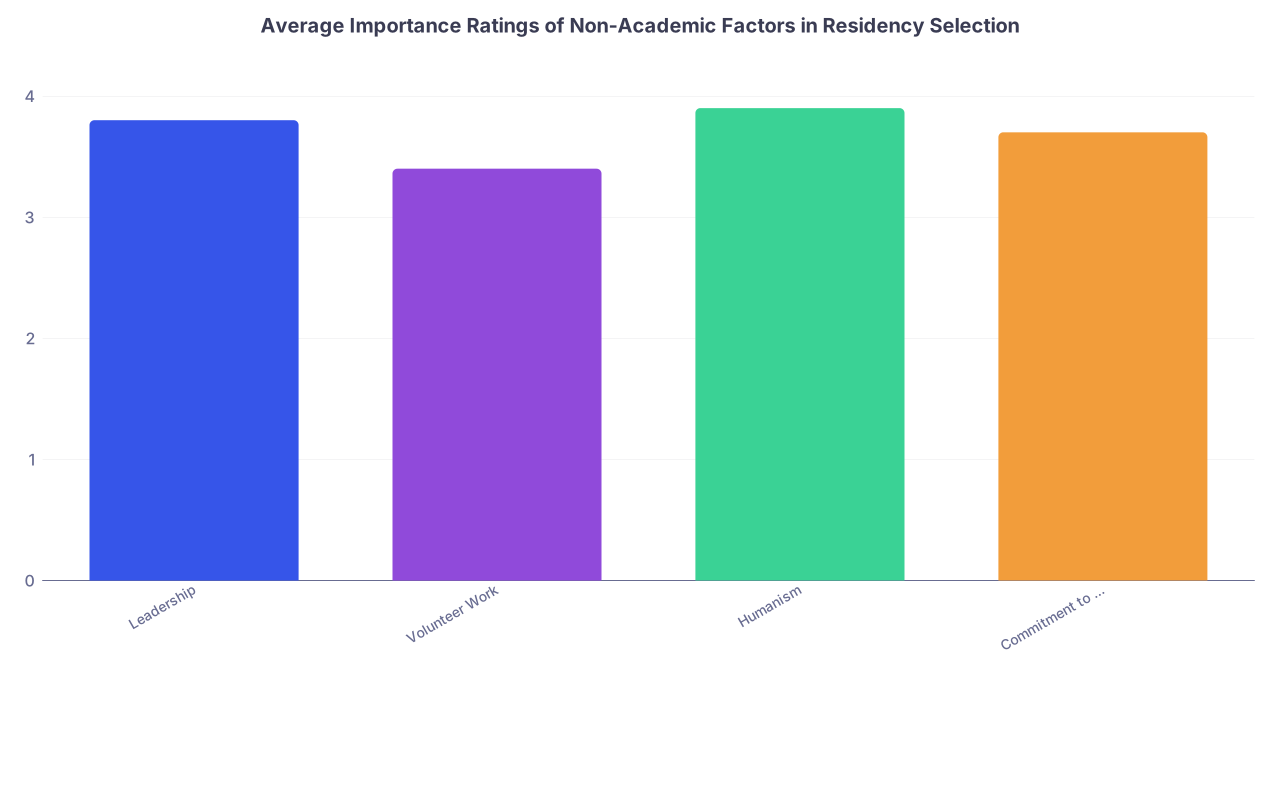
| Category | Value |
|---|---|
| Leadership | 3.8 |
| Volunteer Work | 3.4 |
| Humanism | 3.9 |
| Commitment to Underserved | 3.7 |
(Scale 1–5, rough composite based on NRMP Program Director Survey patterns.)
So the claim “programs hate advocacy” does not match how they report their own priorities.
What programs do hate:
- Unreliable people
- Residents who bring drama into the hospital
- Colleagues who see clinical work as secondary to their “brand”
If your advocacy signals any of those three, then yes, you will get hurt. But that’s about professionalism and priorities, not about advocacy per se.
The Myth: “Advocacy = Red Flag”
Let me be blunt: the blanket advice “don’t mention advocacy; programs will think you’re a troublemaker” is lazy.
It comes from three places:
Old-school attendings who trained before Twitter and assume any public stance = politics = headache.
These are the people who also told you Step 1 was the only thing that mattered. How’s that working out in 2026?A few high-profile disasters.
Residents disciplined for extreme social media posts. People doxxing institutions. One loud scandal gets generalized to “never say anything anywhere about anything.”Applicants misusing advocacy as a personality substitute.
I’ve seen personal statements that are basically: “I marched, I protested, I wrote op-eds; therefore I care about patients.” Meanwhile, their clinical narrative is tissue-thin. That doesn’t read as passion. It reads as deflection.
The reality is narrower and more uncomfortable:
Programs do not fear “students who care about policy.”
They fear “residents who will prioritize their ideology over patient care, schedule, and team.”
Bad advocacy framing on your application suggests exactly that.
What the Data (and Match Outcomes) Actually Suggest
Nobody runs RCTs on “advocacy” vs “no advocacy” in residency selection. But we have several data points and patterns.
1. Advocacy-heavy schools still match just fine
Look at match lists from:
- UCSF
- Harvard
- University of Washington
- Mount Sinai (which literally has the Department of Medical Education Leadership & Advocacy)
These places produce students who do gun violence research, reproductive justice work, climate and health advocacy, immigration health policy. Those students are not unemployable. They are matching into derm, ortho, IR, you name it.
If “advocacy kills your chances,” these institutions would have a problem. They do not.
2. Some specialties explicitly like policy engagement
Family medicine, pediatrics, psychiatry, EM, and increasingly internal medicine and OB/GYN programs emphasize:
- Community engagement
- Health equity
- Systems-level thinking
Read their website blurbs honestly. Half of them brag about “training physician-leaders and advocates for underserved communities.” That line did not write itself.
They are not hunting for the “quietest, most apolitical cog.” They are hunting for people who can deal with social determinants of health and policy constraints without collapsing.

3. Programs select for fit and risk management, not ideological purity
Residency selection is risk-averse. Directors are trying to answer:
- Will this person show up and do the work?
- Will they get along with my faculty and residents?
- Will they embarrass us publicly?
- Will they stay in the program?
Your advocacy is evaluated through that lens. Not “Do I agree with this person?” but “Is this going to end up in my office at 11 p.m. on a Friday with HR on the phone?”
If your entire public footprint is antagonistic, absolutist, or chronically inflammatory, programs reasonably worry. That’s not a bias against advocacy. That’s a bias against chaos.
Where Advocacy Backfires: The Actual Red Flags
Let me separate three situations: justified concern, genuine red flag, and pure paranoia.
1. Justified concern: unprofessional public behavior
If your advocacy includes:
- Posting identifiable patient info (even de-identified but obviously traceable cases)
- Calling your hospital or school “corrupt”, “unsafe”, etc., by name on Twitter or Instagram
- Threatening language toward groups or individuals
- Doxxing, brigading, or harassment campaigns
Then yes, programs will (and should) flag you. This isn’t “you spoke up; you’re being punished.” It’s “you broadcast you have poor judgment with high-stakes information.”
2. Real red flag: advocacy framed as contempt for medicine
I’ve seen applications with:
- “Clinical medicine is too narrow; I am more interested in systemic change than in seeing patients one-on-one.”
- “I find day-to-day clinical work frustrating and limited; policy is where the real impact happens.”
That may be honest. It also screams: “I’m going to resent my residency duties.” Programs are not going to pay you a salary and invest resources so you can mark time until your policy fellowship.
Residency is primarily clinical work. If your narrative makes that sound like an afterthought, I don’t blame any program for moving on.
3. Pure paranoia: any mention of policy, equity, or justice
On the flip side, I’ve met students scrubbing absolutely everything:
- Removing health equity leadership positions from ERAS
- Hiding publications on abortion access or gun violence as “too political”
- Avoiding any discussion of race, gender, or structural determinants of health in interviews
That’s overcorrection.
Most academic programs live in the same world you do. They teach “racism as a public health crisis” in lectures. They quote WHO on social determinants. They run QI projects on reducing disparities. You’re not smuggling radicalism in by mentioning upstream factors.
How to Present Advocacy So It Helps You, Not Hurts You
If you want to stop guessing, do this instead.
Anchor it in patient care and systems, not ideology
Compare these two lines:
- “I am passionate about racial justice and dismantling oppressive systems in medicine.”
- “Working with Black patients who had repeated ED visits for uncontrolled asthma pushed me into studying how housing policy and air quality regulations drive health disparities.”
Same underlying concern. One is a slogan. The other is anchored in actual clinical reality and systems-level thinking.
Program directors respond better to:
- Specific problems
- Measurable actions
- Concrete outcomes
Vague moral posturing? Not so much.
Show that advocacy improved your clinical skill
This is the part almost everybody misses.
Examples:
- Did your work on language access make you better at working with interpreters and communicating with non-English speaking patients?
- Did your harm reduction advocacy make you more effective—and less judgmental—caring for people with substance use disorders?
- Did your policy project on readmission penalties make you obsessively good at discharge planning?
Spell that out.
“Because of X advocacy experience, I now do Y differently in clinical encounters” is the sentence structure programs actually want.
| Advocacy Topic | Weak Framing | Strong Framing |
|---|---|---|
| Health equity research | “I’m passionate about health equity.” | “I led a chart review that cut missed follow-up in uninsured diabetics by 18%.” |
| Reproductive rights | “I fight for reproductive justice.” | “I created a post-abortion follow-up protocol that increased contraception use.” |
| Gun violence | “I’m an anti-gun activist.” | “I built an ED screening tool for firearm risk tied to social work referrals.” |
| Housing and health | “Housing is a human right.” | “My QI project linked homeless patients to shelters, reducing 30-day ED returns.” |
What About “Controversial” Topics—Abortion, Guns, Policing, Climate?
This is where people get nervous, so let’s stop hand-waving.
1. Abortion and reproductive health
OB/GYN, FM, EM, IM-peds, and many IM programs are deeply invested in reproductive health access. The literature is clear on outcomes when access is restricted. That’s not fringe; it’s mainstream journals and ACOG statements.
Your risk does not come from “I work on abortion access.” It comes from:
- Applying to religiously affiliated or explicitly restrictive programs without adjusting your narrative
- Framing everything as a culture war instead of patient safety and outcomes
- Making it sound like you plan to violate hospital policy on day one
Programs want residents who will practice within their legal and institutional constraints while advocating ethically and professionally for patients. If your language suggests “I will ignore all rules because I know best,” that’s a problem no matter the issue.
2. Firearms and injury prevention
The gun violence literature is now robust. “Injury prevention” and “risk mitigation” are standard framing.
If your work is:
- Data-driven (ED visits, mortality, community-based interventions)
- Tied to patient counseling, safe storage, or risk assessment
- Grounded in public health language
You’re on solid ground. Calling yourself “anti-gun crusader” in your personal statement? Unforced error.
3. Policing, incarceration, and health
There are entire JAMA and NEJM pieces on carceral health, police violence, and mortality. This is not fringe.
Again, the key is tone and framing:
- Patient safety
- Trauma
- Access to care
- Continuity after release
Programs are far more comfortable when you sound like someone who reads data and understands nuance, not someone who only speaks in slogans.
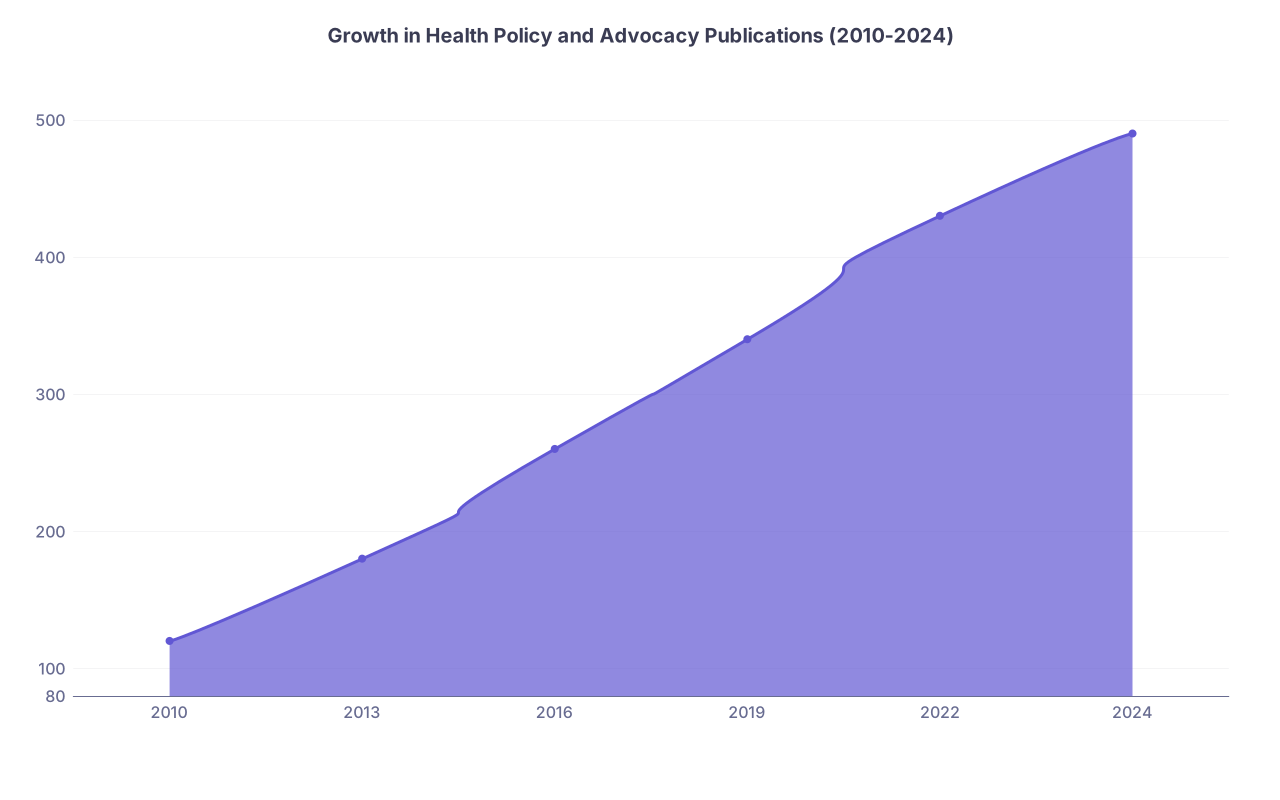
| Category | Value |
|---|---|
| 2010 | 120 |
| 2013 | 180 |
| 2016 | 260 |
| 2019 | 340 |
| 2022 | 430 |
| 2024 | 490 |
The upward trend in peer-reviewed policy/advocacy papers tells you where academic medicine is going. Your application doesn’t need to pretend it is 1995.
The Quiet but Growing Advantage: Advocacy as Leadership Signal
Here’s the part almost nobody says out loud.
Many program directors are under pressure—from departments, hospitals, and accrediting bodies—to show they care about:
- Quality improvement
- Community engagement
- Diversity and inclusion
- Health equity metrics
Residents who can credibly contribute to that work are not a liability. They are assets.
I’ve seen applicants get pulled from the “maybe” pile to the “invite” pile because of:
- A well-designed policy elective that resulted in a published white paper
- A community naloxone distribution program with outcome data
- A climate-health toolkit adopted by their hospital system
Not because anyone agreed 100% with their politics, but because they showed:
- They can manage a project
- They can work with stakeholders
- They can get something across the finish line
That’s exactly what chiefs and future faculty are made of.

Practical Rules: When to Dial Up and When to Dial Down
You want heuristics, not philosophy. Here they are.
Lean into advocacy when:
- You’re applying to academic or safety-net programs
- Your advocacy clearly improved patient care or systems
- You can talk about it in measured, data-driven language
- You have supervisors who can vouch that you are clinically solid and a good teammate
Be more selective or restrained when:
- You’re applying to a small, very traditional community program with no obvious policy/advocacy footprint
- Your public content includes sharp attacks on institutions, named hospitals, or prior supervisors
- Your CV is 90% advocacy and 10% medicine; you need to rebalance
This does not mean lie or erase your work. It means emphasize the parts that highlight clinical growth, collaboration, and professionalism. You are not running for office. You are applying for a job.

| Step | Description |
|---|---|
| Step 1 | Have advocacy experience |
| Step 2 | Feature prominently in personal statement |
| Step 3 | Include on CV but keep framing brief |
| Step 4 | Discuss in interviews with examples |
| Step 5 | Mention if asked, focus on teamwork and professionalism |
| Step 6 | Did it change your clinical practice or systems skills |
| Step 7 | Program values community or policy |
The Hard Truth: Advocacy Won’t Save a Weak Application
One last myth to kill: some people treat advocacy like a magic shield.
- Low scores?
- Mediocre clerkship comments?
- Spotty professionalism record?
They assume they can wrap all of that in “social justice” rhetoric and become untouchable. That is not how this works.
Programs will still rank:
- Solid scores
- Strong clinical comments
- Reliable team behavior
Above someone who’s “very passionate about change” but can’t handle cross-cover.
Advocacy is a multiplier, not a substitute. It enhances an already strong application. It does not rescue a fundamentally weak one.

Bottom Line: What the Data and Reality Actually Say
Three points, no fluff:
Advocacy itself does not hurt your residency chances; unprofessional behavior and sloppy framing do. Programs care about reliability, judgment, and clinical commitment, not your avoidance of policy.
When you tie advocacy to patient outcomes, systems thinking, and leadership, it becomes a clear asset—especially in academic and safety-net programs. Use specific examples, not slogans.
Erase the paranoia, not the nuance. Be honest about your work, present it like a physician who understands data and responsibility, and choose programs whose public missions match what you say you care about.