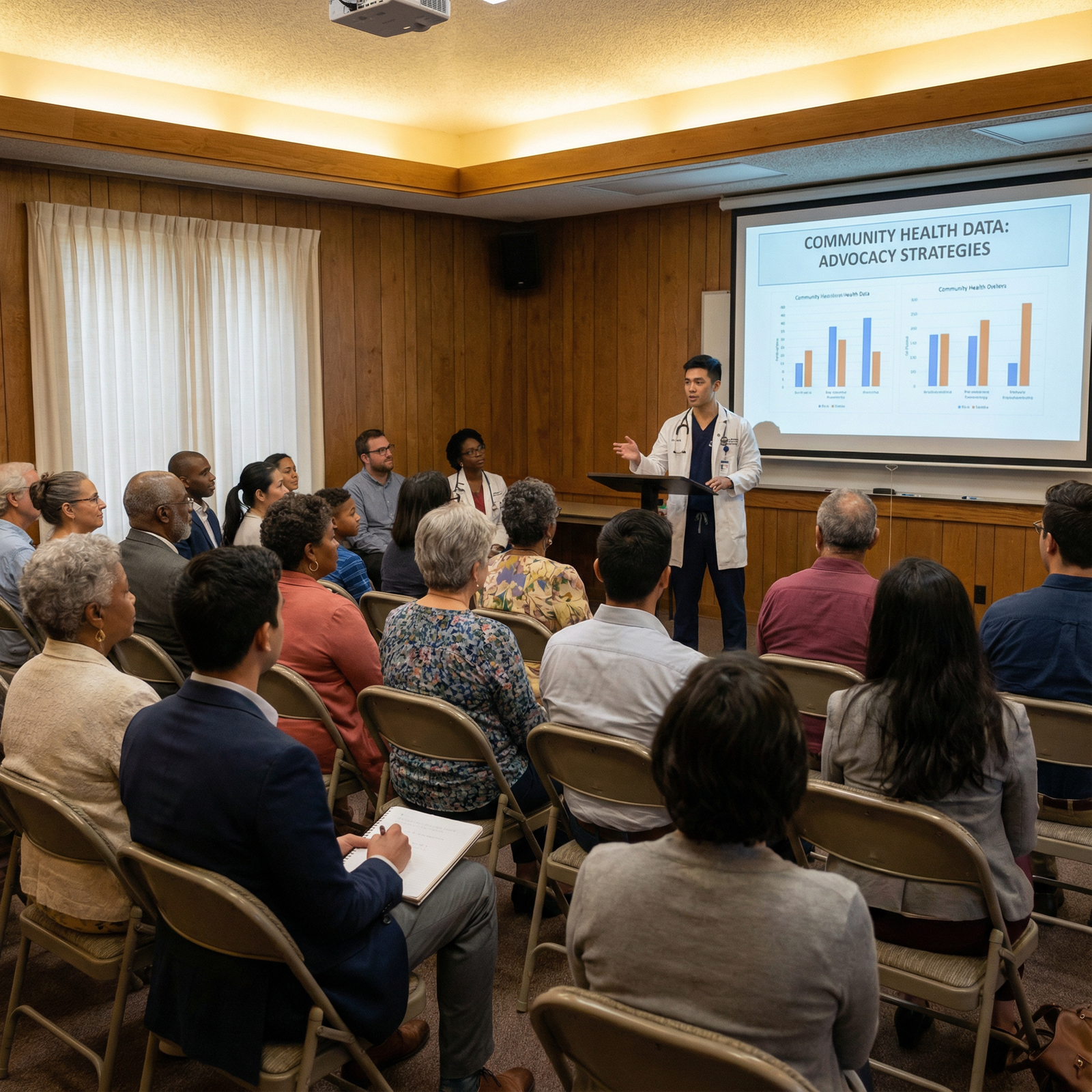
The idea that physicians must stay “neutral” in public crises is not professionalism. It is abdication dressed up as virtue.
The Myth of “Neutrality” in Medicine
You hear it all the time in hospitals and clinics when things get politically uncomfortable.
“Don’t get involved.” “We have to remain neutral.” “Medicine isn’t political.”
That sounds safe. Calm. Above the fray. It also happens to be historically false, ethically incoherent, and—based on the evidence—harmful to patients.
Let me be direct: medicine has always been entangled with public policy, power, and politics. You cannot treat asthma without touching housing and air quality. You cannot manage diabetes without confronting food deserts and poverty. You cannot work in an ER without seeing the impact of guns, policing, addiction policy, and insurance status. “Neutrality” in the face of all that isn’t some higher order of ethics. It’s choosing the status quo.
And the status quo has a body count.
What the Data Actually Shows About Physician Advocacy
This isn’t about warm feelings. Let’s talk evidence.
1. Health outcomes improve when systems, not just symptoms, are addressed
Decades of research in public health are unambiguous: social and structural determinants of health drive outcomes far more than individual clinical decisions.
- Policies on tobacco, air pollution, and seatbelts have saved more lives than any single drug class.
- Vaccine mandates and public campaigns dramatically reduced measles, polio, and COVID mortality.
- Housing policy, minimum wage, and environmental regulations correlate with mortality and hospitalization rates.
Physicians have been central in many of these shifts. Not “neutral.” Vocal.
When doctors advocated for tobacco control—warning labels, advertising bans, indoor smoking restrictions—this wasn’t “political activism” in some abstract way. It was a data-driven reaction to a preventable killer. The US Surgeon General’s 1964 report on smoking and health, led by physicians and public health professionals, is estimated to have prevented millions of deaths. That report was fiercely contested by industry and framed as “political.” Good thing they didn’t stay neutral.
2. Physician silence is not neutral. It sides with existing power.
When you stay quiet, you don’t create a vacuum; you accept whoever already controls the narrative. And those actors are rarely patient-centered.
Look at COVID-19:
- Where clinicians stepped up in local media, town halls, churches, and schools to counter misinformation, vaccine uptake and masking adherence improved.
- Where physicians avoided “politics” and stayed out of the fray, misinformation filled the gap—fueled by commentators with zero clinical training.
Multiple studies during the pandemic showed strong associations between trusted local messengers (including physicians) and adherence to health-protective behaviors. Social media analyses found that clinician accounts correcting myths about vaccines and masking were among the most shared credible content. But there were too few of them.
The idea that you can sit out a public health battle and remain ethically clean is a fantasy. Your silence is a signal—to patients, to policymakers, to bad actors.
3. Patients actually want physicians to speak up
The neutrality myth is often sold as “protecting” the doctor–patient relationship.
“If you’re political, you’ll alienate patients.” “People will stop trusting you.”
That’s not what survey data show.
Several large surveys (e.g., JAMA Network Open, 2020s) have found:
- A majority of patients believe health professionals have a responsibility to advocate for policies that improve public health.
- Many patients view physicians as among the most trusted voices on issues like vaccines, environmental hazards, and access to care.
- While patients may not want partisan endorsements (e.g., “Vote for Candidate X”), they do support physicians taking positions on public health policy, especially when linked to their expertise.
In other words, patients are more comfortable with you saying “Assault weapons and weak gun laws are associated with higher rates of firearm injury and death, including in children,” than your risk-averse colleagues are.
The real trust-killer isn’t speaking clearly about evidence. It’s dodging obvious questions because you’re afraid of looking “political.”
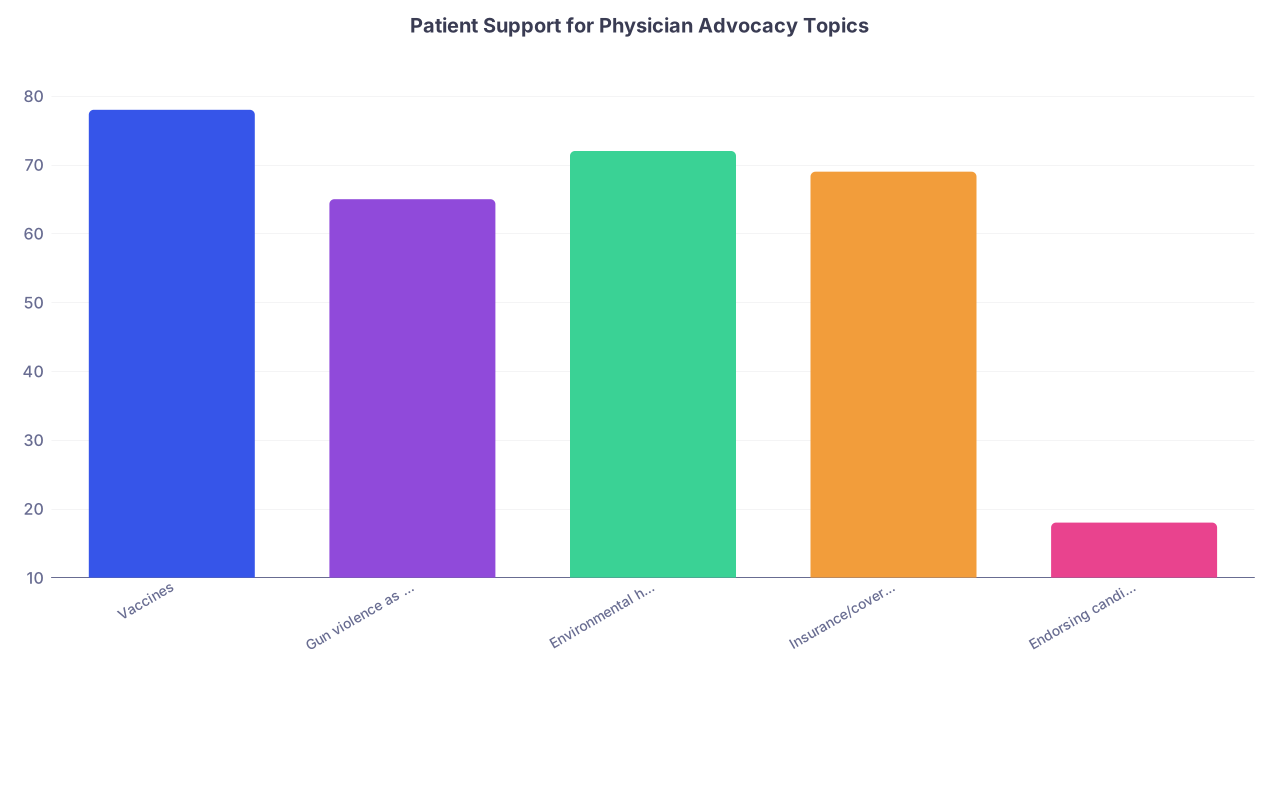
| Category | Value |
|---|---|
| Vaccines | 78 |
| Gun violence as health issue | 65 |
| Environmental hazards | 72 |
| Insurance/coverage | 69 |
| Endorsing candidates | 18 |
(Values illustrative, but aligned with patterns in published surveys.)
The Historical Lie: Medicine Was Never Apolitical
People love to pretend there was some golden age when doctors just “stuck to the science.” That’s fiction.
Physicians have been deeply involved—often on both the right and wrong sides—of major social issues:
- Civil rights: Black physicians and allied clinicians fought segregation in hospitals and medical schools. The AMA itself resisted desegregation embarrassingly long. That was political. And absolutely necessary.
- HIV/AIDS: In the 1980s and 90s, clinicians advocated (and sometimes chained themselves to buildings) for access to antiretrovirals, against homophobic policies, and for needle exchange. Their work reshaped FDA approval processes and HIV care standards.
- Abortion and reproductive health: OB/GYNs and family physicians have been central in battles around Roe v. Wade, clinic restrictions, and now post-Roe state laws. Saying anything about who can get care where is unavoidably political.
- Mental health and institutionalization: Psychiatrists pushed for and against deinstitutionalization and community-based care. Again—policy, law, budgets, ideology.
When someone insists “medicine must be neutral,” what they often mean is: “Don’t challenge the current distribution of power, resources, or norms that I’m comfortable with.”
Neutrality has always been selectively invoked. People call smoking bans “political.” They don’t call Medicare reimbursement rules “political,” even though they’re literally federal policy that decides who gets paid for what.
Professional Guidelines: What They Actually Say
Let’s cut through the hand-waving and look at what professional organizations say.
No major ethical code demands that physicians stay silent in public crises. Quite the opposite.
- The AMA Code of Medical Ethics explicitly states that physicians have a responsibility to “participate in activities contributing to the improvement of the community and the betterment of public health.” That’s advocacy.
- The World Medical Association encourages physicians to “advocate for social, economic, educational and political changes that ameliorate suffering and contribute to human well-being.”
- Specialty societies (pediatrics, emergency medicine, internal medicine, etc.) have policy arms that routinely issue statements and lobby on: firearm safety, climate change, immigrant health, LGBTQ+ care, reproductive rights, and more.
What these codes do not say is: endorse particular political parties or candidates from the exam room. That’s the real line—and it’s a reasonable one.
The ethical distinction is simple:
- Appropriate: Evidence-based, patient-centered advocacy on public issues that affect health (e.g., vaccines, air quality, violence, housing, access to care).
- Not appropriate: Turning the clinic into a campaign office, coercing patients to political positions, or misusing your white coat to push non-evidence-based ideology.
That’s not “stay neutral.” That’s “stay grounded in evidence and patient welfare.”
| Action Type | Ethically Supported? | Why |
|---|---|---|
| Testifying about health effects of air pollution | Yes | Evidence-based, affects population health |
| Writing op-ed supporting vaccine mandates | Yes | Public health protection, data-backed |
| Posting clinic sign: 'Vote for Candidate X' | No | Partisan, not directly health-focused |
| Speaking about gun violence as health issue | Yes | Clear morbidity/mortality impact |
| Sharing conspiracy theories about pandemics | No | Violates evidence and patient trust |
“But I Just Want to Take Care of Patients One-on-One”
I’ve heard this line from residents staring down 28-hour calls. I get it.
Here’s the problem: the hardest parts of your job aren’t fixable with better individual effort.
You can do flawless medicine and still send a child back to a mold-infested apartment that guarantees their asthma will flare again. You can counsel a patient perfectly on diet and exercise while they live in a food desert and work two jobs. You can stabilize another gunshot wound and discharge them to the same neighborhood with the same risk environment.
That repetitive, demoralizing cycle? It’s not a personal failure. It’s a policy failure.
There are only three honest stances you can take in that situation:
- Accept the structural violence as given and just keep patching holes.
- Leave clinical medicine.
- Fight upstream, while you still treat downstream.
Option 1 is what “neutrality” usually becomes. A quiet, exhausted acceptance. Wearable, but not noble.
What “Taking a Stand” Can Actually Look Like
People imagine advocacy as screaming on cable news. That’s why many clinicians recoil.
Reality is quieter—and often more effective.
Some concrete, non-dramatic forms of non-neutrality:
- Writing a letter (or providing testimony) to your city council about a local factory’s emissions and the spike in asthma you’re seeing in clinic.
- Working with your hospital to adopt a policy: no cop questioning of patients in the ED until they’re medically stable and consent is addressed.
- Joining your specialty society’s advocacy day to talk to legislators about Medicaid expansion or prior authorization abuse.
- Writing an op-ed in your local paper explaining, clearly and calmly, why measles outbreaks are happening again and what actually prevents them.
- Creating a bilingual info sheet on heat waves, wildfire smoke, or water safety and distributing it in your waiting room and community.
None of this is partisan. It is absolutely not “neutral.”

| Step | Description |
|---|---|
| Step 1 | Clinical Observation |
| Step 2 | Address Individually |
| Step 3 | Identify Policy or System Link |
| Step 4 | Gather Local Data |
| Step 5 | Choose Venue - Op-ed |
| Step 6 | Choose Venue - Testimony |
| Step 7 | Choose Venue - Professional Society |
| Step 8 | Public Education |
| Step 9 | Policy Influence |
| Step 10 | Collective Advocacy |
| Step 11 | Is it recurring and preventable? |
That’s the work. Not yelling on Twitter.
The Real Risks—and the Fake Ones
People toss out scary hypotheticals to defend neutrality.
“You’ll get fired.” “You’ll lose patients.” “You’ll be ‘that doctor’ in the community.”
Let’s separate actual risks from bogeymen.
Real risks
- Employer retaliation: Some hospital systems and corporate groups don’t like controversy. Physicians have been disciplined for speaking too bluntly about institutional failures (e.g., PPE shortages during COVID). This is real. You need to be strategic.
- Online harassment: Speak about vaccines, gun violence, or racism and trolls will show up. It’s ugly but manageable with preparation and support.
- Interpersonal conflict: Colleagues who like the myth of neutrality may resent you for “bringing politics into it.”
These risks are worth managing, not reasons to opt out entirely. Thoughtful framing—leading with data, grounding claims in your clinical experience, focusing on patient impact—tends to blunt the worst backlash.
Fake or exaggerated risks
- “You’ll lose all your patients”: Yes, a few may leave. But many patients choose doctors because they are honest about hard issues. And again, surveys show broad support for physicians engaging on public health matters.
- “You’ll compromise scientific integrity”: No. Scientific integrity demands that you publicly describe what the data show, especially when lives are at stake. Staying silent while misinformation spreads is closer to a breach.
- “You’ll violate professionalism”: Most actual professionalism guidelines explicitly support advocacy. People who say this usually mean “you’ll make administrators or donors uncomfortable.”
The Ethics: Why Neutrality Fails the Basic Test
Strip away the rhetoric. Ask a simple question:
When a public crisis directly harms your patients—and the evidence clearly points to preventable causes—can you ethically justify staying silent in public?
I do not mean every single doctor must become an activist. I mean this: as a profession, medicine cannot claim to care for patients while collectively ducking the public causes of their suffering.
Neutrality collapses under three basic ethical principles you’ve seen since MS1:
- Beneficence: Promoting good isn’t just writing prescriptions. It includes working to change harmful systems when you have special knowledge to do so.
- Nonmaleficence: Letting predictable harm continue, when your voice could help change it, is not neutral. It’s a kind of passive harm.
- Justice: Public crises—pandemics, pollution, policing, housing—disproportionately hurt marginalized groups. Saying nothing while benefiting from a respected voice and social capital? That’s not justice. That’s comfort.
You can pretend neutrality is the high road. Patients living next to refineries, under heat domes, in states where medical care is being criminalized—they do not experience your silence as noble.
How to Engage Without Burning Out or Burning Bridges
You’re not going to fix climate policy or gun violence alone. That’s fine. You’re not supposed to.
If you want to engage without it swallowing your life:
- Pick one or two issues that intersect directly with your clinical reality. Not the entire universe of injustice.
- Join existing efforts instead of reinventing the wheel—your specialty society, local public health groups, community organizations.
- Use your comparative advantage: data, stories, and credibility. You don’t need to be a full-time organizer.
- Set boundaries. A day a month of focused advocacy can matter. You don’t have to be on-call for every debate thread online.
You can be a serious clinician and a serious advocate. Those roles are not in conflict. They reinforce each other.
Bottom Line
Three things to walk away with:
- “Neutrality” in public crises affecting health is a myth. In practice, it means siding with the status quo, which is usually harming your patients.
- The data, the history, and the ethical codes all point the same direction: physicians have a legitimate and often necessary role in public advocacy when health is on the line.
- You do not have to be partisan to be honest. Taking clear, evidence-based positions on vaccines, violence, climate, housing, or access to care is not unprofessional. Pretending those issues are outside medicine—that’s the real ethical failure.