
Only about 10–20% of physicians ever actively engage in formal advocacy or health policy work, yet over 80% pay dues to at least one professional medical society at some point in their career.
That mismatch is your first red flag.
Everyone tells you: “If you care about policy, join the (insert specialty) society, get on a committee, that’s how you make change.” The implication is that membership = influence. Reality is a lot messier.
Let’s go through what the data actually show about medical societies and policy work—who gets real influence, what societies actually do, and where your limited time and money realistically move the needle.
What Medical Societies Actually Do in Policy (Not the Marketing Brochure Version)
Most societies will tell you they “advocate for patients,” “shape health policy,” and “fight for the profession.” Some of that is true. Some of it is branding.
Strip away the slogans and you get four main policy functions:
- Lobbying (legislatures, regulators)
- Policy development (position statements, guideline influence)
- Political spending (PACs, campaign donations)
- Public messaging (media statements, letters, amicus briefs)
The question you actually care about: does your individual membership give you meaningful leverage in any of those buckets?
Short answer: mostly no, sometimes yes, and you need to be very deliberate about which societies, which roles, and which level (local vs state vs national).
Let me ground this with some real patterns.
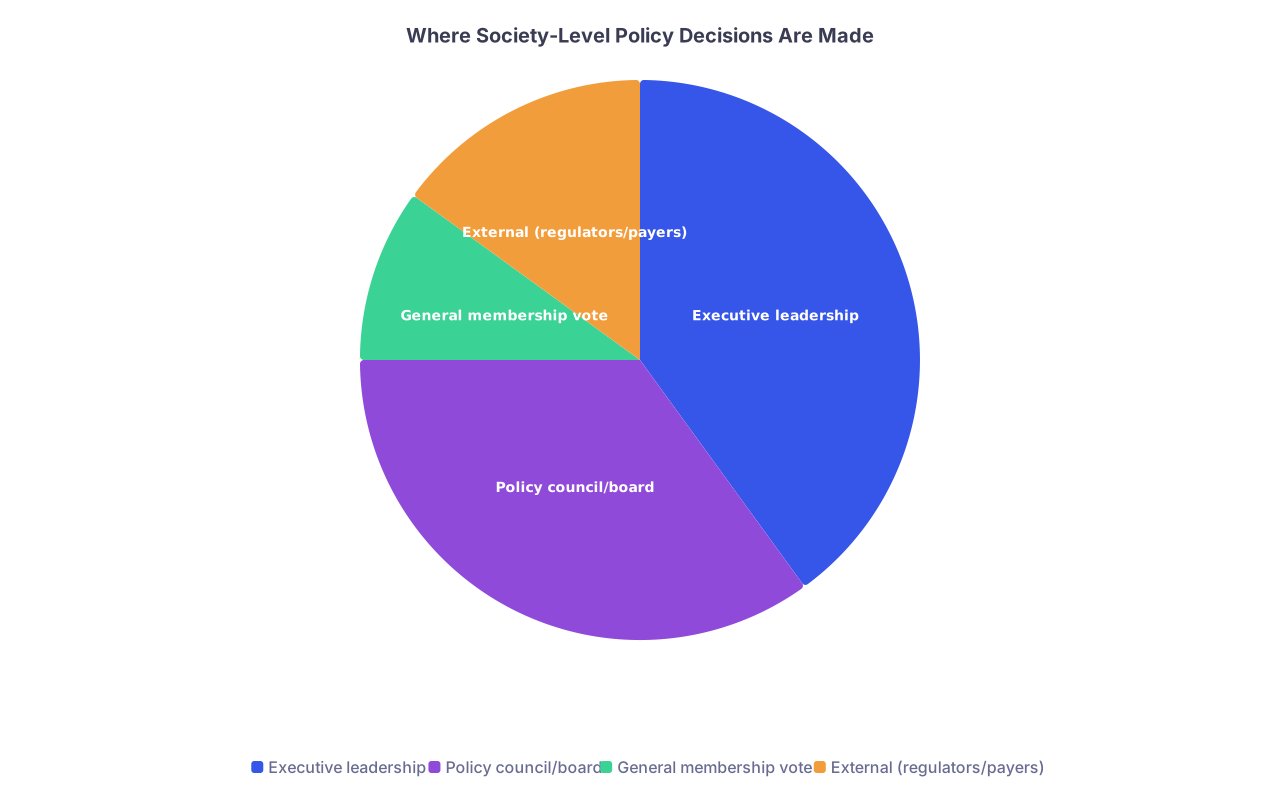
| Category | Value |
|---|---|
| Executive leadership | 40 |
| Policy council/board | 35 |
| General membership vote | 10 |
| External (regulators/payers) | 15 |
Most policy direction in big medical societies is set by a relatively small group: executive boards, policy councils, and paid staff. General members rarely vote directly on specific policy stances. You vote on leaders, if that.
So if you think “I’ll pay dues and then I’ll have a say in national policy,” you’re already off the rails. Membership alone is basically a political subscription, not a steering wheel.
Myth 1: “Joining a Society Is the Best Path to Doing Policy Work”
This is the most common, and it’s wrong in two distinct ways.
First, most societies are not policy engines; they’re professional maintenance organizations. Their core functions are:
- Conferences and CME
- Specialty branding and networking
- Career advancement structures (fellowship status, committees)
- Clinical guidelines and educational materials
Policy is often a side function, driven by a small group of historically involved members plus staff lobbyists.
Second, the real policy work—what ends up in law or regulation—often bypasses medical societies altogether and goes through:
- Direct legislative testimony by individual experts or coalitions
- Academic centers and think tanks producing policy briefs
- Cross-profession coalitions (e.g., nursing, public health, law)
- Patient and disease advocacy groups with compelling narratives
I’ve watched state legislators invite a practicing rural doc and a patient group leader to testify on scope-of-practice laws while representatives from large medical societies sat in the back of the room. Not speaking. Not at the mic. Just “monitoring.”
So is joining a society the path? No. It’s a path, and usually not the most efficient one for early-career people who want to actually shape policy.
Where Society Membership Does Help for Policy Work
This is where the nuance matters. Society membership can be worth it if you treat it as an instrument, not an identity badge.
Here’s where it actually helps:
1. Legitimacy and “Letterhead Power”
Legislative staff and agency officials like recognizable brands. A letter that says:
- “Internal Medicine Resident, PGY-2” gets one reaction.
- “Member, State Chapter of the American College of Physicians” gets another.
- “Policy Committee Member, [Specialty] Society” lands differently again.
Is that fair? No. Is it real? Yes.
Societies confer signal. That signal opens doors for:
- Meetings with staffers
- Invitations to stakeholder calls
- Quoted roles in press statements (“Dr. X, representing the AA….”)
You’re not getting that just as “random concerned clinician,” no matter how insightful your policy brief is.
2. Access to Existing Advocacy Infrastructure
Many societies already have:
- Contracted lobbyists
- Policy staff who track bills and regs
- Template letters, talking points, one-pagers
- Existing relationships with key legislators
If you’re trying to get into policy, this is plug-and-play training:
- You can shadow staff in meetings.
- You can learn how they prep for hearings.
- You can see how they adjust strategy when a bill suddenly moves at 10 p.m. on a Friday.
The catch: you have to move beyond passive membership. Just paying dues does nothing. You need to:
- Join state/local chapters (where things are smaller and more permeable)
- Volunteer for the health policy/advocacy committee
- Actually show up to the unglamorous stuff: Zoom policy briefings, 7 a.m. strategy calls, “doctor in the legislature” days where you mostly wait around
3. Pipeline to High-Impact Roles (If You Start Early)
The leadership pipeline in most societies is predictable and slow—but that’s actually good if you’re strategic and patient.
Typical sequence:
- Student/resident member → basic involvement
- Committee service (policy, ethics, practice)
- State chapter leadership role
- National committee/section leadership
- Sometimes: interface to national commissions, federal advisory groups, guideline panels
A lot of the “name” physicians in national policy circles—AMA delegates, ACP health policy leaders, ACOG legislative committee folks—didn’t parachute in from nowhere. They climbed this ladder over 5–15 years.
So if you’re early in training and want a policy career, society membership can be your long game infrastructure. Just do not confuse “joined” with “on track.” You have to move, not just pay.
Where Society Membership Is Overrated for Policy
Now the other side. Here’s where medical societies are dramatically oversold as vehicles for policy work.
1. Your Dues ≠ Your Voice
Look at how policy decisions actually get made in many large societies:
- Executive board and policy council draft or approve positions.
- Staff shape language to align with long-term relationships and political feasibility.
- Membership may get a summary, an opaque vote at an annual meeting, or nothing.
You are not in the room. Most members will never see the internal tradeoffs: “We’ll back X if we soften our stance on Y to keep hospital systems and payers at the table.”
Members who do not hold a leadership role function basically as a funding base and letterhead mass. That is fine if you know that’s what you’re signing up for. It’s delusional if you think each member has direct policy voice.
2. Time Sink Without Clear Output
I’ve seen young physicians burned out by society “policy work” that was mostly:
- Drafting infinitely edited statements that never leave the intranet
- Sitting on committees that meet quarterly and accomplish nothing measurable
- Attending “Hill Day” photo ops where 50 physicians cram into a staffer’s office for 15 minutes and send the same talking points heard from ten other groups that morning
If you can’t answer “What policy lever am I touching?”—bill language, agency guidance, payer policy, scope-of-practice rules, etc.—you’re probably doing performance advocacy, not policy advocacy.
You don’t need a society to waste your time. You can do that for free.
3. Misalignment Between What You Want and What They Lobby For
This part is uncomfortable, but it matters ethically.
Many societies:
- Oppose things you might support (e.g., certain scope-of-practice expansions, single-payer structures, aggressive transparency rules).
- Support things you might question (payment structures that benefit certain specialties disproportionately, defensive stances on discipline or quality oversight).
| Issue | Typical Society Stance | Many Individual Clinicians |
|---|---|---|
| Single-payer / public option | Cautious / opposed / neutral | Mixed, often more supportive |
| Scope of practice for NPs/PAs | Frequently restrictive | More variable / collaborative |
| Prior auth reform | Strongly supportive of reform | Supportive |
| Malpractice reform | High priority | Medium priority |
| Social determinants / upstream policy | On paper supportive, low lobbying intensity | Often high concern in practice |
If you want to work on policy for the public’s health, and your main professional organization spends most of its political capital on reimbursement and liability protections, you need to be honest about that. You may be funding advocacy you ethically disagree with.
So, yes—joining a medical society might help your policy career. It might also make you complicit in policy positions you’d argue against if they weren’t wrapped in your specialty’s logo.
Alternatives That Often Deliver More Policy Impact
If your goal is “I want to concretely shape policy,” societies are just one tool.
Here are others that, frankly, often deliver more punch per unit time for early and mid-career people.
1. State and Local Public Health Departments
Unsexy. Underfunded. Understaffed.
But this is where rules actually get written and implemented:
- Emergency orders during outbreaks
- Local health regulations (housing, water, environmental health)
- Data reporting standards
- Implementation of federal programs
You can:
- Join advisory boards
- Help draft clinical protocols that become standard across a region
- Work on implementation plans that directly change patient access
None of this requires society membership. It requires showing up to public meetings and being the rare clinician who can talk both medicine and systems.
2. Disease-Specific or Patient Advocacy Groups
If you want to push a specific policy—insulin pricing, mental health parity, harm reduction, maternal mortality—patient advocacy orgs often move faster and hit harder than broad medical societies.
They:
- Tell emotionally powerful stories
- Mobilize constituents (voters)
- Target specific legislation with narrow, clear asks
Your medical expertise + their organizing power is often more potent than your voice channeled through a 100,000-member professional organization trying to keep everyone happy.
3. Direct Work with Legislators and Staff
The most brutally effective path:
- Identify the committee or agency that actually controls your issue.
- Build relationships with staffers.
- Become their go-to evidence explainer.
You can do that as:
- “Endocrinologist in district X”
- “Emergency physician at Y hospital”
- “Family medicine resident working in community clinics”
Yes, a society affiliation might help your intro email get opened. But your real currency is responsiveness, clarity, and reliability. That does not depend on a member ID number.
For Students and Trainees: When Is Joining Worth It?
Everyone pushes students and residents to “get involved” with societies early. Sometimes that’s helpful; often it’s just dues extraction plus resume inflation.
Here’s a more honest framework.
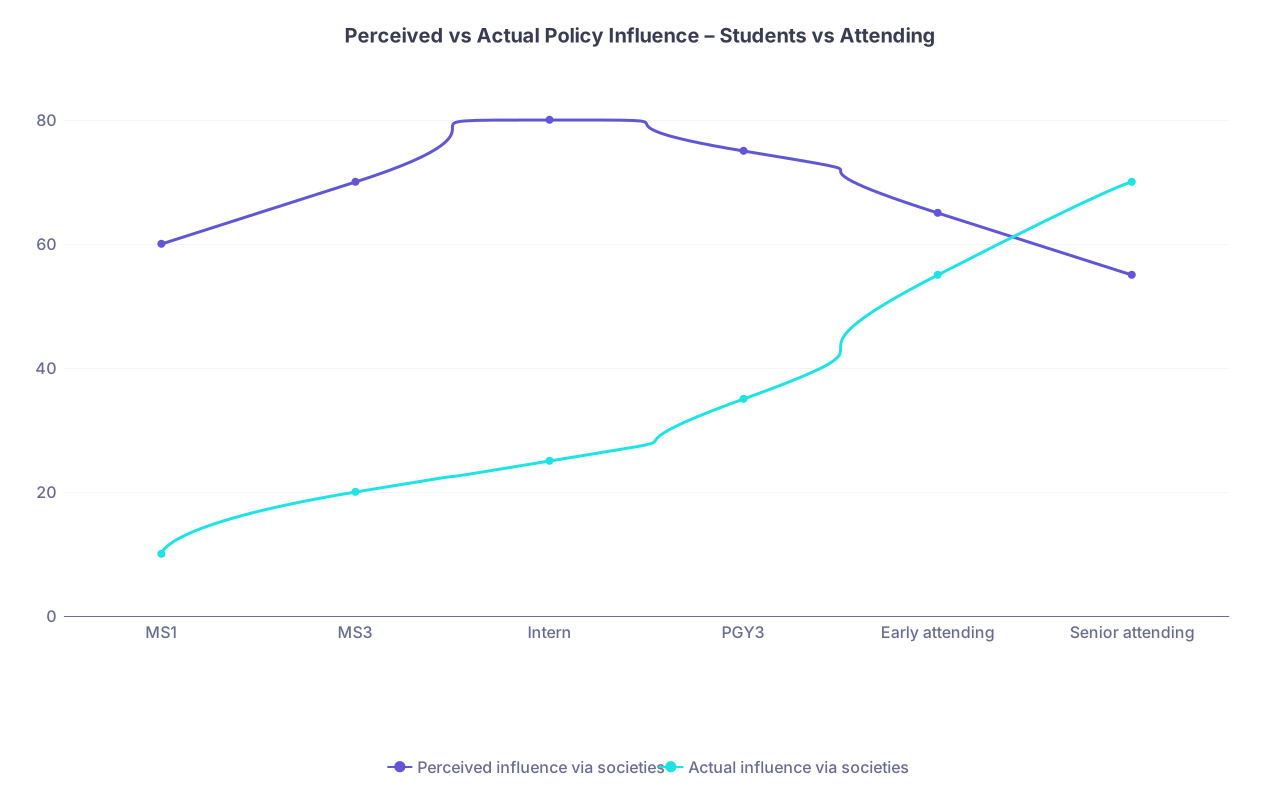
| Category | Perceived influence via societies | Actual influence via societies |
|---|---|---|
| MS1 | 60 | 10 |
| MS3 | 70 | 20 |
| Intern | 80 | 25 |
| PGY3 | 75 | 35 |
| Early attending | 65 | 55 |
| Senior attending | 55 | 70 |
Students often feel like society involvement is their main policy route. Actual influence climbs much later, once you have expertise, a stable job, and credibility.
So as a student or resident, joining a society can be worth it if:
- The dues are low or waived, and
- You get real opportunities:
– testify,
– help write policy briefs,
– meet directly with legislators, and
– receive mentorship from people working at state/federal policy levels.
It’s not worth it if:
- Your role is “medical student representative” whose job is to sit on Zoom and be a token.
- All “policy work” means posting advocacy day photos on social media.
- You’re paying meaningful money for “membership” that never translates into direct exposure to real policy levers.
Ask for specifics:
“What have student/resident members actually done in policy in the last 2 years? Not attended—done, authored, or led?”
If you get vague answers, there’s your answer.
Ethical Frictions: Policy, Professional Power, and You
You said this is under “PERSONAL DEVELOPMENT AND MEDICAL ETHICS,” so let’s not dodge the uncomfortable part.
Medical societies are political actors that often:
- Defend professional turf
- Shape payment systems that benefit some groups of clinicians much more than others
- Sometimes slow down or water down reforms that would clearly benefit public health but reduce professional control or income
This doesn’t make them villains. It makes them interest groups.
The ethical question is: are you comfortable aligning your identity and your public-face advocacy with an organization whose priorities are, frankly, not purely patient-centered?
You might decide yes—because:
- You believe strong physician organizations ultimately protect care quality.
- You plan to push them in a better direction from within.
- You view their lobbying for autonomy and reimbursement as necessary to sustain the workforce.
You might decide no—because:
- Their stance on issues like scope of practice, insurance expansion, or reproductive health conflict with your values.
- You prefer working with groups where patients, not professionals, set the agenda.
Both are defensible. What’s not defensible is pretending societies are neutral “for the public” actors. They’re power structures. Joining them for policy work is an ethical choice as much as a career choice.
How to Decide: A Cold-Eyed Checklist
Before you renew or join for “policy work,” ask these:
- Can I point to at least one specific bill, regulation, or formal policy where this society has had clear, documented impact in the past 3 years?
- Do they offer structured, recurring advocacy roles for members at my career stage that touch real levers, not just symbolic events?
- Are their major policy positions broadly aligned with my ethical and political views on health, not just my specialty’s income?
- Is the time and money cost lower than or comparable to direct engagement with public health departments, legislators, or patient groups?
If you can only answer “yes” to #1 and #3, and “no” or “unclear” to #2 and #4, membership is likely more about professional identity and networking than policy impact. That might still be fine—but don’t lie to yourself about it.

| Step | Description |
|---|---|
| Step 1 | Clinician interested in policy |
| Step 2 | Direct legislator engagement |
| Step 3 | Medical society leadership |
| Step 4 | Public health dept / hospital committees |
| Step 5 | Patient or disease advocacy group |
| Step 6 | Committee work and long-term roles |
| Step 7 | Staff relationships and testimony |
| Step 8 | Implementation and protocols |
| Step 9 | Campaigns and coalition work |
| Step 10 | Goal |
The Bottom Line
Three things to walk away with:
Joining a medical society by itself does almost nothing for your policy impact. Influence comes from specific roles, long-term involvement, and actual decision touchpoints—not a membership card.
For early-career people, direct engagement with public health departments, legislators, and patient advocacy groups often beats society membership in speed and impact per hour. Use societies as one tool, not your only tool.
Ethically, you’re aligning with an interest group, not a neutral “voice of medicine.” If you join for policy work, do it with eyes open about what they actually lobby for—and be prepared to either shape that from within or balance it with other advocacy channels.