
17% of U.S. deaths during the first year of COVID were attributable to policy choices, not viral biology.
That line alone should kill the slogan “politics has no place in medicine.” But the slogan keeps shambling around like a zombie at grand rounds, repeated by attendings, deans, and random Twitter physicians who apparently missed every ethics lecture they were ever given.
Let’s cut through the sentimentality and look at what the data – and actual medical ethics – say.
The Comfortable Myth: Medicine as a Politics-Free Zone
You’ve heard the line in every flavor.
“Keep politics out of the exam room.”
“We’re here to treat patients, not push agendas.”
“Medicine should be neutral.”
It sounds noble. Calm. Professional.
It’s also historically wrong, ethically incoherent, and empirically dangerous.
Here’s the real problem: people who say “politics has no place in medicine” almost never mean “let’s remove political influence from health.” They mean “let’s keep my preferred status quo unexamined” – the status quo that already reflects years of political decisions: reimbursement structures, clinic locations, formularies, immigration rules, policing, housing policy, you name it.
You’re practicing in a political ecosystem whether you like it or not. The only question is whether you admit it and act ethically, or pretend you’re “above politics” while quietly reinforcing whatever the current power structure happens to be.
What the Data Actually Shows: Politics Changes Who Lives and Who Dies
Let’s start with numbers, not slogans.
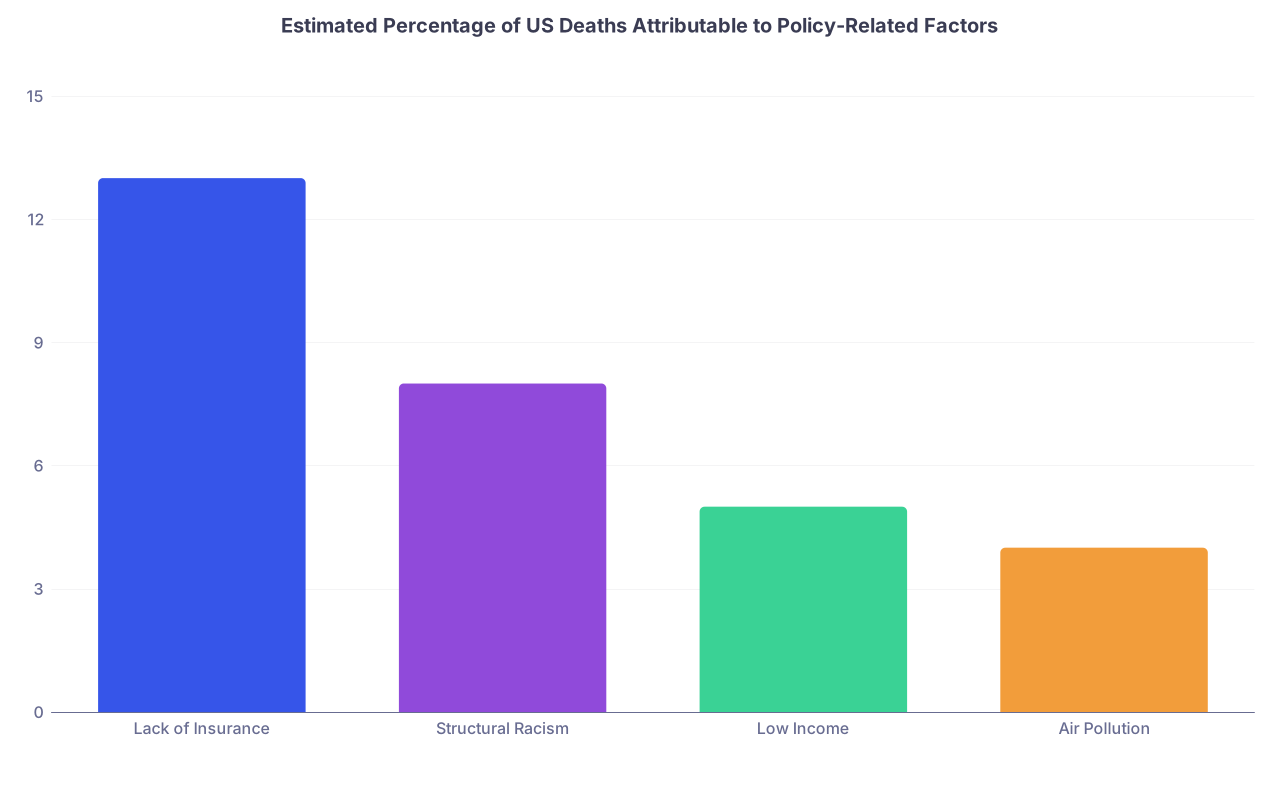
| Category | Value |
|---|---|
| Lack of Insurance | 13 |
| Structural Racism | 8 |
| Low Income | 5 |
| Air Pollution | 4 |
Those are rough, conservative estimates from multiple large studies over the past decade. Not rhetorical flourishes. Actual mortality.
- Lack of insurance: A 2014 study in the Annals of Internal Medicine estimated that expanding Medicaid under the ACA prevented about 19,200 deaths over four years in participating states. States that refused expansion? Higher mortality. That’s not a “political opinion.” It’s a difference-in-differences analysis.
- Structural racism: The Black–White mortality gap persists even after controlling for education and income in many datasets. The causes – residential segregation, environmental exposures, policing patterns, biased lending – are political structures, not random nature.
- Air pollution: Tighter EPA rules reduce mortality from cardiovascular and respiratory disease. When those rules are weakened, mortality goes up. Again, consistently documented.
If you think this is abstract, ask anyone who rounded in safety-net hospitals before and after local Medicaid expansion. I was seeing fewer delayed-cancer-diagnosis train wrecks two years after expansion. Not zero. But fewer. Patients suddenly able to afford follow-up visits and imaging isn’t a philosophical debate; it’s “do they die five years earlier or not.”
You cannot ethically treat health outcomes as if they float in a vacuum, disconnected from the policies that produce them.
That’s the basic confusion: people pretend politics is some optional overlay, when in reality, it sets the baseline risk environment for every patient you see.
Medical Ethics 101: Neutrality Is Not an Option
Let’s recall the four principles everyone parrots first year:
- Autonomy
- Beneficence
- Non-maleficence
- Justice
The “politics has no place in medicine” camp loves the first three in the micro sense and quietly erases the fourth.
But justice is not decorative. It’s a core part of mainstream, boring, non-radical bioethics. And justice in health care isn’t just “be nice to everyone equally in the room today.” It is explicitly about fair distribution of benefits and burdens across populations.
Which means what? It means that if:
- You know a policy predictably creates preventable morbidity and mortality in a specific, identifiable group
- You benefit from that system
- And you choose to “stay neutral” because “politics has no place in medicine”
You are not ethically neutral. You are endorsing that distribution by your silence.
I’ve heard attendings say during residency: “We’re not here to talk about immigration policy; that’s politics.” This, while treating a patient in status epilepticus who’d been off meds for months because they were terrified of being picked up by ICE at the clinic.
You can’t pretend the policy is irrelevant to your obligation to beneficence and non-maleficence. The threat environment is literally altering whether this patient can access care. That’s medical.
Ethics bodies have been clearer than many clinicians:
- The American College of Physicians states that physicians have an obligation to “advocate for policies that improve the health of the public.”
- The AMA Code of Medical Ethics talks explicitly about “social justice” and “advocacy to promote access to health care for all.”
None of those documents add an asterisk saying “unless someone calls it political on Fox News.”
“But I Don’t Want to Push My Politics on Patients”
Good. You shouldn’t.
This is where people conflate two very different things:
- Partisan cheerleading in the exam room (bad idea)
- Honest discussion of health-relevant policies and structural factors (ethically required)
Your patient doesn’t need you to tell them who to vote for. They do need you to tell them, for example, that:
- Their asthma is worse because their housing is mold-infested and the landlord is ignoring legal obligations.
- Their diabetes regimen is failing because their insurance formulary keeps changing cheaper meds, and there are appeal rights they don’t know about.
- The closure of the nearby OB unit wasn’t “just market forces” but a direct result of state-level decisions on Medicaid reimbursement and hospital consolidation.
From an ethics standpoint, it’s the same as any other risk counseling. We already talk about diet, exercise, seat belts, gun storage, domestic violence. All of these touch law and policy. Nobody screams “stay in your lane” when you advise on seat belt laws.
What makes doctors skittish is when those policies challenge existing hierarchies – policing, immigration, reproductive rights, racial inequities. Then suddenly, “politics has no place in medicine” comes out as a shield.
That’s not principled neutrality. That’s selective silence.
To be clear: you absolutely can draw lines. You might decide:
- You will not wear campaign buttons in clinic.
- You will not ask patients about their party affiliation.
- You will not turn visits into soapboxes.
Reasonable. But that’s not “keeping politics out of medicine.” That’s refusing partisan branding while still acknowledging policy reality.
History Lesson: “Neutral” Doctors Have Never Been Neutral
Look at any era where medicine intersected with brutality and injustice.
- Segregated hospitals in the U.S.
- Apartheid-era South Africa’s health system.
- Physician participation in torture and “enhanced interrogation.”
- Nazi medicine, obviously the extreme case.
Very few of the physicians involved saw themselves as political extremists. Many claimed they were “just doing their job” under the law, working within the system, not taking sides.
That posture – “I’m just a technician; politics is for others” – is precisely what allowed atrocities and routine injustice to be medicalized.
You do not need to jump to Nazis to make the point. Go read about the Tuskegee syphilis study or forced sterilization of Black, Indigenous, disabled, and incarcerated patients in the 20th century. These were policy-backed programs. Doctors kept their heads down, said they were honoring “science,” and avoided conflict.
Every time there’s a retrospective ethics inquiry, we tell ourselves, “We’ve learned. We’d speak up now.”
Then someone suggests maybe we should talk about policing as a public health issue because of homicide and trauma rates, and a chorus of clinicians yells: “Politics has no place in medicine!”
You can’t have it both ways. Either you accept that structural power is your concern, or you admit you’re okay with being a neutral tool of whatever structure exists. Including the ugly ones.
Where “Politics” and Clinical Practice Directly Intersect
Let’s get even more concrete.
| Clinical Domain | Key Policy Levers Affecting Care |
|---|---|
| Diabetes management | Insurance formularies, Medicaid expansion |
| Obstetric care | Hospital consolidation, abortion laws |
| Trauma care | Firearm regulations, policing practices |
| Asthma/COPD | Environmental regulations, housing codes |
| Mental health | Parity laws, criminal justice policies |
You probably already feel these day to day:
- Insulin suddenly becomes unaffordable because a state didn’t adopt a cap. You manage the fallout. That’s politics.
- Your county loses its only OB service because of reimbursement and consolidation rules. You see the maternal morbidity spike. That’s politics.
- You repeatedly discharge the same schizophrenic patient to homelessness because there’s no funded supportive housing. That’s politics.
You can either call these “unfortunate circumstances” and shrug. Or admit they’re the downstream manifestations of legislative and regulatory decisions and treat them as part of your ethical landscape.
Saying “politics has no place in medicine” is like saying “gravity has no place in orthopedic surgery.” You’re free to say it. You just sound unserious.
The Weaponization of “No Politics”
The phrase isn’t just naïve. It’s usually strategic.
Watch when it gets deployed:
- When physicians speak about racism as a public health crisis
- When clinicians support reproductive rights or gender-affirming care
- When public health experts criticize pandemic responses or misinformation
- When professionals call out carceral health abuses – jails, prisons, detention centers
Suddenly, “medicine should be neutral.” But when medical societies lobby for higher reimbursements, tort reform, or relaxed scope-of-practice laws that benefit physicians? Strangely silent about “politics.”
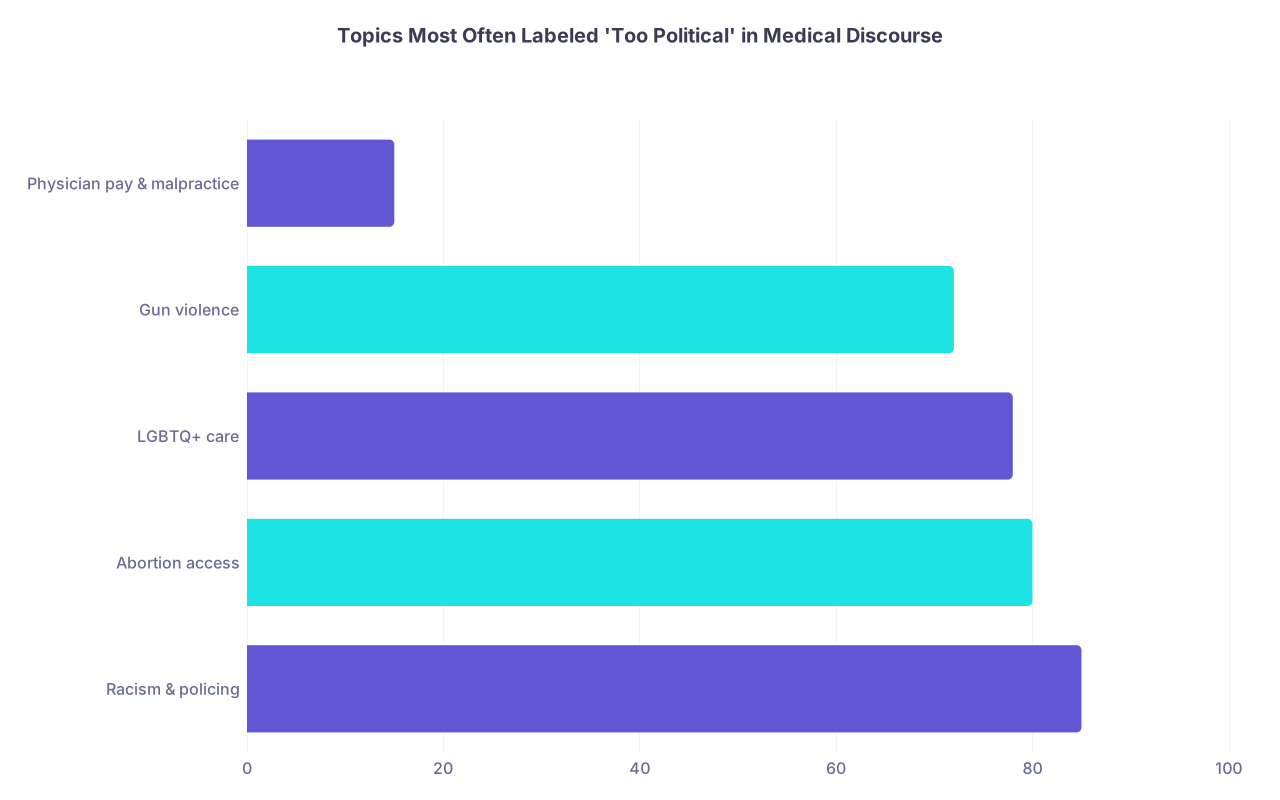
| Category | Value |
|---|---|
| Racism & policing | 85 |
| Abortion access | 80 |
| LGBTQ+ care | 78 |
| Gun violence | 72 |
| Physician pay & malpractice | 15 |
That discrepancy tells you what’s really going on. “Politics has no place in medicine” rarely means “let’s strip politics out entirely.” It means: “Your politics – the ones that threaten existing power or economic interests – have no place here. Mine are ‘professional issues.’”
If you care about ethics, you should be allergic to that double standard.
What Ethical, Non-Delusional Engagement Actually Looks Like
Here’s the part everyone pretends is impossible: you can be politically literate and ethically grounded without turning into a partisan hack.
That looks like:
- Knowing the basic policy determinants of your patients’ main problems. If you see a lot of uncontrolled asthma, you should know local air quality, housing enforcement, and insurance coverage rules. That’s just competence.
- Being transparent about evidence. “This law is associated with X% change in Y outcome,” not “anyone who supports this law is evil.”
- Being explicit with patients about goals. “I want you to have consistent access to medications / safe housing / continuity of care. Right now, this policy is making that harder. Here’s what we can do short-term, and here’s how some patients choose to engage long-term.”
- Separating advocacy spaces. Lobby your legislature, write op-eds, testify at hearings – all excellent. Do not turn a 15-minute visit into a hostage situation where the patient is forced to listen to your stump speech.
Is there a risk of overreach? Of course. A physician can absolutely abuse their authority to pressure patients. That’s unethical. But the solution to potential abuse is not to amputate your social awareness. It’s to develop better ethical muscles, clearer boundaries, and more humility.
If you practice long enough, patients will ask you directly: “What do you think about X law?” You can either mumble something about not being political, or you can answer honestly, with evidence, and then pivot back to their goals.
“Based on the data, this law is likely to make it harder for people in your situation to get [care/meds/support]. What matters most to you, and how can we work around it right now?”
That’s not partisan. That’s honest, contextualized medicine.

| Step | Description |
|---|---|
| Step 1 | Clinical issue tied to policy |
| Step 2 | Clarify patient goals |
| Step 3 | Explain relevant evidence simply |
| Step 4 | Offer info and resources |
| Step 5 | Refocus on immediate care plan |
| Step 6 | Support without pressuring |
| Step 7 | Patient wants to discuss policy? |
Stop Calling Reality “Politics”
At the core of this myth is a category error.
- Saying “Black maternal mortality is 2–3x higher than White” is not “being political.” It is reporting a fact.
- Saying “State A’s Medicaid refusal leads to higher uninsured rates and worse cancer outcomes” is not taking a partisan position. It’s describing evidence.
- Saying “Gun in the home increases suicide and homicide risk” is not sneaking in ideology. It’s epidemiology.
People slap the label “political” onto inconvenient facts they don’t want to discuss. Then demand doctors stop “being political.” Translation: “Please stop saying true things that make me uncomfortable.”
Your duty is to reality, not to someone’s comfort with their preferred narrative.
If reality has political implications – and health reality almost always does – so be it. That’s not you “bringing politics into medicine.” That’s politics having already barged into health, and you refusing to pretend otherwise.
The Bottom Line
You can keep the slogan if you want, but mean something different by it. If by “politics has no place in medicine” you mean “partisan coercion has no place in the exam room,” fine. Agreed.
If you mean “doctors should ignore the policies that shape who gets sick, who gets care, and who dies,” then you are not defending medical ethics. You’re abandoning it.
Three things to walk away with:
- Policy is a major determinant of morbidity and mortality. Ignoring that is not ethical neutrality; it is clinical negligence at the population level.
- Medical ethics already includes social and distributive justice. Pretending otherwise is a convenient fiction for people who like the current distribution.
- The real task is not to “keep politics out of medicine,” but to engage with policy honestly, transparently, and non-coercively – aligned with patient welfare, not partisan branding.
If that feels uncomfortable, good. Ethics usually does when it’s doing its job.