
The promotion system in academic medicine was not built to reward policy work. When it does, it’s usually by accident, not design.
Let me walk you through how this really plays out behind closed doors in promotion committees, dean’s offices, and those “confidential” e-mails between division chiefs. Because the story you’re told as a junior faculty member—“Just follow your passion in advocacy and it will all count”—is, at best, half true.
How Promotions Actually Get Decided
You’ve probably seen the official promotion criteria: “excellence in research, teaching, and service” with some vague line about “impact on health policy or public health.” On paper, policy work is welcomed. In rooms where decisions are actually made, the hierarchy is different.
At most academic medical centers, the internal scoreboard looks like this:
| Item | Typical Weight for Research Track |
|---|---|
| First/last author papers | Very High |
| Grant funding (PI/Co-PI) | Very High |
| National reputation (talks) | High |
| Teaching evaluations | Moderate |
| Committees / Service | Low |
| Policy work / Advocacy | Very Low to Highly Variable |
The dean’s office would never publish a table like that. But that’s the mental spreadsheet people are using.
I’ve sat in meetings where a candidate had:
- Written a state-level policy brief that led to a real change in Medicaid reimbursement
- Testified twice at the legislature
- Led a city task force on overdose response
And the first question from a senior basic scientist on the committee was: “Yes, but where are the R01s?”
Not “what changed in the real world?”
Not “how many lives might this affect?”
Just: “Where is the grant money?”
There’s a brutal honesty here: policy work is often invisible to the people who control promotions unless you translate it into the metrics they already value—publications, grants, national reputation. If you don’t, it gets filed under “nice service” and quietly ignored.
Why Policy Work Gets Discounted (Even When Everyone Pretends It Matters)
Let me be direct: the system isn’t neutral. It’s biased against messy, real-world work.
There are four structural reasons policy work is sidelined.
1. It doesn’t bring in obvious money
The thing nobody says out loud in your mentoring meetings: promotion committees are tightly coupled to revenue. They’re not just judging you as an academic; they’re evaluating you as an asset to the institution’s financial ecosystem.
Scientific grants?
Overhead.
Prestige.
Press releases with “$5M NIH grant awarded to…”
Policy briefs?
Maybe a newspaper quote. No indirect cost recovery. No clear line to the hospital’s bottom line.
So you’ll hear polite admiration: “This is really important work.” Then someone opens the spreadsheet and quietly circles back to your grants column.
2. It’s hard to count—and committees love things that are easy to count
Papers can be counted. Citations can be counted. h-index: one line in the dossier.
What’s the h-index of a law you helped write? How many citations for your testimony that changed a state regulation? Most committees have no mental model for this.
So they default to what they know:
- Peer-reviewed manuscripts
- First and last author positions
- Impact factor
- Amount and role on grants
If your policy work doesn’t show up in those lanes, it’s discounted. Not maliciously. Just lazily.
3. Most committee members don’t understand policy work
Promotion committees are often dominated by basic scientists, proceduralists, and people whose careers were built in the era when “impact” meant “New England Journal, R01, done.”
To them, “policy work” is an opaque blob:
- They don’t know how long it takes to write a solid policy brief
- They don’t know the difference between a token advisory board and a real decision-making seat
- They lump “sitting on a blue-ribbon commission” with “volunteering at a student-run clinic” under “service”
So unless someone in the room can decode what you did—and fights for it—it dies in the shuffle.
4. The system still worships the individual genius model
Policy work is inherently collaborative, messy, and diffuse. You’re one of 10 signatories. One member on a council. One voice in a coalition.
Academic promotion committees, however, are obsessed with your unique, identifiable contribution.
So you testified in front of Congress? They want to know:
- Were you invited as the expert witness or one of many?
- Did you write the core report or co-sign it?
- Are you recognized nationally as the expert on this policy issue?
If it’s not obviously you as the central driver, they mentally discount the credit.
When Policy Work Does Count: The Quiet Exceptions
Now the part people never explain clearly: policy work can absolutely move your promotion forward—but only under certain conditions.
I’ve watched this play out for health services researchers, public health physicians, psychiatrists, OB/GYNs involved in maternal mortality work. The common thread wasn’t that committees suddenly cared about policy on its own. It was that the policy contributions were converted into “conventional currency.”
Conversion Rule #1: Policy must be tightly braided with scholarship
If all your policy work lives in memos, closed-door meetings, and unpublished reports, it’s invisible at promotions.
The people who “get credit” for policy work almost always do one thing differently: they publish off that work.
- A Medicaid waiver evaluation becomes 2–3 first-author papers in Health Affairs, JAMA, AJPH
- A guideline-writing role becomes a high-visibility consensus statement with your name up front
- A city-level overdose intervention becomes a multi-site implementation paper plus a methodological piece
The behind-the-scenes truth: a mediocre policy experience with three good papers is more promotable than a stunning real-world impact that never showed up in PubMed.
Conversion Rule #2: You turn policy work into funding
No, you don’t have to get NIH R01s for everything. But you do need to show some pipeline from your policy work to money.
This can look like:
- Foundation grants (RWJF, Commonwealth, Arnold Ventures, local foundations)
- Government contracts or cooperative agreements
- Evaluation grants attached to a state initiative
- PCORI or HRSA awards
Once a dean sees: “Policy → grant → indirects → name recognition,” suddenly your “advocacy” becomes a strategic institutional asset.
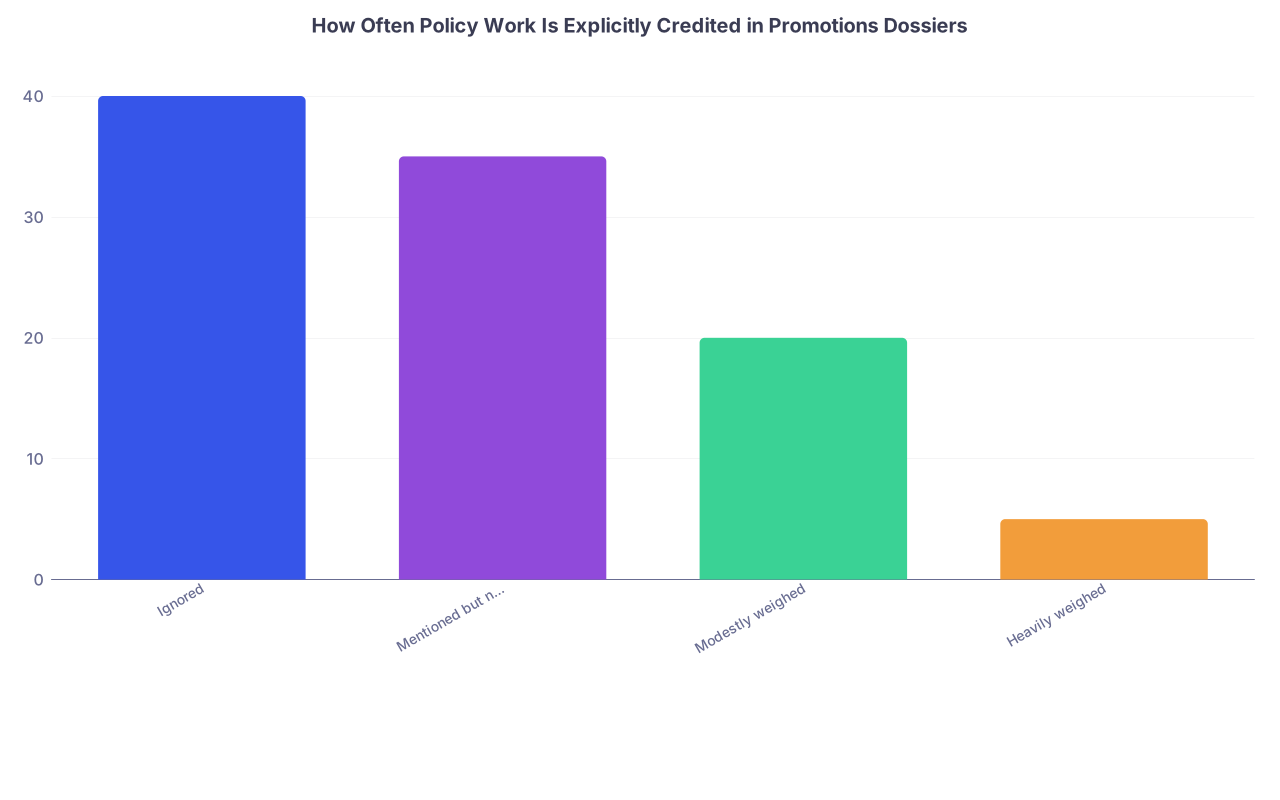
| Category | Value |
|---|---|
| Ignored | 40 |
| Mentioned but not weighed | 35 |
| Modestly weighed | 20 |
| Heavily weighed | 5 |
The rough reality from what I’ve seen: in the majority of mid-tier institutions, policy work is either ignored or politely acknowledged with no real weight. Only a small fraction of places—and candidates—get it to count heavily.
Conversion Rule #3: Your department chair understands and cares
You can do everything “right” and still be sunk by one thing: a chair who doesn’t get policy.
I’ve sat through those internal calibration meetings where division chiefs prep cases:
- Chair A: “Dr. X’s work on firearm policy has shaped state legislation, and she’s become a go-to national expert. Here are the papers, here are the national talks, here are the funded evaluations.”
- Chair B: “Dr. Y is passionate about advocacy. She does a lot of work with community groups and has spoken at the city council. Her publication record is modest but she’s very committed to equity.”
Guess who gets taken seriously?
Same “policy” theme. Very different framing. The first sounds like institutional value. The second sounds like extracurriculars.
If your chair is from an old-school lab science world and views policy as “interesting but not real scholarship,” you’ll have to work twice as hard to translate your contributions into a language that carries weight.
How Different Tracks Treat Policy Work
Not all tracks are equally hostile to policy work. Some quietly reward it. Others pretend to be flexible but punish you later.
| Track | Policy Work Value If Unpackaged |
|---|---|
| Tenure / Research | Low (unless tied to grants/papers) |
| Clinician-Educator | Low–Moderate (if linked to curriculum / guidelines) |
| Clinician-Scholar / Practice Track | Moderate (if regional/national impact) |
| Public Health / Health Policy Dept | High (if measurable impact) |
Tenure / Research track
This is the harshest environment for policy work. On this track, policy is a supplement, not a core currency. You’re still judged by:
- Papers (volume and quality)
- Grants (especially as PI)
- National visibility in academic circles
Policy influence is only helpful if you can say: “My policy work is a direct extension of my funded research program.” If instead it looks like a side hobby, it can actually hurt you by raising the question: “Why are they not publishing more?”
I’ve seen files where the committee essentially said: “Impressive advocacy. But if they spent that time writing two more high-impact papers, they’d be over the bar.”
Clinician-educator tracks
These tracks are marketed as “perfect for people interested in advocacy, teaching, and service.” Reality is more nuanced.
Policy work helps here when:
- It translates into curricular contributions (e.g., a health policy course you designed, clinical guidelines you helped write that are used in teaching)
- It creates institutional programs (e.g., a new clinic model tied to a policy change, QI projects aligned with regulations)
If it stays external—city commissions, national advocacy groups, op-eds—it’s admired but not consistently weighed.
Public health schools and actual “policy” departments
This is where policy work can carry real weight. At places like Harvard Chan, Johns Hopkins Bloomberg, UNC, or departments of health policy and management, the culture is different.
But even there, the pattern holds: the policy work that “counts” is the work that can be traced to:
- Rigorous evaluation
- Clearly documented causal links to change
- Multi-year programs, not one-off events
You’ll still be asked: “What is your program of scholarship?” Not just “What good did you do?”
How to Make Policy Work Promote-Ready
Let me spell out what people who successfully braid policy and promotion do differently. This is the part most mentors either hand-wave or don’t actually know how to operationalize.
1. Design policy work like a research program from day one
Do not treat policy work as community service. Treat it as a program of scholarship that happens to operate in political and social space.
Before you say yes to that task force or advisory council, ask yourself:
- What papers can come out of this?
- What data will we generate or access?
- Can this align with a grant proposal I’m writing or could write?
- Will this give me a seat that’s more than token—real influence and authorship opportunities?
If the answer to all of those is “no,” it might still be meaningful ethically, but it will not move your promotion file.
2. Convert everything into artifacts
Promotion committees don’t care what you say you did. They care what’s on paper.
For every significant policy activity, you need artifacts:
- Policy briefs you wrote or co-wrote
- White papers with your name in a clear place
- Official letters of appointment (to commissions, councils, boards)
- Documentation of leadership roles (chair, lead author, principal investigator)
- Media coverage where you were the primary expert, not a random quote in paragraph 12
These become appendices. External letter writers then reinforce: “Dr. ___ has been instrumental in reshaping ___ policy; here are specific examples.”
3. Actively manage the narrative with your chair
You cannot assume your chair understands your world. You have to coach them.
That means preparing a one-page “Policy Impact Summary” before your promotion cycle:
- 3–5 policy contributions
- For each: what changed, its scale (institutional, city, state, national), and how it links to your scholarship
- Any funding or major publications tied to each contribution
Your chair will lift phrases from that summary for their letter. If you do not provide this, they’ll default to generic flattery: “Dr. X is a passionate advocate for public health and involved in many initiatives.” Fluff. Useless.
4. Choose external letter writers who actually value policy
Another quiet secret: your external referees can make or break how your policy work is interpreted.
If your file goes to someone who only cares about classic R01 metrics, they’ll “damn with faint praise”: “Dr. Y is active in advocacy work but has a modest publication record; this is slightly below the threshold at my institution.”
You want evaluators who:
- Have themselves done policy-relevant work
- Are from departments or schools that value policy impact
- Understand that “impact” is not limited to lab citations
Give your chair a curated list of suggested letter writers with a one-line rationale for each. They still have to pick some independently, but you heavily influence the pool.

| Step | Description |
|---|---|
| Step 1 | Policy Activity |
| Step 2 | Service Only - Low Promotion Value |
| Step 3 | Design for Scholarship |
| Step 4 | Publications |
| Step 5 | Grants or Contracts |
| Step 6 | National Role |
| Step 7 | Stronger Promotion File |
| Step 8 | Is there data or evaluation? |
Most people stop at A and C. The people who actually get promoted because of policy work deliberately build E, F, and G.
Ethical Tension: When Promotion Incentives Clash with Good Policy
You’re in public health policy. So let’s not pretend this is just a career tactics game. There’s an ethical layer here that gnaws at a lot of people.
The incentives of the promotion system can push you toward:
- Work that is easy to publish, not necessarily what communities most need
- Large, abstract datasets instead of messy, local coalition work
- High-profile advisory roles over slow, unglamorous organizing
I’ve watched faculty burn themselves out because they were constantly torn between:
“Do what actually matters to this community right now”
vs.
“Do what will produce the papers and grants I need to survive here.”
You can’t ignore this. But you can be strategic:
- Bundle community-driven work with research designs that can generate publishable insights
- Use “safe” academic outputs to subsidize “riskier” policy efforts
- Say no to purely symbolic roles, even if they sound impressive, if they don’t advance either impact or promotion
And be honest with yourself: if your heart is in policy and you’re at an institution that will never value it, you may be in the wrong place. Some campuses will always see you as “the advocacy person.” That can stall you indefinitely, no matter how much good you do.
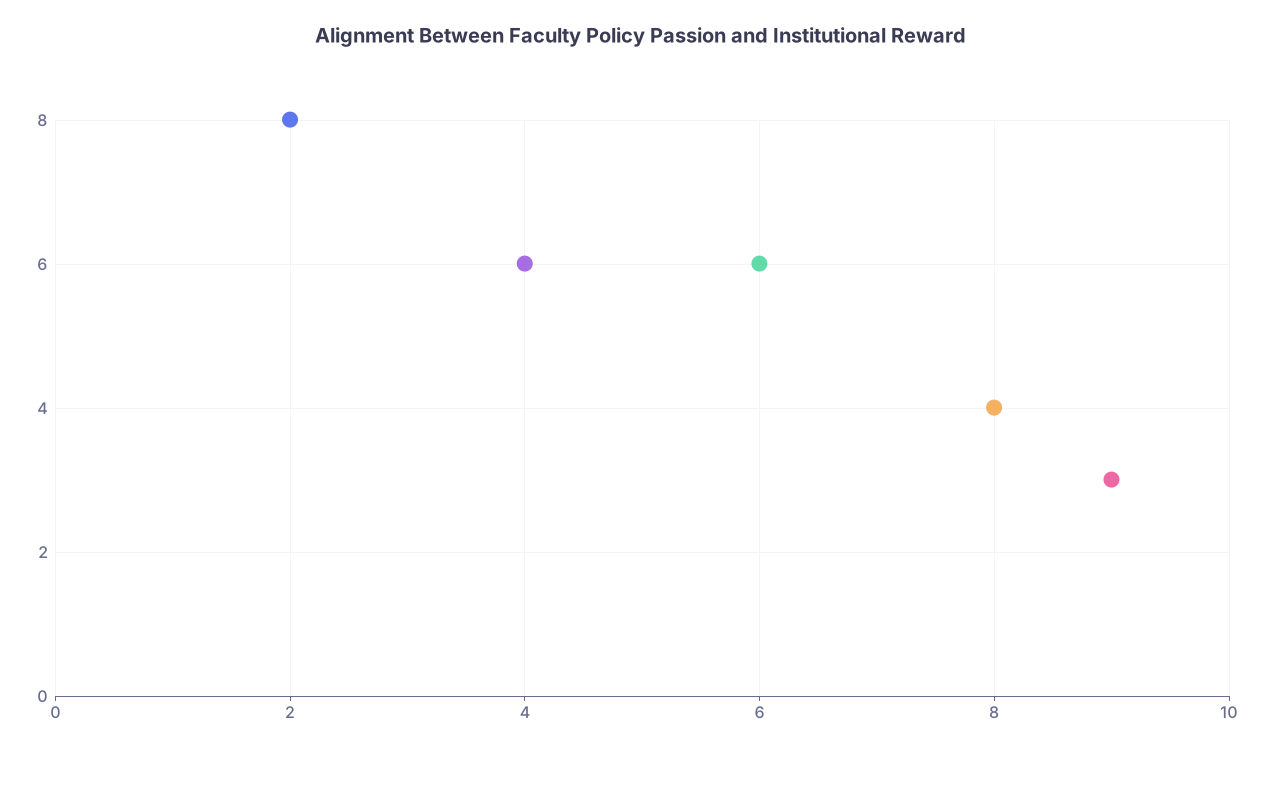
| Category | Value |
|---|---|
| Faculty 1 | 2,8 |
| Faculty 2 | 4,6 |
| Faculty 3 | 6,6 |
| Faculty 4 | 8,4 |
| Faculty 5 | 9,3 |
(Conceptually: the more policy-centered you are, the more you need a place that structurally rewards it. Otherwise, the misalignment becomes painful.)
Quick Reality Checks Before You Go All-In on Policy
Here’s what I’d ask you, bluntly, if we were talking 1:1 and you said, “I want my academic career to be built around policy.”
- On your current track, is policy work explicitly recognized or just “encouraged”?
- Does your department have anyone who actually got promoted on the back of policy work? Name them. What did they do differently?
- Can you point to a program of scholarship tied to your policy interests, or are you doing disconnected one-off things?
- Does your chair talk about your policy work as “strategic” or just “admirable”? Listen carefully to their adjectives. They tell you everything.
If you can’t answer those clearly, you’re flying blind.

FAQs
1. Should I list every committee and advisory group I’m on in my promotion dossier?
No. That’s how your policy work gets dismissed as generic “service.” List selectively. Prioritize roles where you had clear influence, defined responsibilities, and tangible outputs—reports, guidelines, legislative changes. Then spell out, briefly but concretely, what changed because you were there. Ten serious roles beat thirty vague ones.
2. Do op-eds and media appearances help at all for promotion?
They help as secondary evidence of national recognition, especially in health policy departments and schools of public health. They almost never carry weight on their own at traditional medical schools. Package them as part of a narrative: “My research on X led to invited commentary in Y and media engagement that shaped public understanding and informed [policy body].” Otherwise, they’re seen as vanity, not scholarship.
3. Can I succeed on a traditional research track if more than half my time is in policy work?
Not unless that policy work is essentially indistinguishable from a rigorous research portfolio when written up. If more than half your time is in policy and you’re not regularly turning that into grants and high-quality publications, you will look “under-productive” compared to your peers. Either restructure your policy work to generate scholarly output, or consider a track or institution that explicitly values policy impact.
4. How do I know if my institution will ever truly value my policy work?
Look at promotions history, not mission statements. Who got promoted in the last 5–10 years? What did their CVs actually look like? Do any of them have dossiers that resemble the career you want—heavy on policy, moderate on classic lab science? If the answer is no, assume the institution will not suddenly change for you. Either you adapt your strategy, or you start planning your exit to a place where what you care about isn’t treated as a hobby.
Key points: promotions reward what’s easy to count, not what’s ethically satisfying; policy only “counts” when you convert it into publications, grants, and visible leadership; and your chair’s understanding of policy may matter more than your actual impact.