
It’s 7:45 a.m. on a Tuesday. You’re sitting outside the department chair’s office, coffee going lukewarm in your hand, rehearsing your line:
“I wanted to talk about getting some protected time for advocacy work.”
You’ve convinced yourself this is reasonable. Ethically necessary, even. You’ve drafted a one‑pager about Medicaid redetermination or firearm injury prevention or abortion access. You’ve got data on burnout, moral injury, “professionalism in public policy.”
The door opens. The chair waves you in.
You see a friendly face. What you do not see is the mental ledger that’s already flipping open in their head.
Let me walk you through what’s actually happening inside your chair’s brain when you ask for protected time for advocacy—and how to play that game without selling your soul.
The First 10 Seconds: Which Box Are You Going In?
Before you finish the sentence, your chair is categorizing you. They have three or four boxes they use for every “advocacy” ask.
Roughly, the internal monologue goes like this:
“Is this real institutional value or a vanity project?”
Translation: Will this show up on a slide for the Dean, an LCME site visit, or a donor pitch? Or is this you wanting to tweet under the department letterhead?“Who’s going to cover your work?”
Clinics, OR time, call schedules, inpatient blocks. Chairs are always counting heads. Behind every “protected day” is someone else picking up your slack, and they know exactly who those people are.“How risky is this politically?”
Are you pushing for “food security in our patient population” (safe) or stepping into “state-level abortion restrictions” (radioactive for certain institutions)? They’re not just guessing. They’ve gotten emails from legal, compliance, risk management. They know where the landmines are.“Is this about the mission, or is this about your brand?”
Chairs watch the social media. They know who’s doing advocacy, and who’s doing “Advocacy™” for followers, podcast invites, and panel slots.
You might think you’re pitching a moral imperative. Your chair is triaging a resource allocation problem under political constraints.
That’s the gap you have to bridge.
The Chair’s Real Job (That Nobody Explains to You)
You think your chair’s job is to be the moral leader of the department.
That’s the nice version. The actual job is more like:
“Keep the dean and the hospital CEO happy, keep the RVUs and relative rankings up, keep faculty from leaving in droves, and avoid embarrassing headlines.”
Advocacy can help or hurt each of those. That’s why chairs are skittish.
Let’s spell out the competing pressures.
| Pressure | What It Looks Like Day-to-Day |
|---|---|
| Money | RVUs, payer mix, clinic access, OR block utilization |
| Politics | Board, dean, hospital CEO, donors, state legislature |
| Accreditation | LCME, ACGME, Magnet, quality metrics |
| Reputation | USNWR rankings, media coverage, Twitter storms |
| Morale | Burnout, retention, recruitment, gossip mill |
Now drop your ask into that matrix:
“I’d like 0.2 FTE of protected time for health policy advocacy around Medicaid expansion.”
Your chair hears:
- Money: 0.2 FTE less clinic/inpatient. Who covers? What revenue is lost?
- Politics: Are we about to anger the Board chair who donates to the governor?
- Accreditation: Could this look like “community engagement” on a site visit? Might be useful.
- Reputation: Could this lead to an NEJM Perspective, a Washington Post quote, a panel at the AMA? Also useful—if it aligns with leadership.
- Morale: Will others resent that you get time while they grind RVUs?
If you walk in thinking this is about “Is this ethically right?” and they’re thinking “Does this destabilize my already precarious balance?”—you’re going to talk past each other.
What Chairs Secretly Like About Advocacy (Yes, There Is a Sweet Spot)
Here’s the part no one tells you: most chairs actually do like advocacy. In theory. Many went into academic medicine expecting to be part of “changing the system,” then spent 20 years negotiating call schedules and reading budgets.
So there are advocacy projects that make their eyes light up. They just don’t advertise the criteria.
The three flavors of advocacy that chairs love
Brand-safe, metrics-aligned advocacy
Bingo words here:- “health equity”
- “social determinants of health”
- “community engagement”
- “vaccine outreach”
- “gun violence as a public health issue” (depends on your region, but nationally this is getting safer in academic centers)
- “opioid use disorder treatment access”
If it can show up in a USNWR narrative, a grant application, or a diversity and inclusion report, your odds go up.
Grant-backed or philanthropy-backed advocacy
You walk in and say, “I have a foundation interested in supporting 0.2 FTE for a clinician advocate to work on X.” That’s a very different conversation.Translation to chair’s brain: “I can say yes without moving money away from someone’s FTE.” Now we’re talking.
Advocacy that plugs a PR hole
When the hospital has just been roasted in the media—for racial disparities in maternal outcomes, for example—leadership is suddenly thirsty for “visible commitment to change.” If your advocacy fits that problem, you are no longer a cost. You’re a damage-control strategy.
What Chairs Secretly Fear: The Things They Will Not Say Out Loud
Let’s talk about the real anxieties that rarely get named in the meeting—but absolutely shape the answer you get.
1. “You’re going to become uncontrollable”
Chairs have lived through this: a previously low-key colleague gets some national attention as a policy voice. Overnight they’re on NPR, then on a panel with a senator, then tweeting things that have the hospital’s name in their bio while criticizing state policy.
The chair gets:
- a call from the Dean
- an email from Legal
- a “we’re monitoring this” note from Marketing/Communications
Your request for protected time triggers the question:
“Am I investing in a future star and institutional asset—or in someone who will go rogue and drag us into a political war we did not choose?”
If you’re already spicy on social media, they’ve noticed. Do not kid yourself.
2. “I can’t open this door for everyone”
If you’re a second-year attending in EM, asking for 0.2 FTE for advocacy, the chair is imagining what happens when:
- the palliative care doc asks for 0.2 FTE for state-level end-of-life policy
- the OB/GYN asks for 0.2 FTE for reproductive rights
- the addiction psychiatrist asks for 0.2 FTE for harm reduction policy
They can’t give everyone 0.2 FTE. They don’t have the money. Or the political capital.
So they’re calculating: If I say yes to you, how do I justify saying no to the next three?
3. “This might blow back on my promotion”
Chairs still answer to someone. A dean, a CEO, a Board. They’re being judged on departmental stability, finances, and reputation.
If your advocacy creates:
- negative press
- a hostile phone call from a legislator
- a donor threatening to pull a gift
They know exactly who’s going to pay that price. And it’s not you.
How To Walk In Like Someone They Can Safely Bet On
Here’s the part where I stop diagnosing the problem and give you what you actually need: how to structure your ask so a rational chair can say yes.
Step 1: Come in with the “institutional win” already framed
Do not lead with your passion. Lead with their problems.
Try this structure:
- “Our department and hospital are being measured on X (equity metrics, readmissions, access, community engagement).”
- “There’s a clear policy angle tying that to Y (Medicaid, housing, firearm safety, maternal health policy, scope of practice laws).”
- “I’m already doing Z activities (testimony, op-eds, collaborations with state medical society). I’d like to formalize this as a departmental asset.”
You’re not an idealist asking for a subsidy. You’re proposing a defined role that advances stated institutional goals.
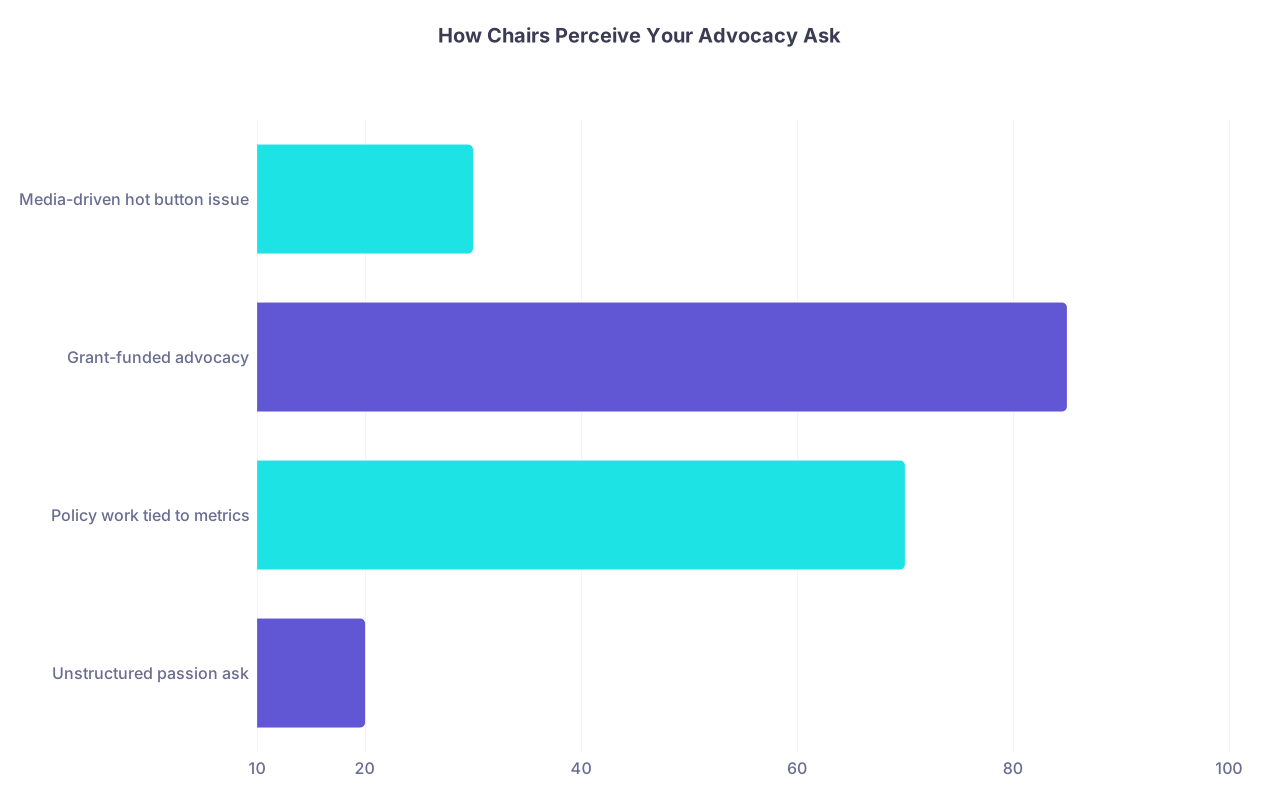
| Category | Value |
|---|---|
| Unstructured passion ask | 20 |
| Policy work tied to metrics | 70 |
| Grant-funded advocacy | 85 |
| Media-driven hot button issue | 30 |
Step 2: Be explicit about workload tradeoffs
The fastest way to a “no” is to act like 0.2 FTE appears from the sky.
Walk in already having thought about the coverage problem:
- “My clinic volume is 8 half-days a week. I’m proposing to shift one clinic half-day into protected advocacy time, and I’ve spoken to X who is open to increasing their clinic by a half-day if their FTE is adjusted.”
- “On inpatient, I currently take 1 in 5 weeks as attending. I’d be willing to move to 1 in 6 for a proportional FTE shift if we can define this role.”
You do not need to fully solve it. But you do need to show you understand someone else pays for your time. And that you’re not blind to that.
The chairs I know visibly relax when a junior faculty walks in and says, “Here’s who I’ve spoken with about coverage and what could work.” That’s adult behavior. They’ll meet you halfway.
Step 3: Define deliverables like you’re writing a grant
Vague advocacy is a chair’s nightmare. Concrete advocacy is a relief.
Spell it out:
- 3 invited talks for state societies
- 2 policy briefs co-branded with the department
- X number of legislative meetings per quarter
- Submissions of op-eds with department affiliation to Y outlets
- 1 annual report summarizing policy impact, media reach, and alignment with hospital priorities
This is not overkill. This is how you convert “this person wants time off clinical duties” into “this is a program with outputs I can sell upstairs.”
Step 4: Make the politics explicit, not invisible
Do not pretend your topic is neutral if it isn’t. Chairs hate surprises more than they hate controversy.
Say it out loud:
“This work intersects with [gun policy / abortion / immigration / policing]. I’ve reviewed our institutional policies on public statements and affiliations. Here’s how I plan to conduct this under the institution’s name versus my personal capacity.”
If you proactively separate “me as faculty member” from “me as private citizen” and show you know when not to drag the hospital logo into a fight, you lower their blood pressure. Dramatically.
Institutional Reality Check: Where You’re Asking Matters
You already know politics vary by geography. What most residents and early attendings don’t appreciate is how much the governance structure of your institution changes your odds.
| Institution Type | Advocacy Risk Tolerance |
|---|---|
| Private academic, no religious affiliation | Highest |
| Public academic in blue state | High |
| Public academic in purple state | Mixed, very topic-dependent |
| Religious-affiliated health system | Low to very low |
| Community hospital system | Highly variable, often CEO-driven |
At a place like UCSF or Boston Medical Center, a chair can plausibly sell your Medicaid policy work as part of the core mission. At a Catholic health system in a conservative state, anything around reproductive health, LGBTQ+ issues, or harm reduction is going to be radioactive in certain rooms. Your chair knows this. You should too.
So you adjust:
- Same underlying ethic
- Different branding and framing
- Sometimes, different sponsoring entities (e.g., do work via the county medical society, a nonprofit, or a professional association rather than the hospital itself)
The Ethics Piece: Are You Compromising or Being Strategic?
Let’s talk personal ethics, because that’s the subtext of most of these questions.
You’re torn between:
- “I have a moral obligation to speak clearly about injustice.”
- “I work in a system that can fire me, block my promotion, or quietly sideline me.”
The mistake I see early-career people make is going binary. Either:
- They play it completely safe, become bland, and hate themselves.
- Or they go maximalist on social media, get labeled as “difficult” or “a liability,” and discover that opportunities dry up in ways nobody puts in writing.
There is a third path: disciplined, strategic advocacy.
That looks like:
- Knowing exactly which fights need your institutional letterhead and which do not.
- Conserving your “controversy capital” for issues where your voice and identity genuinely move the needle, not every outrage-of-the-day.
- Building a track record of competence, reliability, and collegiality so that when you push hard, people believe you’re doing it for the right reasons, not clout.
And yes, there’s some compromise. Welcome to adulthood in a captured healthcare system.
The ethical line I use is this:
Are you aligning your words and energy with patient welfare and professional integrity—even if you’re sometimes moderating the volume or changing the channel?
If yes, you’re not selling out. You’re choosing tactics.
How To Time the Ask (This Matters More Than You Think)
Same ask. Different week. Different answer.
Chairs live in cycles you don’t see clearly: budget season, promotion season, accreditation visits, scandal cleanups, donor campaigns.
Best times to ask for advocacy-related protected time:
- Right after the institution gets bad press on a health equity or access issue
- Right after a major policy change (Medicaid unwinding, new restrictive state law) where leadership has publicly said, “We are committed to …”
- During strategic planning cycles, when they’re forced to produce bullet points about “community engagement” and “population health”
Worst times:
- End of fiscal year when they’re trying to close a budget gap
- Right after a faculty member elsewhere blows up in the media and leadership is in damage-control mode
- When the chair is in year 1 and still terrified of making politically risky moves
Pay attention. You hear more than you think on service, in meetings, on those rambling emails from the Dean.
If They Say No: Reading the Subtext
You walk out with a “no.” Or a “not now.” That tells you something.
There are really only four meanings:
“We literally don’t have the money.”
Common in small departments and RVU-obsessed systems. Signal: they’re cutting other things too. People lose admin time, research support shrinks. This is structural, not about you.“Your topic is too hot for this institution.”
They’ll talk around this with words like “sensitive,” “complex environment,” or “we have to be careful.” Believe them. They’re not lying.“We don’t see you as the one to do this.”
Hard truth. Maybe they don’t think you’re ready, or they’d rather back a full professor with an endowed chair. This is ego-bruising, but it’s real. You may need more academic or leadership capital first.“I personally don’t care about this.”
Some chairs are just not wired for advocacy. They came up on pure RVUs and R01s. They can’t see what you see. That usually doesn’t change.
Your response depends on which you’re dealing with:
- Structural money problem? Look for external funding (foundations, societies).
- Too-hot topic? Shift where you do the work (professional orgs, non-profits) and build personal credibility off-campus.
- “Not you”? Ask directly: “What would you need to see from me, over what timeframe, to reconsider?” Then decide if that’s worth it.
- Chair doesn’t care? You might outlast them. Or you might need to move.
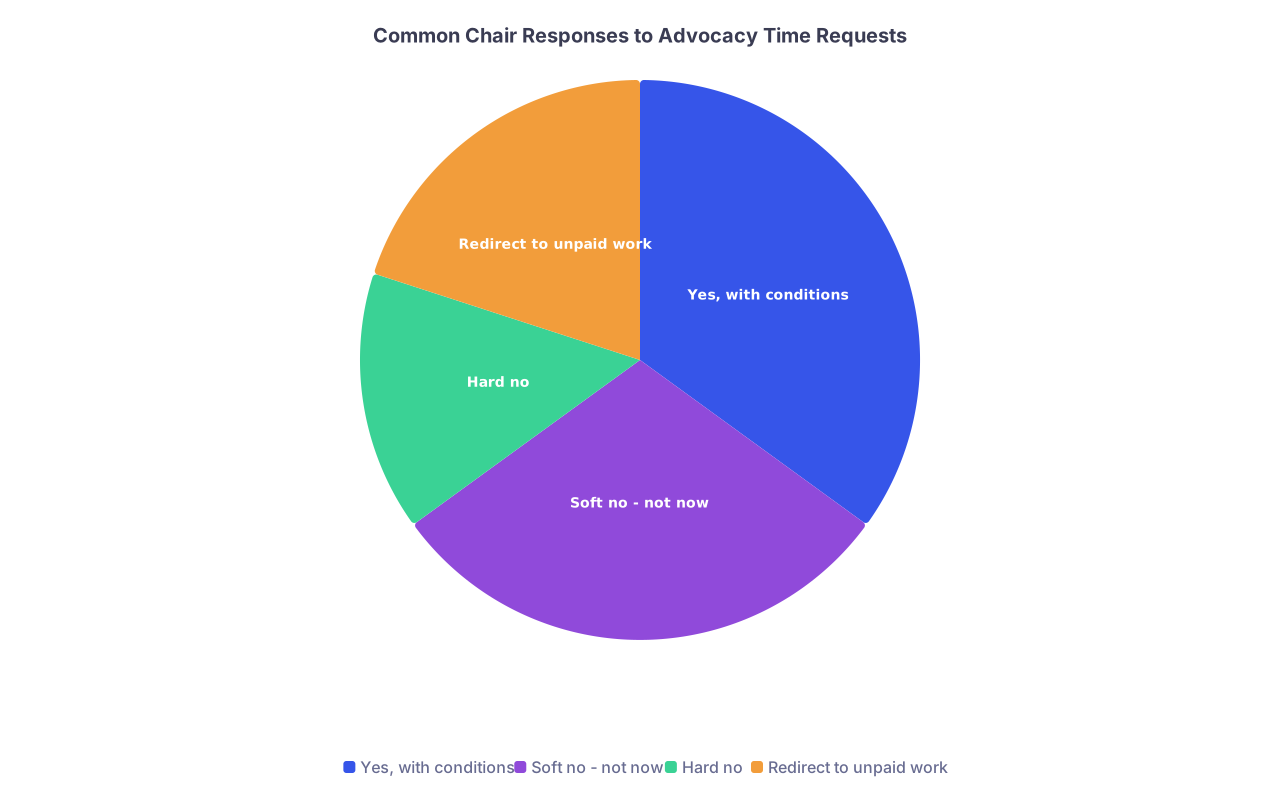
| Category | Value |
|---|---|
| Yes, with conditions | 35 |
| Soft no - not now | 30 |
| Hard no | 15 |
| Redirect to unpaid work | 20 |
FAQ: What People Usually Ask Me After This Conversation
1. “Should I do advocacy under my own name only and keep the institution out of it?”
Early on, that’s often the safest way to start. Use your personal affiliations (professional societies, nonprofits, local coalitions) rather than the hospital logo. Build a portfolio: testimony, op-eds, invited talks. Later, when you have a track record and some rank, you can go back and argue that formalizing this under the department banner benefits them. Having already shown you can handle media and policy spaces without creating messes is your best credential.
2. “Is it career suicide to push for controversial issues like abortion or policing?”
It can be, if you’re reckless and completely ignore your environment. But I’ve watched people build entire careers in those spaces. The consistent pattern: they’re technically excellent in their clinical/research work, they’re disciplined in public messaging, and they deliberately cultivate allies with power (section chiefs, deans, external organizations). If your institution is fundamentally misaligned with your core advocacy, though, the long-term play is usually to move—not to spend a decade banging on a locked door.
3. “What if my chair says they support advocacy but won’t give time or resources?”
Then they support advocacy the way people support “work-life balance”—as a slogan, not a commitment. Treat that as defined reality, not a misunderstanding. Do the work you can sustain without burning out, document it for your CV, and look for ecosystems (centers, institutes, other departments, or even other universities) that put real dollars and FTE behind these activities. Words are cheap. Budget lines are not.
4. “How much advocacy can I realistically do without any protected time?”
Enough to build a foundation, not enough to change the world alone. Think 5–10% of your effort: one clinic afternoon a month spent on policy meetings, one op-ed or brief a year, a couple of key hearings or coalitions you commit to. The mistake is trying to run a full advocacy portfolio on top of 1.0 FTE clinical; that’s how people flame out and become cautionary tales. Start small, strategic, and sustainable—then use visible wins to justify the next ask.
Two things to take away.
First, your chair isn’t the enemy. They’re running a political and financial maze you barely see. If you walk in speaking their language—deliverables, coverage, risk—they’re far more likely to help you than to block you.
Second, don’t confuse resistance with a verdict on your ethics. Sometimes you’re just asking the wrong person, at the wrong time, in the wrong building. Your obligation to patients and to justice doesn’t vanish because a chair says no. It just means you have to be smarter about where, and how, you fight.