
You fire off a tweet between consults.
A new public health policy drops. Mask guidance, abortion restrictions, a vaccine allocation plan. You feel your blood pressure spike. You type a sharp, righteous 240-character response, hit “post,” and go back to rounds.
By lunch, your mentions are chaos. A screen-shotted reply is circulating in a Facebook group with your hospital’s name tagged. A resident texts: “Uh… are you seeing this?” That one tweet—meant as advocacy—now looks like a professional liability.
This is how it happens. Not with a conspiracy thread. Not with hate speech. With one “borderline” tweet that did not feel borderline in the moment.
Let me be clear: physicians and public health professionals must speak up on policy. Staying silent has its own ethical cost. But there are specific, predictable mistakes that make advocacy tweets backfire—professionally, ethically, and sometimes legally.
You are here to avoid those.
1. Confusing “Being Right” With Being Professional
You can be medically correct and still ethically wrong in how you say it.
I have watched perfectly valid policy critiques turn into disciplinary cases because the tone was contemptuous or demeaning. The science was fine. The professionalism was not.
Typical self-sabotaging tweets look like:
- “Any politician supporting this is an idiot who has never read a single paper on X.”
- “If you oppose this vaccine, you are a selfish, uneducated moron.”
- “These parents are killing their kids with their ignorance.”
The mistake: assuming that professional ethics care only about accuracy, not about respect, power dynamics, or the impression you create as a physician.
Common consequences:
- Patient complaints to your hospital or licensing board
- Screenshots forwarded to department chairs or deans
- “Unprofessional behavior” flagged in credentialing or promotion discussions
How to avoid this:
- Attack the policy, not the person
- Bad: “These legislators are criminals.”
- Better: “This bill undermines evidence-based care and will increase preventable deaths.”
- Replace character insults with outcome language
- “This decision is harmful” beats “You are horrible.”
- Read your tweet as if you are a scared patient, not a colleague
If a vulnerable patient saw this, would they still feel safe being honest with you?
A simple rule: if your tweet would look ugly as a screenshot in a licensing board letter, do not post it.
2. Forgetting the “Physician Hat” Is Never Fully Off
You think you are tweeting “as a private citizen.” That line will not save you.
Boards, hospitals, and the public do not distinguish cleanly between your personal and professional personas when your bio says: “MD, Pediatrician, University of X,” or you tweet about cases from your clinic. Once your professional identity is linked to the account, your “just my opinion” disclaimer has almost no protective value.

Big mistake patterns:
- Adding your hospital or health system in your bio, then posting harsh partisan content
- Listing your credentials (“Cardiologist, MPH”) and presenting speculation as expert consensus
- Posting clinic stories, then switching to aggressive political takes in the same thread
Ethically, once you use your credentials to lend authority to your policy commentary, you owe the public higher standards of accuracy, balance, and civility. That is not optional.
How to avoid this:
- Decide what your account is:
- Professional advocacy account (tied to your name and role)
- Personal, semi-anonymous account (minimal identifiers, still ethically constrained)
But do not pretend they are the same thing.
- If you use your credentials:
- Stick closely to your area of expertise
- Separate “here is my expert view” from “here is my personal political view”
- Assume any tweet can be printed and placed in front of:
- Your program director
- Your future promotion committee
- A malpractice jury
If that image worries you, adjust what you post.
3. Violating Confidentiality Without Realizing It
Nobody posts, “Here is my patient’s name and diagnosis.” That is not the main risk. The real trap is thoughtless “anecdote advocacy.”
Typical backfiring tweets:
- “Had a 16-year-old girl today, pregnant after rape, now blocked from abortion because of this law. She cried the whole visit. This is what this policy does.”
- “Just intubated an unvaccinated dad with three kids at home. I am so tired of this. This is on our leaders.”
- “Our ICU is full of (small rural town) elders who could not get Paxlovid due to this ridiculous pharmacy rule.”
You think you de-identified the patient. You probably did not. Combine age, location, hospital, timing, and context—people can recognize themselves or family.
That complaint email to your chief? It often starts with: “I know this is about me/my wife/my dad because…”
How to avoid this:
- Change three or more non-clinical details every time
Age, timing, non-essential demographics, or the exact setting. Do not mention your clinic name + town + specific situation together. - Ask yourself: could anyone in that patient’s circle plausibly identify them from this tweet? If yes, do not post.
- Advocate using aggregates and patterns, not single, fresh cases:
- “New abortion restrictions have already disrupted care for multiple adolescents in our region” rather than “this morning I saw a 16-year-old from X.”
- Wait.
Do not tweet in the same week as a case that upset you. Emotional immediacy is the enemy of privacy.
Once you breach trust publicly, it is almost impossible to repair.
4. Performing Outrage Instead of Doing Advocacy
There is a difference between venting and advocating. Twitter rewards venting. Your professional obligations do not.
Common mistake: using exaggerated, absolutist language that feels good in the moment and detonates later.
- “This policy is literally genocide.”
- “Every doctor who follows this law is complicit in murder.”
- “Public health has completely lost its mind. Nothing they say is trustworthy.”
These perform well with your followers. They also:
- Undermine public trust in all health guidance, not just the bad policy
- Trap your colleagues who must work within constraints you are dismissing
- Give ammunition to bad-faith actors who claim, “See? Even doctors think public health is a scam.”
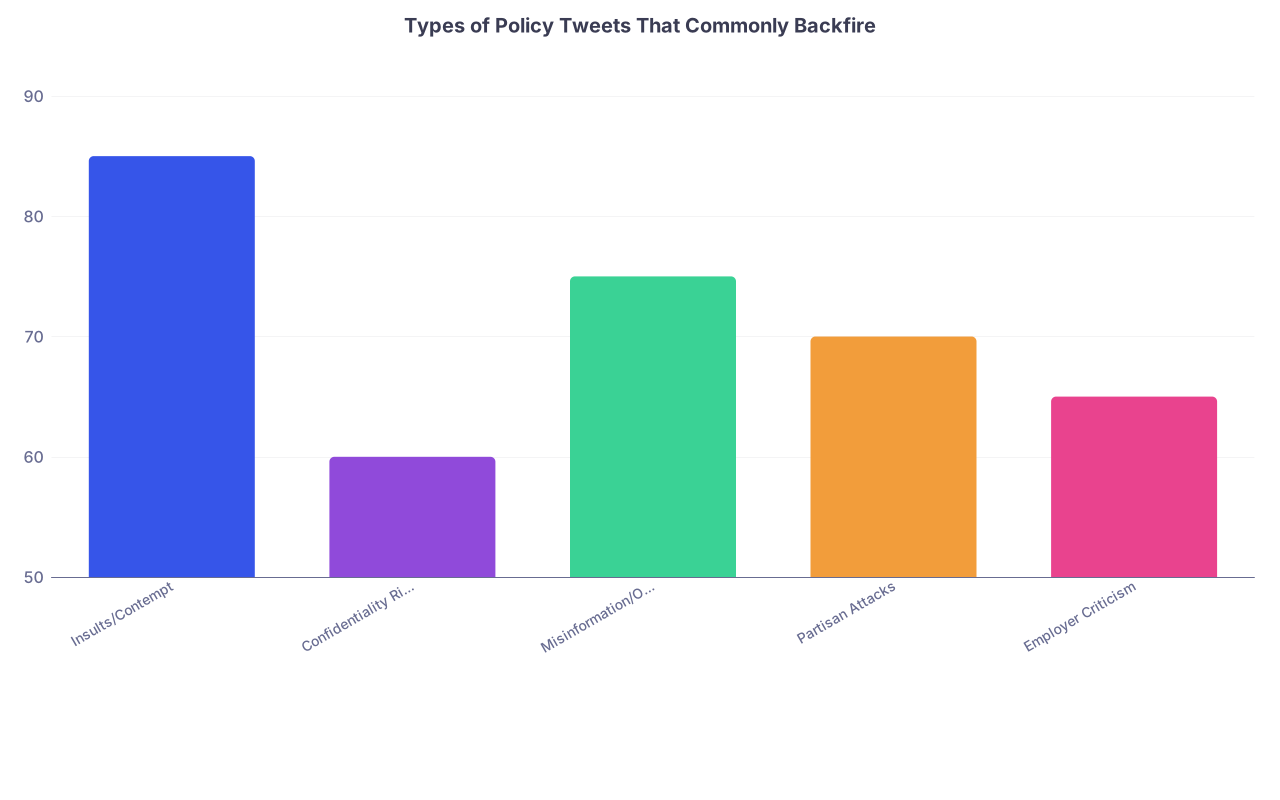
| Category | Value |
|---|---|
| Insults/Contempt | 85 |
| Confidentiality Risks | 60 |
| Misinformation/Overstatement | 75 |
| Partisan Attacks | 70 |
| Employer Criticism | 65 |
How to avoid this:
- Reserve extreme moral language for situations that truly meet that bar
If everything is “genocide,” the word stops meaning anything—ethically and politically. - Replace absolutist statements with precise claims:
- Instead of “public health cannot be trusted,” use “this guideline conflicts with current evidence on X and requires revision.”
- Ask yourself: “Does this tweet help someone understand the issue better or just show how angry I am?”
Outrage might be justified. Twitter is not therapy. If you need to vent, do it in a private chat, not as your public-facing advocacy.
5. Mixing Clinical Advice With Policy Rants
Dangerous combo: you are mad about a policy, you are a doctor, and someone in the replies asks, “So what should I do?” You answer.
This is where people stumble into:
- Unlicensed telemedicine
- Off-the-cuff advice that contradicts local resources
- Statements that look like you are telling people to ignore laws or public orders
Examples:
- “If your hospital refuses to provide this abortion, just lie and say X.”
- “Those isolation rules are nonsense; if you feel okay, you can go back to work.”
- “That ban is illegal—just keep prescribing, they cannot enforce it.”
Ethically and legally, this is a mess. You’ve blurred the line between general commentary and individualized guidance, possibly encouraging illegal or unsafe behavior.
How to avoid this:
- Draw a bright line in your replies:
- “I cannot give personal medical advice on social media. Talk to your own clinician.”
- “I am discussing policy and evidence, not individual care decisions.”
- Keep to general statements:
- “People in this situation should speak with trusted clinicians and, where available, legal counsel.”
- Never explicitly advise people to lie, deceive, or break law. You can criticize the law vigorously. You do not need to coach people on evasion.
Remember: tweets get screenshotted and read without context. “It was just a reply” will not matter.
6. Platforming Misinformation While “Dunking On It”
Quote-tweeting something ridiculous with, “This is pure nonsense” feels like “fighting misinformation.” Often, you just amplified it.
Classic mistake:
- Sharing conspiratorial or fringe claims to mock them, inadvertently exposing them to a much larger audience.
- Engaging in long, public arguments that keep the misleading post circulating in timelines.
- Linking directly to low-quality, harmful content you want to condemn.
From an ethics standpoint, you are still responsible for what you boost, even if you disagree with it.

How to avoid this:
- Describe, do not link, when calling out harmful narratives:
- “Some are claiming X. Here is why that is false,” instead of quote-tweeting the original.
- If you must show an example, use screenshots with identifiers cropped, not retweets that drive traffic.
- Focus on prebunking and education:
- Explain what the evidence actually says.
- Teach people how to recognize similar misleading patterns in the future.
Your goal is to starve bad information of oxygen, not become its best promoter.
7. Turning Advocacy Into Partisan Loyalty Tests
A policy is not automatically good because “your side” proposed it, nor automatically evil because “their side” did. But tweets rarely show that nuance.
Mistake patterns:
- Equating disagreement with a specific policy to being “anti-science”
- Calling colleagues “traitors” or “sellouts” if they raise legitimate concerns about implementation details
- Sharing partisan talking points framed as medical consensus
Ethically, your duty is to:
- Patients
- Public health
- Evidence
Not to a party or politician.
When your advocacy account reads like a campaign surrogate, you lose credibility with patients across the political spectrum. And you make it harder for colleagues to see your critiques as grounded in data rather than loyalty.
How to avoid this:
- Criticize and praise across partisan lines when the evidence calls for it.
If you never find fault with “your side,” that is a red flag. - Center patients and outcomes:
- “This provision will reduce access to insulin for low-income patients” instead of “Typical [party] cruelty.”
- Do not use your MD to launder party messaging. Link to primary data, not campaign graphics.
You are allowed a personal political identity. Just do not pretend it is synonymous with medical ethics.
8. Publicly Attacking Your Own Institution Without a Plan
There are times when public whistleblowing is necessary. But most policy-adjacent complaints about your hospital or health department are more impulsive than strategic.
Tweets that age very badly:
- “My hospital is full of cowards who refuse to stand up against this mask policy.”
- “Administration is lying; we have no PPE and they do not care if we die.”
- “We are secretly out of ICU beds and they’re hiding it from the public.”
Even if the problems are real, blasting them without:
- Internal attempts to fix
- Documentation
- Protection can backfire on you fast.
| Situation Type | First Step | When Public Tweet Might Be Justified |
|---|---|---|
| Policy confusion/miscommunication | Talk to supervisor | Almost never |
| Safety issue (PPE, staffing) | Incident report/OH&S | After formal channels fail |
| Data manipulation or fraud | Compliance/legal | As last resort, with legal advice |
| Illegal patient care barriers | Ethics committee | Only when internal escalation blocked |
How to avoid this:
- Use internal channels first:
- Ethics committee, graduate medical education office, occupational health, union (if you have one).
- Document concerns privately (emails, memos) before blasting anything publicly.
- If you’re considering public whistleblowing:
- Get advice from a lawyer or trusted mentor.
- Be factual, specific, and avoid defamation-level claims.
- Consider whether revealing certain internal details could breach patient confidentiality indirectly.
“Speaking truth to power” sounds great until you are unemployed and under investigation because you did it impulsively and sloppily.
9. Tweeting in Real Time While Emotionally Flooded
Most catastrophic advocacy tweets share one thing: they were written immediately after something enraging.
- A devastating case
- A harmful law passing at 11 pm
- A disgusting comment from a politician
You are flooded. Your prefrontal cortex is offline. Twitter is right there.

| Step | Description |
|---|---|
| Step 1 | Trigger - Policy news or case |
| Step 2 | Draft offline and wait 12-24 hours |
| Step 3 | Edit to remove and depersonalize |
| Step 4 | Post with awareness and save copy |
| Step 5 | Emotion level calm enough? |
| Step 6 | Contains insults or patient details? |
| Step 7 | Would you be OK seeing this in a board letter? |
This is when people:
- Insult patients
- Call colleagues “cowards”
- Use extreme analogies they would never defend calmly
Then they delete. But deletion does nothing once screenshots exist.
How to avoid this:
- Use the drafts folder:
- Type the furious tweet. Save as draft. Walk away.
- Have an “ethics buddy”:
- One colleague who previews any tweet on sensitive topics when you’re heated.
- Create a personal rule:
- No posting advocacy tweets after a night shift, after a bad code, or after more than one drink.
Your best advocacy will not come from your worst emotional state.
10. Overstating the Evidence Because It Matches Your Politics
This is a quieter ethical failure, but it is common.
You want a policy outcome. So you:
- Cite preliminary or weak data like it is conclusive
- Ignore uncertainty and confidence intervals
- Tweet “Studies show X” when you mean “one preprint suggests X”
Once people see you exaggerate for “your” policies, they are justified in distrusting you on everything else.
How to avoid this:
- Use calibrated language:
- “Early data suggest…”
- “So far, studies show an association, not causation.”
- Link directly to primary sources, not only opinion pieces that summarize those sources.
- When the evidence is mixed, say so.
“There is evidence on both sides, but from an ethical standpoint, I support…”
Your professional credibility is your main asset. Do not burn it for retweets.
11. Ignoring Power Dynamics and Lived Experience
Physicians and public health professionals hold institutional power whether you feel powerful or not. When you tweet about policy, you are not just “a person with an opinion.” You are someone whose words can shape norms and harm groups already marginalized.
Common ethical missteps:
- Dismissing community concerns about surveillance, policing, or medical mistrust as “anti-science”
- Talking over experts in racism, disability, or reproductive justice while claiming “the data” says otherwise
- Framing policy trade-offs as purely technical when they are deeply values-based
You may not intend harm, but ethically, you are accountable for foreseeable impacts.
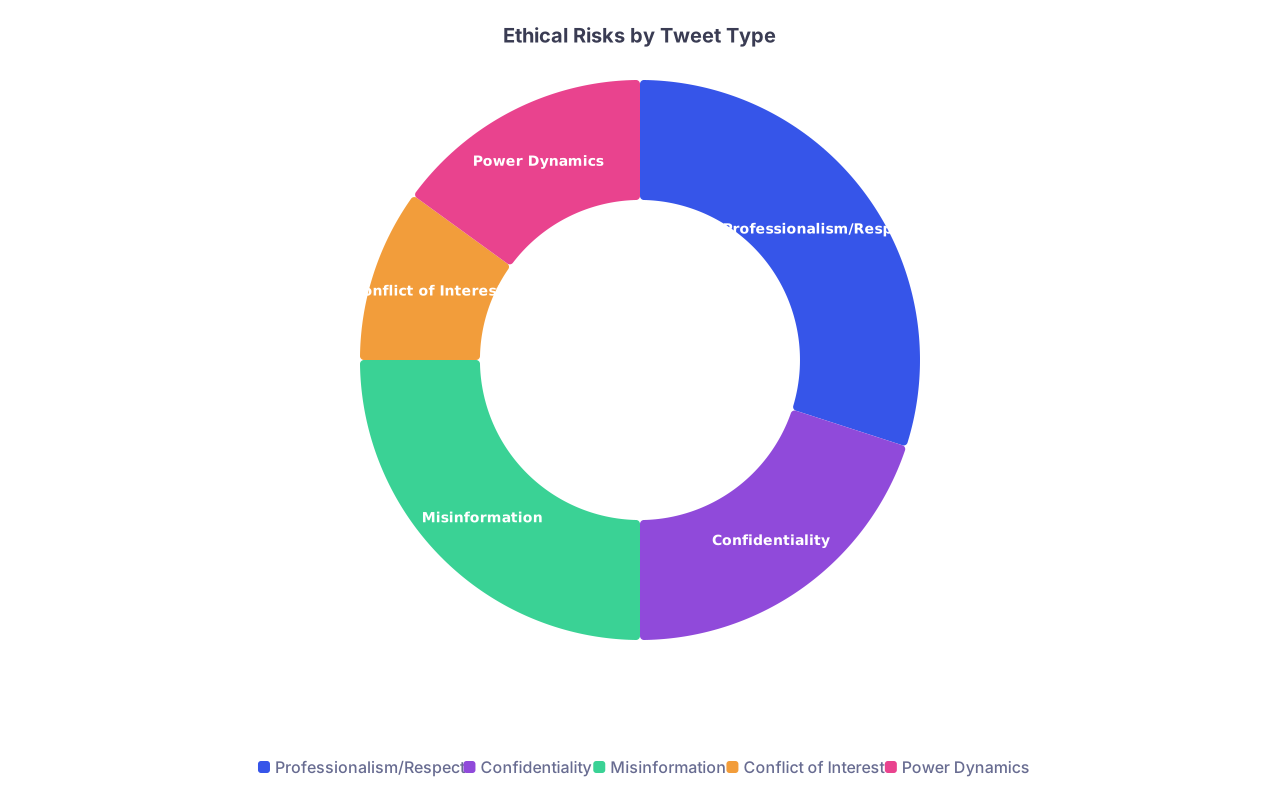
| Category | Value |
|---|---|
| Professionalism/Respect | 30 |
| Confidentiality | 20 |
| Misinformation | 25 |
| Conflict of Interest | 10 |
| Power Dynamics | 15 |
How to avoid this:
- Before tweeting about policies that heavily affect specific communities:
- Ask: “Whose voices should be centered here, and am I amplifying or replacing them?”
- Use your platform to boost experts and advocates from impacted groups, not just your own take.
- Admit limits:
- “As a clinician, I see this from the health side, but people living this policy may see other harms I don’t.”
Humility is not optional in ethical advocacy.
12. Treating Online Advocacy as a Substitute for Real Work
The last mistake is more subtle but corrosive: mistaking visible outrage for actual change.
If your policy engagement consists mainly of:
- Sharing hot takes
- Joining pile-ons
- “Raising awareness” without follow-through
…then you are at risk of ethical self-deception: feeling like you have fulfilled your duty to justice while contributing little beyond noise.
This matters because:
- You burn out on performative conflict instead of building coalitions.
- You discourage others who might engage in more constructive ways.
- You become cynical when, shockingly, the 12 angry threads did not change the law.
How to avoid this:
Use Twitter as:
- An entry point:
Identify organizations, coalitions, and campaigns doing grounded policy work. - A complement:
Tweet about a bill and call your representatives, join professional society advocacy, show up for testimony. - A tool for targeted things:
- Explaining complex evidence in understandable language
- Sharing stories with consent and safeguards
- Coordinating with colleagues on statements and open letters
Tweets are cheap. Ethical advocacy is not.
Key Points to Remember
- Professional identity follows you online. Accuracy is not enough; tone, respect, and confidentiality standards still apply.
- The fastest backfires come from impulsive, emotionally charged tweets—especially those that insult, disclose too much, or exaggerate evidence.
- Use your platform for clear, honest, patient-centered advocacy, not partisan loyalty, venting, or performance. Your future self—and your patients—will be much better off.