The biggest myth about hospital policy is that residents have no real power. That’s wrong.
They don’t have formal power. But behind closed doors, resident voices are one of the most dangerous—and useful—forces in the building. Program directors know it. Chiefs know it. The CMO definitely knows it. You just don’t see the levers they’re actually pulling.
Let me walk you into the rooms you aren’t invited to yet and show you how this really works.
The Rooms Where Residents Actually Matter
Here’s the first truth: your impact on hospital policy almost never starts in a big boardroom with the CEO. It starts in smaller, slightly depressing conference rooms with stale coffee and too many laptops.
There are a few rooms where resident voices carry more weight than you think:
- GME Committee meetings
- Patient safety / quality improvement (QI) meetings
- Morbidity & Mortality (M&M) when leadership is present
- Duty hours and wellness task forces
- Union or resident council strategy sessions (where they exist)
You won’t be told this explicitly, but leadership relies on residents for three things:
- Unfiltered reality from the front lines
- Early warning on dangerous policies
- Cover and legitimacy when they already want to change something but need “grassroots support”
At a mid-sized academic center I work with, the resident member of the GME committee is the person who single-handedly stopped a disastrous “ED boarding solution” that would have parked admitted patients on resident-run hall beds all night. Not because she had formal veto power. Because she calmly said, “If you do this, we will absolutely blow your duty hours and PRN orders will skyrocket. I’m happy to send you the incident reports when it happens.” The CMO backed off. They knew she was right, and they did not want that paper trail.
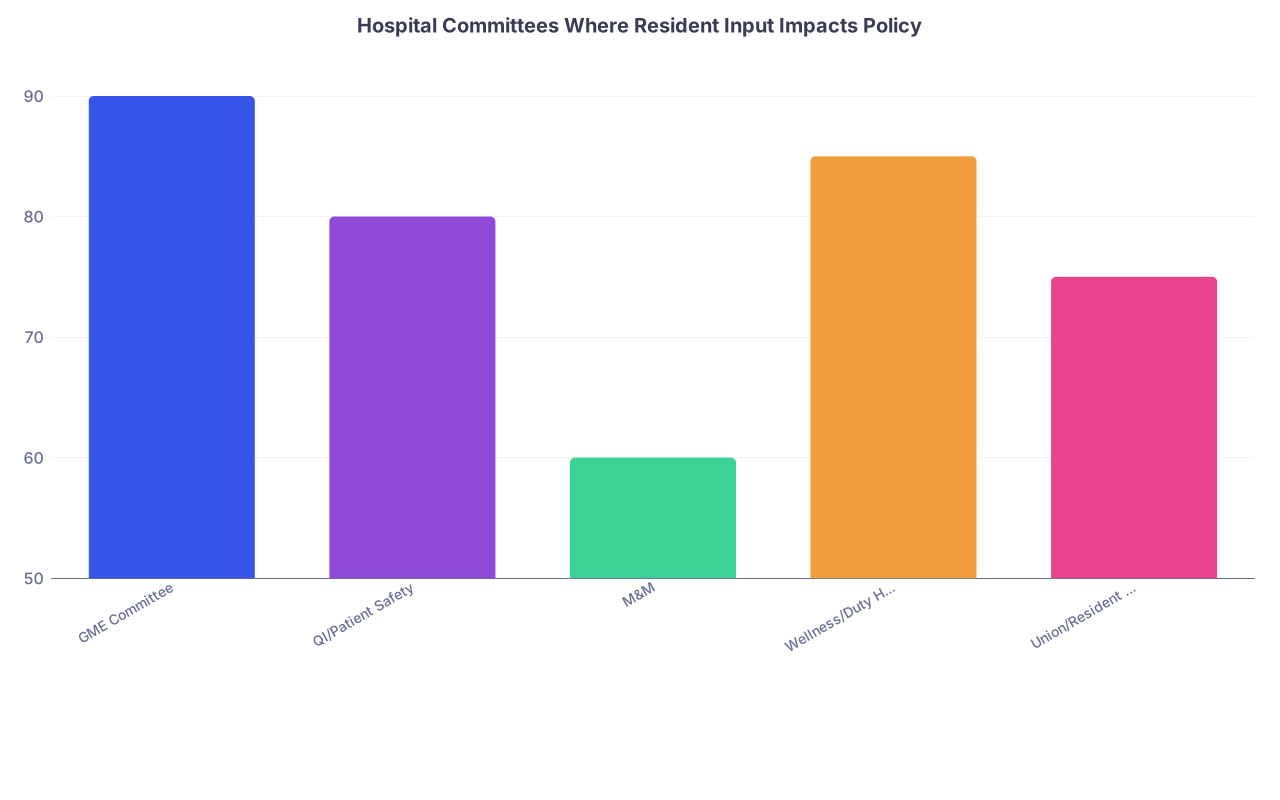
| Category | Value |
|---|---|
| GME Committee | 90 |
| QI/Patient Safety | 80 |
| M&M | 60 |
| Wellness/Duty Hours | 85 |
| Union/Resident Council | 75 |
The public story is that policy is shaped by “stakeholders” in a “collaborative process.” The private story is that one or two residents in the right room, saying the right thing, can reroute a policy quietly before it lands on your lap as a “new initiative.”
But you have to understand the game you’re actually playing.
How Leadership Really Listens to Residents
Here’s what the emails say: “We value resident feedback and strive to incorporate your voices in institutional decision making.”
Here’s what actually happens in senior meetings.
Your feedback gets filtered through three layers:
- Your chief residents
- Your program leadership (PD/APDs)
- The political nervous system of the hospital (GME office + CMO + patient safety leadership)
If your voice dies before step 2, it might as well have never existed.
At one large academic program, the PD walks into the monthly DIO (Designated Institutional Official) meeting with three things on a notepad:
- “This is fine, residents just annoyed.”
- “This is becoming a safety issue.”
- “If we ignore this, we will lose people to transfers or get cited by the ACGME.”
Notice what’s missing: “Residents don’t like the new schedule because it feels unfair.” Leadership barely registers that. But “this will hurt patient safety” and “this could trigger ACGME trouble” get attention immediately.
I’ve seen a resident send a detailed, articulate email about wellness and burnout and get a polite, empty reply. That same resident, six months later, framed the same issue as “we’ve had three near-misses overnight in the last two weeks because the night float is covering too many units.” Suddenly, QI is involved, the chief medical officer is asking questions, and HR is talking about staffing.
It’s not fair. But it’s how they’re wired.
The Ethical Line: Advocating Without Becoming “That Resident”
Now let’s talk about the part nobody mentors you on: how to push for change without getting quietly blacklisted.
There is a blacklist. It’s informal, it’s rarely written down, but people absolutely say things like, “He’s great clinically but tends to stir the pot,” or “She’s high maintenance; don’t put her on that committee.” I’ve heard those words in search committee meetings. You do not want to be the resident who’s always complaining and never strategic.
The trick is to position yourself as three things at once:
- Patient safety advocate
- System thinker
- Reasonable adult
Not the angry junior who storms into the PD’s office with, “This is unacceptable.”
Here’s the ethical balance:
- You are morally obligated to speak up when systems put patients at risk or exploit resident labor.
- You are professionally smart when you do it in a way that gives leadership room to fix the problem without losing face.
- You are short-sighted if you escalate everything to maximum volume and burn your credibility early.
At one hospital, a PGY-2 basically tanked their own reputation by turning every minor annoyance into a formal complaint: cross-cover frustration, unpleasant attending, ancillary staff rude at 3 a.m. The PD started pre-filtering everything they said. When they finally raised a real safety concern—nurse staffing cuts on nights—it got lumped in with “more of the same.”
Contrast that with the chief at another program who kept a quiet log of specific incidents for months: delayed STAT imaging because of transport cuts, pharmacy verifications backing up, sub-I’s doing resident-level work because staffing was thin. When she walked into the QI meeting, she didn’t say, “We’re drowning.” She said, “Here are 12 concrete cases over the last 8 weeks where our current system increased risk of harm. I’ve anonymized them, but I can provide more detail if needed.”
Policy changed. They added a night transport tech and stopped trying to “repurpose” sub-I’s as scut support.
Advocacy without data is complaining. Data without narrative gets forgotten. Ethics sits in the middle: telling the truth, backed by specifics, aimed at fixing the system rather than venting your frustration.
Where Resident Voices Quietly Rewrite Policy
Let me walk you through the specific arenas where residents genuinely shift hospital policy, even if nobody ever gives them the credit publicly.
1. Duty Hours and Workload
This one is obvious on paper and messy in reality.
Everyone signs the ACGME duty hours attestation. Everyone lies a little. The truth leaks through pattern recognition: recurrent emails, anonymous surveys, whispered confessions to the APD you trust.
The real leverage point isn’t “I worked 92 hours last week.” Single anecdotes get brushed off as “rough weeks.” The leverage is patterns that can’t be hand-waved away.
At one surgical program, weekend “pre-rounding” before the official 6 a.m. start was pushing residents well over 80 hours. It had been “the culture” for years. Nothing changed until a resident on the clinical competency committee asked a simple, weaponized question: “Do we want to keep pretending this doesn’t exist, or do we want to redesign the pre-round system so we can actually look the ACGME in the eye?”
That line got repeated at the GME committee. Suddenly, leadership framed it as an institutional integrity problem, not a resident whine. They adjusted staffing, added a PA on weekends, and officially shifted start times.
The quiet message from leadership: “Don’t embarrass us in front of the ACGME. Help us fix things before they become citations.” If you talk in that language, you get things done.
2. Patient Safety and Incident Reporting
Most residents treat incident reporting (Midas, RL Solutions, whatever your system is) like a black hole. You file an event, you get a generic “Thank you,” and nothing seems to happen. So people stop reporting.
What you don’t see: when the reports start clustering around resident-identified issues, patient safety committees pay attention. Especially when a resident shows up in person to connect the dots.
I watched an IM resident use incident reports as a tactical weapon. Nurses were repeatedly bypassing the paging system and texting patient info to resident personal phones. HIPAA nightmare. Everyone hated it. No one wanted to confront nursing leadership.
So this resident documented every single instance for a month. Logged dates, times, de-identified content, and filed incident reports attached to “communication failure” each time. Then she asked to present at a patient safety meeting—not as a victim, but as a collaborator: “We’re all trying to communicate efficiently. This is how the system is forcing people to break rules. Let’s build something better.”
Outcome: new secure messaging system rolled out, formal prohibition of non-secure texting, and nursing in-service training. Official story: “Interdisciplinary team identifies communication improvement opportunity.” Unofficial story: one resident refused to normalize unsafe workarounds.
That’s how it usually happens.
3. Electronic Medical Record (EMR) Changes
You want to see a room full of attendings glaze over? Ask them about order set tweaks. Residents, on the other hand, live and die by clicks.
Most hospitals have an “informatics committee” or “EMR optimization group” that no one under 40 wants to be on and no one over 40 understands. Residents who sit on those committees are quietly powerful.
Changes that often come directly from residents:
- Removing useless mandatory fields from admission notes
- Building admission order sets that actually reflect real workflows
- Auto-populating discharge med reconciliation with fewer clicks
- Fixing paging workflows buried inside the EMR
At one hospital, a resident on the informatics committee killed a spectacularly bad idea: mandatory “wellness checkboxes” built into every note. Someone in quality thought it would be great to have physicians document that they had “considered provider wellness.” It was idiotic. The residents on the committee looked around and said, “If you do this, we will click ‘yes’ 200 times a week and hate you for it. This will create zero wellness and a ton of resentment.”
The project died in that room. Before it ever hit your screen.

4. Call Rooms, Security, and Physical Safety
Here’s something you will never see in a glossy recruitment brochure: the email chains about assaulted residents, broken call room locks, and unsafe parking at 2 a.m.
Those conversations are brutal. And they move policy faster than almost anything else.
I know of a case where two female residents were followed from the hospital to the parking garage on consecutive nights. Security brushed it off as “no confirmed threat.” The residents documented times, locations, lack of escort availability. Their chief brought it to the PD and said, very clearly, “If something happens, we’ll all be in the newspaper for ignoring known risks.”
Within weeks, security patrol patterns changed. Shuttle service hours were extended. The hospital spent money. Why? Because residents framed the issue exactly how risk management and legal see it: documented hazard + known vulnerability + lack of mitigation = lawsuit and reputational disaster.
Ethically, this is where resident advocacy is most non-negotiable. Your safety is not “a nice to have.” It’s a baseline. Speaking up here isn’t being difficult; it’s refusing to play the sacrificial hero in a system that should protect its trainees.

| Step | Description |
|---|---|
| Step 1 | Resident Safety Incident |
| Step 2 | Document Details |
| Step 3 | Report to Chief or PD |
| Step 4 | Involve Security and Risk |
| Step 5 | Task Force or Meeting |
| Step 6 | Policy and Resource Changes |
| Step 7 | Monitor for Future Events |
| Step 8 | Pattern or Serious Risk |
The Political Reality: Why Some Resident Voices Carry More Weight
Let me be blunt: not all resident voices are treated the same.
Patterns I’ve seen repeatedly:
- Chief residents get listened to more than interns.
- Senior residents who are viewed as “strong clinically” get taken more seriously.
- Residents on formal committees (GME, QI) get taken more seriously than random email senders.
- The resident who only talks when it matters gets more traction than the one who vents about everything.
Is that fair? No. But it’s human.
At one institution, the CMO told me directly: “We can’t handle every complaint that comes through every backchannel. I watch which issues the chiefs bring to me more than individual emails. If the chiefs are worried, I’m worried.”
So if you’re an intern or junior, your smartest move often isn’t to blast your PD with a manifesto. It’s to:
- Gather a few concrete examples
- Talk to a senior resident or chief you trust
- Ask, “Is this already on leadership’s radar? If not, can you help me bring it up the right way?”
That’s not being deferential. That’s being strategic.
And yes, there’s a gender and race dimension. Underrepresented residents who push back get labeled “angry” or “aggressive” faster. I’ve seen it. It’s ugly. So you protect yourself with documentation, allies, and clear framing: “I’m raising this because it affects patient safety / duty hour compliance / legal risk,” not because “this feels unfair to me personally,” even if that’s true too.

Practical Playbook: How to Turn Your Voice into Policy
You want to actually get something changed? Here’s the behind-the-scenes pattern that works.
Step 1: Turn anger into evidence
Your anger is valid. It’s also useless by itself.
Instead of just complaining that “nights are brutal,” start tracking:
- Number of admissions per night over a month
- Which services get hit hardest
- Delays in pages, orders, or discharges tied to overload
- Any near-misses you can safely de-identify
Now you’re not “whining about workload.” You’re showing system-level failure.
Step 2: Build a small coalition, not a mob
Leadership tunes out mass complaint emails. But three or four residents from different PGY levels saying, “We’re seeing the same problem, here’s what it looks like,” is harder to ignore.
I’ve watched PDs change rotation structures after a calm group meeting more than after any angry email blast.
Step 3: Offer at least one realistic alternative
Policy people hate being backed into a binary: “Do this or you don’t care about residents.” They will dig in.
Better approach: “Here’s the problem. Here are two or three possible ways to fix it. We know budget and staffing are realities—you tell us what’s feasible, and we’ll help optimize from the front line.”
You’re not just complaining. You’re co-designing.
Step 4: Decide when to go on the record
Sometimes you need to be anonymous (surveys, anonymous incident reports). Sometimes anonymity kills your impact.
I’ve sat in meetings where leadership said, “If someone will actually come talk through this case, we’ll act. But we can’t design policy around anonymous rumors.”
You have to judge the risk to yourself versus the importance of the issue. Ethically, when patient or resident safety is at stake, you lean toward speaking with your name attached—and you make damn sure you’re not doing it alone.

The Hidden Curriculum: How This Shapes You Ethically
Here’s the part that matters for your own development, not just hospital policy.
If you go through residency as a passive recipient of whatever policy drops from above, you learn one thing: survival through silence. You internalize that speaking up is dangerous, advocacy is optional, and your job is to endure.
If you engage—even selectively—you learn something else: medicine is a moral profession embedded in political systems. You are responsible not just for your individual orders, but for the structures that make good care easier or harder to deliver.
You start to see:
- Which compromises you’re willing to make and which lines you won’t cross
- How to push for patients and colleagues without burning yourself out
- How power actually functions in hospitals, not how it’s described in your ethics lectures
I’ve watched residents transform. The shy PGY-1 who could barely speak up in rounds becomes the PGY-3 calmly telling the CMO, “We can’t safely run the ICU this way.” The former premed perfectionist becomes the doctor who says, “No, we’re not going to fudge these duty hours, we’re going to fix the schedule.”
That shift is part of your ethical formation. It’s not “extra.” It’s the real curriculum of becoming a physician who does more than write notes and follow orders.
| Arena | Resident Leverage Level | Primary Frame That Works |
|---|---|---|
| Duty Hours/Workload | High | ACGME compliance, safety |
| Patient Safety/QI | High | Near-misses, incident trends |
| EMR/Order Sets | Medium-High | Efficiency, error reduction |
| Security/Physical Safety | High | Legal risk, staff protection |
| Wellness Initiatives | Medium | Burnout → errors, retention |