
The Quiet Backchannel: How Chiefs Use You to Influence Health Policy
You’re a PGY-2 on night float. It’s 1:30 a.m. You’re finishing notes when your chief texts: “Quick question — how’s that new sepsis order set actually working?”
You fire back a detailed answer. It’s clunky. It misses atypical presentations. The EHR alerts are absurd. You think you’re just venting. Next week, you hear your Division Chief in a hospital town hall: “Our residents are seeing real-world failures in our sepsis protocol. We need to adjust thresholds and reduce click burden.”
Your words. Their microphone.
That’s the quiet backchannel.
You think health policy is what happens in Washington, or at least in the C-suite. You imagine white papers, task forces, advisory panels. And yes, those exist. But the daily, gritty, actual shaping of policy — the stuff that dictates how you practice, what gets billed, what gets documented, whom you can admit and where — a disturbing amount of that is filtered, packaged, and sold upstairs through you. Through your complaints. Your silent compliance. Your offhand comments to chiefs.
Let me walk you through how that really works, because you’re already part of it whether you like it or not.
Chiefs as Policy Conduits: The Role You Don’t See
Residents think of chiefs as schedule negotiators, evaluation gatekeepers, and professional email-forwarders. That’s the surface layer.
Behind closed doors, chiefs are information brokers. They sit right at the junction of three worlds: frontline clinical chaos, mid-level administration, and high-level institutional or system policy.
I’ve sat in those meetings. The hospital VP of Quality doesn’t ask, “How do the nurses like this new protocol?” They ask the chiefs: “Are the residents actually using it? Are they complaining? Is it slowing down throughput?”
Because administrators know something you don’t acknowledge enough: you are the workhorse. If policy fails at your level, it fails, full stop.
So chiefs become the translators. They take your:
- late-night Epic rants
- “this is stupid” hallway comments
- case presentations where “we couldn’t follow the protocol because…”
- angry group texts after a patient sat in the ED for 18 hours
… and they convert that into structured “feedback” they can safely present in committee.
You’re not in those rooms. But your fingerprints are all over those conversations.

Why Chiefs Need You (Even When They Pretend They Don’t)
Most chiefs are in an awkward spot. They’re close enough to administration to get cc’d on policy emails, but not high enough to set the agenda. They are constantly being asked two questions by leadership:
- “Will the residents comply with this?”
- “Can you get them on board?”
Chiefs can’t answer that from a spreadsheet. They need real stories, real pain points, and real testing on the ground. That’s you.
So they watch you like a barometer. A few things they track, explicitly or quietly:
- Are you bypassing the new order set with “free text” orders?
- Are note templates being used or ignored?
- Are residents fighting for certain patients to be admitted to certain services despite bed management rules?
- Who’s getting burned — residents, nurses, or attendings — by a new rule?
Then chiefs decide what to carry upstairs and what to bury.
Yes, bury. There’s a pile of legitimate concerns that never see daylight because chiefs perceive them as “whining” or “too resident-centric” or politically risky.
That’s the part almost no one tells you: not all of your feedback is created equal, and your chiefs are quietly editing which pieces become “policy relevant.”
The Backchannel in Action: How Your Stories Become Policy
Let me map out what actually happens step by step, because once you see the pattern, you won’t unsee it.

| Step | Description |
|---|---|
| Step 1 | Resident Experience |
| Step 2 | Comments to Chiefs |
| Step 3 | Chief Filters Feedback |
| Step 4 | Selected Issues Presented in Meetings |
| Step 5 | Policy Tweaks or New Rules |
| Step 6 | Implemented on Frontline |
You’re in the ICU. New ventilator weaning protocol is clearly dangerous for that multi-comorbid COPD patient. You override it, discuss it with the fellow, mention it to the chief later: “That weaning protocol almost screwed us tonight. It doesn’t account for chronic CO2 retainers.”
The chief hears variations of this from three more residents and one fellow over a week.
What they do next matters more than you think.
Option 1: They sit on it. Maybe they think, “Administration is obsessed with weaning times. If I say this, they’ll label me resistant to change.” So your concern dies there.
Option 2: They weaponize it. In a joint meeting with the Quality Officer and ICU leadership, they say: “Our residents have identified high-risk flaws. They’ve already adjusted practices informally. If we don’t rewrite the protocol, we’re going to have noncompliance and potential harm.”
Then they share anonymized, specific cases. Your case. That story hits harder than abstract “concerns.”
Suddenly, there’s a revision workgroup. You’re not on it. But your experience fueled it.
How Chiefs Use You Strategically — For Their Own Agendas
This is the part that tends to make people uncomfortable. Chiefs are not neutral. They have their own reputations, alliances, and ambitions.
Sometimes they leverage your experience as ammunition in fights that have very little to do with you directly.
Example:
The hospital wants to cut overnight in-house attending coverage and move to home call “with tele-support.” The intensivists hate it but are under pressure because of cost. They know arguing “this feels unsafe” does not win against budget spreadsheets.
So your program director and ICU chief start collecting “resident safety concerns” stories. Any near-miss, any delay in escalation, any time you felt hung out to dry when backup was slow to respond — that becomes data. They show up in meetings and say:
“Our residents are reporting delayed escalation when attendings are off-site. Here are five concrete cases. If we cut in-house coverage, this will worsen. We are not comfortable with the patient safety risk.”
Now you’re the moral force behind their financial argument. You might agree with them. You might not even know this battle is happening. But your name, your anecdotes, your distress — that’s being spent as political capital.
I’ve watched chiefs turn offhand resident frustration — “It takes forever to get a CT after 10 p.m.” — into a full-scale critique of radiology staffing models because they’re already in a turf war with that department. The end result might actually help you. But don’t kid yourself: you were a means to an end.
Informal Channels: The Conversations That Actually Matter
You think “policy input” is formal surveys, focus groups, structured town halls. Those matter to some extent, but they’re mostly optics unless they align with what’s already being pushed.
The real levers are informal.
That chat you have with your chief at 2 a.m. in the workroom? That can matter more than a 50-question “Resident Wellness Survey” no one reads deeply.
The random comment at the end of a chiefs’ check-in: “By the way, this discharge before noon metric is killing us… we’re discharging unstable patients to hit the target.” That line might get repeated almost verbatim at the next Length of Stay meeting — with your name removed but your frustration intact.

Chiefs are constantly scanning for three patterns in what you say:
- Repetition: The same complaint from different residents, on different rotations, at different times of day.
- Severity: Anything that sounds like a sentinel event, even if it wasn’t technically reportable.
- Optics: Issues that, if made public or sent up the chain, would embarrass the institution.
If your story checks at least two of those boxes, it has a good chance of being escalated. If it checks all three, it will almost always become “an agenda item” somewhere.
But again — you usually only see the end product: new protocol, updated workflow, stern email from Quality. You don’t see how your words were edited, softened, dramatized, or strategically placed.
The Data Game: How Your Behavior Becomes Evidence
It’s not just your words. It’s your clicks.
EHR reports are quietly used as policy feedback — especially around compliance and feasibility.
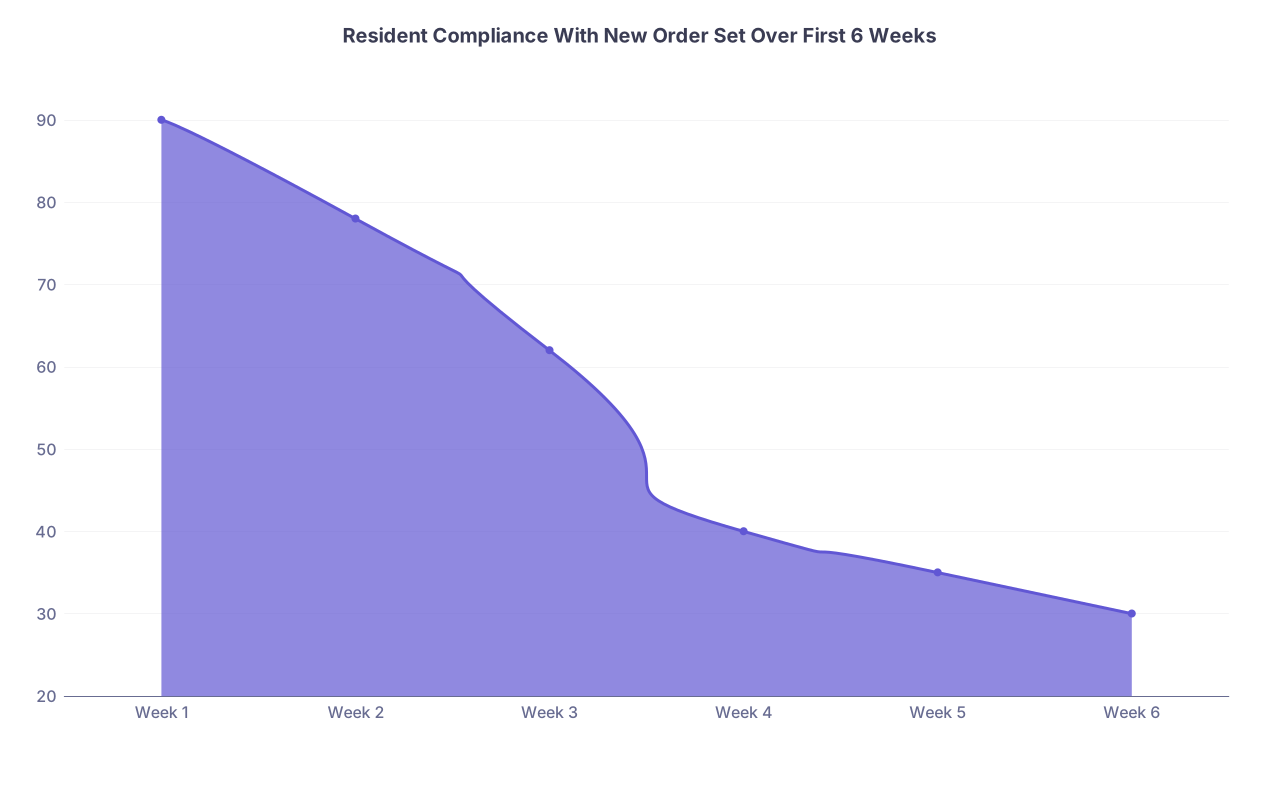
| Category | Value |
|---|---|
| Week 1 | 90 |
| Week 2 | 78 |
| Week 3 | 62 |
| Week 4 | 40 |
| Week 5 | 35 |
| Week 6 | 30 |
When a new policy launches — say, a standardized admission order set for heart failure — leadership is watching adoption rates. When they see the line fall off a cliff after week 2, they don’t just stare at the graph. They walk straight to the chiefs and ask:
“Why are your residents not using this? What’s going on?”
Then chiefs come to you, sometimes disguised as “feedback sessions,” sometimes as casual questions.
How you answer shapes policy follow-up:
- If you say, “We keep forgetting,” that becomes: “We need more education and reminders.”
- If you say, “This misses half of what we need, it’s faster to free-text,” that becomes: “The tool doesn’t match clinical reality, needs redesign.”
- If you say, “Honestly, none of the attendings use it either,” that becomes: “There’s no attending buy-in; this is a culture issue, not a resident problem.”
So your behavior + your explanation = justification for either fixing the policy or doubling down and blaming clinicians.
Don’t underestimate that second part. A lousy policy can survive if leadership can pin noncompliance on “resident resistance,” “training issues,” or “documentation laziness.”
The Ethical Trap: When You’re Used to Sell Bad Policy
Here’s where personal development and ethics crash into each other.
Sometimes chiefs — under pressure from above — use you to endorse policies that harm you and your patients.
Example: Documentation “optimization.” The hospital wants to roll out note templates that are essentially billing upcoding machines disguised as efficiency. Chiefs are told: get residents to use them. Period.
So leadership says: “These will reduce your burden. Less typing! More time with patients!” The chiefs are asked to “get resident feedback” and then come back with a supportive narrative.
If you’re not paying attention, you might say, “Yeah, the smart phrases are faster.” That becomes:
“Our residents are excited about how much more efficient notes are with the new templates.”
Next step? Mandatory adoption. And quietly, the billing department is thrilled at your new detailed ROS and 12-point exam on a stable patient with a runny nose.
You’ve now participated in expanding billing and overdocumentation while also making your own life more autopiloted and less intellectually engaged. The ethical part: you endorsed something without understanding its primary aim.
| What You Say | How It Gets Reported Above |
|---|---|
| "This is faster but bloated and generic." | "Residents report increased efficiency." |
| "We feel pressured to discharge early." | "Residents are very aware of LOS goals." |
| "Alerts fire constantly; we ignore them." | "High alert exposure; need more training, not fewer alerts." |
| "We bypass order sets for complex cases." | "Residents use clinical judgment to tailor standard tools." |
See the pattern? Nuance gets stripped. Anything that can be framed as support for the agenda, will be.
That’s the ethical landmine: if you speak imprecisely, or casually, or without understanding context, your words can be twisted into institutional propaganda.
How to Protect Yourself and Still Have Impact
You shouldn’t go silent. Silence just helps bad policy sail through unopposed. But you can be less naïve about how chiefs and leadership will use what you give them.
A few concrete principles that I’ve seen smart residents use well:
Be specific, not vague.
“Things feel unsafe at night” is useless. “Two nights this week, we had 26 patients and one attending on home call 45 minutes away; we had delays in managing decompensations” is much harder to spin.
Separate your emotional reaction from your policy critique.
“I’m burned out and this new pre-rounding requirement is stupid” is easy to dismiss.
“This requirement duplicates documentation already done in the EHR and adds an average of 45 minutes before first patient contact” is harder to ignore.
Make it about patient outcomes and system failure, not just your inconvenience.
You’re allowed to care about your life. But policy changes only happen when there’s a plausible link to patient harm, legal risk, or public image. Frame your concerns accordingly.
Ask how your feedback will be used.
In a chief meeting, you’re allowed to say: “Is this going to the GMEC? To hospital leadership? Can you share how you’ll present this?” The answer tells you a lot about whether you’re being heard or harvested.

And occasionally, you will have to decide: am I willing to have my name associated with this? Because chiefs will sometimes ask you to sit on a panel, or speak at a committee, to “provide the resident perspective.”
If you do that, prepare. Clarify your stance. Write down what you refuse to say, even if nudged. Administrators love the sentence: “Residents are really on board with this.” Don’t give them that line unless it’s actually true.
When You Are the Backchannel for Patients
One more layer: patients themselves. You are often their last honest audience.
Patients and families sometimes unload things on residents they will never say on a Press-Ganey survey or to an attending: fear about being discharged too early, confusion about why certain services won’t admit them, frustration about insurance games.
You hear the real stories of policy failure: the uninsured patient turned away from rehab, the dialysis schedule constrained by an insurer’s “preferred” center hours, the psych patient held in the ED because there’s no inpatient bed anywhere in the region.
If you’re thoughtful, you can funnel those up through chiefs as well. Not as vague moral outrage, but as patterns:
“On psych call this month, we had four patients boarded more than 72 hours in the ED due to no inpatient psych beds, all with deteriorating behavior. This isn’t an exception; it’s structural.”
Those stories don’t just feed hospital-level decisions. They sometimes feed into advocacy at the county or state level — when enough data and consistent resident reports accumulate, leadership might finally push for funding, partnerships, or public messaging.
But again, someone has to carry that torch from your mouth to the people who sign contracts. That someone is usually your chief, PD, or a sympathetic attending with a committee seat.
Recognizing When You’re Being Managed
There’s one last ugly truth: sometimes chiefs are under explicit orders to “manage” you into accepting a policy that’s already a done deal.
You’ll know it’s happening when:
- You’re “asked for feedback” after the rollout, not before.
- Every concern you raise is answered with “we hear you,” followed by a list of minor cosmetic tweaks but no change in the core policy.
- Chiefs repeat phrases that sound eerily like admin-speak: “We have to align with system priorities,” “This is a regulatory expectation,” “Other programs are doing this successfully.”
At that point, your ethical question shifts. You’re no longer just a trainee; you’re a professional being nudged into complicity.
You can still choose how much legitimacy you lend. You can say, “I’ll comply because this is required, but I don’t endorse the rationale, and I believe it has these harms.” Chiefs may not love that sentence. But if they’re honest people, they’ll respect it more than saccharine fake buy-in.
Three Things to Remember
You’re already in the policy game. Every complaint, workaround, and story you share is potential ammunition in a room you never enter.
Chiefs are filters, not just messengers. They decide which of your experiences become “data” and which die in the call room.
If you want to hold onto your ethics, be precise. Speak in specific harms and patterns, not just vibes, and always assume your words might be repeated — with or without your name — on the next floor up.