
The myth that “the best ideas win” in health policy is a lie that keeps most physicians quiet and irrelevant.
Some voices get amplified. Most get politely ignored. And it has very little to do with who’s smartest, most ethical, or closest to the bedside. I’ve watched faculty with world-class data get sidelined, while a charismatic hospitalist with a Twitter following and one good analogy becomes the go‑to quote for a national outlet.
Let me walk you through how that actually happens.
The Uncomfortable Truth: Policy Doesn’t Care How Hard Your Day Was
Here’s the first hard truth: your daily suffering on the wards is not inherently persuasive to policymakers.
Legislators, agency staffers, hospital executives—they do not wake up thinking, “How do I fix intern burnout?” They wake up thinking:
- How do I avoid a headline?
- How do I move my boss’s agenda?
- How do I not get embarrassed in a hearing?
- How do I respond to the three interest groups in my inbox today?
So when a physician voice gets amplified, it’s almost never because it’s the “purest,” most clinically grounded voice. It’s because that person has become useful to someone in power.
Useful in a very specific way:
They can translate chaos into a sound bite, a story, or a clear ask that lines up with a political or institutional objective. If you cannot do that, you could be the greatest clinician in your state and you’ll still be invisible in policy rooms.
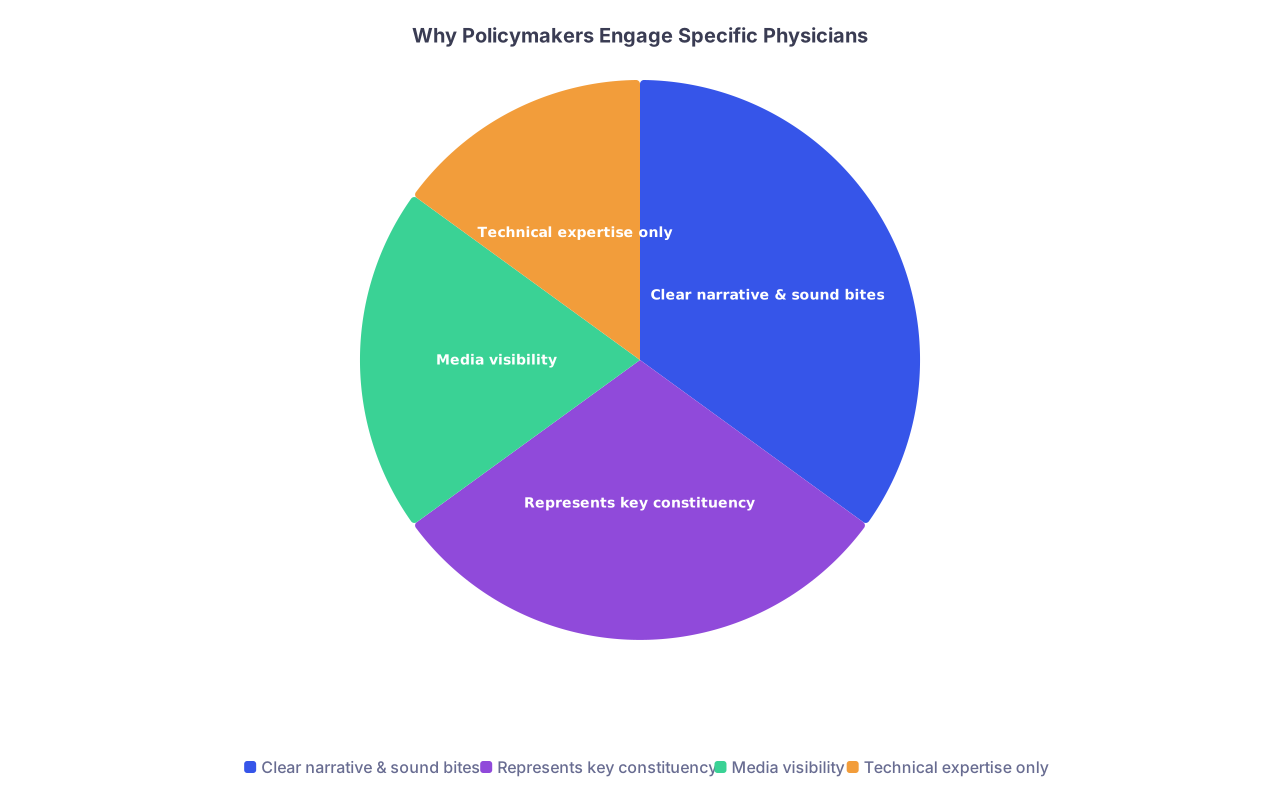
| Category | Value |
|---|---|
| Clear narrative & sound bites | 35 |
| Represents key constituency | 30 |
| Media visibility | 20 |
| Technical expertise only | 15 |
That chart is basically what staffers complain about behind closed doors: “The doc was smart, but I can’t use anything they said.”
The people whose voices carry understand this game—sometimes consciously, often instinctively. They stop trying to “explain everything” and start trying to be quotable, reliable, and aligned.
Who Actually Gets in the Room (and Why Them, Not You)
You think the path to influence is: be good → do research → publish → get invited.
That happens in maybe 10–15% of cases. The rest? Relationships and positioning.
Here’s the rough pipeline I’ve seen over and over in academic centers and large systems:
A faculty member or clinician becomes “the face” of some issue locally. It might be gun violence, abortion access, addiction, telehealth, rural care. Sometimes by accident after one op-ed or one local news hit.
A comms person flags them: “This doc is really good on camera / with reporters.” That note goes into a file.
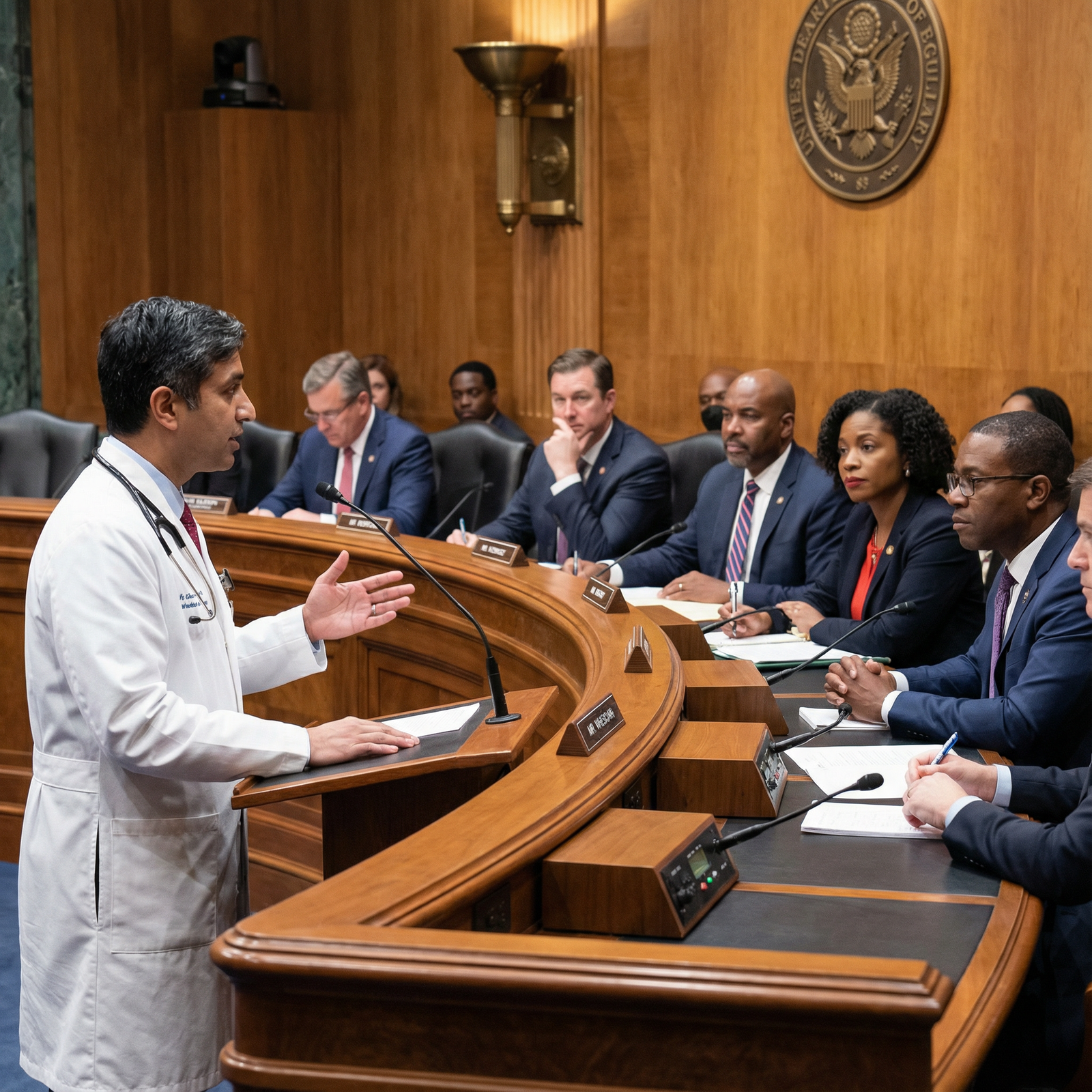
A state rep’s staffer calls the hospital: “We need someone to testify or brief us on X.” The hospital does not email the entire medical staff. They forward that name.
That person shows up, is coherent, doesn’t embarrass anyone, and follows through with requested data. Staffer saves their cell.
Next time something similar comes up? Same name. Now they’re “our go‑to physician on [issue].”
None of that is fair. All of it is real.
The selection filters are absolutely not about “best in field.” They’re about:
- Are you fast? (Respond to emails, share a one‑page summary instead of a 30‑page PDF.)
- Are you safe? (Not going to free‑solo some fringe view on camera.)
- Are you clear? (Can a staffer paraphrase you in 1–2 sentences to their boss?)
- Do you align with an institutional or political need?
Once you meet those criteria once or twice, your voice gets structurally amplified: you get called again, quoted again, invited again. Your colleagues, who might know more than you, never even hear about the invitation.
The Unspoken Gatekeepers
There are three powerful gatekeepers you never see on the org chart:
- Communications / PR staff
- Government relations (GR) staff
- Committee staffers (legislative or regulatory)
If you are not known to these people, you do not exist in policy.
Inside every large hospital or medical school, there is a government relations person whose whole job is to manage the relationship between the institution and policymakers. That person has a short list of clinicians they will put in front of a legislator without anxiety.
You want to be on that list? You have to deliberately behave like someone they’d trust. Which is not the same as “never rock the boat.” It’s: “If you’re going to rock it, they’re not going to drown.”
Why Certain Messages Get Turned Up—and Others Get Muted
You can have a moral argument, a data‑driven argument, and a politically viable argument. Only one of those consistently gets you amplified.
Let me show you how this actually plays out.
We had two physicians at one institution arguing about prior authorization abuse:
- Physician A: Brilliant researcher. Had a 60‑slide deck of data, nuanced policy recommendations, and a lot of “it depends.”
- Physician B: Pulled one stark number and a patient story: “My 5‑year‑old patient with leukemia waited 17 days for an OK on a drug we ordered in 30 seconds.”
Guess whose quote made the state newspaper’s front page and got repeated in three committee hearings?
Not the person with the full regression analysis.
The system amplifies what’s emotionally sticky and administratively simple. It tunes down what sounds like a dissertation defense.
| Message Type | Emotional Impact | Policy Clarity | Amplification Likelihood |
|---|---|---|---|
| Dense technical analysis | Low | Medium-High | Low |
| Simple patient story | High | Low-Medium | Medium |
| Story + clear policy ask | High | High | Very High |
| Pure outrage / rant | High | Low | Unstable (brief, risky) |
You don’t have to dumb things down. But you do have to stage them:
- Lead with the story or vivid example.
- Follow with the 1–2 numbers that frame the scale.
- End with the specific, feasible ask.
Physicians who master that structure get invited back. The ones who insist on walking through the entire methods section get a polite “thank you” and are never called again.
Why Some Ethically Strong Voices Never Get Heard
This one will sting a bit.
Some of the most morally grounded physicians are terrible policy advocates.
They approach policy conversations like ethics consults: carefully hedged, inclusive of all perspectives, meticulously balanced. That’s admirable on a ward note. It is death in a 7‑minute briefing with a state senator.
In practice, there are three ethical profiles I see:
The absolutist
“Anything short of single‑payer is immoral.”
They might be right about a lot. But if their stance leaves no room for incremental policy steps, staffers quietly stop inviting them because every meeting ends with “burn it all down.”The paralyzed pluralist
“There are a lot of perspectives… it’s complicated…”
Ethically sensitive, but they never get to: “Here’s what you can do this session.” So they leave no actionable footprint.The principled strategist
“Here’s the ethical north star. Here’s the next achievable step that moves us in that direction, without making things worse for the most vulnerable.”
These people get amplified. A lot.
The system—government, hospitals, payers—loves physicians who can argue from values but still translate that into incremental, politically realistic change. Those are the folks who end up on advisory boards, task forces, blue‑ribbon commissions.

| Step | Description |
|---|---|
| Step 1 | Clinician with strong ethical views |
| Step 2 | Seen as risky |
| Step 3 | Seen as unhelpful |
| Step 4 | Seen as valuable |
| Step 5 | Invited rarely |
| Step 6 | Invited often |
| Step 7 | Advocacy style |
If you want your moral voice amplified, you have to accept a trade: you will push for steps, not revolutions, most of the time. And you have to be crystal clear which is which.
Say: “If it were up to me ethically, I’d do X. I know you can’t get there right now. Here’s the step I think you can pass this year that moves us closer without collateral harm.”
That’s how you stay in the room.
The Role of Identity, Politics, and Institutional Comfort
We’d be lying if we pretended this was purely meritocratic or purely skill‑based.
Certain physician identities get courted and amplified for optics. Women, Black physicians, Latino physicians, rural docs, community health leaders—people in power know they need those faces at the table to avoid the photo of “six white men in suits deciding maternal health policy.”
But here’s the part nobody says out loud: being the “diverse face” can get you in the room, but it does not guarantee anyone listens to you. In fact, I’ve watched institutions trot out a Black woman OB/GYN for the press conference, then ignore her recommendations in the internal strategy meeting.
So you get two overlapping games:
- Optics game: Who looks good at the microphone?
- Influence game: Who actually shapes the draft, the budget line, the regulation text?
The physicians whose voices actually influence policy often:
- Understand the optics game and don’t get seduced by it.
- Demand to see drafts, not just podiums.
- Build quiet alliances with staffers and committee chairs, not just public audiences.
If you are from an underrepresented background, here’s the move: use the visibility they need from you to get yourself access to the quieter rooms where things get written. Ask for that explicitly.
“Happy to speak at the press event. But I’d also like to be looped into the working group that’s drafting the actual language.”
You’d be surprised how many people just never ask.
On ideology: if your views align neatly with the dominant political party in your state or with your hospital’s “strategic priorities,” your odds of amplification skyrocket. If your views cut against the money or the party, you need more skill, more allies, and more resilience to get heard.
I’ve watched hospital-employed physicians quietly warned off testifying against major donors’ interests. Not in writing, never in email, always with phrases like, “We’re concerned about optics,” or “This could complicate relationships that fund our charity care.”
You want your voice amplified in spite of that? You need:
- Some independent platform (professional org, academic appointment, media connections)
- A clear line you won’t cross, even if it costs you committee seats or nice titles
Otherwise, your “voice” is on lease to your employer’s risk calculus.
What the Amplified Physicians Actually Do Differently
You’ll like this part less, because it involves work that’s not billable and not recognized in RVUs.
Physicians whose voices carry in policy consistently do four things behind the scenes:
They cultivate staffers, not just “big names.”
They send follow‑up emails with short, usable summaries. They become the person a burnt‑out aide can text at 9 PM: “My boss needs to understand prior auths in three sentences.” That aide will outlast three election cycles.They learn the mechanics of power.
They know how a bill moves. How a rule gets written at CMS or a state Medicaid office. How a hospital board agenda gets set. They stop yelling into the void and start targeting the choke points.They practice talking like a human, not a paper.
They rehearse stories. They test metaphors. They watch recordings of themselves in hearings and interviews and actually adjust.They pick a lane.
Not “healthcare is broken.” Too big, too vague. They become the physician voice on one or two concrete issues: step therapy, reproductive access, overdose policy, rural closures, whatever. The narrower your lane, the more your name comes up when that issue hits the news.
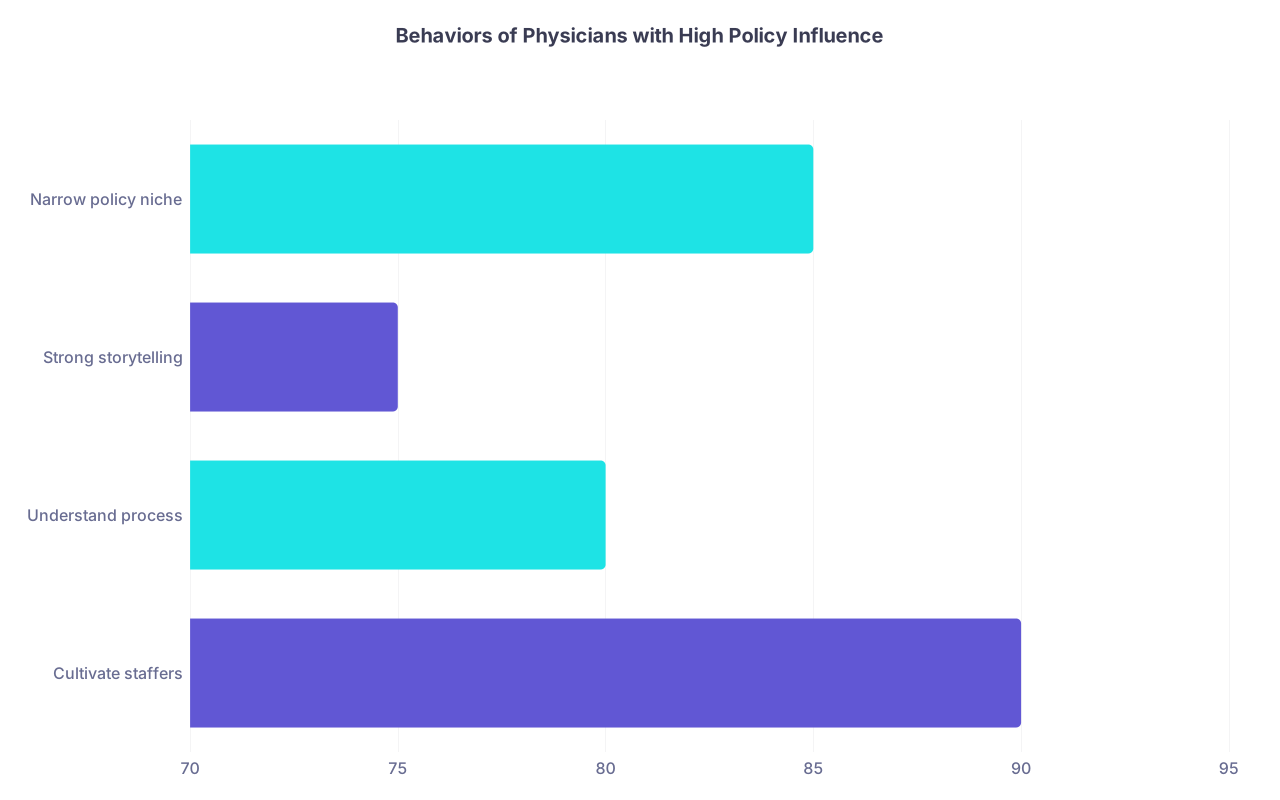
| Category | Value |
|---|---|
| Cultivate staffers | 90 |
| Understand process | 80 |
| Strong storytelling | 75 |
| Narrow policy niche | 85 |
I’ve watched junior attendings out‑influence full professors simply because they did those four things while the professors complained in the hallway.
How You Can Shift From “Background Noise” to “Go‑To Voice”
Let’s move from diagnosis to action.
If you actually want your voice amplified—not just the fantasy of it—there’s a practical way to start.
Pick one issue that already keeps you up at night. Something where you are both emotionally invested and clinically credible. Not “fix healthcare.” Something like:
- Medicaid red tape blocking your patients’ meds
- Maternal mortality in your county
- Gun violence in your ER
- Fentanyl overdoses in your city
- Nursing home neglect you see on consults
Then work this sequence:
Clarify your story
Write down one patient story that keeps replaying in your head. Strip out identifying details. Make it short enough to tell in 60 seconds.Clarify your number
Find 1–2 numbers that put that story in context. Local if you can. “In our state, 1 in X…” beats “Nationally, around…”Clarify your ask
Not “we need more funding.” What is one concrete, achievable change? A prior auth rule. A reporting requirement. A training mandate. A scope or staffing change. Something that could realistically be drafted and passed in one or two cycles.Find your gatekeepers
Identify your institution’s government relations person. Ask for a 20‑minute meeting. Say: “Here’s the issue I see every week. Here’s the story, the data, and what I think is changeable. If this comes up, I’d like to be someone you call.”Start small but visible
Write one op‑ed or commentary. Local paper, specialty society newsletter, not JAMA. Offer yourself to your institution’s comms team as a source if they ever need someone to comment on this topic.

| Step | Description |
|---|---|
| Step 1 | Pick one concrete issue |
| Step 2 | Craft story and number |
| Step 3 | Define specific policy ask |
| Step 4 | Meet government relations staff |
| Step 5 | Do small media or op-ed |
| Step 6 | Respond quickly to opportunities |
| Step 7 | Become go to voice |
That’s the quiet, unglamorous path most amplified voices actually walked. Not a TED Talk. Not a viral tweet. Just a series of small, strategic steps that signaled: “I’m here, I’m clear, and I’m safe to use.”
FAQs
1. I’m just a student/resident. Does any of this apply to me yet?
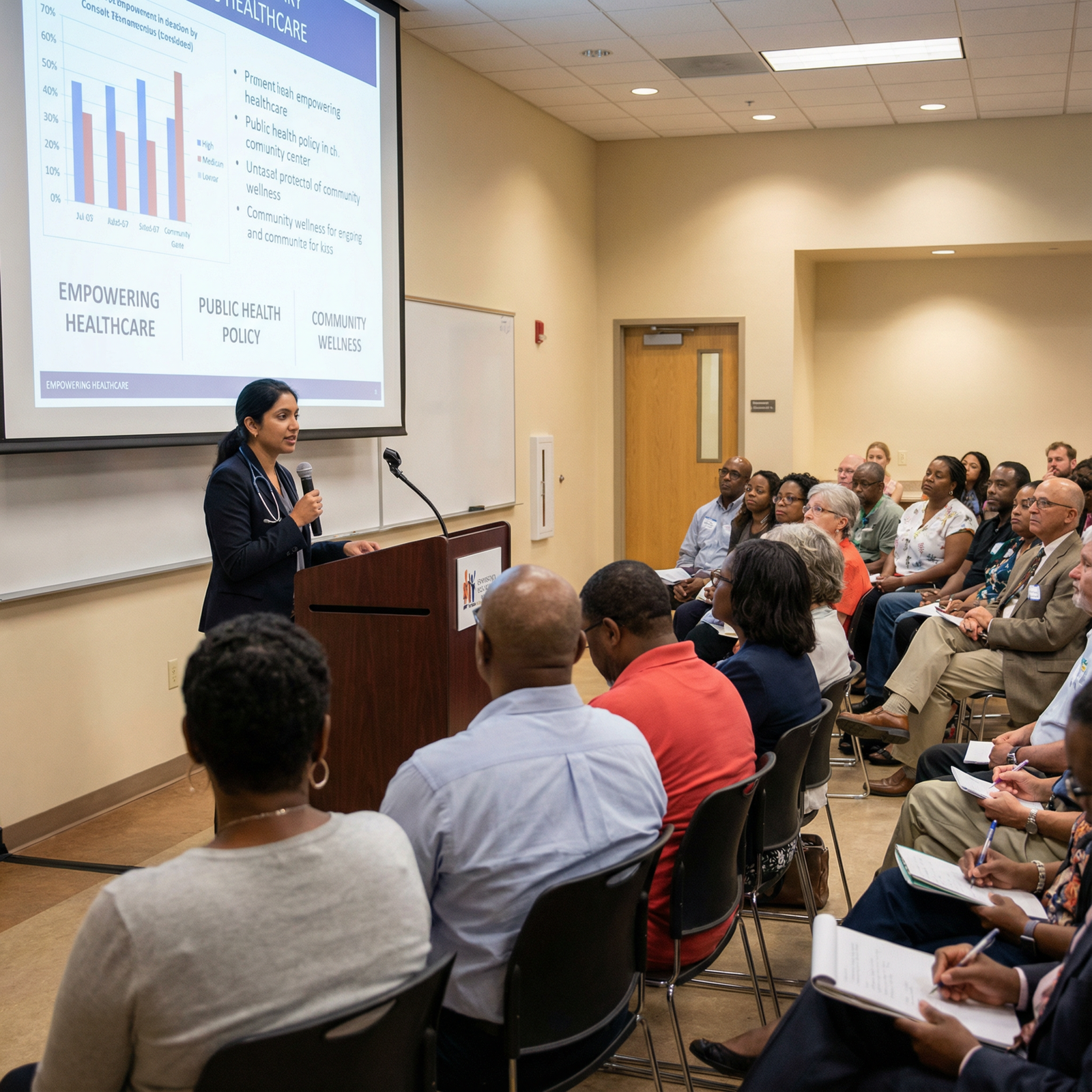
Yes, but differently. As a trainee, you are not going to be the primary quote on a high‑stakes regulatory change. What you can do is start building the skills and relationships. Join your state or specialty society’s advocacy days. Watch how staffers interact with physicians. Offer to help with background research and one‑pagers. Start writing short, sharp pieces (letters to the editor, brief commentaries) on issues you see. You’re building a reputation for clarity and reliability long before anyone hands you a microphone at a hearing.
2. How do I stay authentic and not just become a mouthpiece for my hospital or a political party?
Draw your lines in advance. Decide what you will not say even if asked. You can be aligned on some issues and independent on others, but you must be transparent about that with yourself. When your institution’s interests diverge from your patients’ interests, you have three options: push internally and accept you might not be put forward publicly; speak independently through other channels and accept possible career cost; or step back from that particular policy arena. What you cannot do ethically is pretend there’s no conflict.
3. I’m not naturally charismatic or media‑savvy. Am I just out of luck?
No. Charisma is massively overrated in policy. What staffers and reporters care about more is: Are you understandable? Are you available? Are you consistent? You can absolutely learn to tell a clear story and shave the jargon. You can prepare three go‑to explanations for your issue, at different complexity levels. You can practice until you sound human and not like an abstract. That’s skill, not personality magic.
4. Isn’t this all just elitist gatekeeping? Shouldn’t all physicians’ voices matter?
In a perfect world, yes. In the real world, access and attention are scarce resources. Gatekeeping is absolutely happening—and a lot of it is self‑inflicted because physicians assume “if I do good work, someone will find me.” They will not. You can either rage against the unfairness and stay sidelined, or you can learn the rules of the current game well enough to bend them, make space for others, and gradually change who gets amplified. Being naive about how influence works does not make you more ethical. It just makes you easier to ignore.
To put it bluntly:
Policy amplifies the physicians who are usable—clear, aligned, responsive—and who understand that influence is built through staffers, stories, and specific asks, not titles and outrage.
If you want your voice to matter, stop waiting to be discovered. Pick an issue, learn the mechanics, build the right relationships, and become the person whose call actually gets returned.