
The way physician stories get used in Washington isn’t noble advocacy. It’s targeted ammunition—carefully weaponized by hospital lobbyists who know exactly which narrative will move which member of Congress.
Let me walk you through what actually happens when your “patient story” leaves the hospital and ends up in a binder on Capitol Hill.
The Pipeline: How Your Story Gets From Bedside to K Street
Here’s the part no one tells residents and attendings: hospital systems treat your emotional encounters with patients as raw material.
I’ve watched this pipeline up close.
A resident finishes a brutal overnight. STEMI with no cath lab access. Or a child transferred three states away because the local pediatric beds were full. The resident tells the story in morning report or to a service line director. Somebody higher up hears it and thinks: “That’s a policy story.”
From there, three things usually happen behind the scenes:
Internal “Issue Spotting”
Strategy folks—often with titles like “Director of Government Relations” or “VP for Policy and Advocacy”—sit in quarterly or even monthly meetings with service line leaders. They aren’t there to talk about your burnout. They’re there to harvest details.
Phrases I’ve heard word-for-word:
- “Do we have any recent cases that show payer denials causing bad outcomes?”
- “We need a story that illustrates why rural payments cannot be cut.”
- “Any recent OB cases where we had to transfer due to staffing shortages?”
They’re collecting anecdotes to align with legislative priorities: Medicare cuts, GME expansion, prior auth rules, 340B, site-neutral payments, etc.
Story Refinement and Sanitization
Once they have a case, they strip it down.
- No identifiers. HIPAA isn’t optional.
- No messy uncertainty. They want a clean villain: insurer, CMS rule, workforce shortage, drug pricing, you name it.
- No institutional blame. If the hospital’s own policies or finances worsened the situation, that part vanishes.
Suddenly the complex tangle of:
- understaffing,
- hospital margin priorities,
- bad IT systems,
- dysfunctional call schedules, gets distilled into: “This is what happens when Medicare cuts hospitals.”
Convenient, right?
Matching Story to Member of Congress
This is where it becomes pure strategy. Lobbyists map stories to legislators like a matchmaker:
- Rural story → rural Republican on Ways and Means.
- Underserved minority patient → urban Democrat on Energy and Commerce.
- Veteran harmed by delays → any member with a large veteran population.
The physician is often an afterthought at this stage. The story is the asset. You are the delivery mechanism if needed.
The Hill Day Theater: How They Script You
If you’ve ever been invited to a “fly-in” or “Hill Day,” you’ve already been part of the show. You just might not have realized how scripted it was.
Here’s the playbook.
Step 1: Pre-Meeting Grooming
You’ll get an email like:
“We’d love for you to come to DC to share your experience caring for patients and the challenges you face.”
Sounds flattering. mission-driven. Advocacy. But in the prep call, the tone shifts.
You’ll hear:
- “Let’s pick one patient story to focus on.”
- “Avoid technical jargon; focus on the human impact.”
- “We want to show how [specific bill or payment policy] affects real people.”
They’ll “help” you re-tell your own story in a way that serves their talking points. Not yours.
You’ll be asked to emphasize:
- Suffering.
- System failure.
- The urgency of “supporting hospitals.”
You’ll be gently redirected away from:
- Administrator decisions.
- Physician staffing caps.
- Executive compensation.
- Anything that suggests the hospital played a role in the harm.
Step 2: Talking Points Over Judgment
You’ll be sent a 1–2 page “one-pager” packet. It’ll have:
- The bill number.
- The ask (“Please cosponsor…” / “Please oppose cuts to…”).
- Three talking points.
- A placeholder box: “Physician/PATIENT STORY HERE.”
That box is you. You are the “evidence” to plug into a pre-written argument.
Nobody will say this out loud, but here’s the hierarchy in their minds:
- The ask.
- The vote.
- The story that supports the ask.
- The physician delivering it.
In that order.
Step 3: The Meeting Dynamic
In the room with a congressional staffer (almost always the health LA, not the member), you’ll see how this actually runs.
The hospital lobbyist or government relations lead will:
- Open with the bill and the ask.
- Drop a 2-sentence summary of the problem.
- Turn to you: “Doctor X can tell you what this looks like on the front lines.”
You talk. You get five minutes, maybe less. The staffer watches your face more than your words. They’re gauging authenticity.
Once you’re done, the lobbyist jumps back in:
- “And this is why Section 2 of H.R. XXXX is so critical.”
- “This is exactly what we are trying to fix with this payment adjustment.”
- “If these cuts go through, hospitals like ours simply cannot sustain these services.”
That’s the pivot. Your story is the emotional bridge to their technical ask.
You’ll leave feeling like you “made a difference.” The hospital will leave having done its job: pushing its financial priorities, using you and your patient as the messenger.
What They Push vs What They Ignore
Here’s where ethics and reality start pulling against each other. You need to understand which stories get airtime and which never leave the building.
| Story Type | Likelihood of Being Used |
|---|---|
| Blames insurers / prior auth | Very high |
| Supports higher hospital payments | Very high |
| Highlights workforce shortages | High |
| Critiques hospital leadership | Near zero |
| Exposes unsafe internal policies | Near zero |
| Calls for physician autonomy | Low to moderate |
Stories that clearly support:
- increased hospital reimbursement,
- protection of current revenue streams,
- opposition to “site-neutral” payments,
- expansion of hospital-controlled training slots,
get aggressively promoted.
Stories that would:
- call out unsafe staffing ratios,
- question billion-dollar capital projects,
- highlight executive bonuses in a loss-making year,
- challenge the shift toward RVU over patient care,
get buried. Or turned into internal “quality improvement” discussions instead of policy ammunition.
From the lobbyist’s perspective, this is rational. Their client is the hospital system. Not patients as an abstract concept. Not “healthcare justice.” Definitely not your sense of professional ethics.
The Emotional Manipulation: You Are Not Immune
Let me be blunt: they know exactly how to push your buttons.
I’ve sat in pre-briefings where someone from government relations says to a group of residents:
- “Remember why you went into medicine.”
- “This is your chance to speak for patients who do not have a voice.”
- “Lawmakers need to hear from the front lines.”
All technically true. Ethically charged. And skillfully exploited.
The manipulation works on three levers:
Identity You see yourself as an advocate. As a healer. Being asked to “speak for your patients” feels like a moral duty. They lean hard into that.
Guilt When they say: “If we don’t secure this funding, we may have to cut services,” what you hear is: “If you don’t help, more patients like yours will suffer.” The causality is often far more complicated than they admit.
Belonging Inviting you to DC signals: “You’re important to this institution.” It also quietly suggests that real adults at the table “get” that policy is messy and incremental and you shouldn’t rock the boat with systemic criticism.
So you start self-censoring before they even have to. You choose “safe” stories. You leave out the parts that implicate hospital policies or executive decisions. You justify it as being “strategic.”
I’ve seen outstanding, outspoken residents turn into very careful, very polished storytellers the minute they realize the CMO is on the prep call.
The Ethical Tension You Can’t Ignore
Here’s the core problem: your professional obligations as a physician and their institutional goals as a hospital system overlap but are not identical.
Sometimes they align beautifully—expanded Medicaid coverage, funding for GME, protecting EMTALA. Many of those fights genuinely help your most vulnerable patients.
Sometimes they only partly align. Example: hospitals fighting site-neutral payment reform often frame it as “protecting access,” while quietly defending a huge revenue differential between hospital-owned outpatient departments and independent practices.
And sometimes they conflict outright. I’ve watched hospitals lobby hard for policies that:
- entrench market dominance,
- crush independent practices,
- shift risk to physicians,
- increase prices without improving care.
Yet the stories they deploy are always framed as “for the patients.”
Here’s the ethical line you have to draw for yourself:
- At what point does letting your story be used become complicity in a misleading narrative?
- How do you respect patient dignity when their suffering is converted into legislative leverage?
- When do you say no?
Because make no mistake: they will not draw that line for you. Their job is to win votes, not to curate your conscience.
How to Participate Without Being Used
You don’t have to boycott policy advocacy. But you do need to stop walking into it blind. Here’s how you keep your integrity.
1. Always Ask: “What Is the Actual Policy Ask?”
Before you agree to anything, get specific:
- What bill?
- What section?
- What change?
- Who benefits financially? In real dollars?
If they give you vague language like “protecting access to care,” push:
“Walk me through concretely: if this passes, what happens at our hospital financially, and what happens to patient care? If it fails, what happens?”
If they cannot—or will not—answer clearly, that’s a problem.
2. Control Your Own Story
You are not their script-reader.
When you’re in front of a staffer, you’re allowed to say:
- “I’m here with my hospital, but I want to be transparent that this issue has multiple sides.”
- “From my perspective as a clinician, here are the parts of this problem that are not fixed by this bill.”
- “What I’m about to share is a real patient story, and it involves systemic issues beyond this specific policy.”
If that makes the government relations person in the room visibly uncomfortable, good. You’ve just reminded them you’re a professional with independent ethical obligations, not a communications asset.
3. Name Structural Issues, Not Just Villains of Convenience
If the story involves:
- understaffing,
- ED boarding due to lack of psych beds,
- policies that prioritize high-margin procedures over primary care,
you can decide to include that. Even if it’s awkward. Especially if it’s awkward.
Because the staffer hearing your story actually cares about that nuance. They hear spin all day. A physician who calmly says,
“Part of what made this case tragic was our own limited capacity and some institutional policies that made it worse,”
stands out. It signals honesty.
How Data and Stories Get Stitched Together
Behind the scenes, lobbyists don’t just walk around with your anecdote. They bundle it with curated numbers designed to support a specific conclusion.
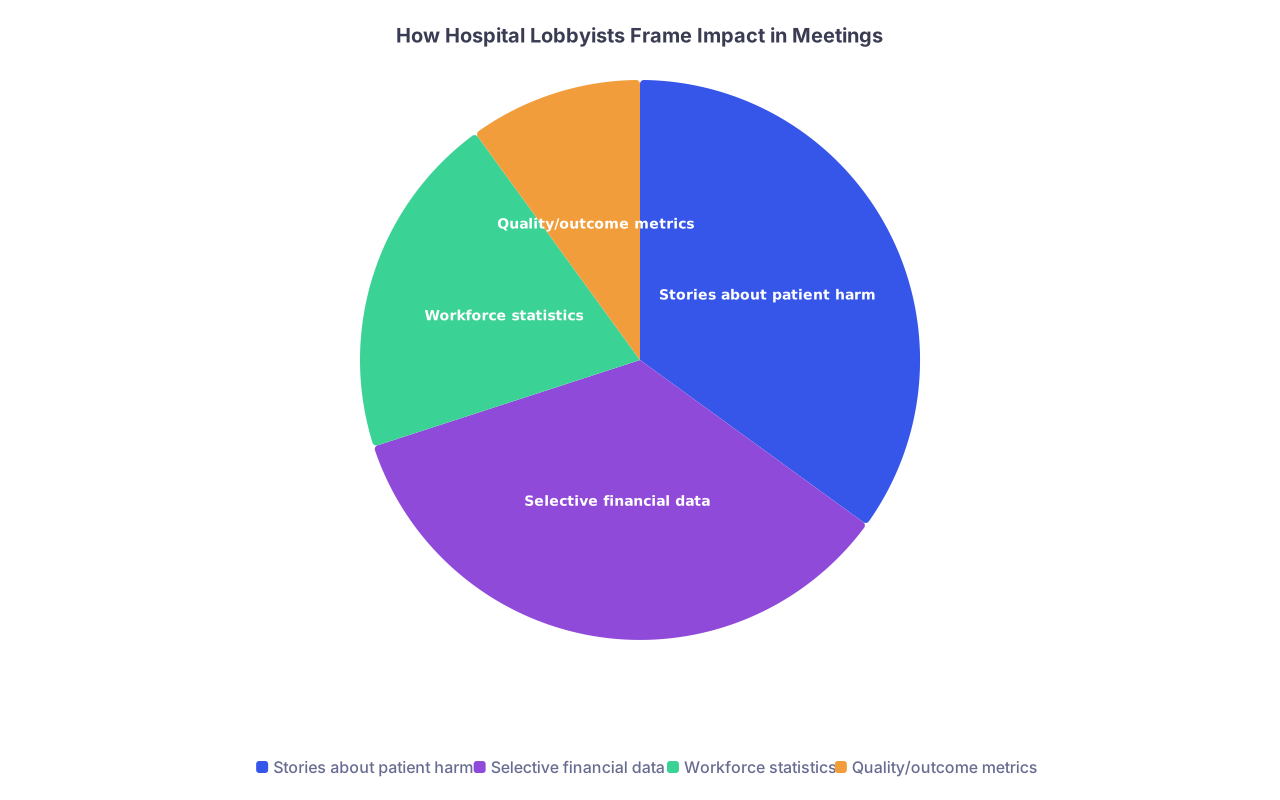
| Category | Value |
|---|---|
| Stories about patient harm | 35 |
| Selective financial data | 35 |
| Workforce statistics | 20 |
| Quality/outcome metrics | 10 |
What actually gets shown on the Hill:
Stories about patient harm
“This patient waited 14 hours in the ED and nearly died.”Selective financial data
Claims that “we lose money on Medicare patients” without disclosing system-level profits, cross-subsidies, or executive comp.Workforce statistics
“We have X open RN positions” paired with demands for more funding, not necessarily commitments to safe staffing ratios.Quality/outcome metrics
Only when they are flattering. Poor quality numbers rarely make it into leave-behinds unless used to lobby for grants or special funding.
The story is always the emotional spearhead. Stats are the shield against skeptical staffers. It’s choreography.
What You Never See: Internal Debriefs
After the Hill visits, there’s usually a recap call or email.
Internally, I’ve heard things like:
- “Your neonatologist was fantastic—really landed the point about cuts.”
- “That hospitalist mentioned burnout; we should steer away from that next time, it opens the door to labor-side stuff.”
- “The cardiologist’s story works well, but we need to tone down references to lack of beds; makes us look unprepared.”
They’re evaluating you as a messenger. Are you on-script? Do you stay within the safe emotional range? Do you avoid raising policy ideas that threaten the institution’s preferred posture?
Nobody will explicitly call it that, but they’re sorting physicians into:
- “Reliable storytellers”
- “Loose cannons”
Guess which group keeps getting invited back to DC and put on panels.
A Smarter Way to Engage With Power
If you want to work in public health policy and keep your soul intact, you need to operate on two levels at once:
Near-term, inside-the-system advocacy
- Use Hill Days selectively and intentionally.
- Insist on understanding the underlying policy.
- Insert nuance and structural critique when warranted.
Long-term, independent voice
- Write op-eds under your own name about what you see.
- Join or build physician groups not financially tied to hospital systems.
- Talk to staffers directly outside orchestrated visits. Many will gladly hop on Zoom and hear your unfiltered perspective.
You do not have to choose between never engaging and being a prop. There is a third option: show up, play the game, but refuse to let your story be fully captured.

| Step | Description |
|---|---|
| Step 1 | Clinical encounter |
| Step 2 | Internal sharing |
| Step 3 | Stays local |
| Step 4 | Story sanitized |
| Step 5 | Linked to policy ask |
| Step 6 | Hill Day meeting |
| Step 7 | Nuanced advocacy |
| Step 8 | Scripted messaging |
| Step 9 | Picked by gov relations |
| Step 10 | Physician asserts independence |
That’s your fork in the road every time your “powerful story” gets noticed.
FAQs
1. Is it unethical to let my hospital use my patient stories in DC?
Not automatically. It becomes ethically shaky when:
- you do not understand the policy being pushed,
- the story is framed in a way that misrepresents causes or solutions,
- your patient’s suffering is leveraged to defend institutional behavior that may have contributed to the harm.
You can mitigate this by controlling how you tell the story and insisting on accurate context.
2. Can I get in trouble for bringing up internal problems (like staffing or executive decisions) in a Hill meeting?
You will not get arrested. But you might annoy your institution. Formal retaliation is rare and risky for them, but informal exclusion—no more invites, subtle sidelining—is common. You have to decide what you’re willing to risk and how you phrase criticism. Framing it as “systemic issues we all struggle with” rather than “my hospital is awful” is usually safer and still honest.
3. How do I get involved in policy advocacy that isn’t just serving hospital finances?
Start by connecting with groups that are physician-led rather than hospital-controlled: specialty societies with strong ethics arms, local medical societies, grassroots physician advocacy groups, academic public health programs. Offer to brief congressional staffers directly—many want independent clinician voices. And write. Blogs, op-eds, letters. Once staffers and journalists see you as a thoughtful, independent physician voice, you’re no longer just another story in a lobbyist’s binder.
Key points to carry with you: your stories are powerful currency in DC, hospitals use them strategically to protect their interests, and you have far more control than you think over how—and whether—your patients’ suffering gets turned into someone else’s talking point.