
The most dangerous ethics mistakes in health policy work are made by well‑intentioned residents who think “this is just administrative stuff.” It is not. It is patient care at scale, and you can do real harm without ever touching a stethoscope.
If you’re a resident dipping a toe into public health policy—hospital committees, quality projects, advocacy, guideline development—your clinical instincts won’t automatically protect you. In fact, they can lull you into a false sense of moral safety.
Let me walk you through the traps I’ve watched smart people fall into. Over and over.
1. Confusing “Population Benefit” with “Ethical Justification”
The first trap: assuming that anything labeled “population health” is automatically ethically superior to individual‑focused care.
It is not.
I’ve seen this play out in quality meetings where someone proudly says, “This policy will reduce readmissions by 10%.” Everyone nods. No one asks, “What happens to the outliers this hurts?”
Classic example: the readmission obsession
Hospitals chasing readmission penalties design policies that:
- Flag “high utilizers”
- Require case management approval for readmission within 30 days
- Add extra documentation hurdles before accepting patients back
On paper? Fewer readmissions. Great population metric.
On the ground? The patient with complex heart failure, poor housing, and no PCP gets delayed in the ED because “utilizer” is stamped all over their chart and people are suddenly “exploring alternatives to admission.”
That’s not an outlier. That’s the predictable harm.
Ethics trap: You accept the aggregate benefit as the only moral data point and ignore the distribution of harms. You’ve basically decided that certain vulnerable patients are acceptable “collateral damage,” but you never said that out loud, so it feels cleaner than it is.
How to avoid this
When you’re in any policy discussion that uses phrases like:
- “Overall this will reduce…”
- “On average we’ll see…”
- “Across our population…”
Force these questions onto the table:
- Who loses under this policy? Name them. Be specific.
- Are the same people losing every time (e.g., uninsured, non‑English speakers, chronic mental illness)?
- If I had to explain this to a single harmed patient in clinic, would it still feel defensible?
Make yourself the annoying resident who says, “Show me the tails of the distribution, not just the mean.” If they cannot—or will not—you’re walking into an ethics minefield.
2. Getting Co‑opted into Biased “Evidence” Without Realizing It
Residents love data. Committees love residents who love data. That’s how you end up as the enthusiastic junior researcher on a “value” or “utilization” project that is ethically rotten at the core.
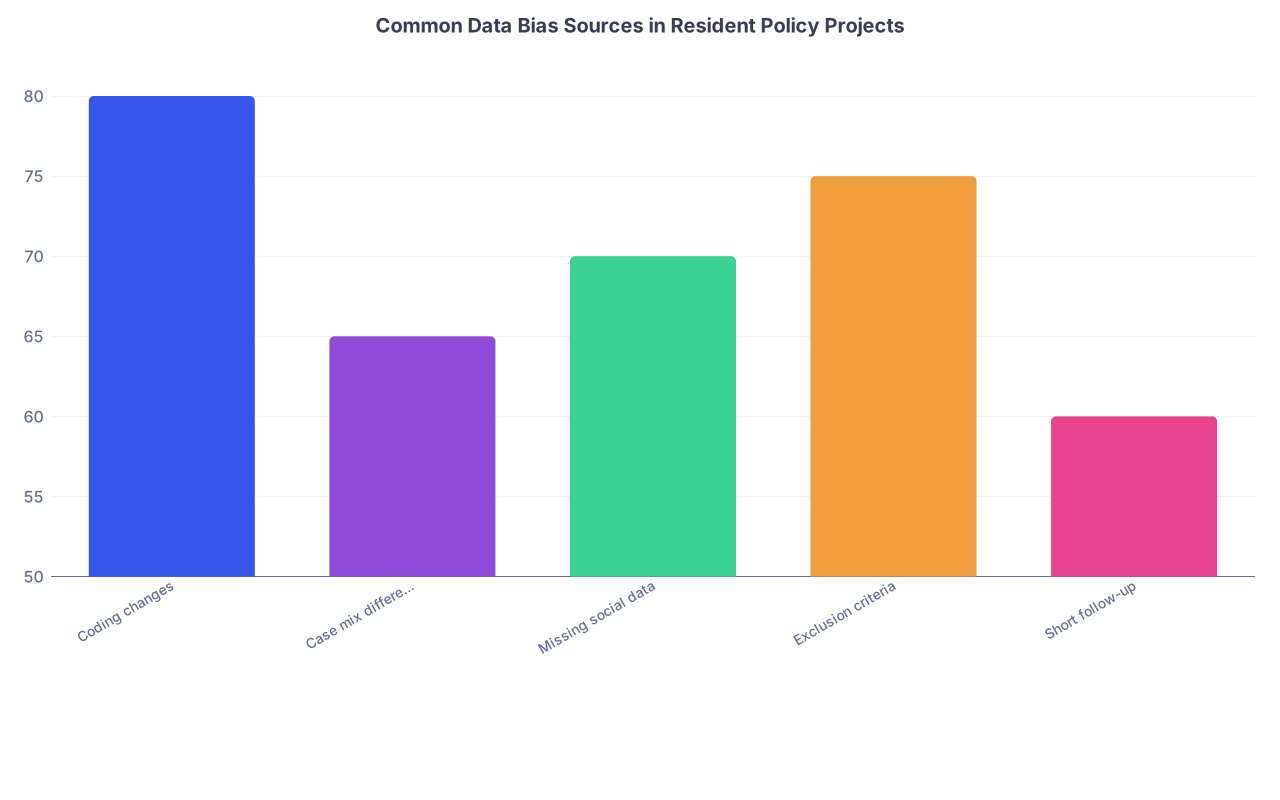
| Category | Value |
|---|---|
| Coding changes | 80 |
| Case mix differences | 65 |
| Missing social data | 70 |
| Exclusion criteria | 75 |
| Short follow-up | 60 |
Here’s the pattern I see constantly:
- Administration wants to cut costs in some area.
- A “quality” or “policy” project appears, framed as “appropriateness of use,” “low‑value care,” or “clinical efficiency.”
- A resident is pulled in to do chart review or data analysis.
- The methods are quietly stacked to reach the desired conclusion.
No one says “We want to deny care to expensive patients.” They say “We want to ensure appropriate use of high‑cost resources.” Much nicer on slides. Much more dangerous for you if you don’t see what’s happening.
Red flags you’re being used as a fig leaf
Watch for these specific moves:
Selective outcomes
Only measuring short‑term metrics that look good, ignoring long‑term ones that might reveal harm.
Example: measuring “hospital LOS reduction” but not 30‑ or 90‑day mortality or functional status.Asymmetric exclusion
Dropping “complex” patients from analysis because “they’re different,” which magically makes an intervention look safe and effective.Missing social context
Treating housing, language, and poverty as background noise, not variables that fundamentally change what “appropriate” looks like.Language laundering
Calling uninsured patients “inappropriate ED users” instead of “people with no other access point.”
Protect yourself and your patients
Before attaching your name to any policy or quality project, ask:
- Who framed the research question and why?
- Is there any scenario where the data outcome would cause the project to be stopped rather than expanded?
- Are we collecting any data on equity—race, language, insurance status, disability?
If the answer to that last one is “no,” you’re being asked to help create policy that is blind to its own inequities. That’s not neutral. It’s unethical.
3. Ignoring Power and Conflicts of Interest (Because You’re “Just a Resident”)
Residents massively underestimate how fast they can be entangled in conflicts of interest in policy spaces.
I’ve watched:
- A PGY‑2 on the “opioid stewardship” committee enthusiastically push a policy they helped draft… while their hospital quietly negotiates a contract with a pain management chain that benefits from more interventional procedures.
- A chief resident presenting “improved throughput” protocols at a system meeting, not realizing the CFO has already sold those “savings” to the board as justification for staff cuts.
You’re not shielded by your training status. You’re exposed.
Where the conflicts hide
They’re rarely about cash in your pocket. They’re subtler:
- Career currency: committee participation, podium time, middle‑author on policy papers.
- Program loyalty: pressure (spoken or unspoken) not to rock the boat.
- Branding: being the “resident representative” on some institution‑facing initiative.
| Source | What It Looks Like for Residents |
|---|---|
| Institutional loyalty | Avoiding criticism of hospital policies |
| Faculty relationships | Supporting your mentor’s pet project |
| Industry influence | Guidelines tied to sponsored education |
| Career advancement | Padding CV with “policy leadership” |
| Time pressures | Accepting prepackaged conclusions |
Questions you’re not asking—but should
When you’re asked to endorse, present, or help implement policy, ask yourself:
- Whose interests are most strongly advanced if this passes? Be concrete.
- Has anyone at this table disclosed financial or non‑financial COIs?
- If I disagreed publicly, what would it cost me here? That’s your power map.
You’re not paranoid if you notice this. You’re awake.
4. Participating in “Equity” Efforts That Are Pure Optics
One of the ugliest traps: being used as the “young, socially conscious resident” on committees that are pure diversity theater.
You’ll recognize it:
- An “equity task force” with no budget, no authority, and no data access.
- Endless listening sessions. Zero binding decisions.
- Hand‑picked “patient representatives” who are unusually compliant and grateful.
- Glossy PDFs with your photo, small font, and “recommendations” that never become policy.
You walk away thinking you helped. The institution walks away with cover.
Tell‑tale signs of performative equity work
- Equity is always framed as a “priority,” never as a requirement or standard.
- No one can tell you what will stop if the equity metrics look bad.
- Equity impact is never written into financial decision‑making or clinical protocols.
- Leadership shows up for the first meeting, then disappears.

How not to be the resident mascot
Before you lend your time and identity to any “equity” initiative, insist on:
- Scope: What explicit decisions can this group make or block?
- Teeth: What structural changes or budget shifts are on the table?
- Follow‑through: Who is accountable if recommendations are ignored?
If the answers are mushy—“We’re still defining that,” “We’ll see where this goes”—assume you’re being asked for legitimacy, not impact.
You can still participate. Just don’t fool yourself about what you’re part of, and don’t let your presence be used to sell ethically weak policy as “resident‑endorsed.”
5. Letting Metrics Replace Judgment
Residents are raised on metrics: LOS, door‑to‑balloon time, HCAHPS, VTE prophylaxis rates. When you enter policy work, those same metrics become “targets.”
Here’s the problem: what you measure becomes what you protect, even when it stops making sense.
Classic scenario: sepsis bundles.
- The policy says antibiotics within X minutes for suspected sepsis.
- ED leadership fixates on “time to antibiotics” as The Measure.
- Suddenly everyone is gaming documentation, starting broad antibiotics early, and back‑justifying sepsis to avoid falling short on the metric.
The ethics failure isn’t just overuse of antibiotics. It’s the complete erasure of clinical nuance in service of one dashboard number.
Metric traps to watch for
Single‑metric worship
When one number becomes the de facto definition of “good care,” everything else distorts around it.Back‑door coercion
“We’re not telling you what to do clinically… but this will be monitored, reported, and linked to evaluations.”Punitive transparency
Publicly posting provider‑level metrics without risk adjustment or contextual explanation. This is ethics theater, not quality.
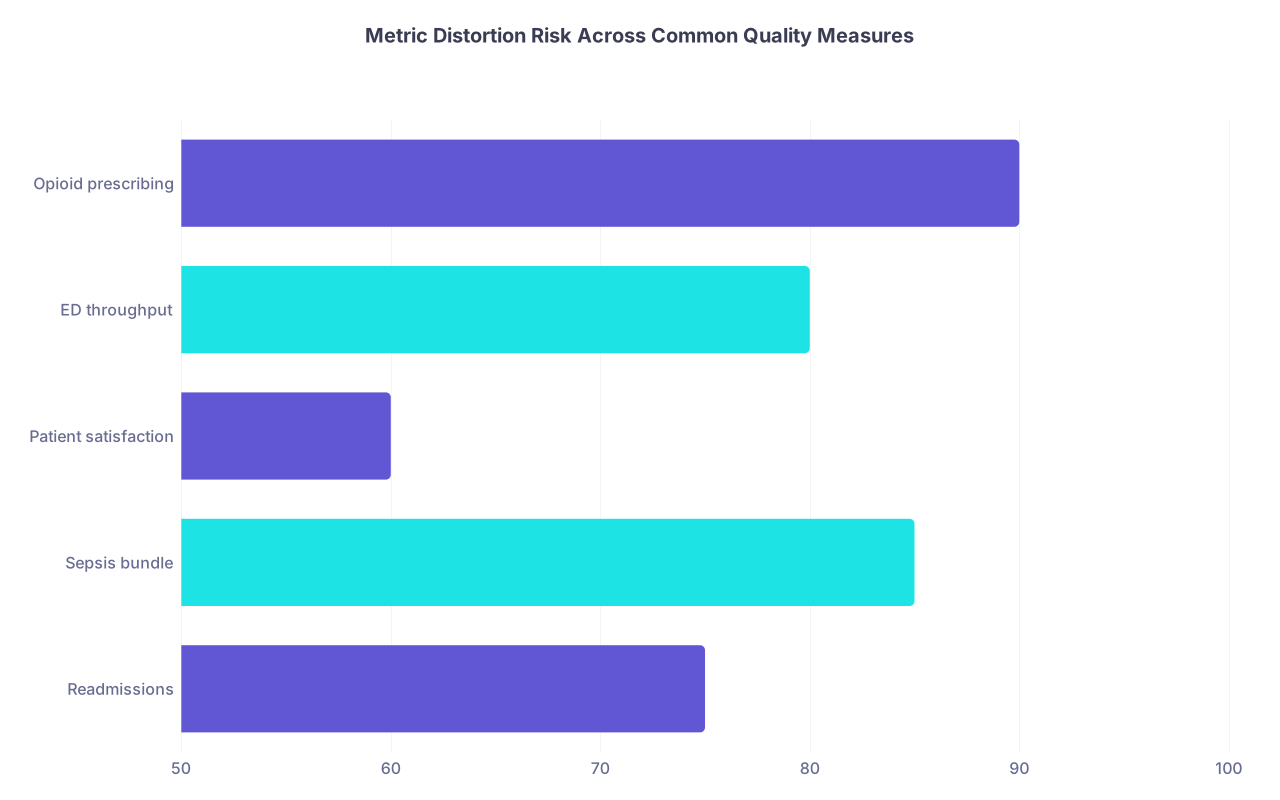
| Category | Value |
|---|---|
| Readmissions | 75 |
| Sepsis bundle | 85 |
| Patient satisfaction | 60 |
| ED throughput | 80 |
| Opioid prescribing | 90 |
How to push back without being dismissed
When metrics are proposed or discussed, ask:
- What decisions will this metric actually drive?
- How might reasonable clinicians feel pressured to distort their care to hit this number?
- What counter‑metrics do we have to catch harm? (If we’re pushing early antibiotics, are we tracking C. diff, resistance, allergy reactions?)
If the room only wants “one simple measure,” they don’t want quality. They want plausible deniability.
6. Staying Silent About Implementation Harm
Here’s a subtle one: a policy can be ethically fine on paper and still be unethical in practice because of how it’s implemented.
Examples I’ve actually seen:
- A “language access” policy that mandates interpreter use but provides so few interpreters that residents are forced to choose between delaying care and violating policy.
- A “shared decision‑making” initiative that hands out glossy handouts—but gives no extra clinic time, turning real dialogue into rushed checkbox conversations.
The trap? Residents think, “The policy is good; the implementation is just a systems problem.” No. Implementation is where ethics lives.
Where implementation goes ethically sideways
Pay attention when:
Resources don’t match requirements
You’re told to do more (more screening, more documentation, more counseling) with zero additional time or staffing.Burden falls on the lowest‑power people
Residents, nurses, MAs carrying all the extra work for leadership’s pet policy.Workarounds become the norm
Everyone quietly documents things that didn’t fully happen just to avoid noncompliance flags.
At that point you’ve left the land of “imperfect rollout” and entered “institutionalized dishonesty.”
What you can do without blowing up your career
You don’t have to lead a revolution. But you should:
- Document specific, concrete cases where the policy as implemented causes harm or dishonesty.
- Bring these to someone who is both safe and has some power (e.g., a respected program director, not just your co‑intern).
- Phrase objections in patient‑centered terms:
“The way we’re implementing this means non‑English speakers are waiting twice as long in the ED.”
If you say nothing, you become part of the silent consent that keeps bad implementation alive.
7. Misusing Patient Stories for Policy Messages
Policy work loves narratives. Legislators, administrators, media—they all want that “one powerful patient story.”
You are uniquely dangerous here because you actually know real patients.
I’ve watched residents:
- Share overly detailed stories in public meetings that clearly identify a patient to anyone locally connected.
- Use tragic cases to “sell” policies the patient might not have agreed with.
- Repeatedly use the same patient story until it becomes a prop instead of a person.
This is not harmless advocacy. It’s exploitation disguised as caring.
The lines you must not cross
Consent theater
“They would totally support this policy” is not consent. Unless you actually asked them, in understandable language, with options to decline, you’re making that up.Re‑traumatization
Re‑telling a patient’s worst moment at every meeting, conference, and op‑ed—without their awareness—turns their suffering into your rhetorical device.Identifiability
Combining age, diagnosis, exact hospital course, location, and outcome makes many patients re‑identifiable in their community, even if you skip the name.
Ask yourself: if this patient heard me tell this story this way, would they feel represented—or used?
You know the answer.
8. Overstepping Your Expertise—Or Hiding Behind Inexperience
Another common mistake: simultaneously doing too much and too little.
- Too much: speaking with absolute authority on population‑level policy just because you’ve seen a lot of sick people in one building.
- Too little: shrinking back and saying “I’m just a resident” when you see obvious ethical red flags.
Both are cop‑outs.
You don’t know everything about Medicaid reimbursement, county health budgets, or global health diplomacy. But you do know what actually happens to real patients when theoretical policies hit exam rooms.
Where residents overstep
- Making sweeping statements like “Patients don’t care about X” based on one clinic.
- Extrapolating from your academic center to rural settings you’ve never seen.
- Proposing policies that are obviously unfundable or unstaffable but sound great on paper.
You lose credibility fast when you do this. And once people tune you out as “idealistic but naive,” they’ll also ignore you when you’re right.
Where residents hide
- Saying nothing when policy language obviously stigmatizes a group you care for daily.
- Staying quiet when leadership misrepresents “what frontline clinicians want.”
- Avoiding conflict by letting sloppy “ethics” language slide.
You don’t have to be a policy expert to say, “That doesn’t match what I see at the bedside.” That is exactly why you’re valuable in these rooms.
9. Failing to Recognize Structural Harm as an Ethical Issue
One more serious trap: treating “structural” issues as outside the bounds of your ethical responsibility.
Examples:
- A discharge policy that expects patients to follow up with PCPs within 7 days, in a county where the wait time for new patient visits is 3 months.
- Telehealth expansion policies that assume everyone has stable internet and privacy at home.
- “No surprise billing” policies with loopholes that your hospital readily exploits.
You’re taught ethics as dilemmas: withdraw life support or not; override autonomy or not. Structural harm is slower, less visible, and far easier to ignore.
But when you’re in policy work, structural harm is your primary moral terrain.
How structural issues get laundered
As “unfortunate realities”
“Look, we’d love for everyone to be insured, but that’s beyond us.”As “operational constraints”
“The system just can’t support that level of follow‑up.”As “individual responsibility”
“Patients need to be more engaged.”
When you hear these lines, ask yourself: is this limitation truly fixed, or simply not prioritized? And if it’s not prioritized, who pays the price?
You won’t fix everything. But you should at least stop accepting structural harm as background noise.
10. Not Setting Your Own Red Lines
Here’s the quietest, most personally dangerous trap: drifting into ethically uncomfortable policy work one small compromise at a time.
- You help with a project you’re not fully comfortable with “for the experience.”
- You present data in a way that simplifies caveats more than you’d like, “for clarity.”
- You sign your name onto a policy you internally think is “mostly fine,” because you don’t want to be difficult.
And then suddenly your name is on a document that will be used to justify real decisions affecting thousands of patients.
You need your own red lines—now, not after the fact.
Examples of reasonable red lines
- “I will not endorse or present any policy that I believe will disproportionately harm a vulnerable group without explicit mitigation.”
- “I will not allow my name as author or representative on a document where my actual concerns are not reflected.”
- “I will not selectively present data if I know omitted data significantly changes the ethical landscape.”
You’ll still compromise. Everyone does. But if you don’t even know what your own hard stops are, the system will happily decide them for you.
Final Thoughts: The Few Things You Must Not Forget
Keep these core points front and center:
Population benefit is not a moral shield. Always ask who’s harmed, especially at the margins. If the same people lose every time, your “population” policy is unjust.
You are not a neutral participant. As a resident in policy work, you can be co‑opted for institutional optics or biased projects. Check conflicts, ask who benefits, and refuse to be a fig leaf.
Implementation and structure are where ethics actually live. A policy that’s fine on paper can be cruel in practice. If roll‑out forces dishonesty, overburdens the vulnerable, or quietly increases inequity, you’ve found an ethics failure—whether anyone labels it that or not.