
The loudest “advocates” in public health are often just very sophisticated self-promoters.
If you work in medicine or public health and you care about ethics, you cannot afford to be naïve about this. There’s a thin line between using your platform for good and using “advocacy” as a shiny label for personal branding, career climbing, or ego. Cross that line often enough, and you’re not helping patients or communities anymore. You’re using them.
Let me walk you through the mistakes I’ve seen smart people make—residents, junior faculty, even seasoned attendings—when their advocacy slowly morphs into a self-promotion machine.
1. Confusing Visibility With Impact
The first big trap: assuming more visibility automatically means more impact.
Someone gets invited to a panel on health equity. They post a 10-slide Instagram carousel about it, tag sponsors, drop a headshot from the podium, and call it “raising awareness.” Two months later, the community they supposedly “advocated for”... sees absolutely nothing change.
Here’s the mistake: equating being seen talking about an issue with actually doing something about it.
Signs your “advocacy” is really about visibility:
- You track likes and followers more closely than policy outcomes or program metrics.
- You post from every event, but cannot clearly explain what changed because of your involvement.
- You prioritize panels and keynotes over the unglamorous work: community meetings, data collection, follow-up, implementation.
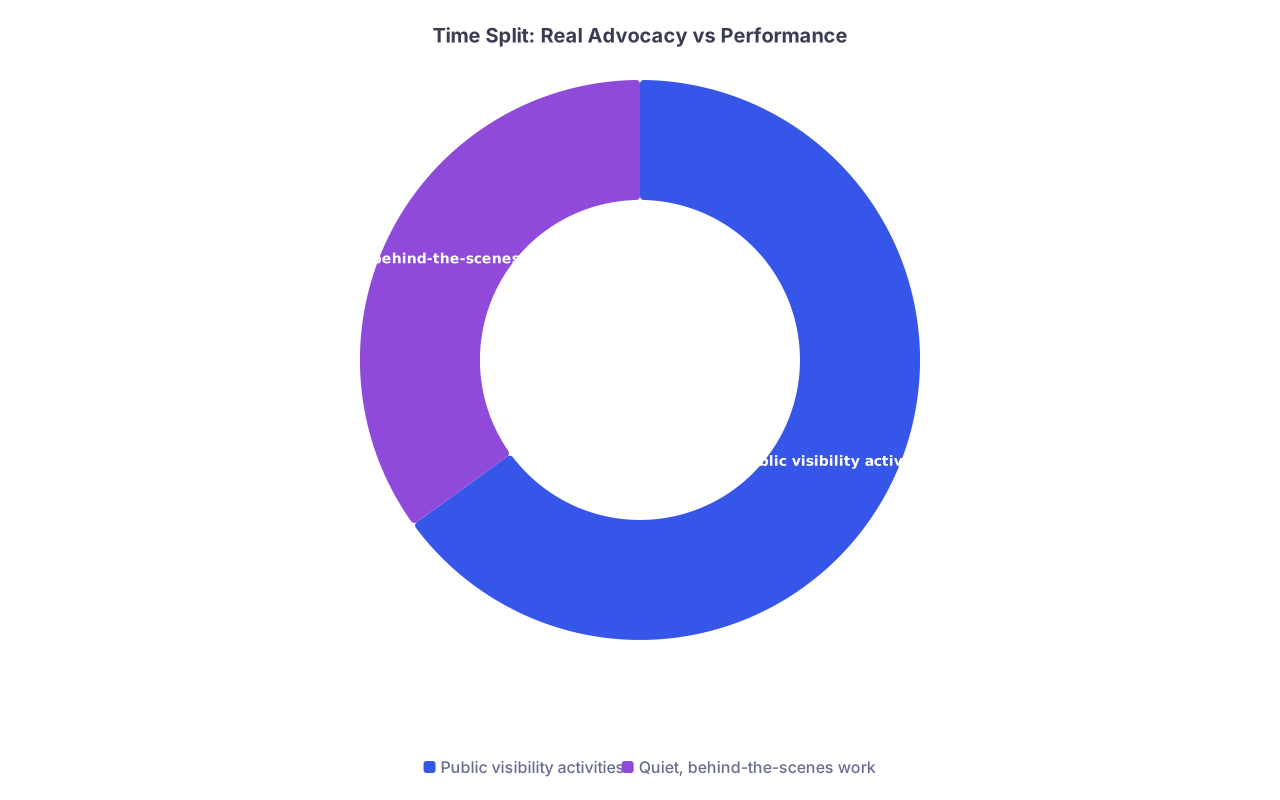
| Category | Value |
|---|---|
| Public visibility activities | 65 |
| Quiet, behind-the-scenes work | 35 |
Do not make the classic error of mistaking movement for progress. If your calendar is full of conferences and your community partners can’t name a single tangible outcome from your “advocacy,” you’ve drifted.
The line you shouldn’t cross: when your primary metric of success becomes how often you are seen, not whether anything measurably improved.
A simple self-check I use: if every camera and platform disappeared tomorrow, would I still be doing this work, in roughly the same way? If the honest answer is “no,” then the work is probably about you.
2. Turning Patients and Communities Into Props
This is where things get ugly.
I’ve watched clinicians tell emotionally charged patient stories at grand rounds, TED-style talks, and policy briefings—with full names, rare conditions, dramatic details—barely de-identified, clearly structured for maximum audience reaction. They call it “giving patients a voice.” In reality, they’re using patients as marketing material.
Do not do this.
Red flags you’re crossing an ethical line:
- You share vivid stories without explicit, informed, ongoing consent—especially on social media.
- You choose the most tragic or shocking cases because they “land better with audiences.”
- You persist with a narrative even when patients, families, or communities are uncomfortable being showcased.
- You “parachute” into a community, collect stories or photos, then vanish once your article/presentation is done.

There’s a particularly nasty behavior I’ve seen: people timing their “advocacy posts” to major tragedies or outbreaks, dropping a personal “reflection thread” that is actually just a soft flex about their prior work, grants, or media appearances. The community is in crisis. They see branding.
Lines you must not cross:
- Do not share identifiable or semi-identifiable patient stories online just because “everyone does it.”
- Do not use vulnerable communities as a backdrop for your personal moral narrative.
- Do not keep telling a story after the person behind it has signaled discomfort or has nothing to gain from you repeating it.
If you wouldn’t say it in front of the patient, their family, and a local community leader—with them fully understanding where it will be published or recorded—you probably shouldn’t be saying it at all.
3. Advocacy as Career Strategy: The Subtle Corruption
Let’s be honest: advocacy can help your career. Committees. Task forces. Blue ribbon panels. NIH or CDC collaborations. Media quotes. It shows “leadership,” “social responsibility,” “impact.”
The danger isn’t that ambition exists. The danger is when ambition quietly becomes the actual goal, and advocacy becomes a means—a costume.
Here’s how that creep usually looks:
- You choose issues because they are “hot” in academia, funding, or politics (climate, gun violence, AI), not because you have relationships, expertise, or long-term commitment.
- You show up just long enough to add the buzzwords to your CV: “health equity,” “community engaged research,” “policy advisor.”
- You redirect group work into personal branding: insisting your name be front-and-center in op-eds, press releases, and social posts.
- You subtly avoid controversial stances that might cost you keynote invitations or media slots.
| Dimension | Authentic Advocacy | Careerized Advocacy |
|---|---|---|
| Issue selection | Based on need & expertise | Based on trend & visibility |
| Time horizon | Multi-year commitment | 6–12 months, grant or cycle bound |
| Accountability | To community & outcomes | To CV, metrics, promotions |
| Risk tolerance | Willing to lose status | Avoids positions that risk image |
| Credit sharing | Collaborative, group-focused | Individual-forward, brand-first |
A line you absolutely shouldn’t cross: tailoring your advocacy positions primarily to protect your own access—media, grants, promotions—even when you know those positions are watered down and ineffective for the people supposedly being helped.
If you find yourself thinking, “I can’t publicly support that bill, it might upset X donor or Y department chair,” ask yourself a hard question: have you become more loyal to your career than to the people you claim to serve?
4. Social Media: The Most Slippery Slope
This is where many well-meaning people slide straight into self-promotion under the advocacy label.
Advocacy needs communication. But social platforms are engineered for performance, addiction, and ego. You’re playing on a rigged field.
Common mistakes:
- Posting advocacy content that’s 80% your headshots, poses, and quotes; 20% actual information or calls to action.
- Turning every institutional win into your win. “Honored to lead…” “Humbled to be the face of…” “Grateful to be chosen as…” You’re the protagonist in every story.
- Live-tweeting closed-door meetings or committee discussions to show you’re “in the room,” instead of respecting process and confidentiality.
- Engaging in public drama with other advocates or organizations because conflict drives engagement—even as it undermines the cause.
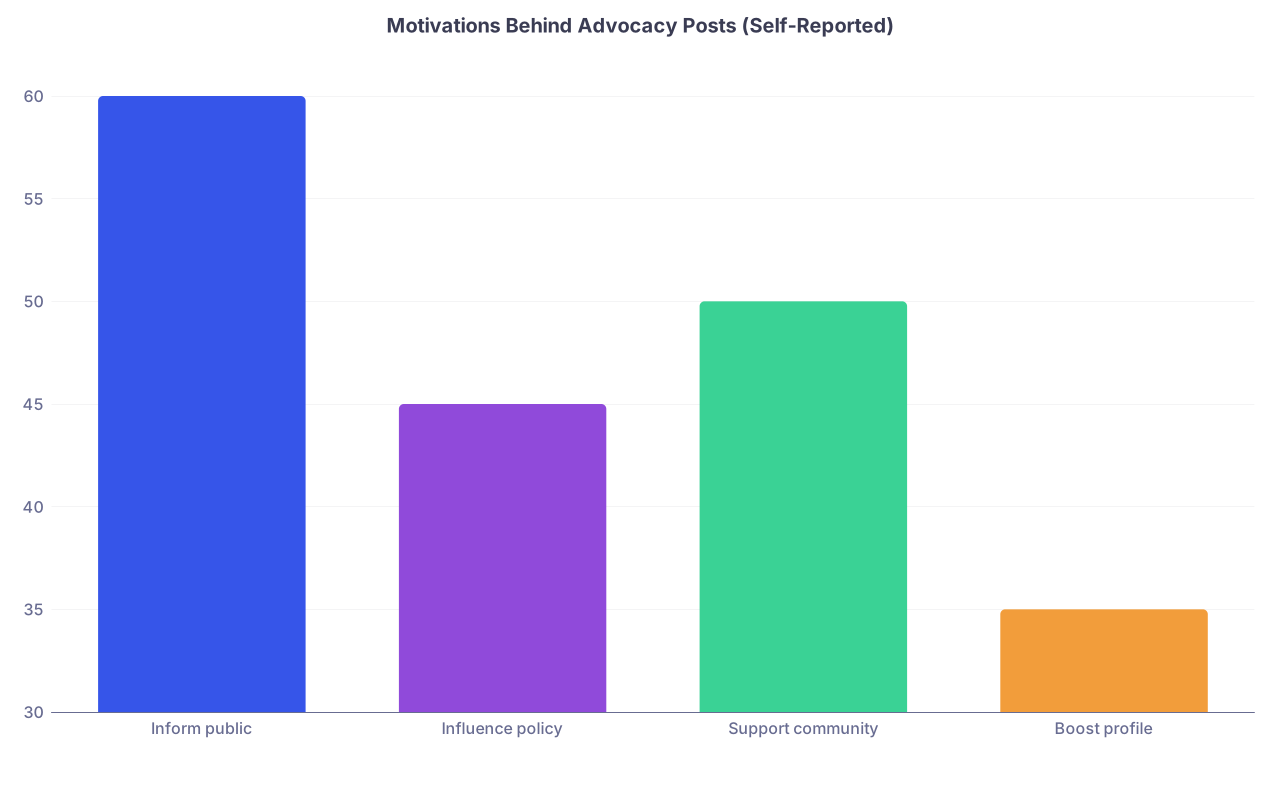
| Category | Value |
|---|---|
| Inform public | 60 |
| Influence policy | 45 |
| Support community | 50 |
| Boost profile | 35 |
Those numbers might look fine. The problem is the unreported motivations. I’ve had residents privately admit: “I felt pressure to keep posting or I’d lose relevance,” or “I almost exaggerated our program results so it’d sound more impactful.”
Here are lines you must not cross on social media:
- Exaggerating your role in a project, policy, or publication to seem more important.
- Sharing partial or misleading statistics to generate outrage or virality.
- Posting sensitive or inside information from policy discussions that could harm trust or derail serious work.
- Attacking individuals publicly (other clinicians, local staff, community leaders) to signal your virtue or “radical stance.”
If your “advocacy” posts cost trust with collaborators, staff, or communities—and you keep going because they perform well—you’re not advocating. You’re performing.
5. Conflicts of Interest: The Quiet Rot Under Good Intentions
Public health policy is tangled with money. Pharma. Tech. Insurance. Nonprofits with corporate sponsors. Tech platforms funding “health equity initiatives” while mining user data.
You must assume conflicts of interest are everywhere, including in you.
I’ve seen people completely lose the plot on this. They “advocate” for a screening program heavily funded by an industry partner, while minimizing the overdiagnosis and cost burden for patients. They serve as “experts” in campaigns sponsored by companies whose product is exactly what their policy push would mandate.
Mistakes that will ruin your credibility:
- Failing to disclose financial ties (consulting fees, grants, speaking honoraria, board positions) when advocating for a policy that benefits those funders.
- Using language from corporate marketing decks as if it’s neutral science or evidence-based policy.
- Allowing funders to influence which data you highlight and which you bury.
- Accepting “advocacy awards” or public roles that are primarily PR vehicles for corporations.
Lines you shouldn’t cross:
- Never present yourself as a neutral advocate when you have a financial or professional stake in the outcome. Disclose it clearly or recuse yourself.
- Don’t sit on “independent” panels or task forces if the sponsor is essentially buying your credibility to push a particular outcome.
- Don’t accept partnerships where the funder controls messaging about your advocacy work or limits criticism of their products or practices.
If your advocacy success and your financial success are tightly coupled, you need aggressive transparency and external checks, not vibes and good intentions.
6. Data Abuse: Overstating, Simplifying, or Cherry-Picking
Public health advocacy absolutely uses data. But policy messaging and clean narratives tempt people to sand down the edges of messy reality.
I’ve watched well-respected clinicians present:
- Relative risk without absolute numbers, making effects sound huge when they’re modest.
- One subgroup’s striking results as if they represented the entire population.
- Preprints or low-quality observational studies as if they were rock-solid causal evidence—because the story aligned with their message.
This is scientific malpractice dressed up as moral urgency.
Do not:
- Cherry-pick only the most dramatic numbers supporting your policy ask, ignoring contrary or nuanced evidence.
- Present early, uncertain data to legislators or the public as settled fact.
- Hide limitations, caveats, or harms because you fear they’ll “water down” the advocacy message.
The line you must not cross: knowingly misrepresenting strength, quality, or direction of evidence to “win” a policy argument.
Advocacy doesn’t entitle you to intellectual shortcuts. If your position cannot survive honest presentation of the evidence—with its limits and uncertainties—your position needs work, not spin.
7. Ethical Guardrails: How to Advocate Without Sliding Into Self-Promotion
You do not need to become a monk who never accepts credit. But you do need guardrails, or you will drift. Everyone does.
Some practical protections:
Community accountability
- Have a real community partner (not just a logo) who can say, “No, this doesn’t represent us,” and whom you actually listen to.
- Make it normal to ask: “Should you be the spokesperson here, or should someone from the affected community be paid and supported to do it?”
Role clarity
- Before stepping into visible advocacy, define your role: Am I the expert explainer? The connector? The signal booster? The behind-the-scenes strategist?
- If your role is “support,” then behave like support. Don’t center yourself in every communication.
Consent and co-ownership
- For patient or community stories, use documented consent and allow veto power. Let them review how their story is framed and where it appears.
- Share authorship or credit fairly. If five people carried the work, you’re not “the architect” just because you had the microphone.
Transparency about conflicts
- Keep a simple, public list of your relevant financial ties and roles. Reference it when you speak or publish on related policies.
- When in doubt, over-disclose. People will trust your honesty more than your perfection.
Personal reflection questions Ask yourself, bluntly, before major “advocacy” moves:
- If this accomplished nothing for the community but built my profile, would I still want to do it?
- Am I the best person to speak on this, or just the most willing/available/ambitious?
- Would I be comfortable if someone I respect deeply dissected my motives and saw every incentive on the table?
- If I lost access to this platform for taking an unpopular but evidence-based stance, would I still take it?
If your answers consistently make you squirm, that’s your warning sign.
FAQs
1. Is it always wrong to benefit career-wise from advocacy work?
No. The mistake is not that advocacy helps your career; the mistake is making career advancement the hidden primary goal. If you choose issues, take positions, and structure your messaging based mainly on visibility, safety, and advancement, rather than community need and evidence, you’ve crossed the line. Healthy version: you do the work with integrity, and if opportunities come, fine. Unhealthy version: you reverse the order.
2. How do I share impactful patient stories ethically in advocacy?
Use explicit, informed, written consent that explains where and how the story will be used—including digital permanence and potential media reach. De-identify beyond regulatory minimums if there’s any risk of recognition. Offer patients the right to withdraw permission before publication. And ask yourself whether their story is necessary for your advocacy point, or whether you’re using it mainly for emotional punch.
3. What if my institution pushes me to be the “face” of an advocacy agenda?
You don’t have to say yes automatically. Ask what community input went into this agenda, who else should be involved, and how credit and decision-making are shared. You can insist on guardrails: community co-speakers, transparent acknowledgment of team members, and clear disclosure of institutional or industry interests. If you’re being used as branding, rather than as a genuine advocate, be willing to decline.
4. How can I tell if my social media advocacy has slipped into self-promotion?
Look at your last 10 posts: How many center you—your face, your awards, your “honored to” moments—versus centering the issue, data, or community? If you removed your name and image, would the posts still deliver value? Also pay attention to your emotional response: if you feel a constant pull to post every meeting, panel, or minor recognition, that’s not advocacy. That’s image maintenance.
5. Is strong, personal branding always incompatible with ethical advocacy?
Not always, but it’s dangerous territory. A personal brand can help spread important messages, but it also creates pressure to stay on-brand, avoid nuance, and chase engagement. The more your identity, income, and opportunities depend on being seen a certain way, the harder it becomes to take unpopular stances, admit uncertainty, or step back when you’re not the right voice. If you build a brand, do it with explicit ethical rules—and people around you who are not afraid to tell you when you’re crossing the line.
In the end, keep three things straight:
- Advocacy is about outcomes, not optics.
- Patients and communities are not content.
- If your “advocacy” mainly serves you, it’s not advocacy—no matter what you call it.