
You’re sitting at your laptop after a brutal clinic day.
There’s one patient you cannot get out of your head—the one whose story perfectly captures what’s wrong with your hospital’s discharge policies, or your state’s Medicaid rules, or your system’s unsafe staffing.
You start typing a powerful Twitter thread / LinkedIn post / op-ed about them. You want people to feel what you see every day. You want to use this story to push for change.
You’re about to hit “post.”
This is exactly where people destroy their careers.
Not because they are cruel. Because they are careless. Or they think, “I changed the age and gender, so it’s fine.” Or, “It’s de-identified enough, who could possibly know?”
Regulators do not care about your intentions.
Plaintiff attorneys absolutely do not care about your intentions.
HIPAA and state privacy laws are not impressed by your advocacy.
Let’s walk through how to use patient stories in advocacy without blowing up your license, your institution, or your patient’s trust.
1. The Big Misunderstanding: “If I Don’t Use Their Name, I’m Safe”
This is the most common and most dangerous myth.
“I didn’t say their name, so it’s not a HIPAA violation.”
Wrong. Spectacularly wrong.
HIPAA cares about identifiable information, not just names. And “identifiable” is a lot broader than you probably think.

What counts as identifiable?
HIPAA has the famous list of 18 identifiers (name, address, phone, email, full face photos, etc.). Everyone memorizes that for exams and then promptly forgets the spirit of the rule:
If a reasonable person who knows the context could figure out who this is, you’re in trouble.
That means you can absolutely violate HIPAA without saying:
- The patient’s name
- The hospital name
- The exact date
Examples people think are “safe” but are not:
“Middle-aged bus driver from the east side with metastatic breast cancer who lost coverage when her husband died last month.”
In a small city? Plenty of people can connect those dots.“Trans patient living at the shelter near 5th Ave who was attacked outside the downtown clinic yesterday.”
That person, their friends, shelter staff—they all know exactly who you’re talking about.“We just intubated a 27-year-old pregnant woman with no prenatal care who collapsed at the airport Starbucks this morning.”
The news, the staff, the family: all know this case.
If someone who already knows the patient or event can read your post and say, “That’s obviously my sister / coworker / neighbor,” you’re skating on thin ice.
The lazy shortcut—“No name = no HIPAA issue”—will burn you.
2. Advocacy vs. Gossip: Where People Cross the Line
You are absolutely allowed to talk about health policy failures. You are allowed to talk about structural racism, access barriers, broken insurance systems. You are allowed to be angry.
You are not allowed to trade patient privacy for rhetorical impact.
The worst offenders fall into three patterns:
Trauma porn for likes
Graphic detail, dramatic suffering, blow-by-blow account of a code or a tragedy. Often posted during or right after a shift.“Look how compassionate/smart I am” stories
The miraculous diagnosis, the last-minute save, the “I stayed late and held their hand while they died” post.Rage-posts about bad behavior
“My drunk patient spat on me today, here’s what I think about people like that.” You’re not just venting—you’re describing a real human being in a clinical encounter.
Stop and ask: Does this story need granular detail to make the policy point?
Almost always, the answer is no.
You can talk about:
- Patterns you see
- Systemic failures
- Types of cases
- Generalized scenarios
Without stitching a specific, recognizable human being onto your advocacy as a prop.
3. “But I Got Their Consent” – Are You Sure?
Another trap: “They said I could share it.”
I’ve watched people get lulled by this. A grateful patient says, “Tell my story if it helps others.” A parent says, “The world needs to know what happened to my son.”
And you think: great, green light.
Not so fast.
There’s a difference between casual verbal “consent” and legally valid authorization under HIPAA.
| Aspect | Verbal Permission ("You can share") | HIPAA Authorization Form |
|---|---|---|
| Legally sufficient? | No | Yes |
| Documented? | Usually no | Signed and stored |
| Scope defined? | Vague | Specific purpose and limits |
| Revocable? | Informally, unclear | Yes, with clear process |
| Holds in investigation? | Very weak | Stronger legal protection |
Common mistakes with “consent”
No written permission.
HIPAA requires a proper authorization to disclose PHI for things like media, advocacy, or public posting. A casual “Ok” in conversation will not protect you.Patient not fully informed.
They may not grasp:- How far social media spreads
- That posts can be screenshotted and archived forever
- That details might be recognized by employers, family, local media
Power imbalance.
You are the clinician. They are vulnerable, often in crisis. Did they feel like they could say no? Courts and boards will care about this.Changing minds.
People who are fine with publicity during an acute crisis often regret it later. Your post lives on.
If you’re planning to share any potentially identifiable story outside standard care (advocacy talk, op-ed, public-facing social media, media interview), the default safe path is:
- De-identify enough that even they themselves would not clearly recognize it
- Or get an actual HIPAA-compliant authorization through your institution’s process
- Or do not share the specific story at all
4. “De-Identification” Done Wrong
The second most common dangerous belief:
“I changed the age a little and didn’t say the hospital. So it’s de-identified.”
People treat “de-identified” like a magic word. It’s not. The law doesn’t care what you call it; it cares whether the person is realistically identifiable.
Here’s where people screw it up:
- They change the age from “83” to “80s” but keep a rare diagnosis in a small town
- They tweak the timing from “yesterday” to “recently” but keep key location details
- They describe unusual personal details (“former Olympic-level swimmer,” “only pediatric transplant patient this month”) that instantly narrows it down
You must think in layers, not single edits.

A safer approach to de-identified advocacy
When telling a story for advocacy, ask:
Can I merge several similar cases into one composite story?
- E.g., “I’ve cared for many elderly patients with congestive heart failure who…” instead of “Last Tuesday, my 79-year-old patient who lives alone on Oak Street…”
Can I remove:
- Exact ages (use ranges or life stages: “in their 70s,” “a young adult”)
- Specific locations (no neighborhood, employer, exact clinic)
- Specific dates (use “a few months ago,” “over the last year”)
- Rare diagnoses plus any distinctive trait in the same story
Can I focus on the policy failure, not the human trivia?
- You don’t need their exact job, religion, number of kids, or favorite hobby to make a point about insurance denials.
Could someone who knows this patient confidently say “that’s definitely them”?
If yes, you’ve not de-identified enough.
5. Social Media: Where People Get Sloppy and Regulators Don’t
If you remember nothing else from this article, remember this: social media screenshots outlive your good judgment.
Boards, hospitals, and lawyers increasingly use your public posts against you.
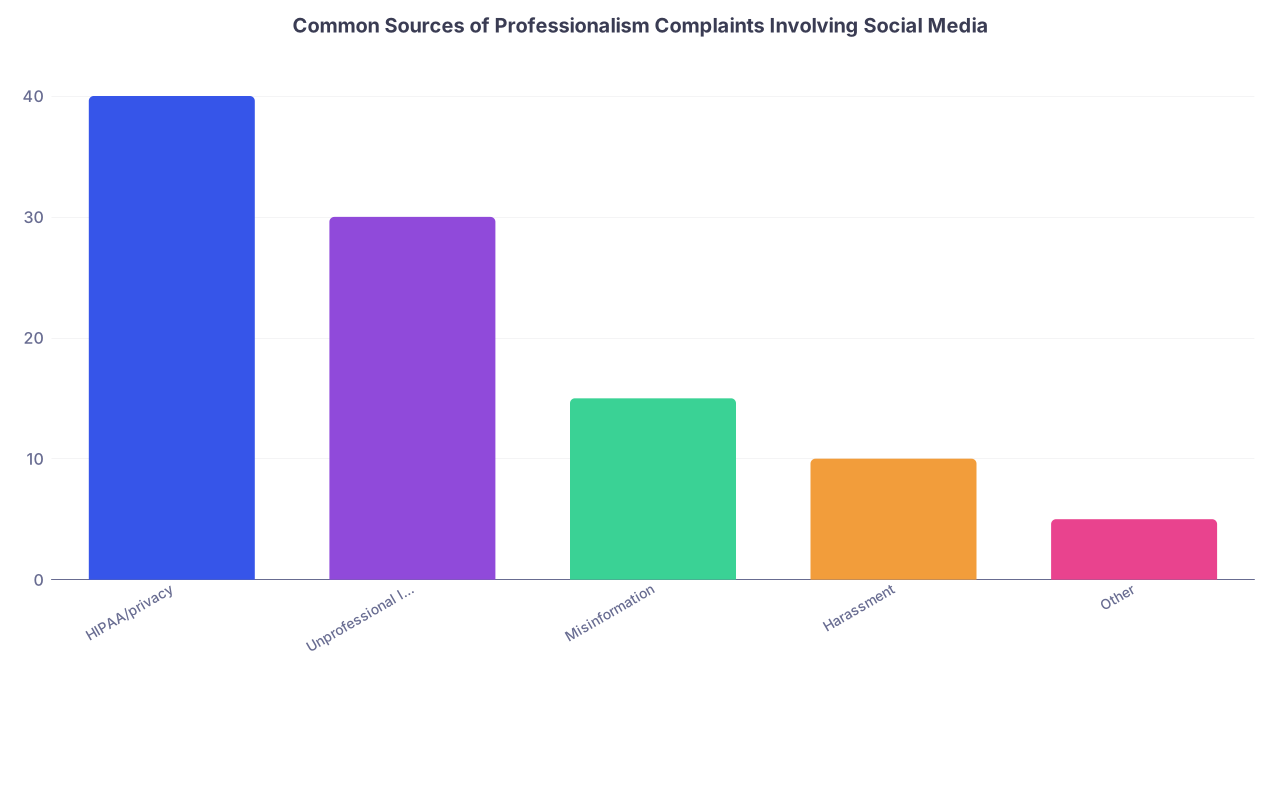
| Category | Value |
|---|---|
| HIPAA/privacy | 40 |
| Unprofessional language | 30 |
| Misinformation | 15 |
| Harassment | 10 |
| Other | 5 |
I’ve seen careers detonated over:
- A seemingly “anonymous” tweet thread about a tragic pediatric death
- A late-night Instagram story complaining about “drunk trauma cases” with enough detail to match a news report
- A Facebook rant about “anti-vaxx parents” mentioning the exact school district and recent measles case
Red flags in your advocacy posts
If your post includes any of these, back up:
- Exact timing: “tonight,” “this morning,” “right now in our ED”
- Specific demographics for a single case: “34-year-old Somali man who drives for Uber”
- Rare events that were in the news: “the bus crash patient,” “the shooting victim”
- Photos anywhere near clinical areas, whiteboards, screens, or identifiable people
- “We just admitted…” or “My last patient of the day…” with detail that narrows it down
Even if you think your account is “small” or “just colleagues,” all it takes is one screenshot and one person recognizing the patient.
And remember: private accounts are not guaranteed safe. Your followers can still screenshot you.
6. Speaking to Media, Legislators, and the Public Without Violating HIPAA
You might be testifying at a city council meeting about ED overcrowding. Or talking to a reporter about why your hospital’s discharge policies are dangerous. Or giving a talk at a community forum.
You want to bring the room with you. Stories do that. But doing it wrong in those settings is even riskier, because your words are on record.

| Step | Description |
|---|---|
| Step 1 | Want to use patient story |
| Step 2 | Do not use specific case - use composite |
| Step 3 | Confirm scope and setting |
| Step 4 | Use story with caution and focus on system issues |
| Step 5 | Is it fully de-identified? |
| Step 6 | Do you have HIPAA authorization? |
| Step 7 | Could patient be recognized by those who know them? |
Safer ways to bring stories into advocacy
Use:
Aggregated experience
“Over the past year, I’ve cared for many patients who had to choose between insulin and rent.”Composite patient
Combine realistic elements from multiple cases into a single, generic narrative. Make sure no single real patient matches that story exactly.Hypothetical scenario
“Let me walk you through what it looks like when a low-wage worker with no paid sick leave develops chest pain…”Published, consented stories
If your institution has already published a fully consented patient story through communications or media, you may refer to that exact, publicly available version—but don’t embellish or add new clinical detail.
When a legislator or reporter presses:
“But can you give me a specific example?”
Your safe script is something like:
“I have to protect patient privacy, so I cannot describe any specific case in a way that could identify an individual. But I can share a composite that reflects what we commonly see…”
This signals professionalism and protects you.
7. Less Obvious HIPAA Traps People Miss
There are some sneaky situations that catch even well-meaning, ethics-minded clinicians.

1. Small communities and “unique” patients
Rural areas. Tight-knit ethnic communities. Niche patient groups (trans patients, rare disease clinics, HIV specialty clinics).
What feels anonymous on your national Twitter feed may be laser-targeted in their community.
If your patient group is small, you have to be stricter about what you share.
2. Educational talks that end up public
You give a grand rounds talk or a teaching session using a “de-identified” case. Someone records or posts slides online. Suddenly what you thought was an internal educational session is effectively public.
If there is any chance your content will be recorded or posted:
- Strip identifiers like you would for a journal publication
- Ask yourself if the patient could recognize themselves, and whether that matters
3. Mixing clinical and personal data
Example: “A patient from my clinic, who also happens to be my neighbor’s cousin, told me…”
Now you’ve linked clinical details with social network info that’s even easier to trace.
4. Venting in “private” groups
Slack workspaces. WhatsApp chats. Facebook doctor groups. Group texts.
People screen-capture everything. Internal chats get leaked in lawsuits.
Typing “This is private” at the top of your rant does not magically create legal protection.
8. A Practical Safer-Use Checklist Before You Share Any Patient Story
If you’re about to post, present, or publish a patient story for advocacy, run through this ruthlessly honest checklist:
Is this actually needed?
- Can I make the same policy argument with a composite or generalized description?
Could a reasonable person who knows the patient identify them from this?
- Friend, coworker, family, staff, local journalist.
Have I removed or altered these elements?
- Exact dates
- Exact age (use rough ranges)
- Specific employer, school, or workplace
- Specific address, neighborhood, or small town
- Unique physical description or rare diagnosis
Am I using this story to center myself?
- Is this more about my heroism, my suffering, my outrage, than the system issue?
Do I have written, HIPAA-compliant authorization if this is identifiable?
- And is that authorization appropriate for this specific medium and audience?
Would I be comfortable reading this aloud in front of the patient and their family?
- Including the most critical or emotional sentences.
If you cannot answer “yes” to the safety questions and “no” to the ego-driven ones, don’t post it. Rewrite it until you can.
9. How to Advocate Powerfully Without Exploiting Patients
Let me be blunt: you do not need to endanger patient privacy to be a strong advocate.
Some of the most effective advocates I know:
- Talk in patterns and systems, not single vivid tragedies
- Use data plus generalized stories
- Work with communications/legal at their institution to craft shareable, compliant narratives
- Collaborate with patient organizations, amplifying patients who choose to tell their own stories
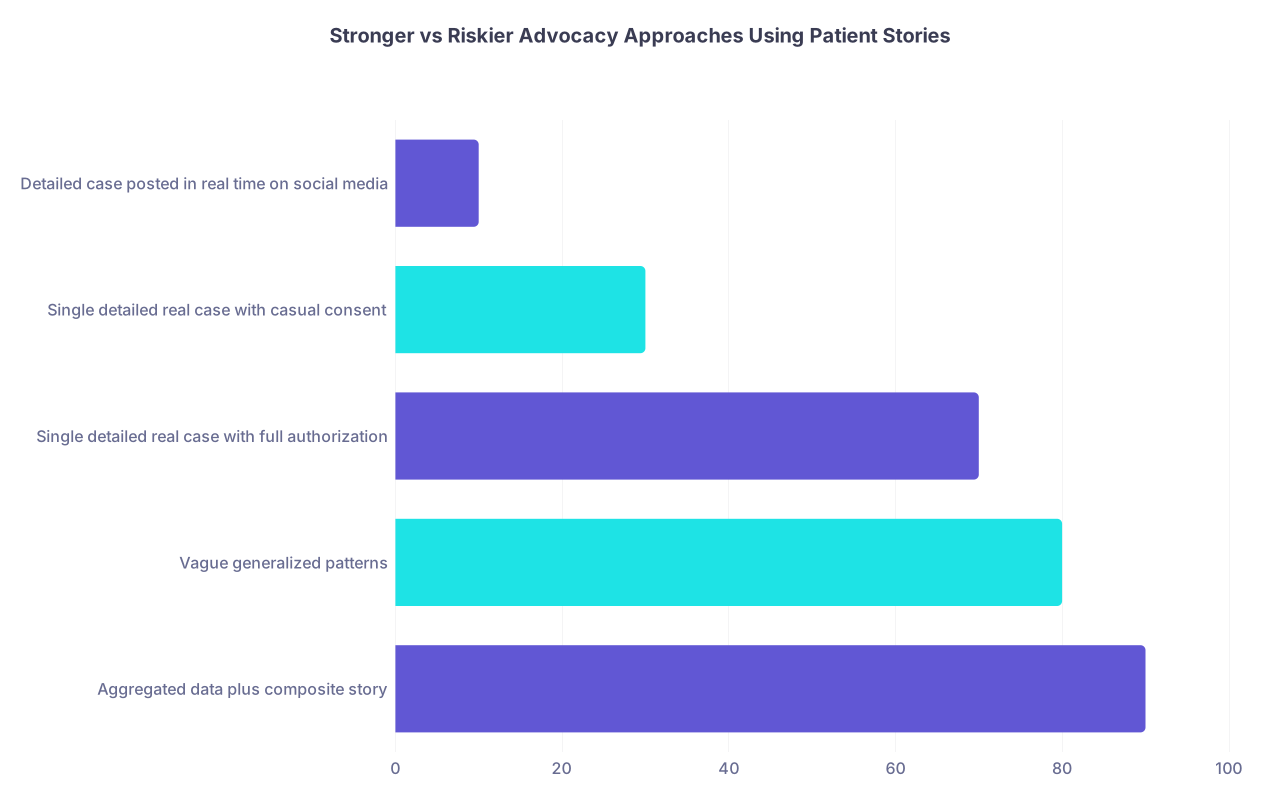
| Category | Value |
|---|---|
| Aggregated data plus composite story | 90 |
| Vague generalized patterns | 80 |
| Single detailed real case with full authorization | 70 |
| Single detailed real case with casual consent | 30 |
| Detailed case posted in real time on social media | 10 |
Notice the pattern: the more specific and real-time a story is, the more dangerous it is from a HIPAA and ethics perspective.
If you want to change the world, protect the people you’re claiming to fight for. That includes their right not to have their worst days dissected online for your argument.
FAQ (Exactly 3 Questions)
1. If I completely change all details (age, gender, timing, location), is it still a HIPAA issue?
If you change so many details that no real patient matches the story anymore, you’re essentially using a fictional or composite case. That’s generally safer from a HIPAA standpoint. The risk comes when your “changed” details are minor—same rare disease, same small town, same newsworthy event. When in doubt, combine elements from multiple patients and avoid any combination that maps cleanly to a single person.
2. Can I share a patient story if it was already covered in the news with their name?
Maybe, but be careful. News coverage doesn’t give you a free pass to disclose additional protected health information from your role as a clinician. You can reference what’s already publicly available, but if you add extra clinical details from the chart or your direct care, you can still violate HIPAA. When a case is high-profile, the identification risk is actually higher, not lower.
3. What if I’m a student or trainee—does HIPAA still apply if I don’t sign the notes or bill?
Yes. Absolutely. HIPAA applies to anyone with access to protected health information through a covered entity—students, scribes, volunteers, residents, everybody. Being “just a student” will not save you if you post an identifiable patient story on social media. Your school, hospital, and future boards will all care, a lot.
Key points, no fluff:
- “No name” does not mean “no HIPAA risk.” If someone who knows the patient can recognize them from your advocacy story, you’re exposed.
- Use composites, patterns, and generalized scenarios for advocacy. Keep specific, identifiable patient stories out of public spaces unless you have ironclad authorization and a damn good reason.
- Your job is to protect patients, even when you’re angry at the system. If your advocacy requires risking their privacy, rewrite your strategy—not their dignity.