
The fastest way for a physician to destroy their credibility in public health policy is to testify badly at a hearing.
Not by being wrong on the science. By looking unprepared, biased, or arrogant in front of people who make the rules—and in front of cameras that will outlive your career.
If you plan to speak at a legislative or public health hearing, you do not need to be perfect. But you absolutely cannot afford certain mistakes. I’ve watched smart, thoughtful doctors get steamrolled in front of a committee because they walked in like it was grand rounds, not politics.
Let’s walk through how not to testify—and how to protect yourself from the landmines.
1. Walking In Like It’s a Journal Club
The first big mistake: treating a public hearing like an academic presentation.
In a legislative or regulatory hearing, the primary audience is not other physicians. It’s:
- Elected officials with wildly variable scientific literacy
- Staffers who quietly control the follow-up
- Lobbyists listening for soundbites
- Journalists waiting for quotes
- Members of the public who already distrust “experts”
If you show up with 18 minutes of epidemiologic nuance and five forest plots, you’ve already lost.
Common errors in this category:
Overloading with data, underloading with meaning
- Reading incidence rates, confidence intervals, and p-values without telling anyone what to do with that information.
- Diving into subgroup analyses when the committee still doesn’t understand the basic risk difference.
Speaking in jargon-heavy, residency-conference language
- Saying things like “noninferiority margin,” “endogeneity,” “effect modification” to people who are still working out what “absolute risk” means.
- Answering a policy question with: “Well, the meta-analysis is heterogeneous…”
No clear ask
- Ending your testimony with “this is an important issue” instead of, “I urge the committee to pass Bill 1234 with an amendment to fund X.”
Here’s the part that stings: when you do this, you look unclear or even evasive, not smart.
How to avoid it:
- Write your bottom line in one sentence first:
“I support/oppose Bill 1234 because [specific impact on patients or public health].” - Build backwards from that. Every statistic should support that single sentence.
- Translate your key numbers into plain language:
- “This policy would prevent about 20 deaths a year in our state.”
- “For every 100 people affected, 10 more will end up in the ICU.”
- Test your testimony on a non-medical friend or family member. If they say, “I don’t get what you want them to do,” you’re not ready.
2. Forgetting You’re Under Oath—Ethically If Not Legally
Some hearings literally swear you in. Others don’t. Either way, you’re under an ethical oath as a physician.
Physicians blow this in predictable ways:
Exaggerating evidence strength to “counter” misinformation
- Calling something “proven” when it’s early data, because you’re angry at denialism.
- Saying “we know this is safe long-term” when we only have short-term follow-up.
Cherry-picking studies
- Presenting only the RCT that supports your position while pretending the three negative trials do not exist.
- Using one flawed observational study because it has a big, dramatic effect size.
Overstating your personal expertise
- “As a leading expert in X…” when you’re a generalist who reads a lot.
- Allowing the committee chair’s intro to over-inflate your credentials and not correcting it.
This is exactly how good-faith physicians later get dragged in public or cross-examined in court: “Doctor, you testified that ‘we know’ X, but your own publications say the evidence is limited. Which is it?”
How to avoid it:
- Before the hearing, write down:
- What the evidence clearly supports
- What it suggests
- What we do not know yet
Then stick to those categories.
Use careful but plain truth:
- “The best available evidence shows…”
- “We have strong reason to believe…”
- “Right now, we simply do not know the long-term impact, and any claim otherwise is speculation.”
Be honest about your lane:
- “I’m an emergency physician; I’m not a virologist, but I can speak directly to what we see in the ED and what the hospitalization data show.”
3. Ignoring Conflicts of Interest (or Minimizing Them)
Nothing undermines a physician’s testimony faster than a concealed or downplayed conflict of interest that gets exposed.
Typical physician missteps:
Failing to disclose industry funding or consulting
- “Oh, that grant was through my institution, not me personally.”
- “I sit on that company’s advisory board but it doesn’t affect what I’m saying.”
Using slippery language when asked directly
- “I’ve done some work with different organizations in this space” instead of naming the companies.
- Pausing, looking uncomfortable, then offering partial answers.
Acting offended when conflicts are questioned
- “I’m here as a physician, not as a pharmaceutical consultant.” That line never works as well as you think.
Here’s the practical reality: everyone has biases and many professionals have financial connections. The sin isn’t having them. It’s hiding them or pretending you don’t.
How to avoid it:
Prepare a clear, concise disclosure statement in advance. Something like:
“For transparency, I receive research funding from Company A for unrelated work on diabetes devices, and I previously served on an advisory board for Company B, which manufactures [type of product] but does not produce any product directly affected by this bill.”Don’t wait to be asked. Include disclosure right at the start of your testimony.
If you’ve got major, direct conflicts (e.g., you’re paid by the company whose product is under regulation), strongly consider:
- Supporting another, less-conflicted physician to be the lead public face
- Being careful to frame your role: “I work closely with [stakeholder], and I’m here to provide technical clarification, not to speak as a neutral party.”
| Situation | Must Disclose? |
|---|---|
| Paid speaker for company on topic drug | Yes |
| PI on unrelated industry-funded trial | Yes |
| Unpaid advocacy with non-profit | Usually |
| General specialty society membership | Typically No |
If you’re debating whether to disclose something, that’s your sign: disclose it.
4. Arguing Like You’re on Twitter, Not Under Record
Physicians sometimes bring their social media persona into a formal hearing. That’s a mistake.
I’ve seen:
- Specialists rolling their eyes at committee members’ questions
- Sarcastic responses like, “Well, that’s not how evidence-based medicine works”
- Thinly veiled contempt for “non-science people making science decisions”
Remember: hearings are performative politics. The point for many committee members is to:
- Get a clip for their district
- Make their base happy
- Show they “stood up” to experts or to industry
If you take the bait and get combative, you become the clip.
Common behavioral errors:
Visible frustration
- Sighing, smirking, shaking your head when a member repeats a conspiracy theory.
- Talking over an official when they interrupt you (they will interrupt you).
Point-scoring
- Correcting an irrelevant technical term just to show they’re wrong.
- Snapping back with, “That’s a strawman” or “That’s not what I said.”
Making it personal
- “With respect, Senator, you don’t have the training to evaluate this.”
- “I’m not here to debate Facebook posts.”
How to avoid it:
Practice hostile Q&A beforehand. Have someone play a skeptical or grandstanding committee member and throw bad-faith questions at you.
Pre-select calm phrases you can use under pressure:
- “I see the concern. Here’s what the data actually show…”
- “I can’t speak to motives, only to outcomes, and the outcome we see is…”
- “That’s not accurate. Let me clarify what we know.”
Refuse to be rushed into a bad soundbite. If they interrupt:
- Stop.
- Look at them.
- Say, “I’ll answer your question directly: [very short, factual line].”
Your goal is not to “win” the exchange in the room. Your goal is to stand up well when the clip hits the news or the legislative archive.
5. Forgetting There’s a Camera and a Transcript
Most physicians underestimate how permanent and searchable their testimony will be.
Later, someone can and will:
- Pull your sentence into a policy brief or lawsuit
- Quote you in a media story, possibly out of context
- Use your own words against you when evidence shifts
Common mistakes:
Speaking off the cuff instead of sticking to prepared language
- Wandering into topics you haven’t thought through because a question “seems simple.”
- Making unscripted strong claims: “I guarantee…” “There’s absolutely no…” “You’ll never see…”
Jokes that do not land
- Trying to lighten the mood with a sarcasm or dark humor. It reads as callous later.
- Laughing along with a dismissive comment about a patient group.
Inconsistent statements across hearings and media
- Saying one thing under oath and a different version in a later op-ed or podcast.
- Using more absolutist language in the hearing than you do anywhere else.
How to avoid it:
Write your opening statement word-for-word and stick closely to it. You can sound natural without freelancing your content.
For tough questions where you don’t know:
- “I don’t know the answer to that, and I won’t guess. I can provide written follow-up with accurate data.”
That line protects you more than any improvisation.
- “I don’t know the answer to that, and I won’t guess. I can provide written follow-up with accurate data.”
Assume every sentence could appear in isolation on the evening news. That doesn’t mean to water everything down. It means:
- No gratuitous metaphors comparing patient groups to “burdens”
- No dramatic analogies that might be weaponized
- No “off the record” moments—there aren’t any
6. Treating Patients as Abstract Numbers—or Worse, Prop Props
Ethically, one of the worst things physicians do in testimony is use patient stories in ways that violate dignity or confidentiality.
I’ve seen doctors:
- Give so many identifying details about “a hypothetical patient” that anyone local could recognize them
- Share trauma stories in graphic detail purely for shock value
- Frame patients as passive victims or villains to score a political point
This isn’t just sloppy; it’s a breach of trust.
Common missteps:
Using stories you don’t have permission to tell
- “I had this patient, a 43-year-old woman with twins, who…” followed by specific workplace details.
Speaking for patient groups you barely work with
- “My patients with addiction just need tougher laws.” From someone who spends 15 minutes a year with them in the ED.
Dehumanizing language
- “These people,” “these cases,” “burdens on the system.”
How to avoid it:
Either:
- Use composite cases clearly labeled as such:
“I’m describing a composite patient based on many people I’ve treated.” - Or get explicit patient consent (preferably written) if you are using a real, identifiable story.
- Use composite cases clearly labeled as such:
Clean your stories:
- Remove or alter age, location, job, family structure, and timeline unless essential.
- Focus on the pattern and the policy impact, not sensational details.
Check your language:
- Replace “burden” with “impact” on patients and systems.
- Use people-first language: “people living with opioid use disorder,” not “addicts.”
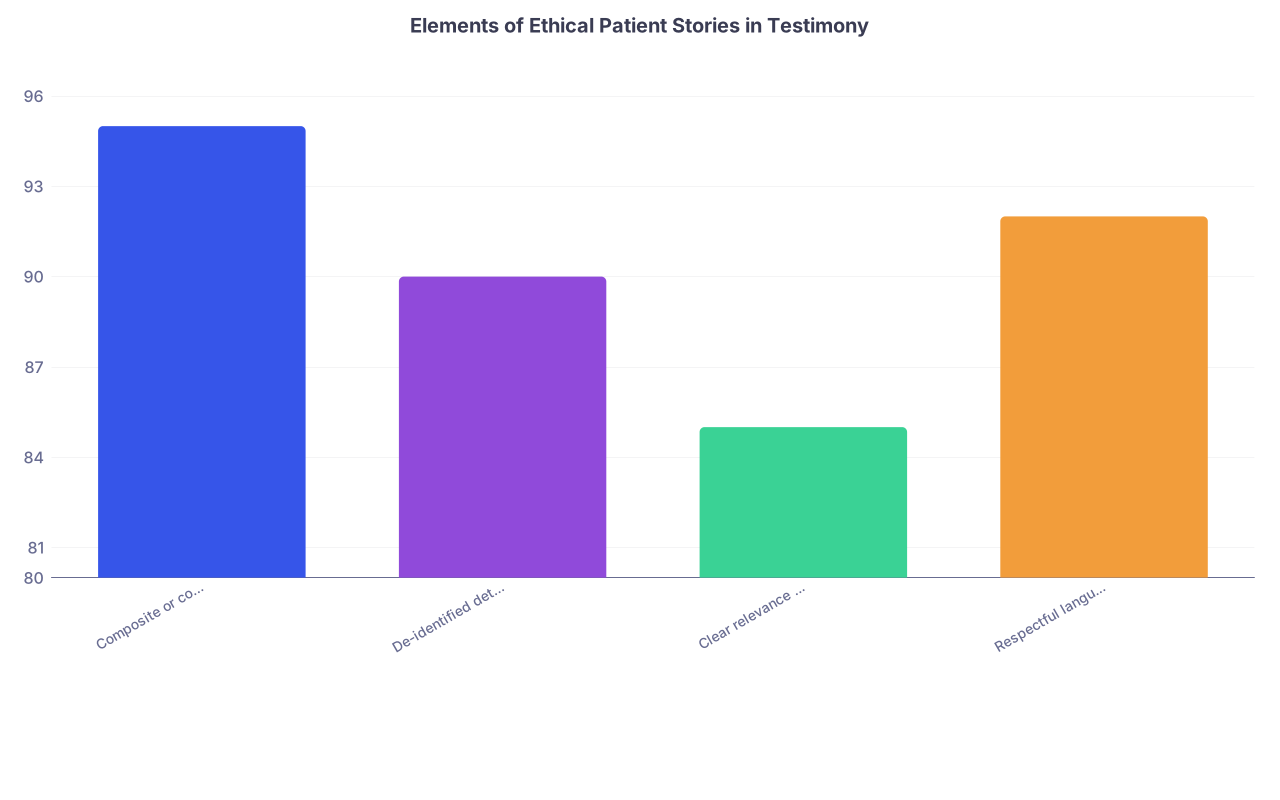
| Category | Value |
|---|---|
| Composite or consented | 95 |
| De-identified details | 90 |
| Clear relevance to policy | 85 |
| Respectful language | 92 |
If you walk out of the hearing and feel even a small twinge of “I hope that patient never hears what I said,” you crossed a line.
7. Ignoring the Policy Mechanics
A lot of physicians show up ready to argue why a bill is good or bad, but not how it actually works. That’s a major credibility gap.
Common blunders:
Not reading the actual bill text
- Relying on a summary from a colleague or advocacy group.
- Getting basic provisions wrong under questioning: “Actually, Doctor, the bill does not do that.”
Offering unrealistic implementation ideas
- “We should just require X of all clinics” without realizing there are no enforcement mechanisms.
- Suggesting documentation or reporting requirements that would be impossible in small, rural practices.
Ignoring fiscal or logistical constraints
- “We need more staff” with no sense of where they would come from or how long training takes.
- Brushing off cost questions with “You can’t put a price on health.”
How to avoid it:
Read the bill. Not just the summary. The actual text. Mark:
- Definitions
- Requirements
- Enforcement sections
- Funding and timelines
Talk to:
- A health department official
- A hospital administrator
- A clinic manager
at least once before you testify. Ask, “If this passed tomorrow, what would break?”
When you don’t know implementation details, say so clearly:
- “From a clinical standpoint, this change would save lives. I’m not the expert on exactly how the funding or staffing allocation should be structured, but it will require investment.”
That kind of honesty helps your testimony. It shows you know your limits and respect other expertise.
8. Going Alone and Unprepared
Another huge mistake: treating a public hearing as a one-person improv show.
Physicians walk in without:
- A coordinated strategy with other speakers
- Basic familiarity with opposing arguments
- Any time spent practicing being cut off or rushed
What happens then?
- Your three minutes get burned just getting warmed up
- You duplicate points another physician already made instead of reinforcing or extending them
- You get blindsided by standard talking points industry or opposition has used in three other states already
How to avoid it:
- Connect with:
- Your specialty society (e.g., ACP, AAP, ACEP)
- Public health associations
- Hospital or system government relations staff
These people know the process. They usually have:
Position statements
Prior testimony examples
Anticipated opposition arguments and data
Rehearse in constraints:
- Practice your testimony as exactly 3 minutes (or whatever time is allotted). Use a timer.
- Practice giving your core message in 30 seconds in case you’re asked to “wrap up quickly, Doctor.”
Assign roles if multiple physicians are testifying:
- One focuses on clinical impact
- One on systems/resource impact
- One on equity/ethics
Don’t all say the same thing in slightly different words. That wastes your collective influence.

| Step | Description |
|---|---|
| Step 1 | Get Hearing Notice |
| Step 2 | Read Bill Text |
| Step 3 | Contact Policy Team or Society |
| Step 4 | Define Clear Ask |
| Step 5 | Draft Testimony |
| Step 6 | Disclose Conflicts |
| Step 7 | Rehearse With Timer |
| Step 8 | Test Hostile Q and A |
| Step 9 | Deliver Testimony |
9. Neglecting Your Own Safety and Well-Being
One topic doctors rarely think about: personal risk.
Public testimony—especially on hot-button issues (vaccines, reproductive health, gun violence)—can trigger harassment, threats, doxxing, and professional attacks. This is no longer hypothetical.
Bad physician mistakes here:
- Using personal contact info on public documents
- Posting real-time location on social media (“About to testify at the capitol!”)
- Arguing with trolls or harassers online afterward
- Ignoring emotional impact—sleeplessness, hypervigilance, anxiety—after ugly hearings
How to avoid it:
Use institutional or professional contact information whenever possible for public record. Not your personal cell or home address.
Discuss with:
- Your employer’s security or legal team
- Your professional association
before a high-conflict hearing.
Set boundaries for social media:
- Decide in advance if you’ll comment on your testimony publicly and how.
- Do not engage with bad-faith attackers. Mute, block, document if needed.
Recognize that moral distress is real. If the hearing goes badly or policy moves in a harmful direction, you may feel complicit or demoralized. Talk to trusted colleagues or a therapist about it. That’s not weakness; it’s maintenance.
Your Next Step
Do not wait until the week before your first hearing to think about any of this.
Today, do one concrete thing:
Download or pull up the text of a recent health-related bill in your state, and write a 3-sentence testimony:
- One sentence describing who you are and your role.
- One sentence stating clearly whether you support or oppose the bill and why.
- One sentence naming a specific action you want the committee to take.
Then read it out loud—like you’re under oath, on camera.
That tiny exercise will show you exactly where your weak spots are, long before you’re sitting in front of a microphone with the red light on.