
The fastest way for a medical student to tank a community policy project is to treat community partners like background characters in your academic story.
You are not the protagonist here. And if you act like you are, they will remember it—and they will not work with you again.
This isn’t hypothetical. I’ve watched students walk into housing coalition meetings, parent advisory boards, harm reduction groups, and immigrant rights organizations… and lose the room in under ten minutes. Not because they were mean. Because they were oblivious. Entitled. “Well-intentioned” in exactly the wrong way.
Let’s walk through the most common ways medical students alienate community partners in public health and policy work—and how to not be that student.
Mistake #1: Treating Community Partners as Data Sources, Not Decision-Makers
This is the most common sin: extraction.
Students show up with:
- A pre-written project proposal
- A survey designed entirely by their academic team
- A “needs assessment” that somehow never asked what the community actually wants
Then they say the line I hear way too often:
“We’d love your input, but the IRB is already approved.”
Translation to the community:
“We already decided what’s important. Help us check the box.”
Here’s what this looks like in real life:
- A student group joins a local tenants union “to understand barriers to healthcare,” but they talk the entire meeting and only ask tenants to fill out their survey.
- A “community-engaged” policy elective where students present a draft policy brief on food insecurity to a church-based food pantry—and discover the pantry was never asked what they actually need.
- A student emails a mutual aid group asking, “Can you distribute our survey to your network?” with no offer of shared authorship, compensation, or even a follow-up meeting to discuss what was learned.
Community folks see this constantly. Academic tourists. In, out, paper, poster, gone.
How to avoid this mistake:
- In your first interaction, ask: “What are your priorities right now? What’s on fire?” Then stop talking.
- Don’t arrive with a locked-in project. Bring 2–3 flexible ideas and explicitly say: “These are just starting points. We’re ready to pivot.”
- If you need IRB early, design a protocol that leaves room for co-creation and amendment—and be honest about what’s flexible and what isn’t.
- Assume they are co-leads, not consultants. Ask: “Who on your team should be at the decision-making table for this?”
If your project could run exactly the same way without that community partner, you are using them. That’s not partnership. That’s extraction.
Mistake #2: Talking Policy Jargon at People Who Live the Policy Reality
Nothing shuts down trust faster than being talked down to—especially by someone who’s never had to choose between rent and insulin.
I’ve watched a 24-year-old MS2 explain “social determinants of health” to a neighborhood leader who’s been fighting redlining and zoning laws since before that student was born. You can imagine how that went.
The problem isn’t just jargon. It’s hierarchy. You implicitly signal:
- “I know the policy framework; you just have ‘stories.’”
- “You are the case report; I am the expert.”
Common culprits:
- Slides full of “stakeholder mapping,” “upstream policy levers,” “multi-sectoral intervention design”
- Long monologues about the Medicaid waiver process… to people who’ve been denied coverage repeatedly
- Quoting stats about overdose death rates to harm reduction workers who attend those funerals
How to avoid this mistake:
- Speak like you’re talking to another professional—which you are. Just in a different domain.
- Translate your world, do not dominate with it. “In the hospital we call this ‘social determinants of health’—but you’ve been dealing with these conditions for years. What does this look like in your community?”
- When you present a number, follow with: “Does this match what you’re seeing?” Then shut up.
- Ask, “What language do you use when you talk about this issue with your community or at city council?”
If you sound like you’re defending a thesis more than you’re inviting collaboration, you have already lost them.
Mistake #3: Overpromising, Then Ghosting
Community partners are used to people vanishing after the “project period.”
Medical students are notorious for:
- Promising to share results, then disappearing after the grade or poster session
- Saying “We’ll totally come back next year!” when they know they’ll be on away rotations
- Building tools or policy memos no one maintains once they graduate
Here’s the hard truth:
Your time horizons are short. Their problems are not.
Alienation happens when you:
- Offer help you cannot sustain (“We’ll set up a clinic!” with no physician champion, no funding, no plan after you leave)
- Fail to give updates on policy work you promised (“We’ll send that draft to your board next week” and it never arrives)
- Don’t hand off the project properly when you graduate or change rotations
I’ve seen a neighborhood association president hold up a binder of “student projects” from three different med schools. None followed up. Her exact words: “We are done being your practice community.”
How to avoid this mistake:
- Under-promise, over-deliver. Say, “We can commit to X between now and May. Beyond that, we might be able to do Y, but I won’t promise it.”
- Put your actual availability on the table: clerkships, exams, away rotations, application season.
- Set a concrete exit or transition plan from day one:
- Who owns the work after you leave?
- Where will files live?
- Who will update materials?
- If something changes (Step exam moved, family crisis, burnout), tell them early: “I thought I could do this by June. I can’t. Here’s what I can still do, and here’s how I’ll make sure you’re not left hanging.”
They can handle no. They cannot handle silence.
Mistake #4: Ignoring Power, Race, and History in the Room
Walking into a historically Black neighborhood coalition as mostly white med students from a wealthy private institution—and not acknowledging that power dynamic—is a guaranteed way to generate quiet resentment.
Same for:
- Students from big academic centers parachuting into rural communities and acting like their “evidence-based” solution will fix decades of structural abandonment
- Med students proposing policing-related health policies without addressing historical trauma and ongoing violence
- Students proposing “education campaigns” in immigrant communities that have repeatedly been surveilled and criminalized
Community partners notice:
- Who is speaking most
- Who is making final calls
- Whose name ends up on the paper or policy brief
They also remember the last time a hospital or university made promises about “partnership” and then pushed through something harmful—like expansion that raised rents or “community benefit” programs that mostly benefited the institution.
How to avoid this mistake:
- Name the power imbalance out loud: “We know we’re coming from a large institution that hasn’t always been a good neighbor here. We don’t want to repeat that.”
- Ask about history. “What has your past experience been working with med schools or hospitals? What worked and what really didn’t?”
- Build in shared control:
- Co-authorship on briefs and reports
- Shared presentation of findings (you don’t present alone)
- Community review before anything is shared externally
- Put your ego away. If they say, “We don’t want your health fair; we want your hospital to stop sending debt collectors,” believe them.
If you pretend power doesn’t exist, they will assume you’re either naive or dishonest. Neither one builds trust.
Mistake #5: Prioritizing Academic Timelines Over Community Priorities
One of the biggest tensions: your deadlines vs. their reality.
Your world:
- Course credit timeline
- Grant cycles
- Poster session dates
- Residency application season
Their world:
- Evictions this month
- New city ordinance proposed next week
- Budget meetings where services are getting cut
- A violence spike that changed everything overnight
Students alienate partners when they:
- Rush community input to meet a poster deadline
- Cancel meetings because “this week is rough with exams” while the community is fighting a crucial city council vote
- Push a project idea that’s easy to measure but irrelevant to the biggest fight on the ground
| Type | Academic Focus | Community Focus |
|---|---|---|
| Short Term | Course deadlines | Crisis response |
| Medium Term | Grants, rotations | Budget cycles |
| Long Term | Publications, CV | Structural change |
How to avoid this mistake:
- At the very beginning, map both timelines:
- “Our semester runs from X to Y.”
- “What are your key dates, hearings, elections, or deadlines this year?”
- Adjust the project to match what’s actually urgent for them, not what’s convenient for your syllabus.
- If your timeline truly can’t match their key events, be honest and consider a different role (supporting, not leading).
- Recognize that not every important outcome is measurable by the end of your semester. Some of your work will be foundation-laying, not finished product.
If your Gantt chart trumps their survival issues, they will stop taking your calls.
Mistake #6: Centering Your Learning Instead of Their Outcomes
This one is subtle but deadly.
You say:
- “This will be a great learning opportunity for us.”
- “We need a policy project to fulfill our elective requirement.”
- “We’re hoping to write this up for a publication.”
What they hear:
“You are my teaching case.”
Here’s how centering your learning alienates people:
- You choose issues that look “interesting” or “publishable” but marginal to what they’re fighting for.
- You design the project around what you want experience in (e.g., legislative testimony, cost-effectiveness modeling) instead of what actually moves their agenda.
- You monopolize airtime in meetings because you’re “practicing advocacy,” while they’re trying to get actual work done.
I’ve sat in coalition calls where students spent 15 minutes introducing themselves and explaining their learning objectives while community organizers stared at the clock. One finally said, “We have 45 minutes. Can we talk about the ordinance now?”
How to avoid this mistake:
- Your learning goals? Keep them in your head, not as the opener for the partnership.
- When you propose anything, ask: “How does this move your goals?” If you can’t answer, change the project.
- Structure your reflection assignments (if your course requires them) so they don’t waste community time. Reflect in your own time, not during their meeting.
- If you’re invited to speak or present, ask: “How can this be most useful to you, not just a chance for me to practice?”
You are allowed to learn. But the second your educational needs consistently outweigh their material needs, they’ll see you as a drain, not an ally.
Mistake #7: Confusing Representation With Tokenism
A popular box-checking move: “We’ll get community input by adding one or two community members to our advisory panel.”
Then:
- Meetings are scheduled during their work hours with no compensation.
- Agendas are filled with academic updates; their items are last (and then time runs out).
- Their suggestions get “taken under advisement” but never actually adopted.
- Policy briefs mention “extensive community input” based on one poorly attended Zoom.
Community partners are not stupid. They can tell when their presence is ornamental.
How to avoid this mistake:
- If they’re on a committee, pay them. Stipends, gift cards, honoraria—whatever’s allowed and meaningful in your setting.
- Share the agenda ahead of time and ask: “What would you like on this agenda?”
- Track input visibly:
- “Last meeting you asked for X. Here’s what we changed.”
- “We can’t do Y because of Z constraint, but here’s what we can do instead.”
- Don’t say “community-led” if community members don’t actually hold decision power. Call it what it is.
Better one well-supported community co-leader with real power than six “representatives” treated like decoration.
Mistake #8: Failing to Share Credit—and Risk
When the project goes well, students (and faculty) often collect:
- First-author papers
- Abstracts and posters
- Awards for “community engagement”
- Glowing Dean’s letters
The community partner gets:
- Maybe a logo on the last slide
- A thank-you line in the acknowledgments
- No real say in how findings are presented
On the flip side, when things go badly—policy backlash, political blowback, contentious media coverage—students often retreat behind the institution, while community partners face the long-term consequences locally.
How to avoid this mistake:
- Before you start disseminating anything, ask: “How do you want to be involved and recognized in any reports, presentations, or publications?”
- Offer co-authorship as the default, not the exception, when partners significantly shape the work.
- Never present sensitive findings without community review and consent.
- When there’s risk (challenging local power, criticizing institutions), talk through:
- “Who is safest saying this?”
- “Who will face consequences, and who won’t?”
- “How do we protect each other?”
You don’t get to be bold in print while they deal with fallout on the ground. That’s cowardice dressed up as advocacy.
Mistake #9: Skipping the Boring but Crucial Work of Reliability
There’s nothing glamorous about:
- Answering emails on time
- Showing up when you say you will
- Taking notes and circulating them
- Doing the grunt work (flyers, phone calls, document formatting)
But this is where a lot of students quietly undermine trust.
Patterns that alienate partners:
- Chronic tardiness “because traffic” or “clinic ran long” (it always does; plan for it)
- Dropping balls on tasks and not admitting it
- Needing to be constantly “reminded” to do what you volunteered for
- Only showing up for interesting events—press conferences, hearing days, big meetings—while skipping the smaller work sessions
Community partners talk. “The last group from [Your School] were flaky. I don’t want to waste cycles training another batch.”
How to avoid this mistake:
- Take less on and do all of it. Reliability beats enthusiasm every time.
- If you mess up, own it like an adult: “I said I’d have this done by today and I didn’t. That’s on me. Here’s my plan to fix it.”
- Track your commitments in writing, even if they seem small.
- Ask your partner directly once in a while: “Are we being helpful or making extra work for you?”
Being boringly reliable is the fastest way to differentiate yourself from the revolving door of student volunteers.
Mistake #10: Designing for Policy Wins, Not Community Safety
Students love “impact.” Big policy changes. Legislative wins. Media coverage.
But not every community can safely or strategically pursue those routes at every moment.
Common missteps:
- Pushing public campaigns in contexts where quiet relationship-building is safer
- Encouraging people to share vulnerable stories publicly without fully discussing long-term consequences
- Advocating for mandatory reporting or enforcement-heavy policies that expose marginalized groups to state harm (e.g., carceral responses to substance use “for their own good”)
- Treating “policy success” (a new ordinance, regulation, or program) as the end goal, even if implementation might hurt the people you claim to help
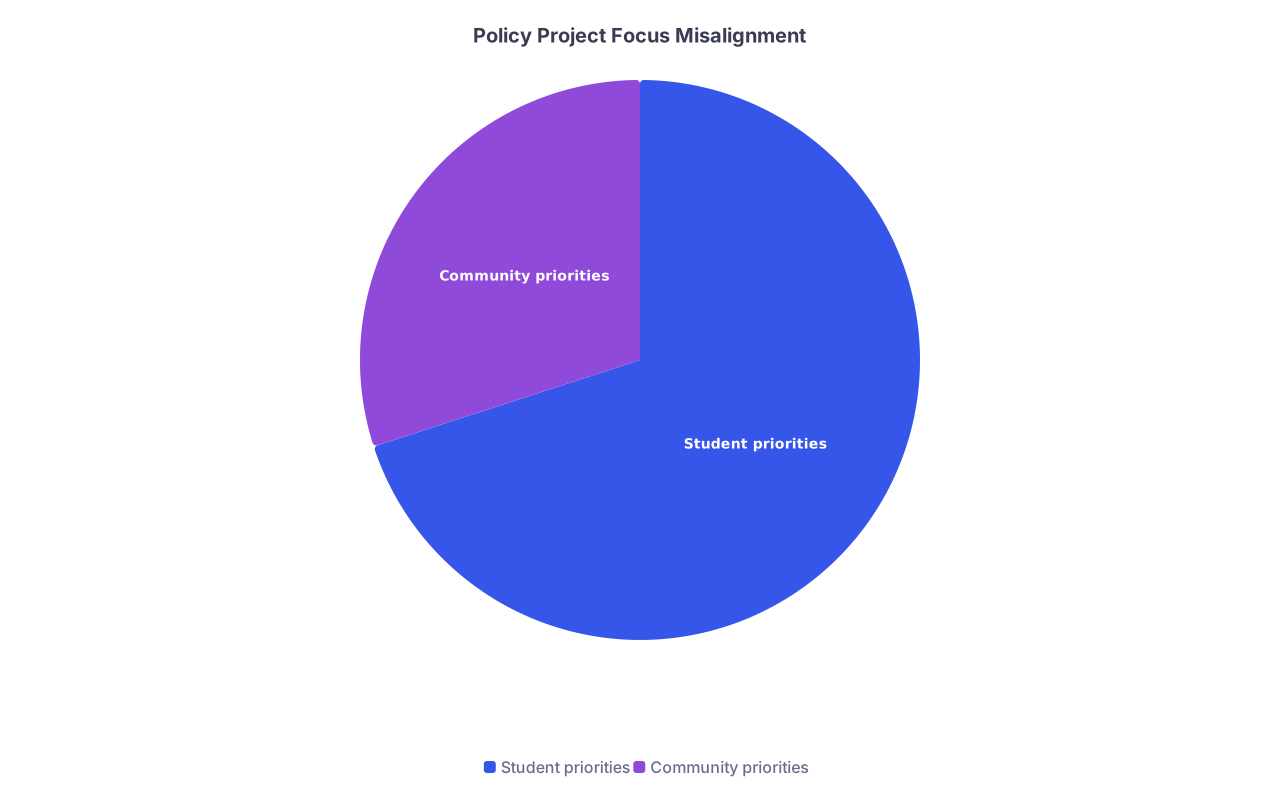
| Category | Value |
|---|---|
| Student priorities | 70 |
| Community priorities | 30 |
How to avoid this mistake:
- Start by asking: “What does safety look like for you in this work? What’s off-limits right now?”
- Before suggesting any public-facing activity, ask: “Has your group done this before? What happened?”
- If you’re pushing for a legal or policy mechanism, map out worst-case scenarios, not just best-case impact.
- Be willing to scale down the visibility of a project to protect people, even if it makes your CV less shiny.
If your “win” makes their lives riskier, you’ve failed ethically, no matter how strong your policy memo looks.
Practical Guardrails to Keep You Out of Trouble
You want a checklist? Here’s the closest I’ll give you—use it like a pre-flight safety check.
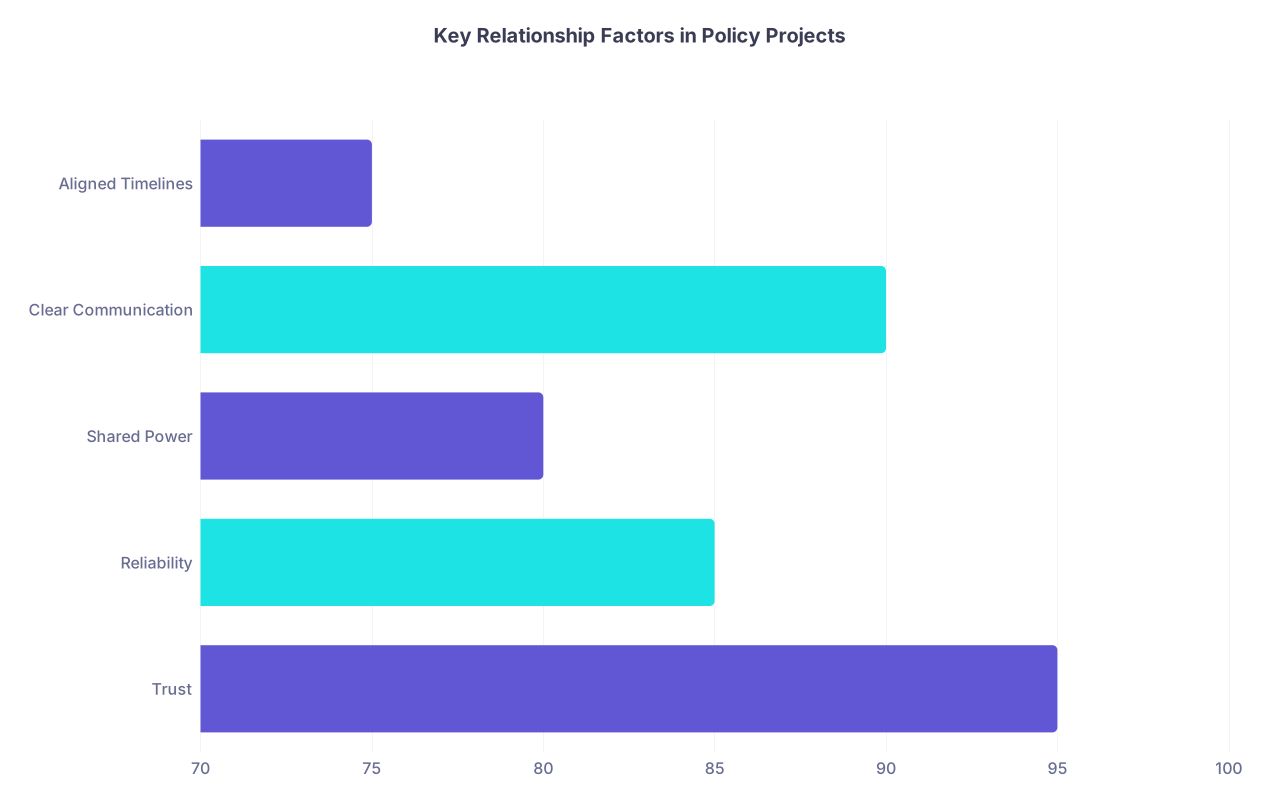
| Category | Value |
|---|---|
| Trust | 95 |
| Reliability | 85 |
| Shared Power | 80 |
| Clear Communication | 90 |
| Aligned Timelines | 75 |
Before You Start
- Have I asked what the community partner actually wants to work on—and am I prepared to pivot?
- Do I clearly understand my time limits, and have I been honest about them?
- Do I know enough about the history between this community and my institution to not walk in clueless?
While You’re Working
- Am I talking more than I’m listening in meetings?
- Am I following through on every commitment—or renegotiating it early if I can’t?
- Is this project making their lives easier or harder week to week?
Before You Leave or Publish Anything
- Has the community partner seen and approved everything with their name or story on it?
- Have we discussed how they want to be credited and what they don’t want shared?
- Is there a clear plan for this work after I’m gone—or am I leaving them holding the bag?
If too many answers make you wince, fix it now. Not later.

| Step | Description |
|---|---|
| Step 1 | Initial Contact |
| Step 2 | Listen to Priorities |
| Step 3 | Co design Project |
| Step 4 | Agree on Roles and Timelines |
| Step 5 | Do the Work Reliably |
| Step 6 | Share Results and Credit |
| Step 7 | Transition or Sustain |



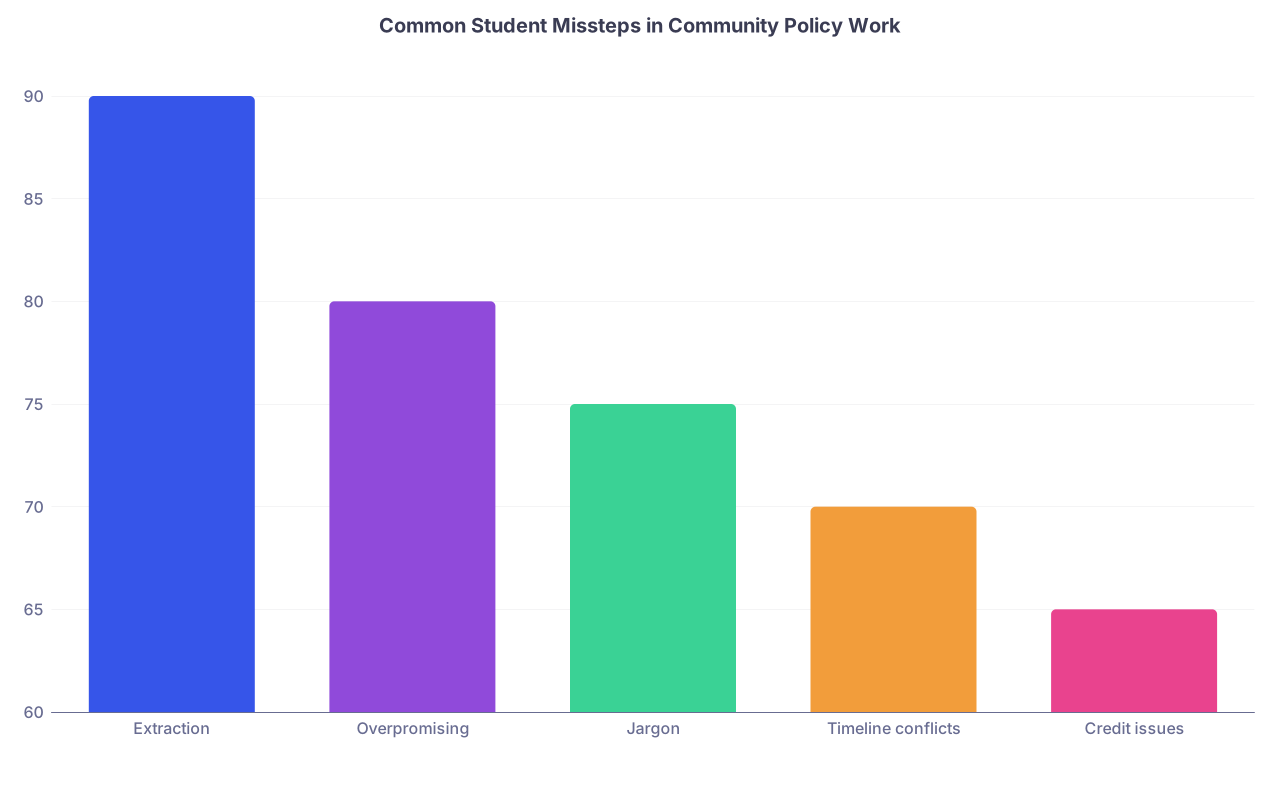
| Category | Value |
|---|---|
| Extraction | 90 |
| Overpromising | 80 |
| Jargon | 75 |
| Timeline conflicts | 70 |
| Credit issues | 65 |
If You Remember Nothing Else
Keep these three points burned into your brain:
- You are a guest, not the hero. Treat community partners as co-leaders with authority, not as sources of stories or data.
- Reliability beats brilliance. Do what you say you’ll do, on their timeline as much as yours. Under-promise, over-deliver, and communicate when things change.
- Impact isn’t ethical if it’s extractive. No publication, policy win, or line on your CV is worth burning trust or increasing risk for the people you claim to serve.
You’ll graduate. They’ll still be there. Act accordingly.