
The biggest mistake ambitious clinicians make is pretending board certification and policy fellowships are sequential. They’re not. If you treat them as “first boards, then policy,” you’ll lose years and most of your momentum.
You have to plan them in parallel. On a clock. With ruthless clarity about what happens when.
Here’s your timeline.
0–12 Months Before Board Eligibility: Set the Dual Track
At this point you should stop thinking “maybe I’ll do policy someday” and start treating it like a second subspecialty. With its own prerequisites, letters, and calendar.
Month 0–3: Clarify your timelines and constraints
You sit down with three hard facts:
- When you’re board-eligible (ABIM/ABFM/ABP/etc. – usually end of residency or fellowship)
- When common policy fellowships start (most are July–September)
- Your life constraints (visas, family, loans, geography)
Create a simple 3-year grid: columns = months, rows = “clinical boards,” “policy apps,” “life.”
At this point you should:
Confirm your board window
- Check your specialty board’s site for:
- Eligibility date
- Application deadlines
- Testing windows (often 1–3 months long)
- Talk to a senior resident who just took boards. Ask bluntly:
“When did you actually start studying, and what did you wish you’d done earlier?”
- Check your specialty board’s site for:
List target fellowships
- Examples:
- Robert Wood Johnson Health Policy Fellows
- VA/NRSA Health Services Research Fellowships
- Congressional Fellowships (e.g., APSA, AAAS for certain fields)
- State health department fellowships
- Institutional health policy or quality/safety fellowships
- For each, write:
- Duration (1 year, 2 years)
- Start month
- Do they require board eligibility or completion of residency?
- Funding (stipend vs. full salary)
- Examples:
Decide your first major fork
- Will you:
- Take boards immediately after training then start a fellowship?
- Or overlap your first board attempt with your first year of a policy fellowship?
- My bias:
- If your exam is notorious (e.g., some surgical boards, subspecialty boards) → front-load and get it done at the transition.
- If you’re a strong test-taker and your board is knowledge-based (IM, peds, etc.) → it can safely overlap with early fellowship if you’re disciplined.
- Will you:
Month 3–6: Build minimum viable policy credibility
You do not need a master’s in public health policy to apply. You do need evidence that you care about more than interesting cocktail party conversations.
At this point you should:
- Pick ONE policy lane (you can change later, but you need a hook)
- Examples: addiction policy, maternal health, gun violence, immigrant health, digital health regulation, climate and health.
- Add 2–3 tangible activities:
- Join your specialty society’s advocacy or government relations committee.
- Attend at least one advocacy day (state or DC).
- Co-author an op-ed, policy brief, or white paper with someone who’s done it before.
- Find one policy mentor
- Not an attending who “likes policy.” Someone who:
- Has sat on an advisory board
- Testified, or
- Held a formal government or think tank role.
- Ask a narrow question in your first email:
“I’ll be board-eligible in [year]. I’m trying to decide between [Fellowship A] and [Fellowship B]. Could I get 20 minutes to sanity-check my timeline?”
- Not an attending who “likes policy.” Someone who:
This is all happening while you’re still in heavy clinical training. That’s intentional. You’re creating a paper trail for future fellowship selection committees.
12–18 Months Before Fellowship Start: Align Exam and Fellowship Calendars
Most prestigious policy fellowships have applications due 9–12 months before their start date. That means you’re making big decisions before boards are even taken.
Sketch the real calendar
Assume:
- Your residency/fellowship ends: June Year X
- You’re first eligible for boards: August–October Year X
- Policy fellowship start: July–September Year X+1
- Fellowship apps due: August–December Year X
At this point you should create a calendar that backward-plans:
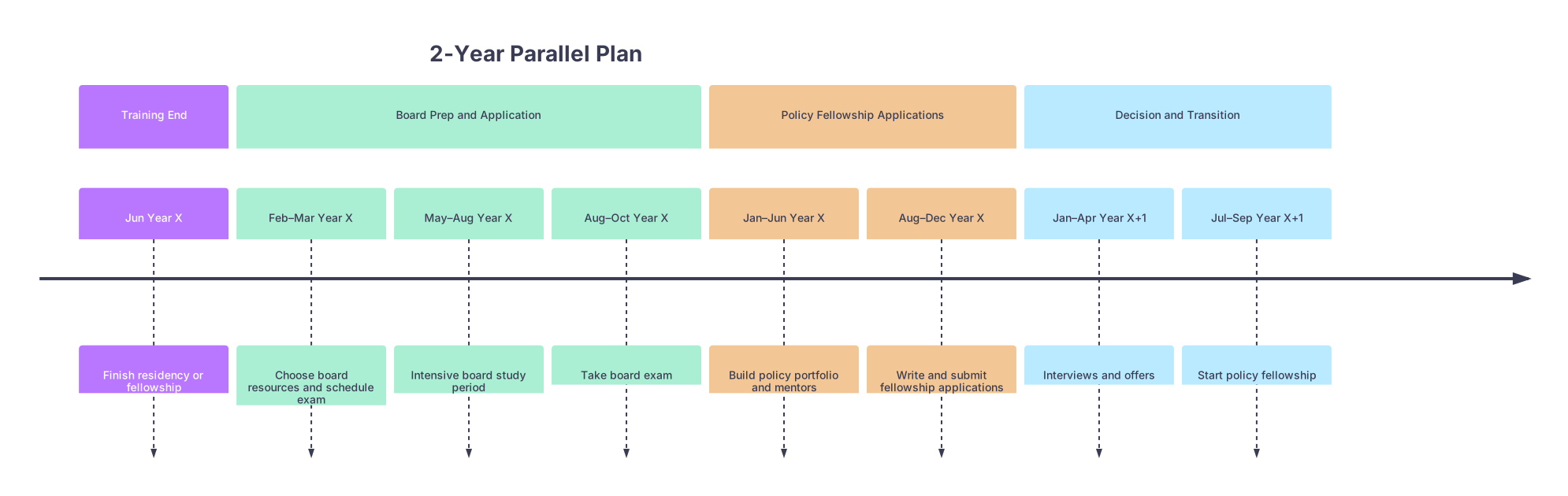
| Period | Event |
|---|---|
| Training End - Jun Year X | Finish residency or fellowship |
| Board Prep and Application - Feb–Mar Year X | Choose board resources and schedule exam |
| Board Prep and Application - May–Aug Year X | Intensive board study period |
| Board Prep and Application - Aug–Oct Year X | Take board exam |
| Policy Fellowship Applications - Jan–Jun Year X | Build policy portfolio and mentors |
| Policy Fellowship Applications - Aug–Dec Year X | Write and submit fellowship applications |
| Decision and Transition - Jan–Apr Year X+1 | Interviews and offers |
| Decision and Transition - Jul–Sep Year X+1 | Start policy fellowship |
Notice the overlap:
- You’re studying for boards at the same time you’re:
- Drafting personal statements
- Chasing letters
- Doing one last policy project.
That overlap is where people crash. Or stall out.
Month-by-Month: 18 Months Before Fellowship Start
Let’s say you want a July Year X+1 fellowship start. Here’s your rough sequence.
18–15 Months Before Fellowship Start
At this point you should:
Do your board prep reconnaissance
- Talk to 2–3 recently boarded colleagues.
- Decide:
- Primary question bank(s)
- Live course vs on-demand vs nothing
- Target exam month
- Block 6–8 weeks of high-intensity study on your future calendar. Not negotiable.
Shortlist 3–5 fellowships
- For each, gather:
- Eligibility (must be board-certified, or just eligible?)
- Required documents (CV, letters, policy writing samples, research?)
- Timeline: application due date, interview window, decision date.
- Rank them:
- 1–2 reach
- 1–2 realistic
- 1 safety/backup (including internal options at your institution).
- For each, gather:
Start one substantial policy project
- Example trajectories:
- Draft a state-level policy brief with a faculty member.
- Join a city task force on overdose prevention.
- Analyze hospital readmission data for disparities and present it.
- The goal: 1–2 outputs that can be discussed as evidence of real policy engagement.
- Example trajectories:
15–12 Months Before Fellowship Start
This is when your timelines get real.
At this point you should:
Lock your exam window
- Register for boards as soon as registration opens.
- Pick a test date that:
- Is NOT within 2 weeks of any major application deadline.
- Avoids known heavy rotations if you’re still training.
- Put that date on your attendings’ and family’s radar. It’s the non-movable anchor.
Ask for fellowship letters of recommendation
- You need:
- 1–2 clinical letters (attendings who can say you’re safe and reliable)
- 1–2 policy/leadership letters (someone who can say you “think beyond the patient in front of you”)
- Ask now, not 4 weeks before deadlines.
- Be explicit:
“I’ll be applying for [fellowship] this fall while also preparing for boards. Could you support me with a strong letter that speaks to [policy engagement/leadership/scientific rigor]?”
- You need:
Draft your policy CV
- Different from your ERAS/CV:
- Highlight:
- Committees
- Advocacy work
- Testimony
- Op-eds
- Quality improvement with system-level implications.
- Highlight:
- Keep pure clinical minutiae minimal. Show that you see systems.
- Different from your ERAS/CV:
12–6 Months Before Fellowship Start: The Double-Track Crunch
This is the highest-risk window. You’re:
- Finalizing fellowship applications
- Starting serious board prep
- Possibly finishing residency/fellowship.
You can’t improvise this.
12–9 Months Before Fellowship Start
At this point you should:
Finalize personal statements and essays
- Timeline:
- T –10–12 weeks from app due: rough draft
- T –8 weeks: get mentor feedback
- T –4 weeks: final polish
- Content:
- Clear “why policy, why now”
- Concrete examples beyond “I care about social determinants”
- A believable plan for integrating clinical and policy work long-term.
- Timeline:
Select and polish 1–2 writing samples
- If fellowships require them:
- Choose:
- A policy brief, OR
- A first-author paper with clear policy implications, OR
- A strong op-ed in a reputable outlet.
- If you have nothing written:
- Draft a 3–5 page policy memo with a mentor, targeting a real decision-maker audience.
- Choose:
- If fellowships require them:
Begin low-intensity board prep
- Target: 10–20 questions/day, most days.
- Record your cumulative performance:
- If you’re in medicine, your QBank percent correct should trend toward passing nationally.
Here’s how your time roughly splits now:
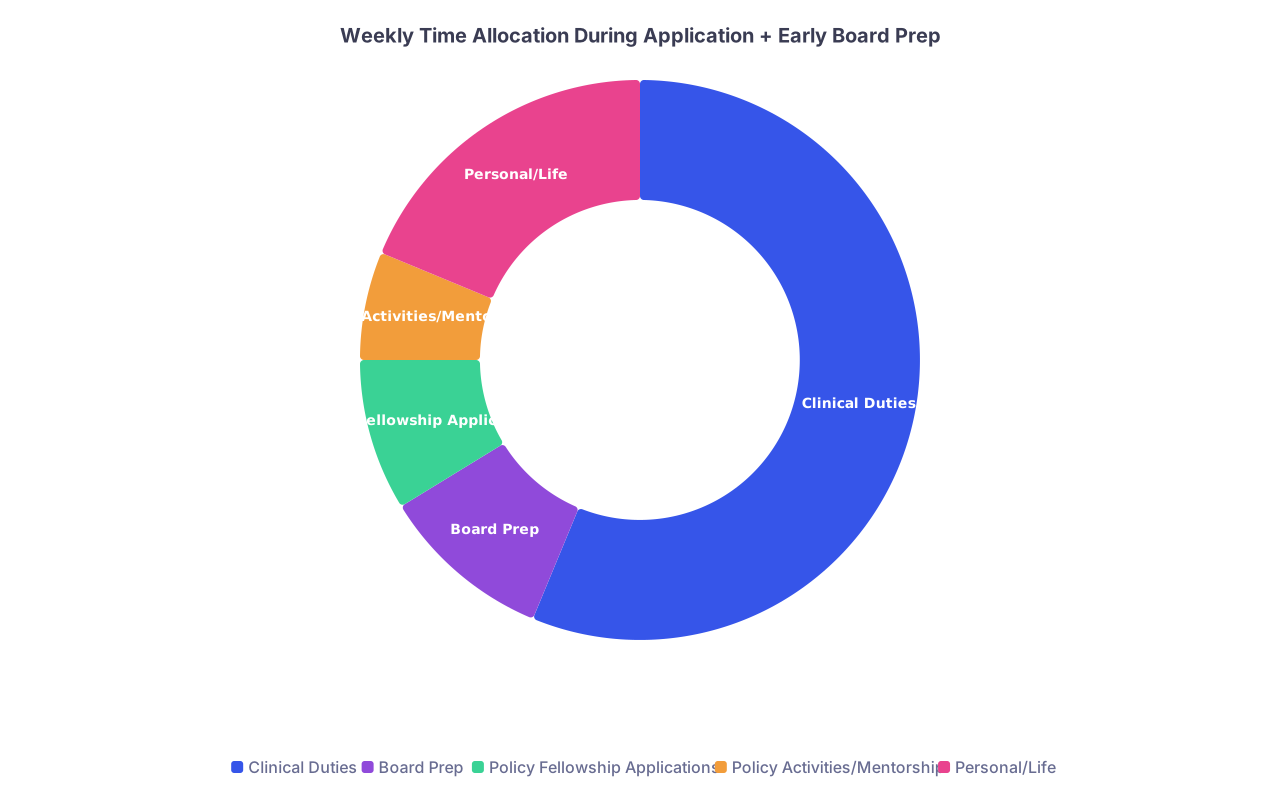
| Category | Value |
|---|---|
| Clinical Duties | 45 |
| Board Prep | 8 |
| Policy Fellowship Applications | 7 |
| Policy Activities/Mentorship | 5 |
| Personal/Life | 15 |
This is not a sustainable forever schedule. It’s a 3–4 month surge.
9–6 Months Before Fellowship Start
Application deadlines are likely in this window.
At this point you should:
Submit fellowship applications on the early side of the window
- Don’t aim for the last possible day. Your clinical life will explode the week you planned to upload everything.
- Confirm:
- All letters received
- Transcripts or proof of training sent
- Any board-eligibility documents uploaded.
Shift your stress from “paperwork” to “performance”
- Once apps are in:
- Increase board questions to 20–40/day.
- Start 1–2 hour blocks on days off for review of weak areas.
- If you’re still finishing training:
- Protect at least two evenings per week as no-call, no-meeting, pure study.
- Once apps are in:
Prepare for interviews with a policy lens
- Start building answers to:
- “Tell me about a time you influenced a system, not just one patient.”
- “Which law, regulation, or policy would you change if you could?”
- “How will you balance clinical credibility with policy work over the next 5–10 years?”
- Write bullet answers, not scripts. Practice out loud.
- Start building answers to:
6–0 Months Before Fellowship Start: Boards, Interviews, and Transition
Now everything stacks:
- Fellowship interviews
- Boards exam
- Possibly moving cities
- Maybe finishing training.
6–4 Months Before Fellowship Start
At this point you should:
Triage your opportunities
- After interviews, you’ll have a sense of:
- Likely fellowship matches
- Backup plans (home institution roles, health system jobs with policy options).
- Rank them realistically.
- Consider one key risk question:
“If I fail boards on the first try, which of these fellowships will still be viable?”
Some are understanding. Some quietly aren’t.
- After interviews, you’ll have a sense of:
Enter high-intensity board prep
- 4–8 weeks before your test:
- Minimum:
- 40–60 questions/day
- 1 full-length practice exam every 1–2 weeks.
- Clear targets:
- Your QBank percentile should be comfortably above the passing standard.
- Minimum:
- Protect sleep. Nothing will destroy your boards and interviews faster than chronic 4-hour nights.
- 4–8 weeks before your test:
Limit new policy commitments
- Say no to:
- New major committee roles
- Big new research or advocacy projects that don’t help your board performance or fellowship candidacy.
- Say yes to:
- One or two high-visibility but low-time events (panel, guest talk) if they give visibility with your future network.
- Say no to:
4–2 Months Before Fellowship Start
This is where the parallel plan either works or falls apart.
At this point you should:
Take your boards (ideally in this window, not later)
- Choose a test day based on:
- Not immediately after night float
- Not within 7 days of a major interview (you’ll be cognitively fried).
- After the exam:
- Give yourself 24–48 hours of real rest.
- Then shift mental energy to transition planning and fellowship prep.
- Choose a test day based on:
Lock in your fellowship or alternative
- Most decisions are out by now.
- If you got what you wanted:
- Confirm start date, salary, benefits.
- Ask for reading lists or pre-fellowship material.
- If you didn’t:
- Activate Plan B:
- A health system role with internal policy/quality work
- Another application cycle with a stronger portfolio (yes, it happens)
- Short-term research or govt contract work.
- Activate Plan B:
Clarify board result contingencies with the fellowship
- Have the uncomfortable email or call if:
- Your exam results won’t be out before start.
- Or if you’ve failed on a prior attempt.
- Most directors prefer transparency:
- “I’ve taken the exam; results due in [month]. I have a structured plan for any remediation if needed, and it won’t compromise my fellowship commitments.”
- Have the uncomfortable email or call if:
2–0 Months Before Fellowship Start
You’re now in the transition.
At this point you should:
Close out clinical identity cleanly
- Finish:
- Discharge summaries
- Research loose ends
- Committee work.
- Communicate that you’re shifting focus:
- Let people know you’re doing a policy fellowship, not vanishing into the ether.
- Finish:
Design your first 90 days of fellowship
- Rough 30–60–90 day plan:
- First 30:
- Learn structure
- Understand power map (who actually makes decisions)
- Observe.
- 31–60:
- Join 1–2 core projects
- Deliver something small but visible (brief, presentation, analysis).
- 61–90:
- Take ownership of a clearly defined policy question or workstream.
- First 30:
- Rough 30–60–90 day plan:
If your board results are pending or negative
- If you passed:
- Update CVs, email signature, and your fellowship program.
- If you failed:
- Do not hide it.
- Inform your fellowship director.
- Present a concrete retake plan:
- Timeline
- Study adjustments (different QBank, tutor, course)
- Boundaries so it doesn’t sabotage fellowship work.
- Do not hide it.
- If you passed:
During the Fellowship: Maintain Clinical and Ethical Grounding
Board certification is not just a piece of paper. It signals to policymakers that you’re anchored in real clinical standards, not abstract theory.
At this point you should:
Keep your clinical skills alive
- Options:
- 2–4 clinical days/month at an affiliated clinic or hospital
- Telemedicine sessions if allowed
- Weekend shifts in your specialty.
- This isn’t just about money. It’s about credibility when you argue for or against policy that touches real patient care.
- Options:
Be explicit about ethical frameworks
- In your fellowship work, tie decisions to:
- Justice (equity, distribution of benefits/harms)
- Autonomy (real, not theoretical)
- Beneficence and nonmaleficence at population level.
- That means:
- Ask who’s bearing hidden risk in every policy.
- Watch carefully for how incentives might push you to prioritize optics over outcomes.
- In your fellowship work, tie decisions to:
Align projects with long-term identity
- Each major project should pass three checks:
- Does it use your clinical expertise? (not just generic analysis)
- Does it build policy tools you’ll use later? (legislative process, cost modeling, implementation)
- Would you be proud to stand behind this decision publicly in 10 years?
- Each major project should pass three checks:
Long-Term: After Fellowship and Initial Board Cycle
You’re out the other side. Now the dual track becomes maintenance.
At this point you should:
Plan recertification and continuing education with policy in mind
- Do not let recert sneak up on you during a major policy role.
- Map:
- CME that counts both for boards and for policy (e.g., quality improvement, equity, implementation science).
- Multi-year recert cycles against:
- Major career transitions
- Elections (if you’re in a government-tied role).
Decide your baseline clinical volume
- Too little and you become theoretical.
- Too much and you won’t rise in policy roles.
- A common workable range:
- 0.1–0.3 FTE clinical (1–3 days/month to 1 day/week) for heavy policy roles.
Guard your ethics when power enters the scene
- Once you’re on committees, advisory boards, or in senior roles:
- Disclose conflicts aggressively.
- Avoid becoming the “clinician fig leaf” for bad policy.
- Remember: board certification is a reminder you’re bound by professional duties, not just organizational loyalty.
- Once you’re on committees, advisory boards, or in senior roles:
Key Takeaways
- Plan boards and policy fellowships in parallel, not sequentially. Your exam date, application deadlines, and life constraints have to live on the same calendar from the start.
- Treat policy work like a second subspecialty: build a real track record (projects, mentors, writing) 12–18 months before you apply, not as an afterthought.
- During the crunch months, protect your exam prep and your ethics. Say no to distractions, be transparent about exam status, and choose policy projects you’d be proud to defend as a board-certified physician years from now.