
Public health advocacy is not “extra.” For physicians, it is squarely inside your ethical job description—and the data backs that up, not just the slogans on hospital walls.
The myth that advocacy is somehow optional, unprofessional, or “political” in a way that clinical work is not? That’s convenient for people who benefit from the status quo, but it is not supported by modern medical ethics, nor by the evidence on what actually improves health.
Let’s pull this apart properly.
The Big Myth: “My Job Is Patients, Not Policy”
I have heard some version of this in every hospital I’ve been in:
“I’m here to treat patients, not get involved in politics.”
Sounds noble. It’s not. It’s a way to avoid discomfort.
The whole “advocacy is outside my scope” idea rests on three shaky assumptions:
- That health is mostly determined by what happens in the clinic
- That policy and politics are somehow separate from medicine
- That ethics only apply at the bedside, not at the level of systems
All three are wrong.
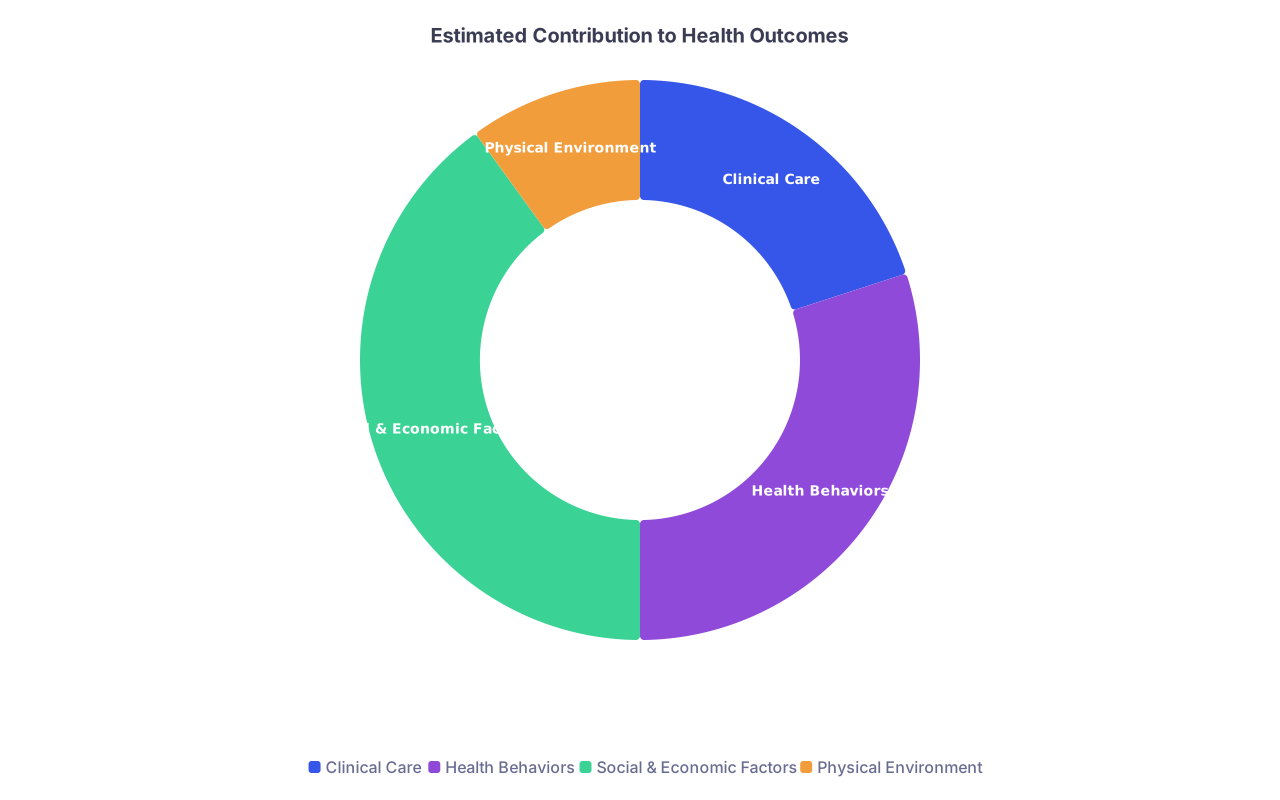
Epidemiology 101: social determinants of health—income, housing, food security, environment, education, structural racism—drive the majority of morbidity and mortality. Clinical care is crucial, but on its own, it is a mop in a flooding room.
| Category | Value |
|---|---|
| Clinical Care | 20 |
| Health Behaviors | 30 |
| Social & Economic Factors | 40 |
| Physical Environment | 10 |
If you swear to “protect and promote health,” and 60–70% of health outcomes sit outside clinic walls, then pretending those domains are “not your scope” is not ethical purity. It is strategic blindness.
What the Major Ethical Frameworks Actually Say
This is where people hand-wave. “Well, professionalism means staying neutral.” No. That’s not what any major ethical body actually says when you read the documents instead of the hospital PowerPoint summary.
1. The Four Principles: Autonomy, Beneficence, Nonmaleficence, Justice
Everyone learns these for exams, then uses them like fortune cookies. Let’s apply them honestly to advocacy.
Beneficence (promote good)
If we know that air pollution triggers asthma, then advocating for emissions regulation that reduces ER visits is not “political activism”; it is disease prevention. You already tell families to quit smoking to reduce exacerbations. Supporting policies that reduce PM2.5 is the same logic, just scaled up.
Nonmaleficence (avoid harm)
Staying silent while preventable harms persist is not neutral; it’s a choice. If you know that housing instability is linked to increased hospitalizations, higher infant mortality, and worse chronic disease control, but you oppose or ignore housing policy reforms on the grounds of “staying in your lane,” you are choosing tolerance of preventable harm. That is ethically relevant.
Justice (fair distribution of benefits and burdens)
Justice is where public health advocacy moves from “nice-to-have” to “ethically required.” Resource allocation, access to care, and structural inequities are not resolved one patient at a time. You can’t “culturally sensitize” your way around a food desert.
A physician who fights to keep a safety-net hospital open is doing justice work. A physician who ignores hospital closures and then agonizes over which single uninsured patient gets a charity bed is performing ethical theater.
Autonomy (respect for persons)
The lazy argument is: “If I advocate, I’m imposing my values on patients.” That’s not how autonomy works. Autonomy means giving people meaningful options and truthful information. Policies that deprive people of clean water or prenatal care do exactly the opposite.
You already advocate all the time: for your patient to get a CT in the ED, for prior auth approval, for a home health nurse. You’re not forcing them; you’re expanding their feasible options. Public health advocacy is autonomy, upstream.
Professional Codes: They’re Not Subtle About This
If you think I’m stretching the ethics, let’s look at what the big organizations actually put in writing.
| Body / Document | Explicit Stance on Advocacy |
|---|---|
| AMA Code of Medical Ethics | Physicians should "advocate for social, economic, educational, and political changes that ameliorate suffering and contribute to human well-being." |
| WMA (World Medical Association) | Physicians have a responsibility to "advocate for adequate health resources" and address determinants of health. |
| CanMEDS (Canada) | Lists "Health Advocate" as one of the core physician roles, with expectations at patient, community, and population levels. |
| ACGME (US) | Requires residents to demonstrate advocacy for quality patient care and optimal patient care systems. |
| GMC (UK) | Doctors must "protect and promote the health of patients and the public," including speaking up about threats to public health. |
There’s no “only if you feel like it and your Twitter is private.” These frameworks explicitly move beyond the bedside to systems and policy.
So when a colleague declares, “Advocacy is outside our scope,” what they’re actually saying is: “I disagree with the profession’s explicit ethical commitments.” Fine, that’s a position. But let’s not pretend it is the orthodox one.
“But Isn’t That Too Political?” – The Neutrality Myth
This is where people get nervous: “Medicine should be apolitical.”
No, medicine should be non-partisan. That’s different.
Saying “children should not be shot in schools,” “people should have access to safe drinking water,” or “race-based clinical algorithms that worsen inequities are unethical” is not partisan in any serious ethical framework. Parties may disagree about how to achieve those goals, but the goals themselves are squarely within health and ethics.
The “apolitical” pose crumbles fast when you look at what doctors already accept as normal:
- We lobby for higher reimbursement rates for certain procedures.
- Specialty societies push hard on scope-of-practice laws.
- Hospitals employ government relations staff to influence regulation.
You are already in politics. The question is: for whose benefit?

When organized medicine mobilizes to protect incomes, that is magically seen as professional. When individual clinicians speak up about gun violence or food insecurity, suddenly it’s “mission creep.” Interesting double standard.
Neutrality in the face of structural harms is not neutral. It sides with existing power arrangements by default.
Scope: Where Do You Actually Have Legitimate Standing?
Now, the contrarian twist: “Advocacy at all costs, on everything, all the time” is also nonsense.
There is such a thing as overreach. Ethical advocacy needs scope, evidence, and humility. Three questions I use with trainees:
- Is this clearly linked to health outcomes?
- Do I have relevant expertise or access to data/perspective that others lack?
- Am I being transparent about where the science ends and my values begin?
Legitimate Scope: Where Your Role Really Matters
You have stronger ethical standing when:
- There is robust evidence of health impact (opioid policy, pollution, firearm injury, incarceration, housing, vaccination).
- You have direct clinical experience with the consequences (e.g., you intubate kids after asthma storms, you see overdose after policy shifts).
- The public or policymakers lack accurate understanding of the medical realities.
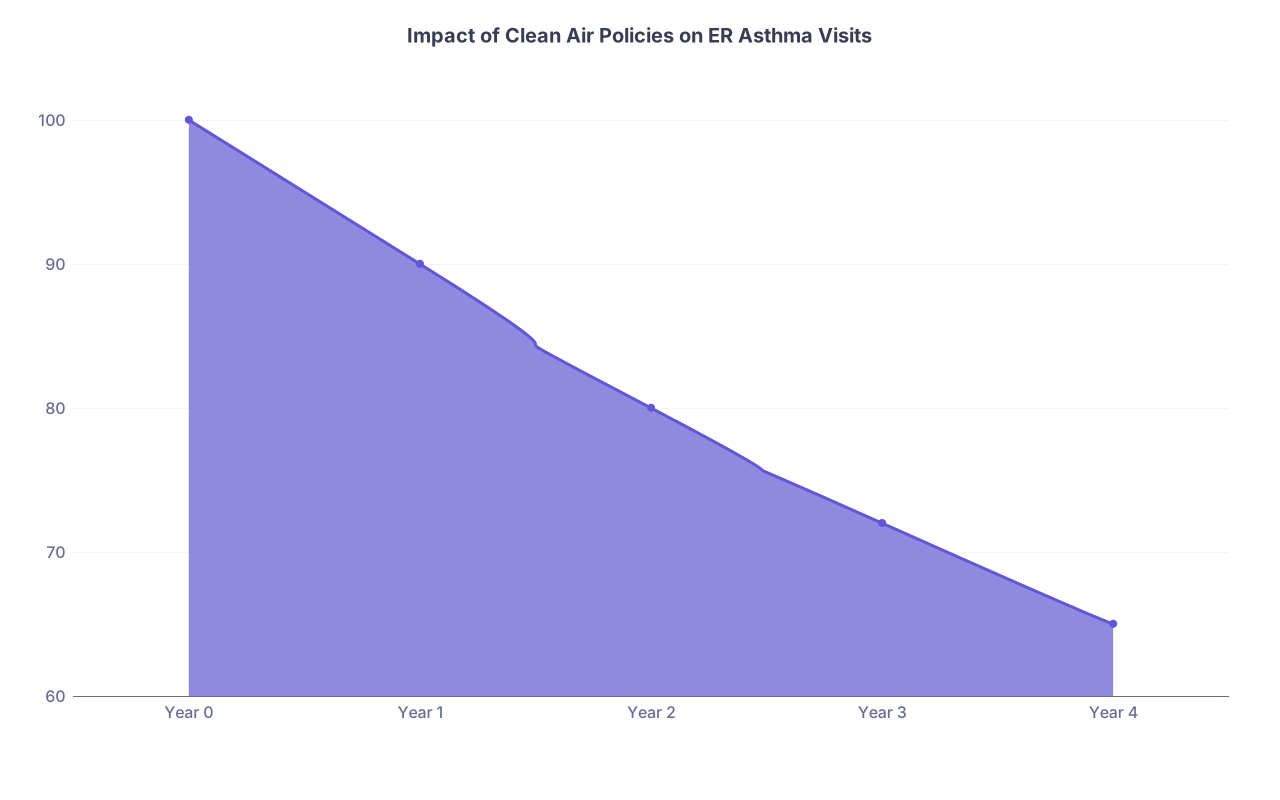
This is not just theory. When cities implemented clean-air regulations or lead abatement, it was partly because clinicians and public health folks kept showing up with data on ER visits, neurodevelopmental outcomes, and mortality.
| Category | Value |
|---|---|
| Year 0 | 100 |
| Year 1 | 90 |
| Year 2 | 80 |
| Year 3 | 72 |
| Year 4 | 65 |
That line doesn’t go down by accident. It goes down because someone refused to treat endless exacerbations and call it “just my job.”
When You’re Out Over Your Skis
On the other hand, if you’re using your white coat to make sweeping claims outside any real expertise—say, opining on macroeconomic theory, foreign policy, or complex legal architecture without bothering to collaborate with people who actually know those domains—you’re not doing public health advocacy. You’re doing branding.
Ethically, the standard is honesty. You can say:
“I’m a pulmonologist. I don’t design traffic systems. But I can tell you what more diesel exposure does to kids’ lungs, and why the current bus depot location is increasing hospitalizations.”
That is scope-aware advocacy. That is defensible.
How Different Ethical Frameworks Actually Justify Advocacy
Not everyone thinks in four principles. Let’s quickly run through other frameworks often taught in medical ethics and how they treat public health advocacy. You’ll notice a pattern.
Utilitarianism: Maximize Overall Well-Being
If your ethical goal is the greatest good for the greatest number, you frankly have a stronger obligation to work at the level of systems.
You can spend 30 minutes adjusting one patient’s insulin or 30 minutes testifying about insulin price caps that would affect thousands. Utility calculus is not subtle here.
Public health interventions routinely beat individual clinical interventions on impact-per-dollar and impact-per-hour. In pure utilitarian terms, ignoring policy-level levers is almost irrational.
Deontology: Duty and Rules
If you focus on duties—keeping promises, following professional codes—you’re stuck with what those codes say. And they say “advocate.”
- You have a duty to protect the vulnerable.
- You have a duty to speak truthfully about harms.
- You have a duty (per many codes) to work toward fair distribution of health resources.
If a state passes a policy that you know, from solid evidence, will increase maternal mortality, your duty to nonmaleficence and truth-telling doesn’t evaporate at the Capitol steps.
Virtue Ethics: What Kind of Physician Are You Becoming?
This one is personal. Virtue ethics asks: what character traits does a good clinician embody—courage, compassion, justice, humility?
I’ve watched residents physically tremble giving public comment at city council about a homeless encampment closure they knew would scatter their patients and worsen outcomes. That’s courage in clinical form.
And yes, there’s a line. Virtue also includes prudence—knowing when your involvement will help vs when you are just signaling. But if you consistently shrink from any public stance because “I might upset someone,” that shapes your character just as much as the opposite.

“But I Don’t Have Time” – The Burnout Reality Check
Now the practical objection: You’re drowning in RVUs, charting, and inbox messages. You can barely pee, let alone redesign Medicaid.
Important distinction: saying “Advocacy is outside my scope” is not the same as “I cannot reasonably fit much advocacy into my life.”
The first is factually wrong ethically. The second is often valid.
No ethical framework demands that every physician become a full-time activist. What it does require is that we:
- Stop pretending advocacy is unprofessional.
- Recognize that some of our colleagues’ advocacy is them fulfilling, not abandoning, their ethical obligations.
- Be honest about trade-offs. You might choose to focus your limited bandwidth on being clinically excellent and supporting others’ advocacy instead of leading it yourself.
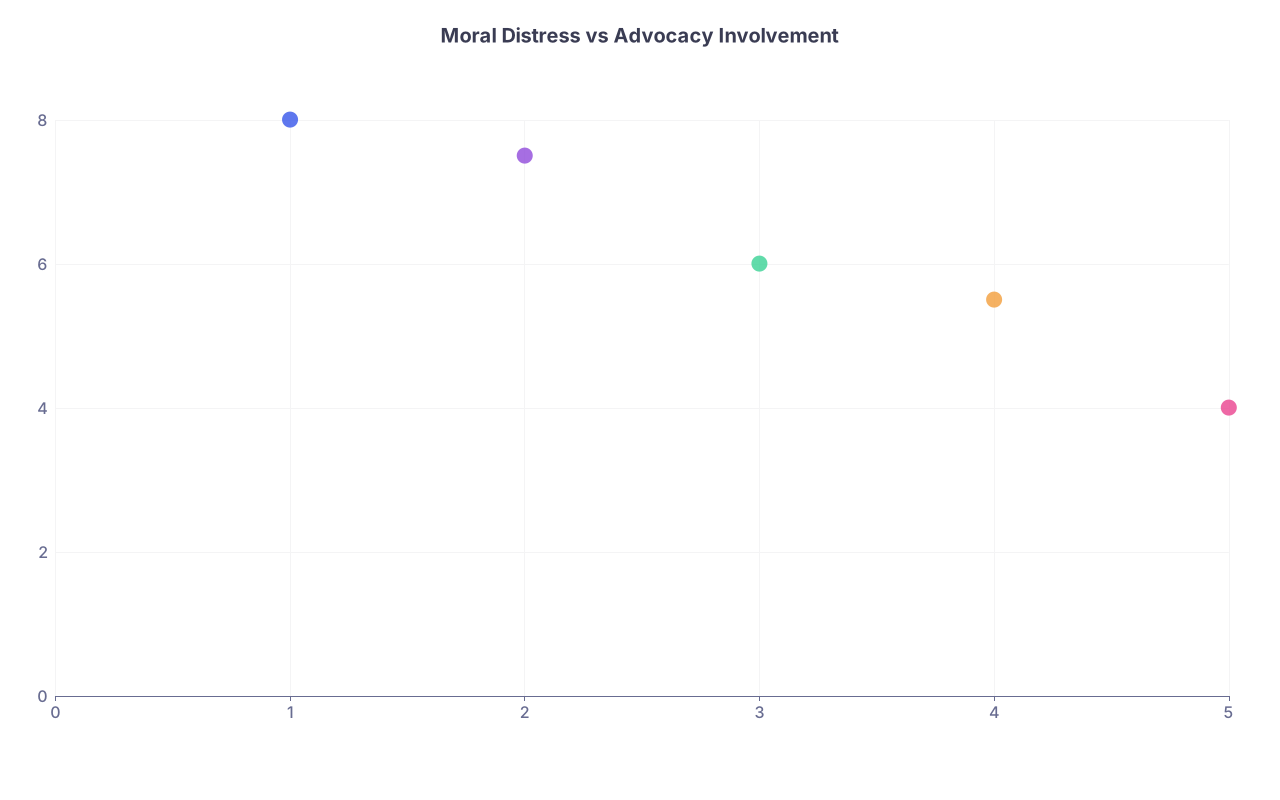
The data on burnout is mixed, but there’s an interesting pattern: clinicians who feel some agency in addressing upstream causes often report less moral distress than those who feel trapped in endless downstream repair.
| Category | Value |
|---|---|
| Low-Adv 1 | 1,8 |
| Low-Adv 2 | 2,7.5 |
| Med-Adv 1 | 3,6 |
| Med-Adv 2 | 4,5.5 |
| High-Adv 1 | 5,4 |
Not a randomized trial, but the pattern shows up repeatedly: some advocacy, done thoughtfully, can actually reduce the feeling that you’re just patching holes in a sinking ship.
How to Advocate Ethically Without Turning Into a Slogan Machine
If you accept that advocacy is in-scope ethically, the question becomes how to do it without losing rigor or alienating patients.
Three principles I push on students and colleagues:
Be evidence-led, not vibe-led.
Tie your advocacy to data, not just your personal outrage. If you’re speaking about minimum wage and health, know the actual studies on food insecurity, hospitalization rates, and mental health, not just a tweet thread.Name where the evidence ends and your values begin.
“The evidence shows X intervention reduces overdose deaths by Y%. I believe, as a matter of values, that this justifies supervised consumption sites.” That’s more honest than claiming the science can do your moral reasoning for you.Stay anchored to health, not party.
You do not need to be a walking platform for any political party. You do need to say, “This proposed law will objectively worsen asthma outcomes / maternal mortality / overdose deaths, based on good data, and that conflicts with our duty to patients.”

You can start extremely small: adding a research citation when you email a hospital leader about unsafe staffing, signing onto a medical society statement about climate and health, supporting a colleague’s op-ed with your data experience. That’s advocacy. It counts.
What’s Actually Outside Your Scope?
Let’s be explicit.
Genuinely outside scope (ethically shaky):
- Using your MD as a generic authority on unrelated political fights (e.g., foreign policy with no health angle).
- Making confident claims in domains where you’ve read no science and done no homework.
- Exploiting patient stories publicly without consent to score political points.
- Presenting clearly partisan positions as if they were “just the science.”
Squarely inside scope (ethically justified, often expected):
- Speaking or writing about how specific policies affect morbidity, mortality, and access to care.
- Pushing your institution to reduce structural inequities (e.g., interpreter access, algorithmic bias, charity care policies).
- Working on local environmental, housing, violence, or addiction policies with direct health impacts.
- Joining specialty society efforts to change harmful regulations or laws.

If you’re avoiding the second list because someone once told you “that’s not real medicine,” they were wrong on the ethics and the evidence.
The Bottom Line
Three takeaways, without the fluff:
Ethically, public health advocacy is inside your scope. Major frameworks—principle-based, duty-based, virtue-based, utilitarian—and professional codes all converge on the same point: clinicians have obligations beyond the bedside, especially where policy clearly impacts health.
Neutrality about harmful structures is not ethically neutral. Staying “out of politics” while patients are harmed by fixable upstream conditions is itself a moral choice, not a safe default.
Scope is about evidence and honesty, not silence. Your advocacy should stay anchored to health outcomes, data, and transparent values. You’re not required to be loud on everything—but pretending advocacy is unprofessional or “not medicine” is the real myth.