
It’s 6:45 a.m. You’re in the workroom, pretending to update notes. The attending just finished a rant about “woke medicine” because someone brought up firearm safety counseling. A senior rolled their eyes when you suggested screening for food insecurity. There’s a COVID patient down the hall, unvaccinated, and you’re the only one masking consistently. And in your head you’re asking:
Did I match into the wrong program?
Am I going to have to mute everything I believe in for three years?
Can they actually punish me if my public health views don’t fit?
You’re not imagining this tension. Public health has become political shrapnel. And you’re stuck in the middle of it while trying to survive residency.
Let’s talk about what’s actually at stake when your public health values and your program’s culture collide. What’s dangerous, what’s uncomfortable but survivable, and what’s a huge red flag.
First: What “Clash” Are You Actually Worried About?
There’s “we disagree on strategy” and then there’s “this place is ethically unsafe.”
Those are not the same.
You might be worried about things like:
- You care deeply about harm reduction, but your program quietly looks down on people who use drugs and avoids prescribing naloxone.
- You believe strongly in vaccination, but your co-residents and some attendings make anti-vax jokes, or treat masking like a moral failing.
- You’re passionate about reproductive rights, but you matched somewhere in a restrictive state with faculty who talk about abortion like it’s fringe or immoral.
- You’re into health equity and structural determinants of health, and your program dismisses that as “excuses” for non-adherence.
- You care about gun violence as a public health issue, but your colleagues say that’s “politics,” not medicine.
Now the disaster-brain spiral kicks in:
What if my evaluations suffer? What if I get labeled “difficult” or “political”? What if they retaliate? What if I can’t do the kind of medicine I believe in?
Here’s the harsh truth: you cannot perfectly align your values with an entire institution. You will clash with some people. Sometimes badly. But that doesn’t always mean you can’t train there or practice your values there.
The real questions to sort out are:
- Are we talking about different opinions, or actual ethical violations?
- Are my views tolerated-but-not-shared, or openly mocked and punished?
- Is there any pocket of alignment here, or is it dead desert across the board?
The answers to those dictate your options.
Where the Line Actually Is: Ethics vs. Annoying Culture
Not every disagreement is an ethical crisis. But some are.
Let me draw a pretty blunt line.
If your program culture:
- Consistently pressures you to falsify documentation about vaccines, masks, or counseling
- Tells you to ignore consent or downplay risks so patients will do what they want
- Punishes or discourages you from reporting unsafe practices, discrimination, or harassment
- Blocks you from following standard of care because of ideology (not evidence)
…that’s not just “clashing views.” That’s a problem. Ethically, professionally, and sometimes legally.
But if the clash looks more like this:
- They roll their eyes when you bring up social determinants of health
- They think universal masking is “overkill”
- They avoid talking about politics, even when it intersects with medicine
- They don’t fund or prioritize public health projects, but also don’t stop you
That’s more “culture mismatch” than ethical emergency. Maddening? Yes. Career-ending? Probably not.
And your brain is going to want to collapse those categories and scream “It’s all catastrophic.” It’s not. Some of it is just: I’m going to quietly do the right thing and let them think I’m extra.
Can They Punish Me for My Public Health Views?
Here’s the part your anxiety doesn’t believe: simply having strong public health views almost never gets you in real trouble.
What gets you in trouble is:
- Disrespecting patients or colleagues
- Refusing to follow program policies without discussing or negotiating
- Publicly trashing your institution in a way that clearly identifies people/places
- Letting activism consume your clinical responsibilities
You can be very “public health-y” and still be seen as professional, competent, and even respected. I’ve watched residents hand out naloxone kits, consistently screen for IPV, talk openly about vaccine misinformation, and be beloved by attendings who disagreed with them.
Because they did it with:
- Respectful language
- Good data
- Focus on patient safety
- Zero need to “win” every argument
You’re probably scared of things like:
- Posting something on social media about public health policy and getting dragged into a professionalism review
- Advocating for reproductive rights and being targeted in a conservative program
- Being known as “the activist” and having attendings grade you harshly
Real risk? Not zero. But also not guaranteed doom.
If you avoid:
- Naming your institution and colleagues directly
- Violating confidentiality
- Harassing or attacking specific people
…it’s very, very rare for programs to blow up your life over professional, evidence‑based public health opinions, especially in 2026 when these conversations are everywhere.
You absolutely can be honest about your beliefs. You just have to be strategic about where, how, and with whom.
Finding “Your People” Inside a Program That Feels Wrong
Even at programs that feel like ideological black holes, there are almost always small pockets of alignment.
The trick is: you need to find them early. For your sanity.
Look for:
- The ID attending who still quietly masks and actually cares about community transmission.
- The pediatrics faculty member who’s involved with local schools and vaccine outreach.
- The OB/GYN who doesn’t roll their eyes when you mention maternal mortality disparities.
- The one senior resident who doesn’t immediately turn any public health topic into a joke.
Notice who uses words like “structural,” “equity,” “access,” “trauma-informed.”
Notice who doesn’t join in when colleagues are mocking “woke” medicine.
Notice whose teaching points go beyond “HbA1c” to “can they afford test strips?”
That’s where you plant yourself.
You don’t need the program’s whole culture to match your values. You need a small core of mentors and allies who don’t make you feel crazy for caring about population health.
And you are absolutely allowed to build a micro‑culture inside a larger one. Your intern pod, your continuity clinic team, your QI project group — those can become safe spaces even if the hospital at large feels hostile.
How to Speak Up Without Getting Burned
This is the part you’re actually scared of: that moment when someone says something that hits one of your public health nerves. The racist comment about “noncompliant patients,” the “why do we care if they’re uninsured?” joke, the vaccine misinformation from a colleague.
You feel that fight‑or‑flight surge. You want to say something. But also you don’t want to be the resident everyone whispers about.
So how do you walk that line?
A few ways I’ve watched people do this without blowing up their careers:
Keep it about the patient, not the ideology.
Instead of, “That’s an ignorant take on public health,”
try, “I’ve actually seen patients really respond when we frame this as harm reduction — can I try that with this person?”
Use curiosity instead of accusation.
“I’m curious how you think about this from a systems standpoint — like, how do we handle this when transportation or housing is the real barrier?”
Anchor to official guidelines.
“I think CDC/WHO guidance still recommends X for this group; would it be okay if we offered that and saw how the patient feels?”
Offer to own the “extra” work.
“I know we’re stretched, but I’m happy to do the social risk screening on my patients if that’s okay with the team.”
There will be attendings or seniors who don’t care, or who shut you down. You will not convert everyone. You’re not supposed to. The goal is not “make everyone agree with me.” The goal is “do right by my patients and stay employable.”
When the Clash Starts to Eat at Your Mental Health
Let’s be honest: even if you’re technically “allowed” to have your views, living in constant friction wears you down.
You start editing yourself in every room. You stop bringing up public health at all. You feel complicit. You wonder if you’re slowly turning into the kind of doctor you swore you’d never be.
If you recognize that, you’re not being dramatic. That’s moral distress.
Watch for:
- Dreading certain rotations because of specific attendings who mock your values
- Feeling physically anxious every time public health comes up, even in casual conversation
- Feeling like your beliefs are “unprofessional” just because no one else seems to share them
- Starting to question your own sense of right/wrong just to fit in
At that point, this isn’t just “program culture.” It’s a personal development and ethics issue — exactly the phase you’re in.
You need pressure‑release valves:
- One or two trusted people inside the institution (mentor, chief, PD associate) who know the score and don’t gaslight you.
- People outside medicine — or at least outside your program — who share your values and remind you you’re not insane.
- Some kind of outlet: a small QI project, community clinic volunteering, research on health equity, whatever keeps you connected to the kind of medicine you believe in.
If you’re thinking, “If I speak up, they’ll think I’m oversensitive,” remember: the people who actually care about education and professionalism usually already know where the cultural cracks are. You’re not the first person to notice.
Very Real Worst-Case Scenarios (And What You Actually Do)
Let’s honor your disaster brain and walk through the ones that keep you up at night.
Worst-case 1: My program labels me “unprofessional” because of my views
This usually doesn’t come out of nowhere. It tends to look like:
- You get feedback about being “argumentative” or “disruptive”
- You’re told your demeanor in team discussions is “polarizing”
If this happens, you don’t grovel and you don’t double down. You clarify.
“Thank you for this feedback — I do care a lot about public health issues, and I also never want to make the team feel attacked. Could you help me identify specific times where my approach felt unprofessional, so I can adjust my communication style while still advocating for patients?”
Then you:
- Document the feedback
- Loop in a trusted mentor or chief resident
- Start being very deliberate with tone and language, especially with known sensitive faculty
You don’t abandon your values. You change how you package them.
Worst-case 2: I feel fundamentally misaligned with the program’s ethics
This is heavier.
If you’re repeatedly seeing things that feel borderline unethical — not just “meh on public health,” but actually harmful — you might start thinking about transferring, or about how to protect yourself while you finish.
No sugarcoating: transferring is hard, sometimes impossible in certain specialties or years. But even if you can’t leave, you can still:
- Document situations that feel ethically concerning (facts only, no ranting)
- Ask for ethics consults when appropriate — that’s literally what they exist for
- Use institutional structures: GME office, ombuds, resident wellness or DEI committees
- Focus your public health energy into rotations, mentors, or projects where it’s actually welcome
Worst case: you survive a misaligned residency, and then you build the career you actually want afterward. People do this. A lot.
You’re Not Broken for Caring About Public Health
Here’s the part you probably haven’t heard clearly enough: your public health instincts are not a liability. They’re not “too much.” They’re not childish idealism you’ll grow out of.
They’re actually part of good doctoring.
Programs that pretend medicine exists in some sterile, apolitical vacuum are lying to themselves. Not to you. You just see the truth earlier.
You might not change your program’s culture. Honestly, you probably won’t. But you can:
- Protect your ability to function and finish training
- Find mentors who share at least some of your worldview
- Practice your version of ethical medicine inside the constraints you’re stuck with
- Build toward a future job that matches your values much better than residency does
You’re allowed to play the long game. You’re allowed to say: “I will survive here, learn what I need, and then I will go where my public health brain isn’t treated like a defect.”

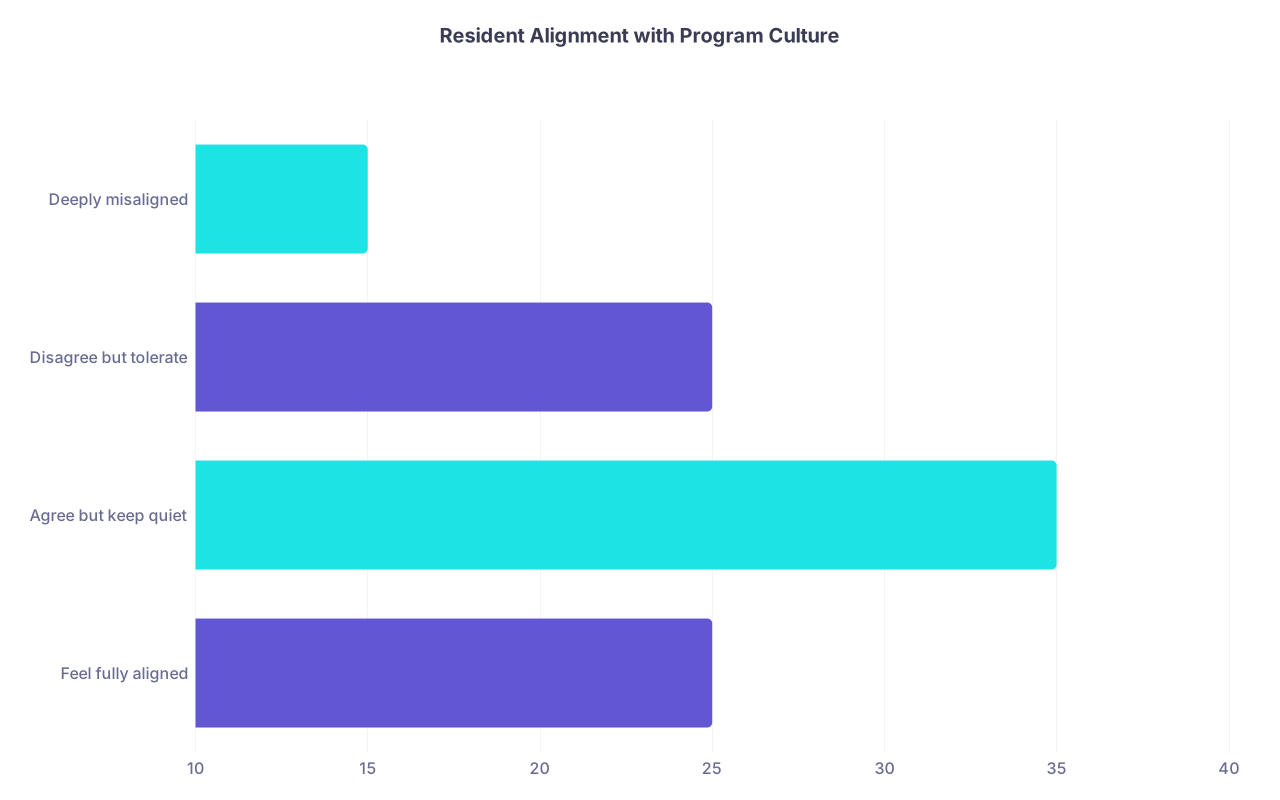
| Category | Value |
|---|---|
| Feel fully aligned | 25 |
| Agree but keep quiet | 35 |
| Disagree but tolerate | 25 |
| Deeply misaligned | 15 |
| Type of clash | Usually means for you |
|---|---|
| Eye-rolls at public health topics | Cultural annoyance, survivable |
| Discouraging community/advocacy work | Limited institutional support, find niches |
| Open mockery of equity or harm reduction | Moral distress, need allies and buffers |
| Pressuring unethical or unsafe practices | Red-flag territory, document and seek help |
If You Remember Nothing Else
You’re probably going to keep spiraling about this at 2 a.m., so here’s the short version to hold onto:
A clash between your public health views and your program’s culture is uncomfortable, but most of the time it’s survivable, not career-ending. The real danger is when you’re pressured into unethical or unsafe behavior — that’s a different category.
You don’t have to convince the whole program. You just need a handful of mentors and allies who see the world somewhat like you do, and a way to practice your values in small, consistent ways.
You’re not wrong for caring about population health, equity, and ethics. If anything, that’s the part of you medicine actually needs the most. Your job in residency is to keep that part alive long enough to use it fully later.