
The biggest threat to your license probably isn’t your public health advocacy. It’s your fear of doing it “wrong” and going silent.
You’re not crazy for worrying, though. I worry about this stuff too. You see physicians disciplined for tweets, for mask posts during COVID, for reproductive rights advocacy… and your brain immediately jumps to: “If I speak up about guns, vaccines, trans care, abortion, climate, am I basically inviting a board complaint?”
Let me walk straight into the paranoia with you and then pull us back to reality.
The Ugly Truth: Yes, Board Complaints Can Come from Advocacy
They can come from anything.
An angry patient. A Twitter thread. A TV interview taken out of context. A Facebook post that your cousin screenshots and sends to your hospital. One annoyed person with time and a grudge can file a complaint.
Boards don’t care how noble your motive was. “But I was protecting public health” isn’t a shield against the process starting.
Here’s the part nobody says out loud: you can be completely in the right, on solid evidence, speaking in good faith… and still trigger a complaint if someone feels:
- You insulted their beliefs
- You disparaged a group they identify with
- You gave what looks like specific medical advice online
- You sounded like you were speaking as their doctor when you weren’t
So yes, it’s possible. It happens. I’ve seen complaints where the “issue” was:
- A doctor posting “If you’re unvaccinated, you’re selfish and putting everyone at risk” and a patient in their panel filed a professionalism complaint.
- A resident tweeting about “parents who refuse antibiotics for actual bacterial infections should lose custody” and a parent who recognized the tone from clinic day felt targeted.
- A physician publicly criticizing their hospital system’s masking policy, and the hospital quietly nudging the board with “concerns about professionalism and patient trust.”
Does that mean you’re doomed if you speak up? No. It means you can’t pretend there’s zero risk.
How Boards Actually Think About Advocacy vs. Misconduct
Boards, on paper, don’t care if you’re pro-vaccine, anti-vaccine, pro-choice, pro-gun, anti-gun, whatever. They care about:
- Patient safety
- Honesty
- Professional boundaries
- Not doing clearly harmful or deceptive stuff under the title “doctor”
They tend to ask questions like:
- Did this physician claim something demonstrably false as medical fact?
- Did they use their MD title to push personal ideology as if it were settled science?
- Did they cross a line with harassment, hate speech, or incitement?
- Did they misrepresent credentials or expertise?
- Did this speech create a foreseeable risk of harm to an identifiable patient or group?
What makes them nervous isn’t “this doctor is loud about public health.” It’s “this doctor looks reckless, deceptive, or cruel while wearing a white coat in public.”
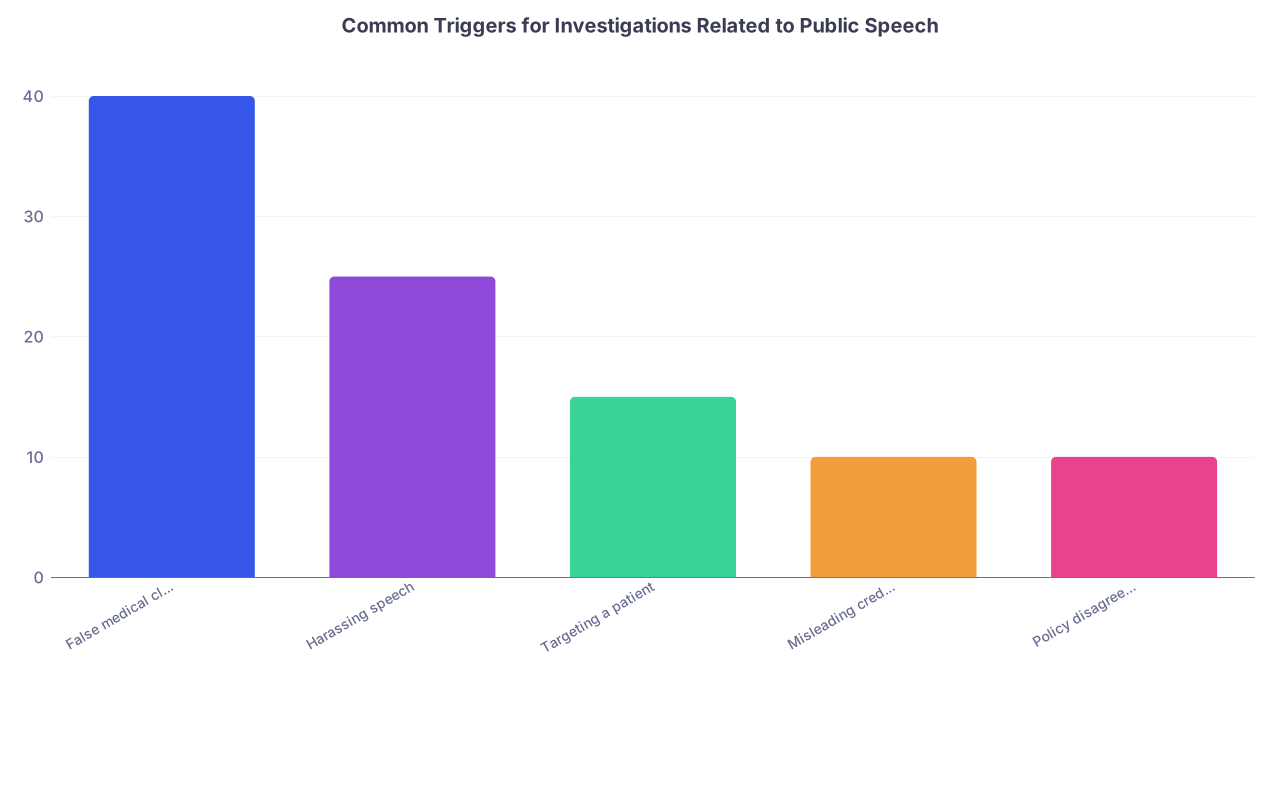
| Category | Value |
|---|---|
| False medical claims | 40 |
| Harassing speech | 25 |
| Targeting a patient | 15 |
| Misleading credentials | 10 |
| Policy disagreement only | 10 |
Policy disagreement alone—“I think the state has failed on gun violence” or “We need mask mandates in schools”—rarely triggers real discipline by itself. Boards usually back off if:
- You’re speaking on evidence-based positions, even if politically controversial
- You keep it broad, not targeted at specific patients
- You avoid clear factual falsehoods dressed up as “doctor’s advice”
But the fear doesn’t care about statistics. Your brain’s stuck on: “What if I become that one headline case?”
The Worst-Case Scenarios You’re Probably Catastrophizing
Let’s say you’re doing public health advocacy: you’re posting about reproductive rights, vaccines, LGBTQ+ health, gun safety, climate as a health crisis—any of the “hot” topics.
Here are the nightmare scenarios your brain probably spins:
- A board drags you in because you wrote one strong-worded op-ed.
- Your residency or hospital reports you for “unprofessional conduct online.”
- Someone screen-caps a tweet, says you violated patient confidentiality, and now you’re defending your entire character.
- Years later, this stuff resurfaces during credentialing, and you’re labeled a “problem.”
You know what? Some of these have happened. Not usually for one mild op-ed, but for patterns of behavior that institutions interpret as “disruptive,” “unprofessional,” or “polarizing”—words that get thrown around a lot when a physician won’t sit quietly.
Where the line tends to get crossed:
- De-identification failure: talking about a case so specifically that the patient (or community) can recognize themselves, even without a name.
- Rage-posting: profanity-laced insults at patient groups (“anti-vaxxers are idiots,” “parents who won’t vaccinate should be jailed”).
- Acting like you’re giving personal medical advice online… without a real clinical relationship.
- Presenting fringe, harmful views as standard of care because you’re a doctor.
What Usually Doesn’t Lead to Board Trouble
You’re probably overestimating how fragile your license is.
These are things I’ve seen physicians do repeatedly without board consequences (assuming no patient-specific breaches):
- Writing op-eds in major papers about failures in COVID policy.
- Publicly criticizing government health decisions, as long as they were clear when it was opinion vs evidence.
- Advocating loudly for abortion access, gender-affirming care, harm reduction, safe injection sites.
- Posting, “As a physician, I support vaccine mandates to protect vulnerable patients” with citations.
- Serving as a public health spokesperson on TV and being openly critical of political leaders.
Boards don’t have time or appetite to chase every doctor with a strong political opinion. They care most when:
- Patients are directly harmed or clearly at risk
- There’s evidence of a pattern that looks unsafe, abusive, or dishonest
- The physician ignores warnings and keeps escalating

Where You Can Accidentally Cross the Line (Without Realizing)
This is the part that should honestly scare you just enough to take it seriously.
You can be 100% well-intentioned and still:
1. Blur the Doctor–Patient Boundary Online
You reply to a stranger: “If you’re having chest pain, take two aspirin and you probably don’t need the ER unless it gets worse.”
Looks like “general advice” to you. To a board, it can look like telemedicine without a proper evaluation.
Safer framing: “Chest pain can be serious. There’s no safe way to diagnose you online—if it’s new, severe, or worrying, you need an in-person evaluation or ER.”
2. Accidentally Reveal a Patient
You write: “Today I saw a 42-year-old teacher from [small town] who refuses insulin for uncontrolled diabetes. I’m so frustrated.”
You didn’t name them. But in a small town… they’re basically named. That’s a confidentiality landmine.
3. Turn Advocacy into Contempt
You’re exhausted. You tweet: “Parents who won’t vaccinate are child abusers. I’m tired of dealing with their stupidity.”
That’s the stuff that ignites professionalism complaints. Not because your frustration is unique—everyone feels it—but because you chose to broadcast it with your MD attached.
How to Advocate Publicly Without Painting a Target on Your Back
Let me give you something your anxious brain actually wants: concrete rules.
Rule 1: Separate Policy Critique from Patient Contempt
Go after systems, policies, misinformation. Not the people you treat.
Instead of:
“Anti-vaxxers are dangerous idiots.”
Try:
“Misinformation about vaccines is putting kids at risk. We need stronger public health communication and better support for families with questions.”
Same message. Less ammo for “unprofessional” complaints.
Rule 2: Be Explicit About General vs Personal Advice
You should almost be annoyingly clear that you’re not diagnosing individuals online.
Phrases like:
“This is general information, not personal medical advice.”
“If you have specific symptoms, please talk to your own doctor.”
“These are population-level recommendations, not a substitute for clinical care.”
Do they fully “protect” you legally? No. But they show you’re acting in good faith, which matters if anything is ever reviewed.
Rule 3: Stick to Evidence When You Say “As a Physician”
If you’re speaking as a doctor, don’t wing it.
You can say:
“As a physician, I support vaccines because they reduce severe disease and death. Data from [CDC, WHO, major trials] shows that clearly.”
Once you veer into:
“As a doctor, I know these vaccines cause infertility, but they’re hiding the data”…
Now you’re walking straight into “false medical claims” territory—a board favorite.
| Situation | Risk Level |
|---|---|
| Citing CDC/WHO data and calling for policy change | Lower |
| Criticizing a legislator's health policy | Lower |
| Vague venting about 'patients' without details | Medium |
| Case description that could ID a patient | High |
| Offering specific online treatment advice | High |
Rule 4: Don’t Post When You’re Shaking with Rage
That’s when we overshare cases. Or insult patient groups. Or subtweet a specific encounter.
If you’re fired up, write the post in notes. Sit on it overnight. Editing 24 hours later saves careers.
Institutional Politics: The Quieter Threat
Honestly, your state board might not be your main problem. Your employer might.
Hospitals, residencies, medical schools—they have their own codes of conduct and brand-protection instincts. You can:
- Get “talked to” about “unprofessional online presence”
- Have promotion or leadership opportunities quietly slide away
- Be seen as “difficult,” “too political,” or “not a team player”
And sometimes they’ll say, “We’re concerned this could reach the board,” even if the actual chance of board action is tiny. It’s a powerful way to scare people into silence.

| Step | Description |
|---|---|
| Step 1 | Public Health Advocacy Post |
| Step 2 | No Action |
| Step 3 | Complaint to Employer |
| Step 4 | Direct Complaint to Board |
| Step 5 | Board Screening |
| Step 6 | Record and Possible Action |
| Step 7 | Anyone Offended |
| Step 8 | Employer Response |
This is why you see attendings say in low voices, at 10 pm in call rooms, “I fully support X, but I’d never put that on Twitter.” They’re not imagining risk—they’re just choosing caution.
You might decide the advocacy is worth that risk. Or you might narrow your targets: focus on evidence, depersonalize your language, and be strategic.
How to Protect Yourself A Little Without Going Silent
You’ll never get to zero risk. But you can get out of the “reckless” zone.
- Use your full name and credentials only when you’re prepared to stand by that content in a credentials committee years from now.
- Keep a hard rule about not discussing same-day cases online—ever. Even vaguely.
- If you’re diving into very controversial spaces (e.g., trans care, abortion where it’s criminalized), consider formal legal/ethics advice and maybe joining organized groups (AMA sections, advocacy orgs) that have infrastructure for this.
- Document your sources. If you’re challenged, you can show you weren’t just riffing.
And yes, you can scrub posts. But assume that anything you post could be screenshotted and live forever. That sounds terrifying, but honestly it just means: post like the board, your program director, and your future self are all reading.
Because one day, they might be.
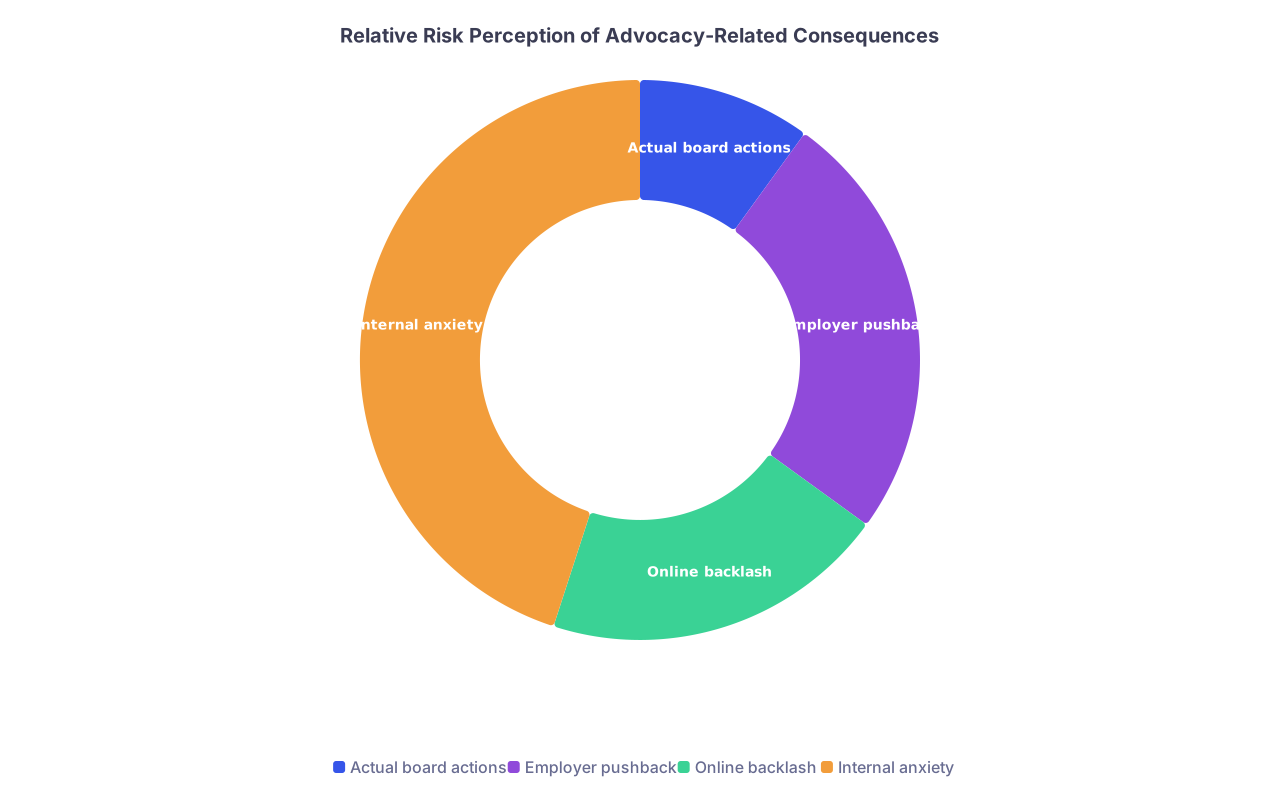
| Category | Value |
|---|---|
| Actual board actions | 10 |
| Employer pushback | 25 |
| Online backlash | 20 |
| Internal anxiety | 45 |
Look at that last piece: internal anxiety. That’s the main thing beating you up right now.
The Part You Probably Need to Hear
Your ethical obligation doesn’t end at not harming patients one-on-one. Public health advocacy is part of caring for people. Staying completely silent out of fear isn’t actually neutral—it maintains harmful status quos.
You’re allowed to be scared of complaints and still speak up. Those two things can exist together.
So the question shifts from:
“Could I get a board complaint from advocacy?”
to:
“What level of risk am I willing to carry to not betray my own ethics?”
There’s no shame if your answer is “low risk.” You can:
- Focus on educational content instead of direct political fights
- Work behind the scenes with local health departments or advocacy groups
- Sign letters with large groups instead of becoming the public face
- Write under your real name but keep it measured and boringly professional
Or, if you’re wired for it, you can choose higher visibility and accept there’s a nonzero chance of headaches. But at least then it’s a choice—not just panicked avoidance.
FAQ (Exactly 6 Questions)
1. Could I actually lose my license over public health advocacy?
Yes, but it’s rare when the advocacy is evidence-based and not targeting specific patients. License loss usually involves patterns of harmful conduct: spreading dangerous medical misinformation, repeated boundary violations, or behaviors that clearly risk patient safety. A single, well-reasoned op-ed about vaccines or abortion is incredibly unlikely to cost you your license. Annoy some people, yes. End your career, almost never by itself.
2. Can I be reported to the board just for criticizing government health policy?
Absolutely. People can report you for almost anything. But boards screen complaints. “This doctor said our governor’s pandemic response was reckless” usually dies at screening unless it’s wrapped in obvious falsehoods (“COVID doesn’t exist”) or hateful speech. Your risk is higher from online mobs and employers than from boards for pure policy criticism.
3. Is it safer to avoid using ‘MD’ or ‘future physician’ in my advocacy work?
Dropping “MD” may reduce the perceived professional angle, but if you’re already known as a physician or trainee, people will still see you that way. Using “MD” raises the expectation that what you say is medically grounded. If you’re going to attach it, stay ruthlessly accurate on anything that sounds like medical advice. If you’re venting more personally, fine to post without professional labels and keep the tone more obviously personal.
4. Can I talk about interesting cases anonymously on social media?
This is the trap. “Anonymous” is often not anonymous to the patient or community. If there’s enough detail that a patient, their family, or staff could recognize the situation, you’re on dangerous ground. De-identification is much stricter than people think. Safest move: don’t post recognizable clinical stories in real time, and don’t post small-community stories at all without changing multiple major details and timeframes—and even then, be cautious.
5. What if my residency or employer warns me about my posts—do I have to stop?
You don’t have to, but ignoring them is risky. That’s the moment to: ask for specific examples of problematic content, request written social media policy, and consider talking to GME, a mentor, or even legal counsel. Sometimes you can negotiate: stay in advocacy, but adjust tone, frequency, or platforms. Sometimes the signal is: “This place won’t support who I am long-term.” Whatever you do, don’t just sign things blindly out of fear.
6. I’m still scared. Should I just stay silent about public health issues?
You can, but that comes with its own cost. Silence might protect you from a tiny risk of formal trouble, but it might also leave you feeling complicit and burned out in a different way. You don’t have to be the loudest voice on Twitter. You can start small: one carefully worded post, one letter to the editor, one talk at a community group. Test your comfort zone, see how it feels, adjust. You’re allowed to gradually find your line instead of deciding in one dramatic all-or-nothing move.
Here’s your concrete step for today: open your social media of choice or your drafts folder and write one advocacy statement you believe in—then revise it to remove patient contempt, add a clear “not personal medical advice” line if needed, and anchor it to at least one solid evidence source. Save it. Don’t even post it yet. Just prove to yourself you can speak up carefully, not stay paralyzed.