You can absolutely tank your reputation with one careless comment on camera.
Let me just say the nightmare out loud, because I know it’s already in your head:
You’re tired, you’re stressed, there’s a camera in your face during a crisis, and you blurt out something clumsy or not fully accurate. Then it’s on the 6 p.m. news. Then Twitter. Then your hospital gets angry. Then your residency/fellowship dreams implode.
That’s the loop your brain is running, right?
You’re not crazy to worry about this. Physicians and trainees do get burned by media quotes. People have been pulled from rotations, investigated by compliance, or dragged on social media. But the way most of us imagine it—one awkward sentence and your career is dead? That’s usually not how it plays out.
Let’s untangle what’s actually at stake, what “wrong” really means here, and how you can protect yourself before a microphone appears in your face.
First: What Does “Saying the Wrong Thing” Even Mean?
The phrase is doing a lot of work in your head. You’re probably lumping totally different risks into one giant vague fear-ball.
Here’s what “wrong” might look like in real life:
- Factually wrong: You give incorrect information about transmission, mortality, vaccine safety, treatment protocols, etc.
- Legally/ethically wrong: You violate HIPAA, talk about specific patients in identifiable ways, or disclose confidential internal info.
- Professionally careless: You contradict your institution’s stated policies on camera, or you sound like you’re trashing leadership.
- Tone-deaf: You sound dismissive of people’s fears, or you say something that comes across as racist, classist, or politically extreme.
- Overstated: You speculate beyond your expertise and it gets framed as “Doctor says X is definitely happening.”
Those aren’t all equally career-ending. Not even close.
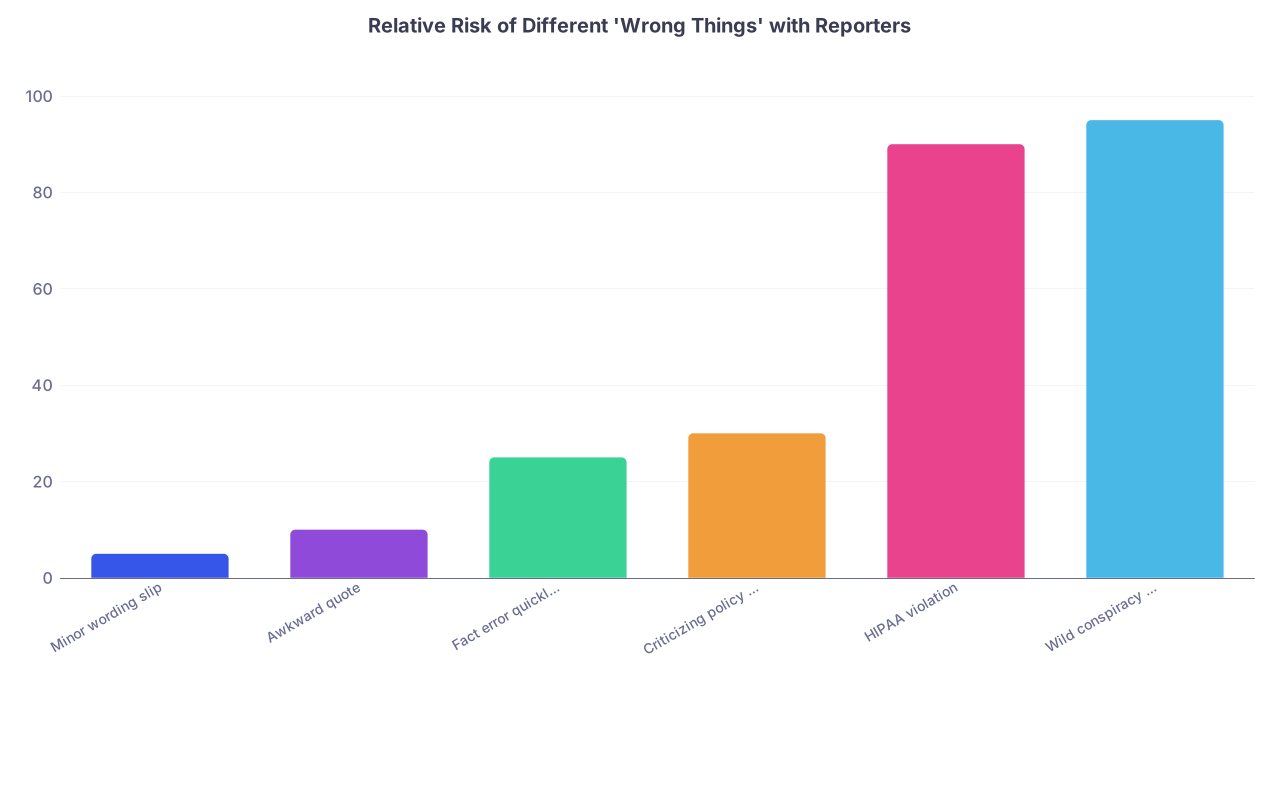
| Category | Value |
|---|---|
| Minor wording slip | 5 |
| Awkward quote | 10 |
| Fact error quickly corrected | 25 |
| Criticizing policy respectfully | 30 |
| HIPAA violation | 90 |
| Wild conspiracy comment | 95 |
In other words: your brain treats “I stumbled over my words” like it’s the same as “I named a patient on live TV.” It’s not.
The Real-World Consequences (vs. the Horror Movie in Your Head)
Let me walk through the worst-case scenario your anxiety is probably running, and then the more realistic version I’ve actually seen.
The horror movie in your head
You imagine:
- Reporter asks you a question you weren’t expecting.
- You answer imperfectly.
- The quote goes viral.
- Your dean/PD calls you in, says you embarrassed the institution.
- Residency programs hear, they blackball you.
- You never match / never get promoted / your career is ruined.
This sequence makes a lot of assumptions:
- That anyone beyond your local area even sees the clip.
- That they care enough to connect it to your name.
- That decision-makers never make mistakes themselves and have zero empathy for media pressure.
It also assumes you’ll do nothing to fix or clarify it afterward, which is rarely true.
What actually tends to happen
Here’s what I’ve seen in real hospitals during COVID, measles outbreaks, opioid stories, etc.:
- A trainee or junior attending says something imprecise.
- The media office or department chair hears about it.
- Someone talks to them: “Hey, next time run it by media relations,” or “Here’s the updated script we’re using about that.”
- They might be told not to talk to press without approval going forward.
- And… that’s it.
For serious stuff (HIPAA breach, clear misinformation, or wildly unprofessional comments), you can see:
- A formal write-up or note in your file.
- Mandatory media/communications training.
- In really bad cases, review by risk management or legal.
Is it possible to get fired or have your career really damaged? Yes. If you do something genuinely egregious (patient-identifying story on camera, racist rant, anti-vax conspiracy speech as “hospital doctor”), then yes, you’re playing with fire.
But a nervous, slightly clumsy answer that isn’t perfect epidemiology? That’s fixable. Annoying? Yes. Career-ending? No.
Your Actual Obligations: Ethically and Professionally
Let’s bring in that “Public Health Policy + Ethics” piece, because this isn’t just about not getting in trouble. It’s about not harming people.
At a minimum, you’re responsible for three things:
Do no harm to patients or the public.
That means: don’t spread misinformation, don’t minimize real risks, don’t overhype unproven treatments, don’t disclose patient info.Stay in your lane.
If you’re an EM intern, you don’t need to speculate on vaccine long-term safety or national policy. You can talk about what you see: full ICUs, the importance of masking, why early testing helps.Respect your institution’s policies.
Most hospitals have rules: “All media inquiries go through communications,” or “Only approved spokespeople speak on behalf of the hospital.” If you ignore that and freelance on live TV as “Doctor at [Hospital],” you’re taking on extra risk.
You do not have an obligation to:
- Answer a reporter’s question just because they asked.
- Speak on camera when you’re uncomfortable.
- Give a quote off the top of your head on complex epidemiology when you haven’t reviewed the latest data.
Saying, “I’m not the right person to speak on that; you can contact our media relations office,” is not cowardice. It’s actually professional.
What To Do If a Reporter Shoves a Mic in Your Face
Let’s get practical, because this is where anxiety calms down: having a script.
Scenario: You’re leaving a shift during a public health crisis. Cameras outside. Reporter walks up: “Doctor, can you tell us what’s going on in there? Are people dying? Are there enough ventilators?”
Your heart rate spikes. Your brain freezes. You’re thinking, “If I say no comment I look like I’m hiding something.”
Here’s a safe baseline script you can literally memorize:
“I’m not authorized to speak on behalf of the hospital, but our communications office can help you with accurate information. What I can say as a physician is that this is serious, and people should follow public health guidance from local and national health departments.”
You can tweak the middle part, but keep the structure:
- I’m not the official spokesperson.
- Here’s the general, safe, true thing.
- Go to the right source.
If they push: “But as a doctor, are you seeing young people die? Is the hospital overwhelmed?”
You can say:
“I can’t discuss specific cases or internal operations, but we are working very hard to care for our patients, and the best way the public can help is by [vaccinating / masking / staying home if sick / following public health directions].”
If you have been given permission to talk to media, still stay simple:
- Stick to what you know firsthand.
- Avoid numbers you aren’t absolutely sure about.
- Don’t speculate into the future (“This will definitely be over by summer” / “We’re all going to get it”).
How to Talk Without Saying Too Much
This is the part that feels like threading a needle while being filmed. There are a few mental rules that help.
1. Use “what we know right now” language
Public health data changes. Fast. You want room to not look like you lied when guidance shifts.
Instead of:
“Children are not at risk from this disease.”
Say:
“Based on the data we have right now, children appear to be at much lower risk of severe disease than older adults, but they can still be affected and can spread it.”
That one phrase—“based on what we know right now”—has saved so many people from looking reckless.
2. Avoid absolute claims
The more absolute your sentence, the more likely it’ll age badly or be used out of context.
Red-flag phrases:
- “Completely safe”
- “No risk”
- “Everyone should…”
- “No one needs to worry about…”
Better framing:
- “Generally safe for most people, with rare side effects.”
- “Lower risk doesn’t mean zero risk.”
- “For people with [condition], the recommendation is…”
3. Never talk about a specific patient. Ever.
Not “the young father I treated this morning,” not “the 42‑year‑old teacher who died yesterday.” Even if you don’t name them, it can be identifiable.
You can say:
- “We’re seeing patients of all ages.”
- “We’ve treated people in their 20s, 30s, and older.”
If a reporter says, “Can you tell us about the child who died here yesterday?” the answer is simply:
“I can’t discuss any specific patient due to privacy laws.”
No apology. No elaboration.
How Bad Is It If I Already Said Something Kinda Wrong?
Let’s say your worst fear happened. You talked to a reporter. You’re now home replaying it, convinced you ruined your life.
Here’s the damage-control checklist.
Step 1: Reality-check your “wrong thing”
Write down exactly what you said, as best as you can remember. Sentence by sentence.
Then ask:
- Was it factually incorrect? Or just not perfectly worded?
- Did you disclose anything identifiable about a patient?
- Did you make a claim outside your expertise?
- Did you speak as if you were the official voice of your hospital?
Most of the time, once it’s on paper, people realize: “Okay, that wasn’t ideal, but it’s not malpractice.”
Step 2: Tell someone early
If you’re affiliated with a hospital or school:
- Let your attending, program director, or a trusted faculty member know.
- Or if you know your institution’s media relations or risk management contact, email them.
Something like:
“I was approached by a reporter outside the hospital today and briefly answered a few questions. I’m now worried I may not have used the preferred language about [X]. I wanted to let you know in case you get any media clips, and I’d appreciate guidance on how to handle this correctly in the future.”
That does two things:
- Shows you’re not hiding.
- Signals you care about accuracy and policy.
Step 3: Correct if necessary
If what you said was clearly wrong (e.g., wrong mask guidance, wrong stats, accidentally dismissive language), sometimes the hospital or health department will issue a clarification, or you can:
- Ask your media team to provide corrected language to the outlet.
- Post a short, calm clarification on your professional social media (if you used your real name/platform there).
Not: “I’m sorry I’m an idiot.”
More like: “Earlier I said X; to be precise, the current guidance is Y.”
I’ve seen this done. People remember the correction more than the original screw-up.
How to Prepare Before You’re Ever on Camera
I know you: you don’t actually want to be a media personality. You just don’t want to spontaneously combust if someone ambushes you with a question.
So build a tiny, boring “media safety kit”:
| Item | Why It Matters |
|---|---|
| 1–2 go-to “safe” sentences | You can default to them under stress |
| Knowledge of media policy | Avoids institutional drama |
| Clear idea of your scope | Keeps you from over-speaking |
| A mentor you can text | For post-interview “did I mess up?” panic |
Examples of safe sentences:
- “People should look to their local public health department and CDC/WHO guidance for the most up-to-date information.”
- “What we’re seeing emphasizes how important [vaccination / masking / testing / early treatment] remains.”
- “I can’t speak for the hospital, but as a physician I can say this is serious, and prevention makes a difference.”
Also: find your hospital’s or school’s media policy. Seriously. It’s usually buried on some intranet page. Knowing whether you’re allowed to talk at all reduces half the anxiety.
The Ethics Piece You’re Afraid To Admit
There’s another layer to this anxiety you probably won’t say out loud: What if I stay silent when I should’ve spoken up?
Because there’s a flip side:
- Not correcting obvious misinformation in your community.
- Not using your credibility to combat conspiracy theories.
- Letting harmful narratives go unchallenged because of fear.
Ethically, that matters too. Public health crises are full of bad actors happy to talk to the press without any training or conscience. You, even as a med student or resident, might actually be more careful and more honest than some loud voices.
So you’re balancing two risks:
- Say something clumsy and get criticized.
- Say nothing and watch misinformation win.
The middle ground is: speak carefully, within your scope, with preparation. Not never speak.

How Institutions Actually See You (Not Just How You See Yourself)
One last perspective shift: you think a single imperfect quote defines you forever. To your institution, you’re one of hundreds of trainees/physicians dealing with chaos.
Things that really get leadership’s attention:
- Patterns of unprofessional behavior.
- Clear disregard for policy after being warned.
- Major, obvious harm (HIPAA, disinformation, harassment).
A one-off awkward phrase in a local news clip? That’s not usually what destroys trust. In fact, I’ve watched PDs, chairs, and deans be surprisingly understanding about media nerves. Many of them have their own horror stories from earlier in their careers.
They also know this: we need clinicians who can explain things to the public. That’s part of public health. Learning how to do that without panicking is actually growth, not a liability.

| Step | Description |
|---|---|
| Step 1 | Reporter approaches |
| Step 2 | Refer to media office |
| Step 3 | Give brief general statement |
| Step 4 | Leave politely |
| Step 5 | Use prepared key messages |
| Step 6 | Say you cannot comment on that |
| Step 7 | Answer briefly within scope |
| Step 8 | Stop before speculating |
| Step 9 | Authorized to speak? |
| Step 10 | Know the answer? |

FAQs
1. If I say something wrong once, will this ruin my chance at residency/fellowship?
Very, very unlikely. Programs care about patterns: professionalism, judgment, honesty. One imperfect media moment isn’t usually even on their radar unless it becomes a huge scandal, and for that you’d typically have to say something obviously harmful (HIPAA breach, bigoted comment, open disinformation). If you make a minor mistake and then handle it maturely—inform leadership, clarify if needed—that actually signals professionalism, not the opposite.
2. Should I refuse to ever talk to reporters as a trainee?
If your institution says “do not talk to media at all,” then yes, follow that. Otherwise, you don’t have to swear a lifetime vow of silence. The safer posture is: don’t impulsively give detailed interviews, but be prepared with 1–2 safe, general statements, and know how to redirect them to official spokespeople. Total silence out of fear isn’t some moral high ground; it’s just one coping strategy, and not always the best one.
3. Do I need formal media training before saying anything to press?
It helps, but it’s not required to utter a single sentence in public. Many hospitals offer short media workshops or have PDFs with do’s and don’ts—those are gold. But even without that, you can follow basic rules: no patient details, no speculating outside your lane, use “based on what we know now” language, and defer bigger questions to public health agencies or official spokespeople.
4. What if a reporter tries to get me to criticize my hospital or leadership?
You are not obligated to provide them with drama. If they ask, “Are you being forced to work without PPE?” or “Is the administration failing?”, you can say something like: “I can’t speak to broader policy decisions; what I can say is that this is a difficult situation for everyone, and questions about institutional policy are best directed to hospital leadership.” If you truly believe there are serious safety/ethical issues, those should be raised through internal channels or with appropriate oversight bodies, not first as a hot take on TV.
5. What happens if I accidentally share something that might be a HIPAA issue?
Don’t sit on it. As soon as you realize it—or even suspect it—tell your supervisor or your institution’s compliance/privacy office. They may determine it’s not actually a breach, or they’ll walk through the next steps (which can include internal documentation, patient notification, etc.). Institutions are far more upset by people hiding potential problems than by people who immediately say, “I think I may have messed up; what do we do to fix it?”
6. How do I calm myself down before speaking so I don’t blank out?
Have a pre-planned, tiny script. Take one deep breath before you answer. Don’t be afraid of short pauses; the camera feels scarier than it looks. Remind yourself: you’re not being tested on boards-style detail, you’re just offering a brief, honest snapshot. If you really don’t know, say, “I’m not the best person to answer that,” and stop talking. You can’t blurt out the wrong thing if you give yourself permission to say less.
Key points: You’re right that words to the media during a crisis matter—but most “wrong things” are fixable, not fatal. Protect yourself by knowing your institution’s policy, staying in your lane, and using simple, prepared phrases. And if you do mess up? Own it early, correct it, and move on.