The lie that you have to destroy yourself to prove you care about justice is killing people who care the most.
You’re not the only one thinking, “If I step back, I’m part of the problem.” I hear some version of this every year from students and trainees: “If I stop organizing, stop showing up, stop posting, it means I never really cared.” Or, “My patients are literally living the consequences of these policies—who am I to rest?”
And under that? The deeper, uglier fear: “Maybe I’m weak. Maybe everyone else can handle it and I just can’t.”
Let’s talk about that.
The Guilt Trap You’re Stuck In
There’s this sick equation a lot of us internalize in medicine and public health:
More suffering I endure = more “legitimate” my activism is.
You know the script:
- If you really cared about health equity, you’d answer that organizing text at midnight.
- If you really believed in reproductive justice, you’d go to the protest after a 12‑hour shift.
- If you really cared about your undocumented patients, you’d be in every city council meeting, no matter how exhausted you are.
So when you feel burned out, your brain turns that into a moral failure. Not “I am human and overstretched,” but “I’m selfish, I’m abandoning people.”
You’re probably comparing yourself to the loudest people in your orbit. The co‑resident who seems to be at every rally. The med student who is somehow doing a dual degree, publishing on health policy, organizing a mutual aid network, and still smiling on Instagram.
You don’t see the breakdowns. Or the chronic migraines. Or the quiet slide into numbness where they stop feeling anything but still keep going, because their identity is now “the activist.”
I’ve watched people go from:
“I will die on this hill”
to
“I don’t care what the policy is, just get me through rounds”
in about 18 months of nonstop “showing up.”
That’s not solidarity. That’s self-erasure.
Burnout Isn’t Just “Being Tired” — It Warps Your Ethics
Here’s where this actually connects to medical ethics, not just vibes.
When you’re burned out, your ethics don’t just stay perfectly intact while your energy drops. Burnout distorts how you think, feel, and decide.
You know this clinically: the overworked attending who gets snappy, the resident who orders extra tests mostly because they can’t think clearly, the nurse who triple-checks less because they’re barely hanging on.
Same in activism.
Burnout pushes you toward:
- Cynicism: “Nothing is going to change anyway.”
- All‑or‑nothing thinking: “If I’m not at 100%, might as well do 0.”
- Moral numbing: you scroll past disasters because you literally can’t absorb another ounce of pain.
That last one is key. You’re scared that if you rest, you’ll stop caring. In reality, you’re already starting to go numb because your nervous system is maxed out.
You know how in trauma literature they talk about “emotional blunting”? That. Except now you’re trying to do ethics and advocacy on a nervous system that’s basically in survival mode.
From an ethical standpoint, staying in that burned‑out state and forcing yourself to keep going isn’t noble. It’s risky. For your patients, your peers, and for the movements you care about.
Movements driven by people who are exhausted become:
- Reactionary instead of strategic
- Fragile instead of sustainable
- Dependent on martyrs instead of building leadership
None of that lines up with justice.
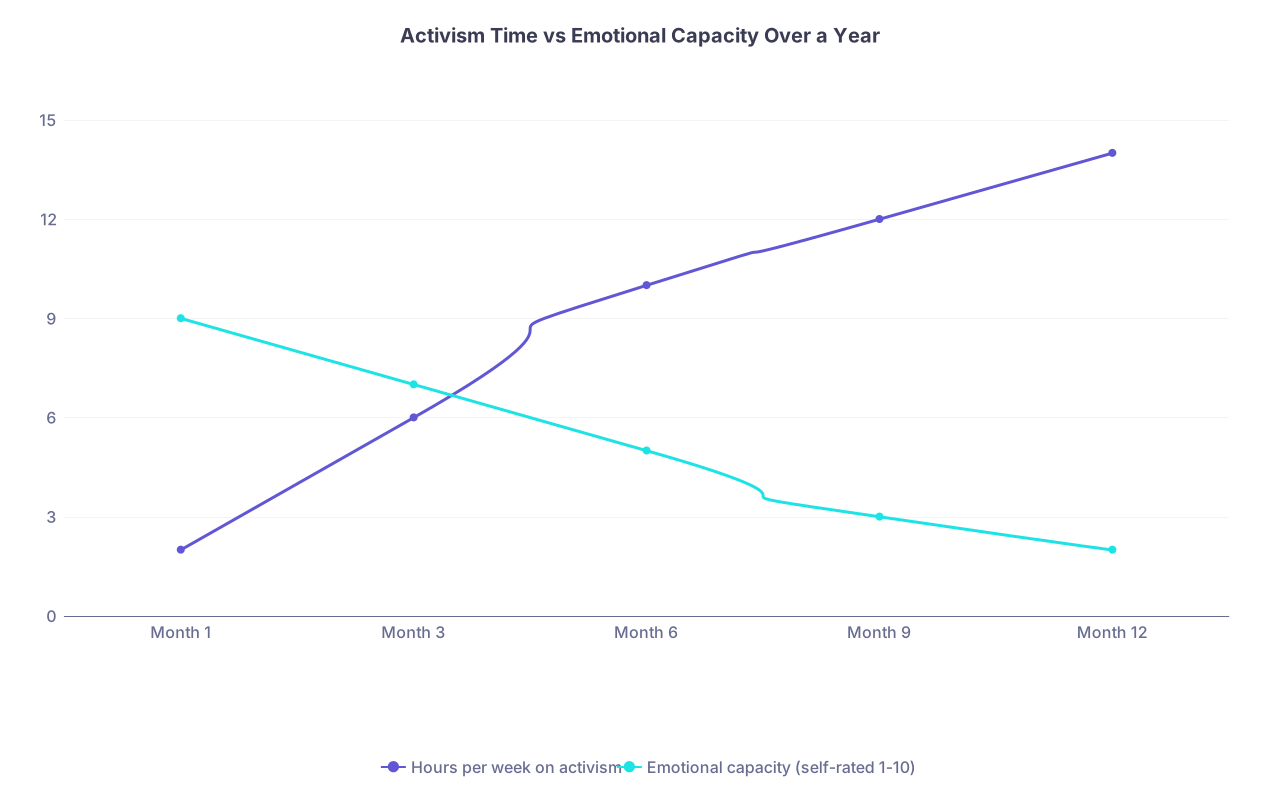
| Category | Hours per week on activism | Emotional capacity (self-rated 1-10) |
|---|---|---|
| Month 1 | 2 | 9 |
| Month 3 | 6 | 7 |
| Month 6 | 10 | 5 |
| Month 9 | 12 | 3 |
| Month 12 | 14 | 2 |
The “If I Don’t Do It, No One Will” Lie
This one hits hard in medicine and public health, because we’re trained into hero culture.
You’re that person in class or residency who always brings up race, or disability, or trans health, or incarceration in discussions. The one emailing about interpreter services or gender‑affirming care. You’ve become “the conscience” of your team.
So the thought of stepping back feels like pulling the only life raft out of the water.
Let me be blunt: you are not the last good person alive.
I’ve seen students take a semester off from organizing and—guess what—the org didn’t evaporate. Other people stepped up. Some things fell through the cracks, sure. But the world didn’t end. And the person who stepped back came back with better boundaries and clearer thinking.
There’s a toxic fantasy that activism should look like:
- Always front‑line
- Always urgent
- Always visible
That’s not how movements actually survive.
They survive because people cycle roles. Some are front‑line this month. Some are behind the scenes. Some are fundraising. Some are literally just surviving so they can be around in 5 years when the rest of us are wrecked.
You stepping back from being the face of something doesn’t erase the work you’ve done or the care you have. It changes your role. That’s it.
Medicine’s Hidden Hypocrisy About Self‑Care
Here’s the part that drives me a little wild.
In ethics lectures, you get told: “Physicians have a duty to maintain their own health.” It’s in the professionalism slides. It’s in the wellness emails. Everyone nods.
And then in practice?
- You’re praised for picking up the extra shift even when you’re sick.
- You’re rewarded for answering patient messages at midnight.
- You’re quietly judged for taking LOA’s, cutting back hours, saying “I can’t be on this committee right now.”
Activism plugs itself right into that same hypocrisy.
Health policy professors love to talk about advocacy. Admissions committees love your activism. Personal statements about “speaking truth to power” get highlighted.
But when you’re drowning? When you say, “I need to pause organizing this semester,” you feel like you’re betraying the exact ideals you sold in your applications.
So you grind harder. Because you feel like your credibility is on the line.
Ethically, that’s backwards.
If we really believe in patient safety, non‑maleficence, and justice, then sacrificing your mental health to the point where you become unsafe, resentful, or numb is actually less ethical, not more.
You’d never tell a suicidal colleague, “Well, at least you’re still at every protest.” But we quietly say that to ourselves.

You Don’t Owe the World Your Breakdown
Let me say this in plain language: You are not ethically obligated to ruin your health for the sake of activism.
Not even for “the most important cause in the world.” Not even if your patients are directly affected. Not even if your own community is directly targeted.
There’s a difference between:
“I don’t care, so I’m not involved”
and
“I care deeply, but my current level of involvement is not sustainable and is starting to harm me.”
Those are not the same. At all.
Sometimes people worry: “But if everyone thought like that, no one would show up.”
That’s not true either. Most people aren’t anywhere near the burnout line. They’re not you. They aren’t at protests on their post‑call day or writing op‑eds at 2 a.m. They aren’t crying in the call room over another preventable death and then still going to a city council meeting.
You stepping back from 120% intensity to 40% doesn’t cause global collapse. It just drags you closer to being a regular human instead of a sacrificial offering.
And honestly? Some people only start engaging once they see models of sustainable activism. Right now they’re scared off because they think it has to look like “all crisis, all the time.”
When you say, “I care about this, but I also rest and protect my health,” you’re not undermining the movement. You’re expanding the range of what’s possible.
What “Stepping Back” Can Actually Look Like (Without Abandoning Your Values)
You don’t have to switch from “in the streets every weekend” to “totally disconnected and pretending nothing is happening.”
There’s a middle zone.
For example:
Maybe you stop being the organizer, and you just sign the petitions, send the pre‑written policy emails, or show up occasionally when you have capacity.
Or you move from public‑facing roles to “maintenance” roles that are more compatible with your current energy: grant writing, editing, mentoring, proofreading, donation organizing. It still matters, even if it doesn’t go on Instagram.
Or you pick one issue instead of trying to hold the entire collapsing world:
- You focus on housing policy in your city instead of every single social determinant of health.
- You choose reproductive justice work and stop guilting yourself about not also doing carceral reform or climate justice this year.
Ethically, narrowing your focus is not abandonment. It’s honesty about your limits.
| Pattern | Unsustainable Version | More Sustainable Version |
|---|---|---|
| Time | 10–15 hrs/week year-round | 2–4 hrs/week with real off-seasons |
| Role | Always lead organizer | Alternate between leading and supporting |
| Scope | Every issue, every campaign | One or two main issues for a season |
| Boundaries | Always reachable, never say no | Clear limits on time and communication |
Also: you’re allowed to have seasons. Sometimes you’re deeply involved. Sometimes you’re lightly supporting. Sometimes you’re just surviving your rotation from hell and staying politically aware without doing much else.
Movements need all three seasons from people over a lifetime.
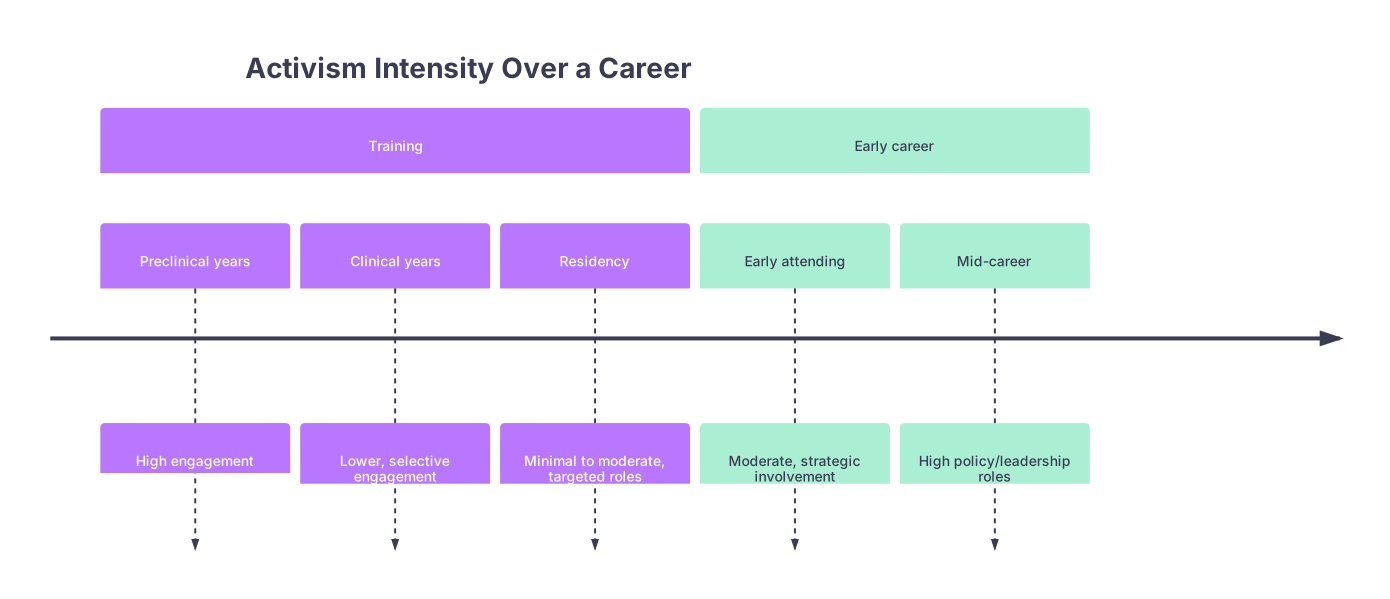
| Period | Event |
|---|---|
| Training - Preclinical years | High engagement |
| Training - Clinical years | Lower, selective engagement |
| Training - Residency | Minimal to moderate, targeted roles |
| Early career - Early attending | Moderate, strategic involvement |
| Early career - Mid-career | High policy/leadership roles |
The Ethics of Saying “No” When You’re in Medicine
This is the part that really messes with med people who care about justice. You’re already hyper‑aware of privilege and power. So the idea of setting boundaries feels selfish.
You might be thinking:
“I’m not the one getting deported.”
“I’m not the one whose water is poisoned.”
“I’m not the one being legislated out of existence.”
So, how dare I be tired?
Here’s where ethics actually helps you out.
Respect for persons and justice don’t just apply outward. They include you. You are also a person with inherent dignity, not a tool.
If you had a patient who said:
“I deserve to be in pain because other people have it worse,”
you’d recognize that as distorted thinking. But that’s exactly the logic you’re turning on yourself when you say:
“I don’t deserve a break because others suffer more.”
You absolutely can acknowledge your relative privilege and still protect your health. Those things are not mutually exclusive.
Sometimes the most ethical thing you can do is say:
“If I keep going like this, I will become bitter, reckless, or leave healthcare entirely. I’m going to step back now so I can still be here—useful, kind, and principled—in ten years.”
Long‑term solidarity beats short‑term martyrdom. Every time.

So… Is It OK To Step Back?
Yes. It’s not only “OK.” It can be the most ethical, responsible choice available to you right now.
Here’s the blunt checklist I use when people ask me this:
- Are you starting to feel numb when hearing about suffering you know you care about?
- Are you regularly sacrificing sleep, health appointments, or basic functioning for activism?
- Are you more irritable, hopeless, or resentful than you used to be about the work?
- Are you doing it mostly out of fear—of being judged, of losing your identity, of not being “enough”—rather than from a place of chosen commitment?
If those are “yes,” then forcing yourself to stay at your current level is not heroic. It’s a slow self‑destruction that will likely take you out of the fight entirely.
And I know the question under all of this isn’t just “Is it okay?” It’s:
“If I step back, will I still be a good person?”
You don’t become a bad person when you hit your limits. You become human. The work you’ve done counts. The care you have still exists. Your values don’t evaporate just because your nervous system throws up a red flag.
You’re allowed to have a future self who’s still in this work. To get there, you might have to stop pretending you’re an inexhaustible resource right now.
FAQ (The Things You Probably Still Worry About)
1. What if stepping back becomes permanent and I never go back to activism?
That’s the anxiety talking. Burnout is famous for telling you “if you rest, you’ll never get up again.” In reality, people who rest actually come back more often than the ones who white‑knuckle through. And if your activism evolves—less protesting, more policy writing, more relational work—that’s not “never going back.” That’s growth. You won’t accidentally wake up one day as a cartoon villain because you took a semester to breathe.
2. Won’t other people think I was just performative if I step back now?
Some might. People project all kinds of things onto each other in activist spaces, especially when everyone’s stressed. But you don’t owe anyone your collapse to prove your sincerity. The people whose opinions actually matter long‑term are the ones who understand sustainability. If someone only values you when you’re overextending, that’s not solidarity. That’s extraction.
3. How do I step back without feeling like I’re abandoning people who rely on me?
You don’t ghost them. You name your limits clearly and you help with transition: “I need to step back from leading this campaign after this month. I can help onboard someone new or share my notes.” That’s responsible. That’s ethical. You don’t have to disappear; you can just shrink the container. People might be disappointed. That’s allowed. You’re not obligated to prevent all disappointment at the expense of your health.
4. Does this make me less competitive for med school/residency/fellowship if I’m not constantly ‘doing activism’?
Admissions and PDs are not sitting around saying, “Hmm, this candidate clearly slept 7 hours last year, reject.” What actually reads as strong is consistent, thoughtful engagement over time, plus insight into your limits and growth. “I burned myself out trying to fix everything, realized that wasn’t sustainable, and learned to choose impact over optics” is a powerful story. A burned‑out, bitter applicant who did everything and clearly hates the world? That’s not a flex.
Key things to hold onto:
- Burnout doesn’t mean you never cared; it means you cared too much for too long without protection.
- You are not ethically obligated to sacrifice your mental health to prove your commitment to justice.
- Stepping back from activism isn’t betrayal—it’s often the only way to make sure you’re still around, and still human, for the long fight ahead.