
The biggest mistake health professionals make with op-eds is thinking timing means “when I have time to write,” not “when power is actually listening.”
You want to influence policy? Then your calendar has to wrap around their cycle, not yours.
Below is a practical, time-anchored playbook for how to time op-eds and media outreach around real “policy windows” — the short, brutal periods when decisions can actually be shifted.
First: Understand the Three Clocks You’re Up Against
At this point, before you write a single sentence, you should map these three timelines:
- The policy clock – when decisions are made
- The media clock – when stories get picked
- Your prep clock – when you realistically can draft, revise, and coordinate
If you don’t align all three, your brilliant op-ed dies in someone’s inbox.
| Clock Type | Typical Unit | Who Controls It |
|---|---|---|
| Policy clock | Weeks–months | Legislators, agencies |
| Media clock | Hours–days | Editors, producers |
| Prep clock | Days–weeks | You and your team |
The Policy Clock: Recognizing Policy Windows
Policy windows open when three streams line up: problem, solution, and politics. John Kingdon wrote the theory; you live the reality.
Classic openings:
- A bill is introduced, marked up, or headed to a vote
- A major scandal, outbreak, or adverse event hits the news
- A budget or guideline revision is under active consideration
- A new administration or health commissioner takes office
At this point, your job is not to “feel strongly.” Your job is to know exactly when those windows will open.
Month-by-Month: Build a Policy-Aware Media Calendar
Assume you’re planning a year of public health advocacy as a clinician or trainee. Here’s how to structure it.
3–6 Months Before Key Policy Windows: Policy Recon and Positioning
At this point, you should:
Map the decision calendar
- Identify:
- Legislative session dates (state + national)
- Budget cycles (often spring for many governments)
- Known guideline revision timelines (USPSTF, CDC, WHO, specialty societies)
- Put on a visible calendar:
- Committee weeks
- Expected public hearings
- Election dates and filing deadlines
- Identify:
Pick 1–2 priority issues
- Example: syringe services expansion, air quality standards, Medicaid redeterminations.
- Do not scatter your effort across 10 topics. You’ll be late on all of them.
Collect data and stories early
- Local hospitalization stats
- Clinic “we had to…” stories (de-identified, of course)
- Quotes from colleagues, community partners, patient advocates
Identify your roles
- Are you:
- The local clinical voice?
- The ethics voice?
- The “we see this every night in the ED” voice?
- Are you:
Start soft-contact with media
- Follow key health reporters on X (Twitter), LinkedIn.
- Send one or two short, non-pushy emails:
- “I’m a clinician working on X. If you ever need local context or data on Y, happy to be a source.”
You’re not pitching yet. You’re becoming legible.
One Month Before a Known Policy Window: Preload Your Content
Now timing gets precise.
At this point (about 4 weeks before a decision moment), you should:
-
- One general op-ed per issue:
- 750–900 words for major newspapers
- 600–750 words for regional outlets
- Have modular parts:
- Opening hook (that you can swap to match current events)
- 2–3 supporting data points
- 1–2 clinical stories
- Clear, very specific policy ask
- One general op-ed per issue:
Draft shorter alternatives
- 400-word version (for fast-turn local outlets)
- 200-word version (letter to the editor)
- 4–6 talking points (bullet list) for radio/TV
Pre-identify target outlets
- Your hierarchy:
- 1–2 dream outlets (NYT, WaPo, major national)
- 3–5 realistic regional/state outlets
- 2–3 niche/public health or medical outlets (STAT, local health blogs, specialty society newsletters)
- Your hierarchy:
Align your content with their editorial tendencies
- Go read:
- Opinion section patterns
- Which columnists cover your issue
- Their average op-ed length and tone
- Go read:
Clear institutional issues
- If you’re hospital- or university-affiliated:
- Check if op-eds need prior review (they often do, officially or unofficially)
- Decide whether you’re signing as “views my own” or on behalf of an organization
- This can take weeks. Do not discover this the night before a vote.
- If you’re hospital- or university-affiliated:
Week-by-Week: How to Ride a Policy Window
Use this for something like: “A major public health bill is heading to committee next month,” or “The health department will release overdose data in mid-May.”
3 Weeks Before the Window
At this point, you should:
Finalize your main op-ed draft
- Get a colleague to sanity-check:
- Is the argument clear in 2–3 sentences?
- Is the policy ask explicit and actionable?
- Is your role clear (why you, why now)?
- Get a colleague to sanity-check:
Prepare event-triggered intros
- Draft 2–3 different opening paragraphs:
- “After last week’s outbreak in X…”
- “As lawmakers prepare to debate Bill Y on [date]…”
- “With overdose deaths hitting another record high this month…”
- Draft 2–3 different opening paragraphs:
Segment your outreach list
- One list for:
- Opinion editors
- Health reporters
- TV/radio producers
- Each gets slightly different messages later.
- One list for:
2 Weeks Before the Window
At this point, you should:
Start subtle pre-outreach
- Short email to 2–3 reporters:
- “Heads up: when [bill/guideline/budget] hits [committee/plenary], the local implications for [community/clinic/hospital] are substantial. I see X every week in clinic and happy to talk on or off the record.”
- Goal: You’re on their radar as “the person who already thought this through.”
- Short email to 2–3 reporters:
Refine your timing decision
- Decide your move:
- Pre-window op-ed to set the frame
- Or mid-window op-ed to push wavering actors
- For most health policy fights, 5–7 days before the key vote or hearing is prime op-ed territory. More lead time for big nationals.
- Decide your move:
Lock in your ethics framing
- You’re in the “Personal Development and Medical Ethics” phase. That means:
- Name the ethical tension clearly:
- “We’re forcing low-income patients to choose between meds and rent.”
- “We’re pretending addiction is a choice while designing systems that guarantee relapse.”
- Tie ethics to policy: “Here is the ethically necessary decision. Here is the concrete policy lever.”
- Name the ethical tension clearly:
- You’re in the “Personal Development and Medical Ethics” phase. That means:
Day-by-Day: The Week of the Decision
Now we get specific. Assume a key committee vote is on Thursday.
T-7 to T-5 Days (Previous Thursday–Saturday)
At this point, you should:
Submit to your top-choice outlet
- Ideal: submit 6–7 days before the vote for national outlets, 3–5 days before for local outlets.
- Subject line: concise and time-tied
- “Op-ed pitch: Local ICU doctor on [Bill X] vote next Thursday”
- In your email:
- 2–3 sentence summary
- Why this week
- Why you
Mention the ticking clock clearly
- “This piece only makes sense if it runs before Thursday’s committee vote on Bill X.”
Give them an easy out + fallback
- “If this is not a fit for [Outlet], I can quickly adapt it for another publication, so please let me know by [date].”
You’re not being pushy; you’re being honest about time-sensitivity.
T-4 to T-3 Days (Sunday–Monday)
At this point, you should:
Follow up once (if no response)
- Short, not needy:
- “Just following up on the op-ed about [issue] tied to Thursday’s vote. Still timely if it runs by Wednesday. Happy to tighten or adapt.”
- Short, not needy:
Prepare Plan B
- If your A-tier outlet passes or ghosts:
- Same day, adapt for a regional outlet:
- Add more local data
- Name local hospitals, counties, clinics
- Submit by end of day Monday.
- Same day, adapt for a regional outlet:
- If your A-tier outlet passes or ghosts:
Alert your allies
- Send the draft (or key points) to:
- Advocacy groups
- Specialty society committees
- Local health department contacts
- Ask them:
- “If this runs, can you amplify on your channels and possibly write supporting letters?”
- Send the draft (or key points) to:
You’re choreographing an echo, not just a solo.
T-2 Days (Tuesday)
At this point, you should:
If nothing has landed yet, go hyper-local
- Many local papers turn op-eds or guest columns around quickly.
- Submit to:
- City paper
- Regional online outlet
- Medical society or hospital newsletter (if they can publish fast online)
Prepare letter-to-the-editor backup
- Compress your argument into 200–250 words.
- Have it ready to fire if someone else’s piece runs first, framing the issue badly.
T-1 Day (Wednesday – Day Before Vote)
At this point, you should:
If op-ed is published:
- Push it hard:
- Email to legislative staff:
- “Flagging today’s op-ed on Bill X from a local clinician. This reflects what we’re seeing on the ground.”
- Share on social, tagging:
- Key legislators
- Journalists
- Professional societies
- Email to legislative staff:
- Offer to brief:
- “If helpful before tomorrow’s vote, I can do a 10-minute Zoom or phone call today.”
- Push it hard:
If op-ed is not published yet:
- Switch to rapid response:
- Short email to opinion editor:
- “Bill X vote is tomorrow morning. If this doesn’t run by tonight, I’ll withdraw and reframe as a post-vote analysis. Please let me know either way.”
- Short email to opinion editor:
- Switch to rapid response:
Get ready for media calls
- Have:
- Three 15-second soundbites
- One 30-second story
- One clear policy ask
- Have:
Day 0: Vote / Hearing / Release Day
This is where most people either panic or miss the shot entirely.
At this point, you should decide: pre-game or post-game? If the pre-game op-ed didn’t hit, you pivot.
If You Published Before the Decision
Be available
- Reply fast to:
- Reporters
- Legislative staff
- Colleagues who want to republish internally
- Reply fast to:
Leverage the floor debate
- Listen for:
- Your talking points being echoed
- Misconceptions you can correct later
- Listen for:
Prepare a short reaction
- 150–250 words:
- “Today’s vote on Bill X will mean…”
This becomes:- A quote for journalists
- A LinkedIn/X post
- A seed for your next, reflective ethics piece
- “Today’s vote on Bill X will mean…”
- 150–250 words:
If You Did Not Publish Before the Decision
You’re not done. You’re just moving to Phase 2: narrative control.
At this point, you should:
Draft a post-vote op-ed within 24–48 hours
- Frame:
- If it passed: “Now the hard part begins: implementing without harming the most vulnerable.”
- If it failed: “What this says about our values and what must change next session.”
- Frame:
Time your submission
- For post-vote reflections, you typically have a 3–7 day window before editors move on.
Beyond Single Events: Seasonal and Cyclical Timing
Policy windows aren’t only votes. They’re seasons.
Annual Policy Milestones You Can Pre-Plan Around
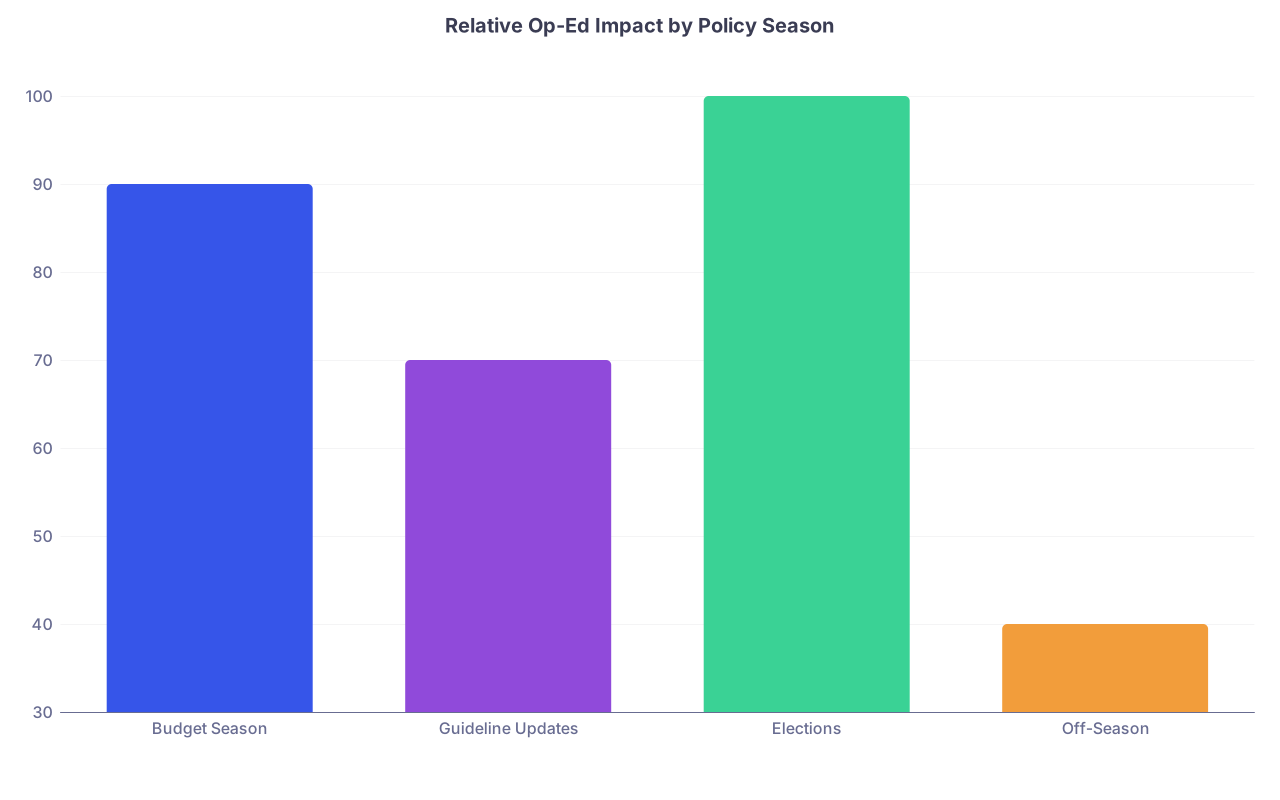
| Category | Value |
|---|---|
| Budget Season | 90 |
| Guideline Updates | 70 |
| Elections | 100 |
| Off-Season | 40 |
Budget season (often spring)
- Ideal for:
- Hospital uncompensated care stories
- Public health infrastructure
- Social determinants (housing, food, transit)
- Start drafting 2–3 months before budget hearings.
- Ideal for:
Guideline updates (rolling, but predictable)
- Ideal for:
- Screening recommendations
- Treatment access issues
- Ethics of risk communication
- Watch:
- USPSTF draft recommendation calendars
- Specialty guideline cycles
- Ideal for:
-
- Pre-election (2–3 months before):
- “Here’s what public health demands from the next mayor/governor.”
- Immediate pre-vote:
- Risky. Editors drown in election content.
- Post-election (1–2 weeks after):
- “A mandate for X? What the results mean for health.”
- Pre-election (2–3 months before):
Off-season
- Good for:
- Deep-dive ethical reflections
- Foundational framing (“We’re talking about overdose wrong”)
- Building your authority before the next hot moment
- Good for:
A Visual: How a 6-Month Advocacy Push Actually Flows
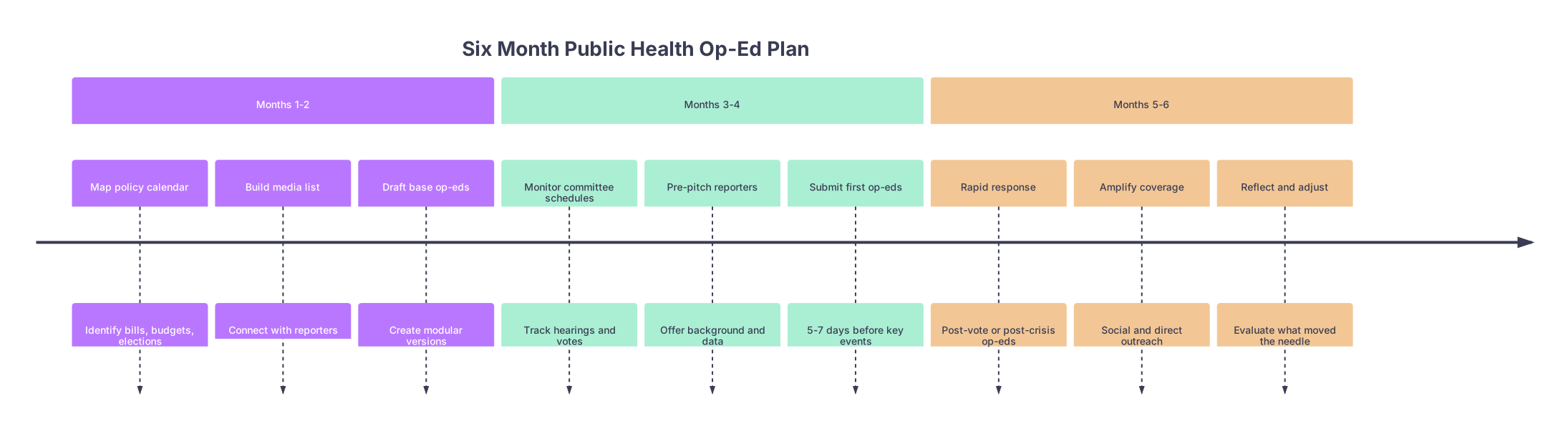
| Period | Event |
|---|---|
| Months 1-2 - Map policy calendar | Identify bills, budgets, elections |
| Months 1-2 - Build media list | Connect with reporters |
| Months 1-2 - Draft base op-eds | Create modular versions |
| Months 3-4 - Monitor committee schedules | Track hearings and votes |
| Months 3-4 - Pre-pitch reporters | Offer background and data |
| Months 3-4 - Submit first op-eds | 5-7 days before key events |
| Months 5-6 - Rapid response | Post-vote or post-crisis op-eds |
| Months 5-6 - Amplify coverage | Social and direct outreach |
| Months 5-6 - Reflect and adjust | Evaluate what moved the needle |
Ethical Grounding: Your Internal Timeline
You’re not a PR shop. You’re a clinician or trainee with an ethical spine. Your internal work has its own timing.
Before You Jump In (Weeks to Months Earlier)
At this point, you should:
- Clarify:
- What harms you’re actually seeing
- Where policy is the real lever (versus clinical practice changes)
- Decide your red lines:
- What you will not say to stay “palatable”
- Where your professional duty requires bluntness
During the Fight
You should:
- Keep checking:
- Are you being used as a token clinician quote with no real influence?
- Are you accidentally giving cover to harmful compromises?
If yes, you either recalibrate your messaging or step back. That’s part of ethical timing too.
After the Window Closes
You should:
- Debrief yourself:
- What came too late?
- Where did you underestimate or overestimate your influence?
- Update your calendar for the next cycle.
- Policy is seasonal. You get another shot.
Simple Weekly Rhythm to Stay “Window-Ready”
Not everyone can live in advocacy mode. Here’s a realistic minimum routine.
At this point (any typical week), you should:
15 minutes, once a week
- Scan:
- State + national health policy headlines
- Your legislature’s committee calendar
- Ask:
- “Is anything I care about moving from hypothetical to real this month?”
- Scan:
60 minutes, once a month
- Update:
- Your issues list
- Your op-ed templates
- Add:
- One new data point
- One new clinical story
- Update:
Deeper work when a window opens
- 2–3 evenings to:
- Finish a draft
- Coordinate with allies
- Do targeted outreach
- 2–3 evenings to:
You don’t need a communications office. You need a calendar and some discipline.
FAQ (Exactly 2 Questions)
1. How far in advance should I pitch an op-ed around a policy vote or hearing?
For national outlets, aim to pitch 5–10 days before the key event, with a clear explanation that the piece is time-sensitive and only makes sense if it runs before the vote or hearing. For regional or local outlets, 3–5 days before is often enough, since they move faster and have shorter production pipelines. Always build in a fallback plan: if a top-tier outlet passes or doesn’t respond within 24–48 hours, immediately adapt and send to a more local or niche publication so the piece still lands before the window closes.
2. What if I miss the policy window entirely — is it still worth writing?
Yes, but you change the purpose. Instead of trying to sway an immediate decision, you pivot to shaping the narrative for the next cycle. Write a post-mortem: what the decision revealed about our values, which harms will now play out, and what must be different next time. These reflective pieces, often published 3–10 days after the event, can be powerful in setting the moral and practical frame that future journalists, advocates, and even lawmakers will reference when the issue resurfaces. You’re no longer pushing a vote; you’re laying track for the next train.
Open your calendar right now and mark the next three likely policy moments that touch your patients — then write one sentence for each about what you’d want to say when that window opens.