You are here
You just got an email from the state health department director:
“Can you send me a one-pager on what your clinic’s data shows about post‑discharge follow‑up? We have a legislative briefing on Thursday.”
You have:
- 47 pages of EHR exports
- 3 years of outcomes data
- A half-finished QI poster
- And… absolutely no one-pager
Here is the gap: you were trained to think like a clinician or researcher. They are asking you to think like a policymaker.
Let me walk you through a concrete, repeatable way to turn messy clinical data into a sharp, persuasive policy one‑pager that a busy legislator or health commissioner will actually read and use.
Step 1: Decide the policy question before touching the data
Most people start by summarizing all their data. That is wrong. Policymakers do not care about all your data. They care about one problem and one decision.
Ask yourself, very directly:
What is the policy question?
- “Should we fund community health workers for heart failure patients after discharge?”
- “Should we mandate 48‑hour post‑partum telehealth check-ins?”
- “Should the city expand funding for ED-based MAT induction for opioid use disorder?”
Who is the actual decision‑maker?
- State Medicaid director
- Hospital board finance committee
- City council health subcommittee
- Ministry of Health primary care director
Different audiences, different angles. A legislator needs the “why this matters to my voters and budget” story. A hospital COO needs “why this will not sink my margins.”
- What decision do you want this one‑pager to move?
- Approve / deny a funding proposal
- Support / oppose a bill
- Authorize a pilot program
- Renew / expand an existing initiative
If you cannot answer those questions in one or two sentences, stop. You are not ready to write.
Write this at the top of a scratch paper:
- “This one‑pager will convince [X decision-maker] to [Y decision] about [Z policy idea].”
Keep that sentence in front of you. Everything that follows is filtered through it.
Step 2: Strip the data down to decision-grade numbers
Your clinical database is a forest. They need three trees.
You want “decision‑grade” data: a tiny set of numbers that directly answer:
- How big is the problem?
- What happens if we do nothing?
- What happens (or is likely to happen) if we implement the intervention?
- What does it cost or save?
Start with a structured pass through your data.
2.1 Identify the core outcome and comparator
Examples:
- Readmission rate within 30 days for heart failure patients
- ED visits for poorly controlled asthma
- Average time from ED arrival to antibiotic for sepsis
- Neonatal ICU admissions among late preterm births
Pick one primary outcome. Two at most. If you have ten, you have none.
Then define:
- Timeframe (e.g., Jan 2021–Dec 2023)
- Population (e.g., adults with Medicaid in your county, not “everyone”)
- Comparator:
- Before vs. after your intervention
- Your clinic vs. other clinics
- Your local data vs. state or national averages
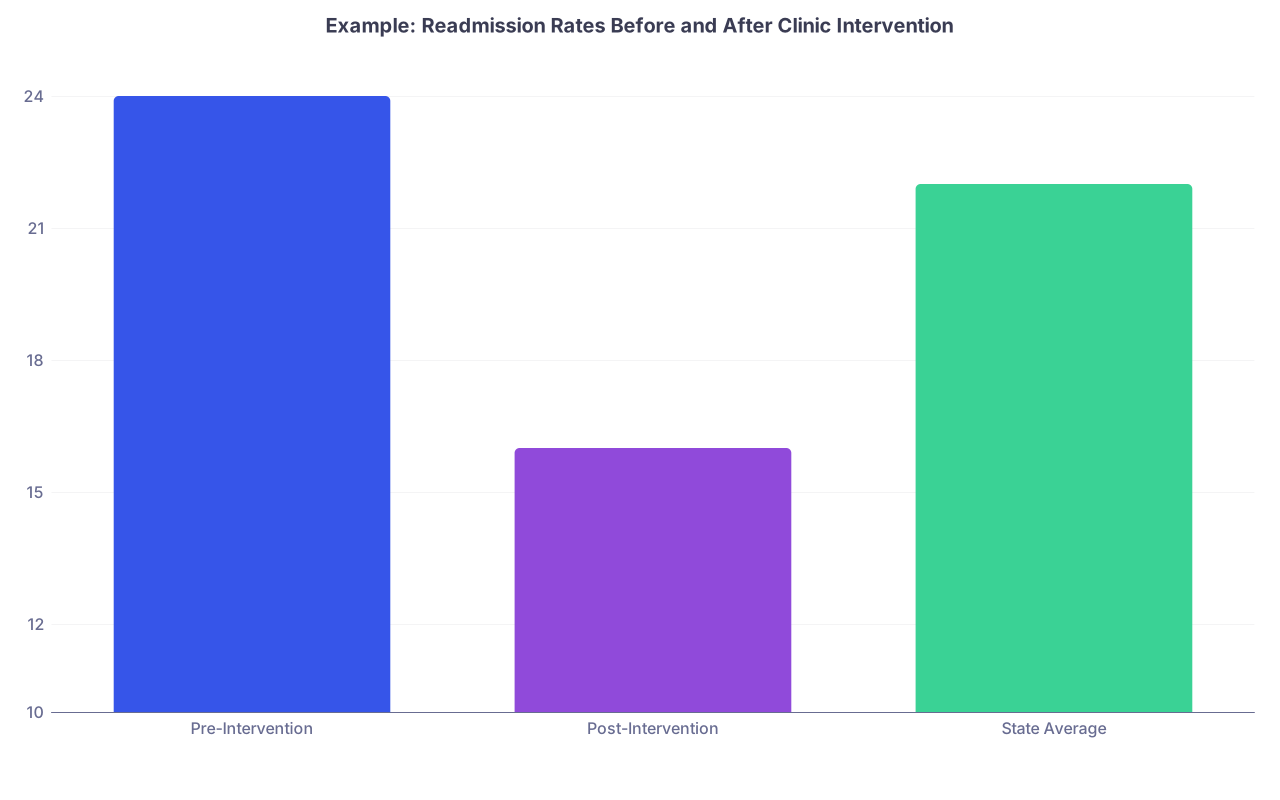
| Category | Value |
|---|---|
| Pre-Intervention | 24 |
| Post-Intervention | 16 |
| State Average | 22 |
Now you have something policymakers recognize: a baseline, a change, a benchmark.
2.2 Convert jargon into plain metrics
Drop:
- “Odds ratios”
- “p-values”
- “Hazard ratios”
Use:
- Absolute percentages (“Readmissions fell from 24% to 16%”)
- Simple counts (“That is 80 fewer readmissions a year in our 500‑patient panel”)
- Rough dollar estimates (“Each readmission costs approximately $9,000”)
If you must mention significance:
- “The reduction is statistically reliable and unlikely to be due to random variation.”
That is enough. You are writing a policy brief, not a methods section.
2.3 Attach money in a disciplined way
You do not need perfect cost-effectiveness analysis. You do need ballpark numbers that are honest and sourced.
Steps:
Find a credible per-event cost:
- CMS tables
- State Medicaid data
- Peer-reviewed estimates (clearly referenced)
Multiply your change by that cost:
- “80 fewer readmissions × $9,000 ≈ $720,000 in direct hospital costs avoided per year”
Show net, not just savings:
- “Program costs: $250,000 annually (3 community health workers + supervision + IT). Net savings: ≈ $470,000 per year.”
Use ranges if needed:
- “$600,000–$800,000 saved, depending on payer mix and case complexity.”
Step 3: Build a one‑pager skeleton before you write a word
The most reliable mistake: people open Word and start typing paragraphs. Do not.
A strong policy one‑pager has a predictable spine. You can tweak labels, but structure should be close to this:
- Title and “Ask” (top 1–2 inches)
- Problem statement (clinical + human + system impact)
- Key data (3–5 bullets or a tiny table)
- Proposed solution (1–2 short paragraphs)
- Evidence of effectiveness (local clinical data + external evidence)
- Implementation and cost snapshot
- Call to action and contact
Think of it like this:

| Step | Description |
|---|---|
| Step 1 | Title and Ask |
| Step 2 | Problem |
| Step 3 | Key Data |
| Step 4 | Proposed Solution |
| Step 5 | Evidence |
| Step 6 | Implementation and Cost |
| Step 7 | Call to Action |
If your draft does not roughly follow that flow, it will feel like a wall of text.
Step 4: Translate clinical language into policy language
You live in clinical language. They live in risk, cost, and constituents.
Here is the translation layer you need in your head.
| Clinical Phrase | Policy Translation |
|---|---|
| 30-day readmissions | Avoidable hospital returns within a month |
| Poor glycemic control | Uncontrolled diabetes leading to complications |
| ED high utilizers | Residents repeatedly using emergency rooms |
| Postpartum follow-up nonadherence | New mothers not getting timely checkups |
| Reduced LOS | Shorter hospital stays and lower bed costs |
If a non‑medical city council member would not understand it on the first pass, you change it.
Quick tests:
- Could you read this out loud in a 3‑minute briefing to a senator and not have to pause to define terms?
- Would a journalist be able to quote your key sentence in an article without adding five lines of explanation?
If no, it is too clinical.
Step 5: Turn your data into a tight visual and 3 bullets
The person you care about is skimming this in 45 seconds between meetings. You need:
- One very simple visual
- Three data bullets, max
For the visual, think:
- Single bar chart comparing “current vs with intervention”
- Tiny line showing trend over 3 years
- Box comparing “our clinic vs state average”
Nothing complicated. Nothing requiring a legend.
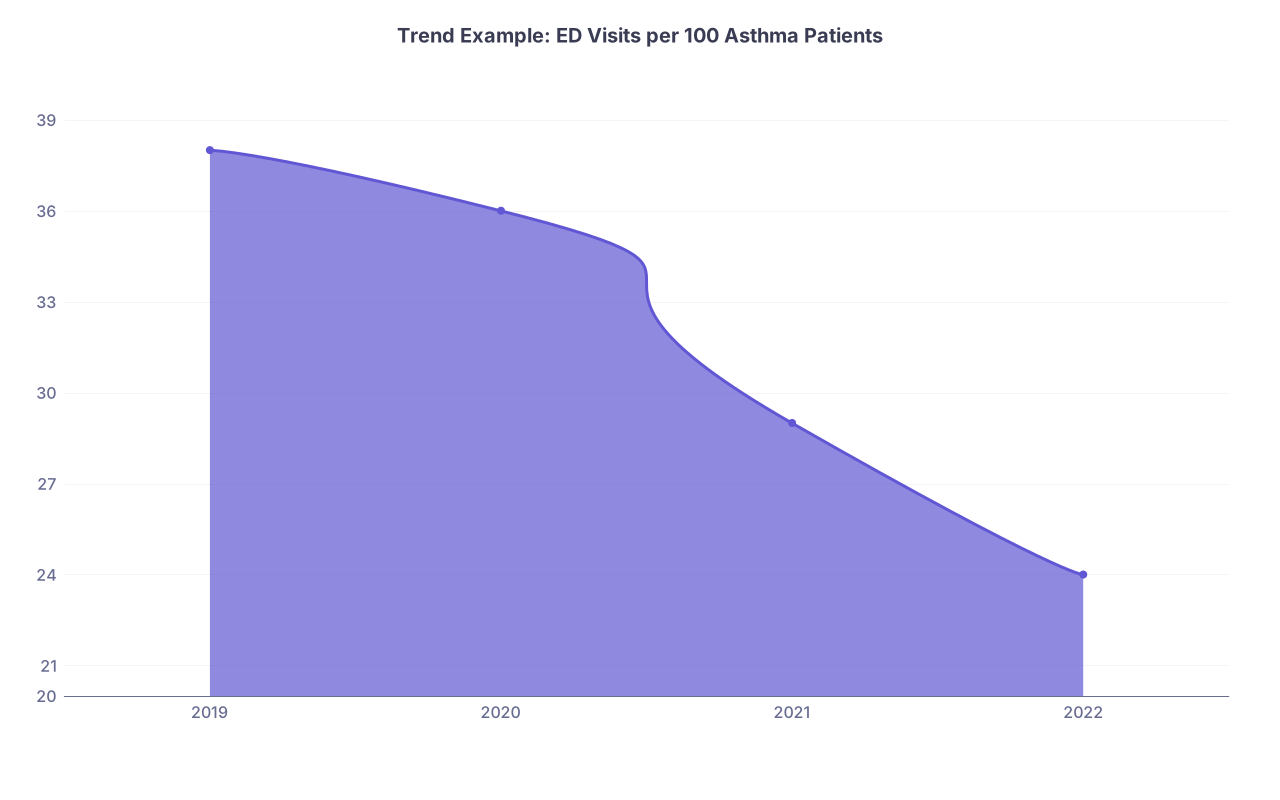
| Category | Value |
|---|---|
| 2019 | 38 |
| 2020 | 36 |
| 2021 | 29 |
| 2022 | 24 |
Then pick 3 bullets:
- Size of problem
- Impact of intervention
- Cost implication
Example:
- “In 2021, 1 in 4 of our heart failure patients were readmitted within 30 days.”
- “After adding two community health workers, readmissions dropped to 16% (≈80 fewer readmissions per year).”
- “This change avoids an estimated $720,000 in hospital costs annually, against a $250,000 program budget.”
If you feel tempted to add a fourth bullet, stop. Put extra details in an appendix if absolutely necessary or have them ready verbally.
Step 6: Write the one‑pager section by section
Now we actually write. Here is a template you can adapt, with commentary on each piece.
6.1 Title + Ask (top section)
You have two tasks: say what this is about and what you want.
Example:
Title:
“Reducing Avoidable Heart Failure Readmissions Through Community Health Workers”
Policy Ask (bold, one sentence):
“We request $250,000 in annual state Medicaid support to sustain and expand a clinic-based community health worker program that has reduced heart failure readmissions by one-third and generated net cost savings.”
If the ask is about regulation or a bill:
- “We urge support for [Bill Number], which will fund clinic-community partnerships to reduce avoidable hospitalizations for high-risk patients.”
Put this right under the title in bold or a shaded box. They should not have to dig.
6.2 Problem statement (5–7 lines)
You want one short paragraph, maybe two. Not a literature review.
Target structure:
- Identify who is affected and how.
- Quantify the burden (local data + external context).
- Link to system and ethical stakes.
Example:
“Adults with advanced heart failure in [County] experience frequent, avoidable hospital returns. In 2021, 24% of our heart failure patients were readmitted within 30 days of discharge, higher than the state average of 22%. These repeat stays are hard on patients and families, strain limited hospital capacity, and drive up costs for Medicaid and other payers. Many of these readmissions are tied to gaps in follow-up, medication access, and home support that are not addressed in the traditional medical model.”
Do not write a paragraph that starts with “Heart failure is a leading cause of morbidity and mortality worldwide…” They know. Get local, fast.
6.3 Key data (visual + bullets)
Drop in:
- A small bar/line chart
- 3 bullets as outlined above
Label the chart clearly with plain language.
“Figure 1. Thirty-day readmission rates for heart failure patients, 2019–2023”
Keep axes simple. No more than 4–5 data points.
6.4 Proposed solution (what exactly you want funded/changed)
Here is where many briefs fall apart. They say “We should do more care coordination.” That is not a policy action.
You need concrete, implementable components:
- Who does what
- For which patients
- At what scale
Example:
“We propose a clinic-based community health worker (CHW) program focused on adults with heart failure insured by Medicaid and Medicare. CHWs, recruited from local neighborhoods, will:
• Visit patients before discharge to review medications and warning signs
• Conduct home visits and phone follow-ups in the first 30 days
• Coordinate with pharmacy and primary care to resolve barriers to adherence
• Connect patients with transportation, nutrition, and housing resources
The program currently serves 150 patients annually at [Clinic Name]. With stable funding, we can expand to 300 high-risk patients per year across two additional clinics.”
That is specific enough that a budget person can picture line items.
6.5 Evidence of effectiveness (your data + external support)
One short paragraph for your local data (already partially shown above), plus 1–2 bullet references to external evidence.
Example:
“Since launching the CHW program in 2022, our clinic’s 30-day readmission rate for heart failure patients has fallen from 24% to 16%, translating to approximately 80 fewer hospital readmissions per year. This pattern is consistent with multiple studies showing that CHW-based transitional care reduces readmissions and total costs for high-risk patients.”
Then add a tiny, clean reference list at the bottom of the page or in a footnote:
- Kangovi S et al. Community Health Worker Support for Disadvantaged Patients. JAMA Intern Med. 2018.
- Balaban RB et al. Reducing Readmissions Through Transitional Care. J Gen Intern Med. 2015.
Do not paste full citation formats if they eat half the page. This is not PubMed.
6.6 Implementation and cost snapshot
You are not writing a grant. You are showing that:
- You have thought through execution.
- This is financially sane.
Example:
Implementation snapshot
- Staffing: 3 full-time community health workers + 0.2 FTE RN supervisor
- Caseload: 100–120 patients per CHW per year
- Timeline: Program is currently operating at one site; expansion to two additional clinics within 6 months of funding
Cost and savings
- Annual program cost: ≈$250,000 (salaries, benefits, supervision, training, and basic IT support).
- Estimated annual savings: $600,000–$800,000 in avoided readmissions and ED visits for high-risk patients, based on current performance and published cost estimates.
- Net impact: $350,000–$550,000 in net system savings annually, along with reduced patient hardship and more efficient hospital bed use.
This is where your credibility lives. Numbers that are obviously inflated or hand‑wavy will get quietly ignored.
6.7 Call to action + contact
End with one direct sentence and your contact block.
Examples:
- “We ask that the committee allocate $250,000 in the FY 2026 budget to sustain and expand this program across three clinics serving high-risk heart failure patients.”
- “We request that [Agency] include clinic-based CHW transitional care as a covered Medicaid service with a per-member per-month rate.”
Then:
“Contact:
[Your Name], MD, MPH
Medical Director, [Clinic Name]
Email: [email] | Phone: [number]”
Step 7: Ethical checks before you sign your name
You are not just selling a program. You are responsible for the integrity of what you present. A few hard lines I recommend:
No cherry‑picking.
If year 2 looked worse than year 1 and year 3, do not quietly drop it. Either show the whole series or be clear you are showing a subset.Be honest about limitations.
Use one short, plain sentence:- “These findings come from a single clinic and a relatively small sample, but they are consistent with larger studies.”
- “We cannot rule out other factors contributing to this decline, such as system‑wide discharge planning improvements.”
Avoid overclaiming causality.
Do not say “Our program caused a 33% reduction.” Say:- “The introduction of the program was associated with a 33% reduction, after a stable baseline for three years.”
Respect patient privacy.
No potentially identifying anecdotes unless:- They are de‑identified beyond recognition, or
- You have the patient’s explicit permission and you say so.
Equity lens.
If your intervention especially benefits disadvantaged groups, say it. But back it with a number:- “Reductions in readmissions were largest among patients in the lowest-income ZIP codes (from 28% to 17%).”

Ethically sound briefs are more persuasive long-term. People remember when numbers turn out to be smoke.
Step 8: Format like a grown‑up, not a lab report
Visual polish is not vanity. It is readability.
Basic rules:
- One full page, front only. If you truly must go over, 1.5 pages max.
- Generous margins. White space is your friend.
- Use headings, bold for key numbers, and short paragraphs.
- No font smaller than 11 pt. Policymakers are not squinting for your p-values.
- Use bullets, but not a bullet explosion.
Consider a simple two‑column layout:
- Left: text sections (problem, solution, implementation)
- Right: chart + key data box + cost snapshot

Consistent, clean formatting makes you look competent before they read a single word.
Step 9: Road‑test it with two fast audiences
Before you send it to anyone important, run two quick tests.
- Non‑clinical reader test (5 minutes)
Hand it to a smart non‑medical friend or colleague. Ask:- “What do you think this is asking for?”
- “What problem is it solving?”
- “What numbers stuck with you?”
If their answers do not match your intent, fix your title, ask, and problem statement.
- Hostile expert test (optional but powerful)
Ask a colleague who likes to poke holes:- “Where is this oversold?”
- “What number would you not trust if you were on the other side?”
Annoying feedback here saves you getting quietly dismissed in a policy meeting.
Step 10: Build a reusable template for your future self
Do this once properly, then stop reinventing the wheel. Create:
A one‑pager template with:
- Title + Ask box
- Problem section
- Data visual placeholder
- Solution, evidence, cost, and call to action sections
A “data translation cheat sheet” with:
- Common clinical outcomes you track
- Standard cost estimates you use (with sources)
- Usual comparators (local vs. state, pre vs. post)
Next time someone emails you, “Can you send a one‑pager on X by Friday?” you are not starting from scratch.

| Step | Description |
|---|---|
| Step 1 | Identify Policy Question |
| Step 2 | Select Outcomes and Comparator |
| Step 3 | Extract and Simplify Data |
| Step 4 | Fill Template Sections |
| Step 5 | Ethical and Accuracy Check |
| Step 6 | Non Clinical Review |
| Step 7 | Finalize and Send |
| Step 8 | Archive as Template |
Over time, you will have a small portfolio of solid, ethically grounded one‑pagers. That is political capital.
FAQs
1. How much clinical detail is “enough” for a policy one‑pager?
Enough to show that your numbers are real and your intervention is concrete, not enough to teach pathophysiology. That usually means: define the patient population in one line, name the primary outcome, and a sentence on how you collected the data (e.g., “Data come from our EHR for all heart failure discharges between Jan 2021 and Dec 2023”). Anything beyond that belongs in an appendix or a separate technical memo.
2. What if my data are messy or not statistically significant yet?
Be transparent and modest. You can still write a one‑pager if you frame it as “early practice-based evidence” backed by stronger external studies. Use language like “early signals suggest” and “results to date are consistent with…” and explicitly state your limitations. What you must not do is present noisy, underpowered findings as definitive proof. That crosses the ethical line.
3. Can I include a compelling patient story, or is that risky ethically?
You can, and sometimes you should, but do it carefully. De‑identify thoroughly or obtain explicit consent if the story is at all recognizable. Keep it to 2–3 sentences, and use it to illustrate—not replace—your data. For example, a short vignette in a sidebar about a patient avoiding a crisis because of the intervention, paired with aggregate numbers, is powerful and ethically acceptable when handled respectfully.
4. How do I handle disagreement between my clinical data and published evidence?
Face it head‑on. If your results are weaker than the literature, say so and propose plausible reasons (smaller scale, different population, shorter follow-up). If your results are stronger, emphasize that your setting may have particular advantages and that replication is needed. Policymakers respect candor. Pretending the discrepancy does not exist undermines both your credibility and the ethical standard you are supposed to uphold.
Key takeaways:
- Start with the policy question and specific decision you want, not with the data dump you have.
- Boil your clinical data down to a few decision‑grade numbers, translate them into plain language, and wrap them in a clean, ethical, one‑page structure.
- Test your one‑pager with non‑clinical eyes, guard your integrity on every number, and then save the template so the next one is twice as fast and twice as sharp.