
You are in a busy primary care clinic on a Tuesday afternoon.
You have been on hold with Medicaid for 27 minutes trying to get a prior authorization for a $12 inhaler. Your MA is behind because every new patient packet is missing a key form. The waiting room is full. The on-call doc last night admitted a patient with a blood pressure of 210/110 who had been “lost to follow-up” for 18 months because no one tracked failed outreach.
Everyone is grumbling. No one is changing anything.
Here is what you are up against: clinics are fantastic at identifying problems and terrible at converting them into concrete, actionable policy. People complain, send a few emails, maybe make a one-off workaround, and then… nothing. Six months later, you are still filling out the same stupid form three times.
You want to do better than complaining. You want to take a real clinic problem and turn it into a policy proposal that an administrator can say “yes” to.
This is how you do that. Step-by-step.
Step 1: Define the Problem So Precisely It Hurts
Most clinic “problems” are too vague to fix:
- “Our discharge process is terrible.”
- “Follow-up is a mess.”
- “Patients keep missing colonoscopies.”
None of those are policy-ready. They are venting.
You need a problem statement that:
- Names the setting and population.
- Specifies the failure.
- States the consequence.
Use this template:
“In [setting], for [who], [what is going wrong] resulting in [measurable or observable harm].”
Examples:
- “In our resident continuity clinic, for patients with diabetes, hemoglobin A1c results are not reliably reviewed within 7 days of posting, resulting in delayed treatment changes and avoidable ED visits for hyperglycemia.”
- “In our pediatric clinic, for children needing vaccines, lack of standardized reminder and recall leads to missed immunization opportunities and low completion rates by age two.”
Now pressure-test it:
- Can someone unfamiliar with your clinic read this and understand what is broken?
- Does it imply something that might actually be fixable with a policy (process, rules, responsibilities, documentation, workflows)?
- Is it focused enough that you can measure before and after?
If you cannot answer yes to all three, you are still at “rant,” not “proposal.”
Step 2: Gather Just Enough Data to Be Dangerous
You do not need a randomized trial. But you do need numbers.
Aim for 1–3 simple metrics that clarify:
- Scope (how big is the problem?)
- Impact (how bad is it?)
- Variation (is this random or systemic?)
Pick measurements that can be pulled in an afternoon, not a semester.
Examples for common clinic issues:
- Missed follow-up:
- % of patients with an abnormal lab result who have no documented outreach within 7 days.
- Average time from lab posting to first outreach attempt.
- Medication safety:
- Number of refill requests per week for meds without recent labs.
- % of refills approved without current monitoring labs.
- Access issues:
- % of new patient referrals scheduled beyond your clinic’s target (say, >30 days).
- No-show rate by appointment type.
If you can, grab 2–4 weeks of data. Enough to show a pattern.
Then make it visual and simple.
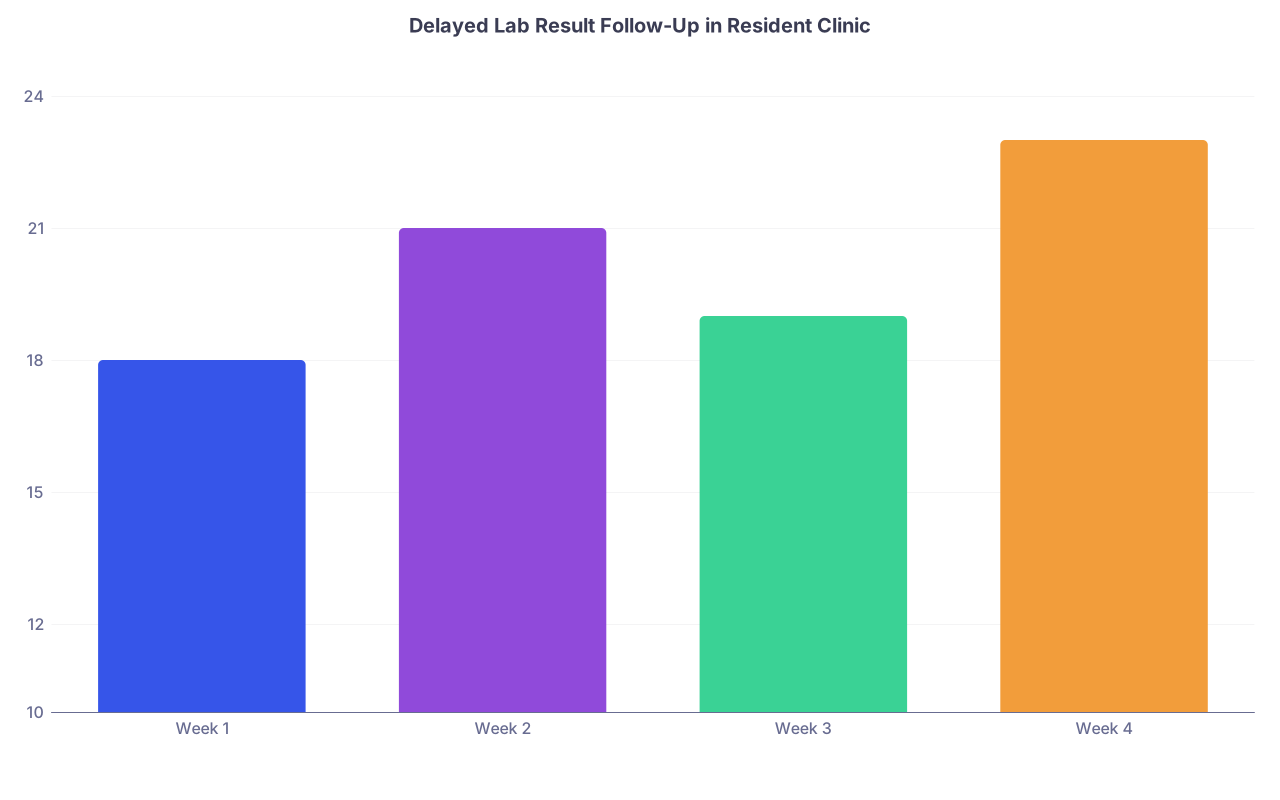
| Category | Value |
|---|---|
| Week 1 | 18 |
| Week 2 | 21 |
| Week 3 | 19 |
| Week 4 | 23 |
Example interpretation: “Across four weeks, we averaged about 20 lab results per week that went more than 7 days without any documented follow-up.”
That sentence is far more persuasive than “we are pretty bad at follow-up.”
Do not overcomplicate this. One decent bar chart with clean numbers beats a mess of half-finished data pulls.
Step 3: Map the Current Process (Where It Actually Breaks)
You cannot write policy for a process you do not understand. That is how you create rules nobody follows.
You need a rough, honest process map. Real workflow, not “ideal” workflow.
Grab two or three people who actually do the work:
- One MA or nurse,
- One front desk staff,
- One clinician.
Then sketch the steps and decisions on a whiteboard:
- “Lab is ordered.”
- “Patient completes lab.”
- “Result posts to EHR.”
- “Result is routed to who?”
- “What happens if they are on vacation?”
- “Who actually calls the patient?”
- “What if phone number is wrong?”
Capture reality, not policy fiction.
Here is a simple example using a flowchart for abnormal lab results.

| Step | Description |
|---|---|
| Step 1 | Lab ordered |
| Step 2 | Patient completes lab |
| Step 3 | Result posts in EHR |
| Step 4 | Auto route to ordering clinician |
| Step 5 | Clinician documents plan |
| Step 6 | Staff calls patient |
| Step 7 | Plan left in chart |
| Step 8 | Result sits in inbox |
| Step 9 | No outreach to patient |
| Step 10 | Clinician sees result? |
| Step 11 | Staff available to call patient? |
You are looking for:
- Steps with no assigned owner (“Somebody” is responsible = nobody is responsible.)
- Decision points with no rule (“Sometimes I call them, sometimes I wait until next visit.”)
- Failure points that recur (“If Dr. Smith is off on Fridays, labs from Thursday are often delayed.”)
From this map, rewrite your problem statement in process terms:
“Abnormal lab results rely on individual clinicians checking EHR inboxes, with no backup coverage or time standard, resulting in an average of 20 delayed follow-ups per week.”
Now you are ready to talk policy, because you see where a rule or standardized process would help.
Step 4: Translate Ethical Discomfort into Policy Objectives
Public health policy lives at the intersection of ethics and operations. If you skip the ethics, you sound like a bureaucrat. If you skip the operations, you sound naive.
You need both.
Ask yourself three questions:
Which ethical principles are being violated or stressed?
- Beneficence: Are we failing to provide timely, effective care?
- Nonmaleficence: Are patients being exposed to avoidable harm?
- Justice: Are certain groups disproportionately affected?
- Autonomy: Are people not given a real chance to understand and act?
Who is most harmed by the current process?
- Your “frequent flyers”? Non-English speakers? Uninsured? Those without stable housing?
What does “good” look like ethically and operationally?
- Not fantasy. A reasonable ethical standard you can implement this year.
Example – abnormal labs again:
- Ethical problem: We are exposing patients to preventable harm (nonmaleficence) and failing to provide timely benefit (beneficence) because our system allows critical results to be missed when clinicians are overburdened or off-clinic.
- Potential justice angle: Delayed follow-up might hit patients without portal access harder, because they rely entirely on phone outreach.
Then convert that into 2–3 policy objectives. Objectives are the “why,” not the “how.”
Example objectives:
- Ensure all abnormal lab results are reviewed and acted on within 3 business days.
- Standardize responsibility and backup coverage for result review.
- Reduce disparities in result communication for patients without digital access.
Those objectives become the spine of your policy proposal.
Step 5: Design a Concrete Policy Intervention
Now you move from “what should be true” to “what we are going to do differently on Monday.”
A policy proposal needs clear answers to five things:
- Scope – Where and to whom does this apply?
- Ownership – Who is responsible?
- Process – What exactly happens, step-by-step?
- Exceptions – When does it not apply?
- Measurement – How will we know if it works?
If you cannot write down those five, you do not have a policy. You have a hope.
Let’s keep working with the abnormal lab result example. Here is a structured proposal.
5.1 Define scope and ownership
- Scope: All adult primary care patients seen in the resident clinic with lab tests ordered during clinic visits.
- Ownership:
- Ordering clinician: primary responsible party for result review and plan.
- Clinic “result nurse” (or designated MA): responsible for executing communication plan and documenting patient contact.
- On-call backup clinician: responsible when ordering clinician is off-service for >3 days.
5.2 Specify the process changes
Convert your messy current map into a tight, rule-based process.
Example new workflow:
- Lab posts to EHR.
- EHR routes result to ordering clinician and “result nurse” pool.
- Ordering clinician must:
- Review the result within 2 business days.
- Categorize: routine, abnormal but non-urgent, abnormal and urgent.
- Document plan in a standardized template (like “Result Plan” smart phrase).
- “Result nurse” must:
- For urgent or abnormal results: call patient within 1 business day of plan documentation.
- For routine results: send portal message or letter within 5 business days.
- Document successful contact or three failed attempts.
Add backup rules:
- If ordering clinician has not reviewed result within 3 business days:
- EHR auto-routes result to on-call backup clinician for that week.
- Backup clinician must review and act within 1 business day.
This is concrete enough to implement and audit.
5.3 Plan for exceptions
You need to acknowledge where this does not neatly apply:
- External labs uploaded as scanned documents: timeline begins when document is uploaded, not when lab was drawn.
- Patients without working phone number or portal access: after three attempts, a letter is mailed and flagged in chart.
State exceptions clearly in one section. Administrators and risk management people love this, because it shows you have actually thought about real-world messiness.
5.4 Decide what to measure
Keep metrics small and brutal:
- Process metrics:
- % of abnormal lab results reviewed within 3 business days.
- % of those results with documented patient contact attempts.
- Outcome proxy:
- Number of ED visits in 30 days after an abnormal lab result, pre vs post policy.
- Or simpler: reduction in weekly count of delayed follow-ups (>7 days), like your original bar chart.
Plan for baseline (before policy) and at least one follow-up time point (e.g., 3 months after implementation).
Step 6: Build a One-Page, Administrator-Ready Proposal
You are not writing a thesis. Most committees will seriously review a 1–2 page memo. They will skim or ignore anything longer.
Structure it like this:
Title – Clear and specific
- “Policy Proposal: Standardized Lab Result Follow-Up in Adult Primary Care Clinic”
Problem and Evidence (4–6 sentences)
- One paragraph with your problem statement and key data:
- “Over a 4-week review of resident clinic, we found an average of 20 lab results per week with no documented follow-up within 7 days. These included clinically significant abnormalities (e.g., A1c > 10%, potassium > 5.5). This creates avoidable risk of harm and medicolegal exposure.”
- One paragraph with your problem statement and key data:
Ethical and Operational Rationale (3–4 sentences)
- Explicitly tie to clinic mission, patient safety, and equity:
- “The current ad hoc system violates basic expectations of beneficence and nonmaleficence. Patients without portal access or reliable phones are especially vulnerable, since they depend entirely on proactive clinic outreach. A clear policy will standardize responsibilities and reduce preventable harm.”
- Explicitly tie to clinic mission, patient safety, and equity:
Policy Objectives (bulleted, 3–4 max)
- Measurable and time-bound where possible.
Proposed Policy (short numbered list of steps)
- Boil your workflow down to 6–10 bullet points / steps. Avoid prose walls.
- Include explicit assignment: “Ordering clinician must…,” “Result nurse will…,” “On-call backup will…”
Implementation Plan (who/when/resources)
- Who approves.
- Who trains staff and when.
- EHR build needs (routing changes, new template, simple report).
- Start date and first review date.
Evaluation Plan (metrics and follow-up)
- List 2–3 metrics, baseline source, and who will review them.
You can support this with an appendix or slide if someone asks for details. But most of the time, the decision-makers want a clear, short, implementable policy.
To make this really concrete, here is a simple comparison.
| Element | Weak Version | Strong Version |
|---|---|---|
| Problem | "Follow-up is bad" | "20 delayed lab follow-ups/week over 4 weeks" |
| Ownership | "The team handles it" | "Ordering clinician + result nurse + backup" |
| Ethics | "This is not ideal" | "Violates beneficence and increases avoidable risk" |
| Process | "We will try to call patients" | "3 calls in 3 days; then letter; all documented" |
| Metrics | "We will monitor" | "% reviewed in 3 days; % with documented outreach" |
Step 7: Pressure-Test with Frontline Staff Before You Sell It
Do not walk straight to the CMO with a policy that your MA will quietly sabotage because it triples their workload.
You need a “pre-mortem” with the people who will live with this.
Grab:
- 1–2 clinicians (ideally including a skeptic)
- 1 nurse or MA
- 1 front desk or scheduler if the policy affects them.
Ask three blunt questions:
- Where will this break down in real life?
- What part of this is unrealistic or confusing?
- What tiny change would make this easier to follow?
Concrete examples I have seen:
- Nurses pointing out, “We already have three different call logs. Add one more and it will not be used.”
- Front desk staff noting, “If you require us to confirm phone numbers every visit, you need to give us a 30-second script and a checkbox, not a free-text field.”
Be ruthless but specific in revisions:
- Remove steps that add complexity but no clear benefit.
- Reduce duplication: if documentation already lives in one place, do not create a second.
- Clarify ambiguous language: “as soon as possible” becomes “within 3 business days.”
This step prevents the classic “top-down policy no one follows” failure.
Step 8: Align With Organizational Priorities and Pitch It
You can have the most elegantly ethical, data-backed policy proposal in the world. If it does not align with something your organization publicly cares about, it will sit in someone’s inbox.
You need to explicitly link your proposal to:
- Quality metrics the clinic already tracks (e.g., HEDIS measures, readmissions, chronic disease control).
- Accreditation requirements (e.g., Joint Commission for result follow-up; PCMH standards).
- Risk management concerns (reducing missed abnormal results is catnip for legal/risk people).
- Equity goals (if applicable and genuine, not performative).
Example framing for a pitch:
- “This policy directly supports our Patient Safety initiative and decreases medicolegal risk from missed critical results.”
- “Our ACO contract includes a metric for diabetes control; timely result follow-up is a lever we are currently wasting.”
- “Our health equity plan mentions digital divide; this proposal ensures patients without portal access are not systematically disadvantaged.”
When you present (in a meeting or via email), keep the actual “ask” simple:
- “Approval to implement this policy in the adult resident clinic starting July 1.”
- “EHR support from IT to create a result routing rule and documentation template.”
- “Permission to pilot this in one clinic for 3 months before system-wide scale.”
Attach your 1–2 page proposal. Offer to report back with 2–3 metrics at a specific date.
Step 9: Run a Pilot, Then Lock It Into Formal Policy
Never push for system-wide adoption on day one. That is how you create large-scale, large-impact failures.
Do a pilot.
9.1 Pilot design basics
- Duration: 2–3 months is enough for most clinic process changes.
- Scope: One clinic pod, one service, or one subset (e.g., resident clinic only).
- Training: 15–30 minute focused session with a one-page quick-reference.
- Support: One person (maybe you) acts as point person for questions.
During the pilot:
- Collect your pre-defined metrics weekly or biweekly.
- Gather informal feedback: is this adding clicks, delaying visits, causing confusion?
You can visualize pilot outcomes like this:
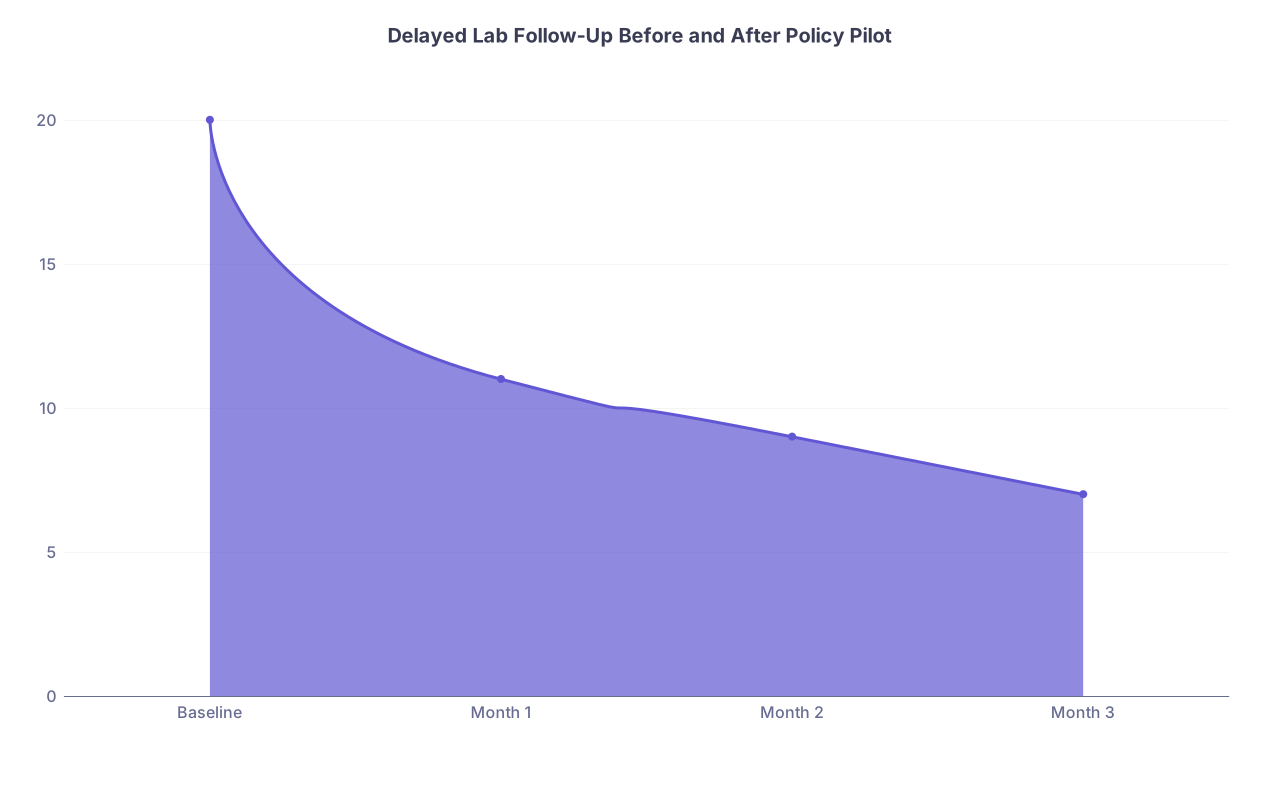
| Category | Value |
|---|---|
| Baseline | 20 |
| Month 1 | 11 |
| Month 2 | 9 |
| Month 3 | 7 |
That chart says more than a page of text: “We cut delayed follow-ups by ~65% over 3 months.”
9.2 Formalize and spread
If the pilot works reasonably well:
- Incorporate minor tweaks from feedback.
- Write the policy into the official clinic manual or institutional policy repository.
- Ask for:
- Formal adoption by the relevant committee (Quality, Safety, Clinical Operations).
- Inclusion in onboarding materials for new staff and residents.
- Periodic audit built into existing quality review processes.
If the pilot fails or performs modestly:
- Do not hide it. Explain what you learned.
- Preserve the data. Sometimes a “failed” pilot shows where the real leverage point is (for example, that you need an auto-text for patient calls more than you need a new routing rule).
Step 10: Turn This Into a Personal Skillset, Not a One-Off Project
You are not just fixing one clinic problem. You are building a professional capability in health policy and medical ethics.
Here is the pattern you just walked through:
- Name the problem precisely.
- Get minimal viable data.
- Map the real process.
- Clarify the ethical stakes.
- Define objectives.
- Design concrete, workflow-compatible policy.
- Pressure-test with frontline staff.
- Align with institutional priorities.
- Pilot, measure, and refine.
- Institutionalize and repeat.
Apply that same sequence to other issues:
- Unsafe opioid refill practices.
- No consistent screening for social determinants of health.
- Poor communication with interpreters.
- Chaotic handoffs between inpatient and outpatient.
You do not need a public health degree to start doing public health policy. You need the discipline to move from “this is bad” to “here is a proposal you can approve this quarter.”
FAQ (Exactly 3 Questions)
1. Do I need IRB approval or formal research protocols to collect data for a policy proposal?
Generally no, not if you are doing routine quality improvement using data your clinic already collects and you are not planning to publish in a research journal. Most institutions treat QI differently from research. That said, check your local QI/IRB policy or ask your quality office. A one-line email (“I plan to look at four weeks of lab follow-up data to support a clinic policy proposal. Does this require IRB review?”) usually gets a quick “no” and covers you.
2. What if leadership is not interested, even with data and a clear proposal?
Then you tighten your alignment with their priorities. If they care about readmissions, show how your policy touches readmissions. If they care about accreditation, connect your proposal to explicit standards. Or shrink the scope: implement as a micro-policy within your own team or one attending’s panel. Success in a small pocket can create leverage. Worst case, you learn how to structure and run change efforts, which you can take somewhere more functional.
3. How do I balance ethical ideals with limited resources and burnout?
You pick battles that are high-yield and realistic. “End all health disparities” is not a policy. “Ensure all abnormal results are reviewed within 3 days using existing staff and one EHR tweak” is. Ethically, your goal is to reduce preventable harm and unfairness under real constraints, not to achieve perfection. If your proposal demands heroics from already exhausted staff, it will die. Build policies that replace chaos with clarity, not that add more work layered on top of chaos.
Key points: First, make the problem painfully specific and back it with simple data. Second, design a concrete, ethically grounded policy that fits real workflows and assign clear ownership. Third, pilot small, measure honestly, and then lock it into formal policy once it proves itself.