
Most “policy” scholarly projects are invisible because they are built backwards. Students start with an abstract idea and a Word document, not with a real problem and a real decision-maker. You want visibility? Start where policy actually lives: power, money, and implementation.
Let me walk you through how to build a policy-focused project that:
- Solves a concrete problem that someone with authority cares about
- Produces a clean, citable product (brief, tool, or protocol)
- Positions you as “the policy person” on your team, not just “the student who did a project”
You do not need to be in DC, have an MPH, or join ten committees. You do need a ruthless focus on:
- the right problem,
- the right stakeholder, and
- the right product.
Step 1: Stop “Brainstorming Topics” and Start Hunting for Problems
If you sit at your desk and try to “think of a policy topic,” you will end up with something vague and forgettable. Policy projects should start where there is friction: delays, waste, harm, or moral distress.
Where to find real, high-yield problems
Spend 2–3 weeks doing reconnaissance instead of forcing a topic. You are looking for situations where:
- People keep saying: “This is ridiculous,” “There must be a better way,” or “Our hands are tied because of X rule.”
- There is obvious misalignment between policy and practice: e.g., discharge policies that contradict social reality, insurance rules that block evidence-based care, public health guidance that nobody on the ground is following.
Concrete hunting grounds:
Hospital / clinic operations
- Discharge delays because of prior authorization rules
- Conflicting isolation policies between infection control and administration
- Readmission penalties versus underfunded transition-of-care programs
Community and public health systems
- Local health department protocols for outbreaks that nobody understands
- School vaccination or mental health policies that clinicians are constantly working around
- Housing, harm-reduction, or food-security programs with huge waitlists and clunky eligibility criteria
Medical ethics and moral distress
- Policies around DNR/DNI, guardianship, or involuntary treatment that leave staff and families angry or confused
- Triage rules during high census or disasters
- Reporting policies (child abuse, intimate partner violence, substance use in pregnancy) that feel misaligned with patient welfare
Here is the test: if you present your “topic” and no one gets animated, drop it. You want people to immediately say, “Oh, that problem. Yes, that’s a mess.”
Step 2: Attach Yourself to a Real Decision-Maker Early
This is the biggest mistake I see: students design a project in isolation, then at the end go hunting for someone to “implement” it. That is backwards. If there is nobody with authority who wants your work, it will die as a PDF in a repository.
You need a sponsor and a user.
- Sponsor – someone who can open doors, send emails, and put your work in front of the right people (program director, department chair, chief medical officer, director of quality, local health officer).
- User – the person or group who would actually use your final product (clinic manager, infection control committee, city health policy unit, school district health coordinator, harm reduction program manager).
Sometimes it is the same person. Usually it is not.
How to find them (and what to say)
You are not asking for a lifelong mentorship. You are offering free, structured labor on a painful problem.
Send a short email like this:
Subject: Quick question about X policy challenge
Dear Dr. ___,
I am a [MS3 / resident / fellow] on [service/program]. I keep seeing [very concrete problem] related to [specific policy or process].
I am required to complete a scholarly project this year and would like to focus on a product that could actually help [your clinic/department/agency] address this. Specifically, I am interested in:
– mapping what the current policy requires,
– analyzing gaps between policy and practice, and
– drafting a concise policy brief or implementation tool you could use.Would you have 20 minutes for a quick meeting to see if this aligns with any current priorities?
Best,
[Name]
You are doing three things here:
- Naming a problem they recognize.
- Explicitly aligning your requirement (project) with their priorities.
- Offering a deliverable they can use (brief or tool).
If they say no, perfect. Move on. You only want sponsors who actually care.
Step 3: Nail the Scope: One Decision, Not World Peace
Most early policy projects are fatally over-scoped. “Improve health equity” is not a project. “Change statewide prior authorization rules” is not a realistic student deliverable.
You want to define the project in terms of one decision you want to inform.
Examples of good, tight scopes:
- Should our county revise its heat emergency response protocol to include proactive outreach to unhoused individuals?
- Should this hospital change its default consult policy for involuntary psychiatric holds?
- Should this clinic formalize a standing order and reimbursement strategy for HIV PrEP initiation in walk-in visits?
- Should this residency program adopt an institutional policy limiting resident work in settings with unsafe abortion bans without legal protections?
If your research question cannot be phrased as “Should X organization do Y differently?” you are still being too vague.
Step 4: Build a Policy Project Blueprint (Before You Touch the Literature)
This is your one-page game plan. If you cannot write this page, you are not ready to start. Here is the structure:
Problem statement (3–4 sentences)
- Who is hurt by the current situation?
- What policy or rule is at the center?
- What is the practical consequence (delayed care, worse outcomes, moral distress, wasted money)?
Decision to be informed
- “This project will inform whether [entity] should [adopt/revise/abolish] [policy X] regarding [population/situation].”
Key stakeholders
- Decision-makers: who can actually change the policy?
- Implementers: who has to live with whatever gets decided?
- Affected groups: patients, community members, staff.
Data sources
- Policy texts, guidelines, statutes, payer policies
- Local quantitative data (EHR pulls, dashboards, quality metrics, cost data)
- Qualitative data (interviews, focus groups, short surveys)
Deliverable
- Policy brief, draft protocol, implementation tool, training module, decision aid, or a combination.
Timeline
- 2–3 months: Analysis and drafting
- 1 month: Feedback from stakeholders
- 1 month: Revision and dissemination
Here is what that looks like compared side-by-side for two typical project types:
| Element | Hospital Readmission Policy Project | Community Heat Emergency Policy Project |
|---|---|---|
| Decision | Change readmission follow-up policy | Revise county heat emergency protocol |
| Data | EHR readmissions, payer rules, interviews | EMS call data, weather alerts, shelter usage |
| Stakeholders | Hospital admin, case managers, payers | Health dept, shelters, outreach teams |
| Deliverable | Policy brief + discharge protocol checklist | Policy brief + outreach algorithm |
Get this blueprint reviewed by your sponsor and user. Lock it in. Then go.
Step 5: Do Policy Analysis Like a Professional, Not a Student
You are not writing a generic literature review. You are doing policy analysis. That means you should answer four brutally practical questions:
- What are the current rules?
- What actually happens on the ground?
- What are the harms, benefits, and tradeoffs of changing the rules?
- What options exist, and which one is best for this specific context?
A simple, effective analytic framework
You do not need a complex model. Use a stripped-down version of standard policy analysis:
Define the problem clearly and measurably
- “Current policy X leads to Y undesirable outcome,” with numbers and examples where possible.
Describe current policy environment
- Laws, regulations, institutional policies, payer rules
- Existing guidelines (CDC, WHO, professional societies)
Map practice vs policy
- How is care actually delivered?
- Where do people work around the policy?
- Where do they simply ignore it?
Develop 2–4 concrete policy options
- Status quo
- Minimal change (tweak wording or workflow)
- Moderate change (new policy or protocol)
- Major change (structural shift, new program, or advocacy to higher-level body)
Compare options using 4–5 criteria
- Effectiveness (Will it fix the problem?)
- Feasibility (Can this place actually do it this year?)
- Equity (Who wins, who loses, who is ignored?)
- Cost (Not a full economic analysis; just major cost implications.)
- Political acceptability (Who will fight this tooth and nail?)
You can use a simple scoring matrix and show it in your final brief. Decision-makers like seeing that you did not just pick your favorite idea.
Step 6: Get the Right Data Without Drowning in It
Most trainees either drown in data collection or collect nothing usable. You want just enough to show the problem is real and to evaluate your options.
Your core data types
Policy and document review
- Institutional policies, protocols, consent forms
- Local/state/federal laws, regulations
- Professional guidelines, insurer coverage criteria
Create a quick extraction table: policy name, year, key provisions, enforcement mechanism, and any ambiguity you notice.
Local quantitative data
- Pull only what maps directly to your problem statement.
- Examples:
- Number of ED visits related to heat illness in unhoused patients
- Time from decision to discharge to actual discharge when waiting for prior auth
- Rate of involuntary holds overturned by psychiatry or courts
Qualitative voices
- 5–15 semi-structured interviews with high-yield people: a nurse, a social worker, a resident, an attending, a patient advocate, a community worker, a case manager.
- One or two focused groups if feasible.
You are not doing full grounded theory. You are looking for patterns: specific bottlenecks, conflicting incentives, and unintended consequences of current policy.
Record clean, verbatim quotes (de-identified). You will use a few of these in your final product. They make decision-makers pay attention.
Step 7: Design a Deliverable That Busy People Will Actually Read
If your “project” is a 40-page manuscript no one asked for, it will not be noticed. You need a front-facing product optimized for real-world use, plus academically acceptable packaging around it (for CVs, posters, papers).
Core product: A policy brief or implementation tool
Aim for:
- 2–4 pages max for the brief
- Highly skimmable: headings, subheadings, short paragraphs, bullet lists
- Professional but simple visuals: one table, one flowchart, maybe one figure
Structure of a strong policy brief:
Title – specific and outcome-focused
- “Reducing Psychiatric Boarding Times: Revising Involuntary Hold Policies at [Hospital]”
Executive summary (1 paragraph)
- The problem
- Why it matters now
- Your top-line recommendation
Background and problem description (½–1 page)
- Key stats and one short case vignette
- 2–3 sentences on current policy and its origin
Analysis of options (1–1.5 pages)
- Brief description of each policy option
- Simple comparison table on the 4–5 criteria
- A few short, direct quotes from front-line staff or affected individuals
Recommendation and implementation steps (½–1 page)
- One clear recommended option
- 3–7 concrete implementation steps
- Suggested metrics for tracking success
This is where many projects fail: they stop at “what should be done” and never say “here is exactly how to start doing it Monday.”
Implementation tool examples
Depending on your project, create one of these:
- A concise protocol or checklist
- A decision tree for clinicians or outreach workers
- A standardized referral or documentation template
- A one-page summary for patients or community partners
- A simple dashboard concept or metric set (even just mocked up)
Use this kind of process map to help yourself design workable steps:

| Step | Description |
|---|---|
| Step 1 | Identify policy issue |
| Step 2 | Draft proposed change |
| Step 3 | Review with stakeholders |
| Step 4 | Create tools and training |
| Step 5 | Pilot on one unit/site |
| Step 6 | Collect feedback and metrics |
| Step 7 | Scale to full implementation |
| Step 8 | Approved? |
| Step 9 | Revise needed? |
You do not need to implement the whole flow. But your project should plug into this kind of reality.
Step 8: Build Visibility Into the Project From Day One
If you want your policy project to get noticed, you cannot treat dissemination as an afterthought. You need a dissemination plan baked into the blueprint.
Internal visibility (inside your institution or local system)
Set specific targets:
Present to at least one decision-making body:
- Hospital quality committee
- Ethics committee
- Department grand rounds
- Local public health board
- School board or community coalition
Translate your brief into slide format:
- 6–10 slides max
- Problem, data, options, recommendation, implementation
Offer a 15–20 minute mini-workshop:
- Particularly if your deliverable is a tool or protocol
- Walk staff through using it with a concrete example
These are not “nice to have.” They are the difference between a project people cite and a project no one remembers.
External visibility (beyond your building)
Think in layers:
Scholarly presentation
- Abstract to a public health, health policy, ethics, or specialty conference (APHA, AcademyHealth, SGIM, ACP, specialty-specific meetings).
- Poster or short oral. The key is to get your name attached to the niche.
Publication or repository
- Methods and analysis as a traditional paper (if the data are solid enough).
- Or short “policy forum” / “perspective” style piece with the brief as a supplemental file.
- If that is too heavy, put it in an institutional repository with a clean citation.
Policy and practice channels
- Offer the brief to local professional societies.
- Collaborate with your health department or community organizations to host it on their website.
- If your institution has a government relations or policy office, get it in their hands.
To understand where you should focus effort, map the time you have against your goals:
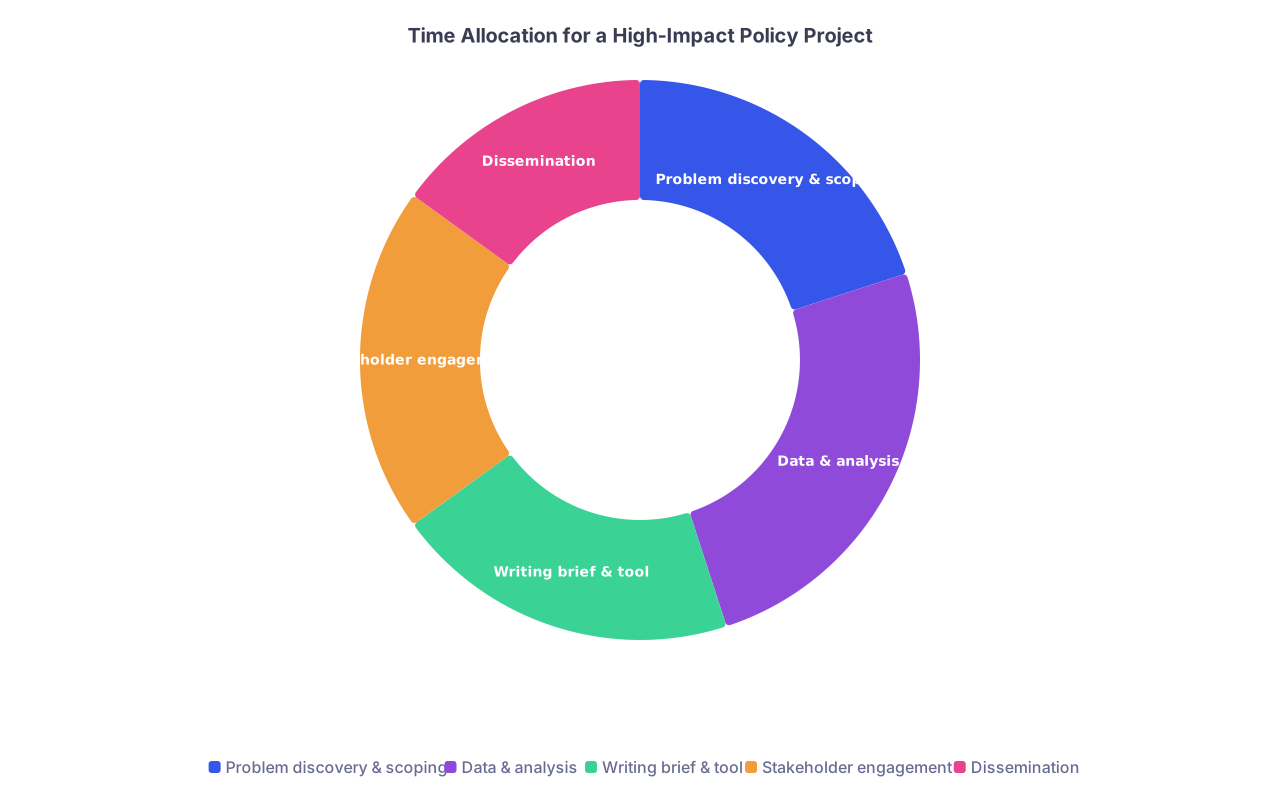
| Category | Value |
|---|---|
| Problem discovery & scoping | 20 |
| Data & analysis | 25 |
| Writing brief & tool | 20 |
| Stakeholder engagement | 20 |
| Dissemination | 15 |
If you spend 80–90% of your time on data and writing and almost nothing on stakeholder engagement and dissemination, do not be surprised when the project disappears.
Step 9: Handle the Ethics and Politics Like a Grown-Up
You are operating in the “Personal Development and Medical Ethics” lane. That is not decoration. Policy projects are full of ethical landmines.
Common ethical traps (and how to avoid them)
Speaking for people you have not actually listened to
- If your policy affects marginalized or heavily impacted groups (unhoused people, people who use drugs, undocumented patients, disabled people), you need their voices in the project.
- That can be through interviews, partnership with community organizations, or co-authorship with advocates. Not just literature citations.
Ignoring conflicts of interest
- If a policy change could hurt someone’s revenue, power, or workload, expect resistance.
- Name these interests clearly in your analysis. It will make your recommendations more credible.
Confusing “technically legal” with ethically acceptable
- Many harmful policies are fully legal. Document the ethical tension explicitly: autonomy, justice, beneficence, nonmaleficence, professional integrity.
- Frame your argument in both legal and ethical terms. Decision-makers pay attention when ethics committees and risk management see the same problem.
Data privacy and confidentiality
- Treat every piece of local data like it will be FOIA’d or leaked.
- De-identify aggressively. Strip any details that could identify individual patients, staff members, or small subgroups.
- Coordinate with your IRB or quality office. Many policy projects are QI, not research, but do not guess. Ask.
Build an ethics paragraph into your brief
Not a token sentence. A short section that answers:
- Who is most affected by the current policy?
- Who is most affected by the proposed change?
- How does this intersect with equity and justice?
- What ethical tradeoffs are you openly acknowledging?
You will be miles ahead of the usual “equity mention” that shows up only in the conclusion.
Step 10: Convert the Project into Career Capital, Not Just a Checkbox
A good policy-focused scholarly project is not just a graduation requirement. It is the anchor for your narrative as a future clinician, public health leader, or ethics person.
Here is how to turn one project into a visible footprint:
1. Package your outputs
You should end the project with:
- 1–2 page policy brief (PDF)
- Implementation tool or protocol (PDF or editable format)
- Slide deck for talks (10 slides max)
- Clean abstract (~300 words) suitable for submissions
- A 2–3 sentence “policy tagline” for your CV and bios
Example tagline:
Led development of a policy brief and clinical protocol to reduce psychiatric boarding times by revising involuntary hold policies at an academic medical center; presented to hospital ethics committee and submitted to [conference].
2. Put it where people can see it
- CV: Create a “Policy and Advocacy Projects” or “Health Policy Scholarship” section.
- Application materials: Use it as the anchor example when programs ask, “Tell me about a project that changed how you think about medicine/public health.”
- Interviews: Be ready with the 90-second version:
- The problem
- What you did
- What changed (or what is likely to change because of the work)
3. Stay attached to the follow-through
Even if you graduate or rotate away:
- Ask to be looped into updates about implementation.
- Offer to help with evaluation metrics or a follow-up brief.
- If the project starts to influence policy beyond your institution, piggyback on that for subsequent abstracts or short communications.
The people who become “known” in health policy did not necessarily do bigger projects. They did repeatable, coherent work in the same direction and kept attaching themselves to implementation.
Where People Blow It – And How You Will Not
Let me be blunt about the three most common failure modes I have seen in dozens of med student and resident policy projects:
The aim is fuzzy
- Fix: One decision, one primary stakeholder, one key recommendation.
No real user
- Fix: Identify the person or group that will use your product in week one. Design with them, not for them.
Zero implementation thinking
- Fix: Include a concrete “first 90 days” plan and basic metrics in your brief. Make it almost harder not to try your recommendation.
Get those three right, and you are already in the top 10% of projects.
Final Tight Summary
Three key points to walk away with:
- Start with a painful, real-world problem and a real decision-maker, not a generic “policy topic.”
- Build a sharp, decision-focused analysis and a short, useable product (policy brief + tool) that fits into actual workflows.
- Design visibility and ethics into the project from day one so it becomes career capital and not just another forgotten scholarly requirement.