
The biggest mistake people make in local health advocacy is trying to “raise awareness” instead of building a coalition. Awareness does not move policy. Coalitions do.
You want to fix something real: asthma in your neighborhood, a food desert, overdose deaths around your clinic, unsafe housing, no mental health access in your school district. You do not need a 50-organization “task force” that produces glossy PDFs and no change. You need a small, disciplined, and powerful coalition.
Here is exactly how to build it.
1. Start Ruthlessly Small: Define the Problem and the Win
If your issue is fuzzy, your coalition will be weak. People do not mobilize around vibes. They mobilize around specific harm and a clear target.
Step 1: Write a one-sentence problem
Make it concrete, local, and measurable:
- Bad: “Health disparities in our city.”
- Better: “Children in ZIP code 19133 are being hospitalized for asthma at 3x the city rate because of mold- and pest-infested rental housing.”
You should be able to say this sentence out loud to a busy nurse, a parent, or a city council staffer and have them immediately get it.
If you have no data yet, use what you have:
- Clinic EHR snapshots
- County health department dashboards
- School nurse reports
- EMS call patterns
- Even “in the last month I have admitted X patients with Y problem, all from the same area”
You can refine later. Start specific.
Step 2: Define a winnable policy or practice change
Your coalition is not “against obesity” or “for equity.” It is for a concrete change within 6–24 months.
Examples that actually move:
- “Get the city council to pass and fund proactive rental housing inspections in the three highest-asthma census tracts.”
- “Get the school district to adopt and implement a no-suspension policy for substance use incidents and replace it with mandated referral to a local treatment partner.”
- “Get the hospital system to commit to 3 full-time community health workers embedded in the two highest-overdose neighborhoods, funded for at least 3 years.”
The test: Could you, in a year, say clearly whether you did or did not win?
If you are not sure what is realistic, you will sort that out once you talk to power-holders. But think narrow. Narrow is powerful.
Step 3: Name the villains and the levers
You do not have to demonize people, but you must be honest about structures:
- Absentee landlords
- A city budget that starves code enforcement
- A hospital that spends millions on PR and $0 on overdose prevention
- A school board that treats behavioral health as “discipline problems”
Then identify the levers:
- Which committee actually controls that budget?
- Which department head signs that protocol?
- Which landlord association has to be at the table for change to stick?
Make a simple sketch: problem → responsible entity → concrete change you want.

| Step | Description |
|---|---|
| Step 1 | Local Health Harm |
| Step 2 | Responsible Agency |
| Step 3 | Specific Policy or Practice Change |
| Step 4 | Concrete Outcome for Community |
If you skip this step, your coalition will drift into generic “awareness events” and die quietly in a year.
2. Map Stakeholders Like You’re Planning a Procedure
You would not go into a complex procedure without imaging and a plan. Same here. You are trying to alter a small piece of a living system.
Step 4: Stakeholder mapping on one sheet of paper
Take a blank page. Draw four quadrants:
- High influence / high interest
- High influence / low interest
- Low influence / high interest
- Low influence / low interest
Then start filling in actual names and roles.
| Stakeholder | Influence | Interest | Current Position |
|---|---|---|---|
| City Council Health Chair | High | Medium | Concerned, noncommittal |
| Housing Code Director | High | Low | Defensive |
| Local Tenants Association | Medium | High | Ready to act |
| Community Pediatric Clinic | Medium | High | Supportive |
| Major Landlord Group | High | Medium | Opposed / wary |
You are looking for three types of people:
- Those already harmed (community members)
- Those with positional power (electeds, department heads, CEOs)
- Those with implementation power (street-level staff, nurses, case managers, inspectors)
Your “small but powerful coalition” needs all three categories represented, even if it is just 1–2 people from each at the beginning.
Step 5: Decide who you actually want inside the coalition vs. who you just pressure
Not everyone belongs in your coalition. Some people you will work with. Some you will work against.
- Potential members: directly affected residents, trusted community organizations, frontline clinicians, school nurses, harm reduction groups, legal aid.
- Targets/pressure points: hospital CMO, landlord associations, police union, city budget director.
A small coalition goes off the rails when it tries to “include everyone” and pulls its direct opponents into the core. You do not invite the landlord lobby to co-chair a tenant asthma coalition. You meet them later, when you have power.
Circle on your map:
- 5–10 people/organizations you want inside the coalition
- 3–5 you want aligned but not central (advisors, data providers)
- 3–5 you will likely confront or at least strongly push
That gives you your initial target list for one-on-one outreach.
3. Recruit Like a Clinician, Not Like a PR Firm
You are not “promoting an initiative.” You are inviting people into a shared project that has real risk and real meaning. That requires one-on-one conversations, not flyers.
Step 6: Conduct structured one-on-ones
You need 10–20 serious conversations before you even say the word “coalition meeting.”
Each conversation should follow a rough pattern:
Story and listening
- “Tell me what you are seeing around [asthma / overdoses / school mental health] in your world.”
- “What was the moment that made you angry or worried enough to care about this?”
Surface self-interest (this is not selfishness; it is motivation)
- “If this changed in our neighborhood, what would that mean for you or your work?”
- “What keeps you from taking this on right now?”
Test for alignment and willingness
- “We are starting a small group focused on [specific win]. Is that something you would want to help shape?”
- “What level of involvement would actually be realistic for you?”
Record this somewhere. Not as surveillance, but as a working memory:
- What they care about
- What they fear (time, retaliation, politics)
- What they can actually do (data access, space, relationships, media, legal expertise, lived experience)
Step 7: Be brutally honest about the time ask
Do not promise “no extra work.” That is how you get people who disappear at the first sign of conflict.
Instead, say something like:
- “We are talking about 1 meeting a month, plus some calls or emails before key decision points. And possibly public actions where your name or organization is visible.”
- “Some months will be quiet. Some months will be intense. You should only do this if you are actually ready to push for change, not just attend meetings.”
This is an ethics point too: people, especially community members who are already exploited, deserve clarity. No “advisory board theater” where you extract stories and give nothing back.
4. Build a Tight Core Group, Not a Loose Email List
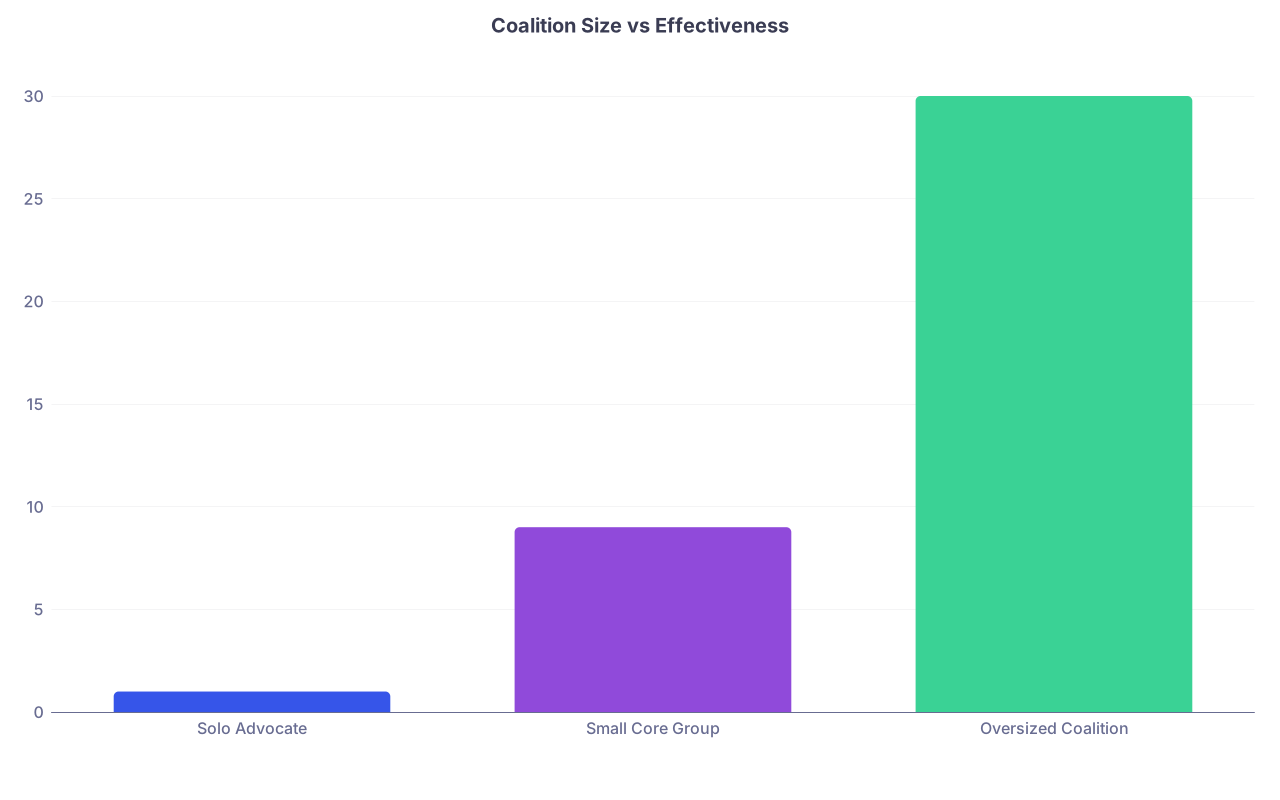
Your goal is not “a list of 200 supporters.” Your goal is a core team of 5–12 people who will show up consistently and take responsibility.
| Category | Value |
|---|---|
| Solo Advocate | 1 |
| Small Core Group | 9 |
| Oversized Coalition | 30 |
The sweet spot is a small enough group to move quickly, but diverse enough to be legitimate.
Step 8: Hold a founding meeting with a clear structure
Do not call it a “kickoff event.” Call it what it is: “First strategy meeting for [X change].”
Agenda template for 90 minutes:
Welcome and purpose (10 min)
- “We are here to fix [specific issue] by winning [specific change].”
Stories from those directly affected (15–20 min)
- 2–3 short, prepared stories from residents/patients/parents.
Quick presentation of data and power map (15 min)
- 3–5 slides or printed handouts: the problem, the target, the lever.
Discussion: Are we aligned on this target? (20 min)
- “Is this the right first win?”
- “What are we missing?”
Define roles and working norms (15–20 min)
- Who is willing to be in the core team?
- Draft norms: decision-making, speaking to media, use of organizational logos.
Next steps and commitments (10 min)
- Date/time of next meeting.
- Specific tasks: “X will talk to school nurses,” “Y will draft a one-pager.”
Two rules:
- Do not leave without concrete commitments.
- Do not let one institution (especially a hospital or university) dominate the room.
Step 9: Formalize just enough structure
You do not need a 10-page charter. But you do need:
- A name (short, local, and specific)
- A 3–4 sentence mission
- A clear primary target (e.g., “City Council Health Committee” or “Hospital Executive Board”)
- A simple decision rule:
- Consensus for strategy changes, or
- Majority vote for day-to-day decisions, with commitment to respect outcomes
And you need to be explicit about representation:
- At least 30–50% of your core team should be directly affected people, not just professionals speaking “for” them.
- Rotate facilitation. The physician or professor does not always chair.
Ethics here is non-negotiable: if you are using community pain to advance your career, your coalition will rot from the inside. People can smell that.
5. Choose Tactics that Punch Above Your Weight
Small coalitions win by being sharp, visible, and hard to ignore — not by trying to do everything.
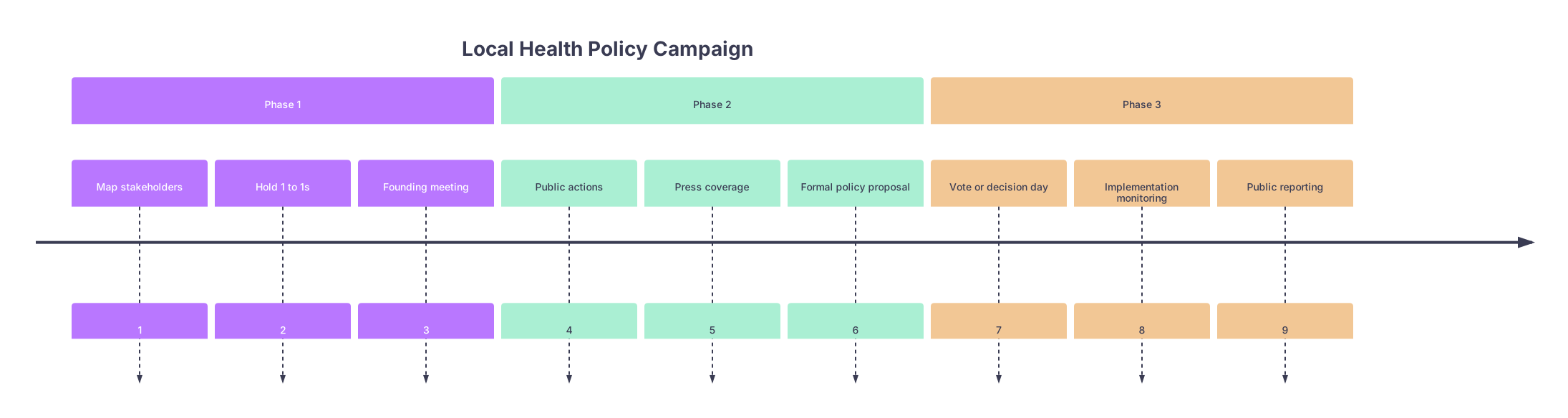
Step 10: Design a simple campaign arc
Think in three phases:
- Build the case and relationships
- Collect stories and basic data.
- Meet with initial allies and low-level officials.
- Apply escalating public pressure
- Present at public meetings.
- Release a short report or fact sheet.
- Coordinate media or social media hits.
- Close the deal and monitor implementation
- Negotiate details with decision-makers.
- Get commitments in writing.
- Stay present as policy is implemented.
| Period | Event |
|---|---|
| Phase 1 - Map stakeholders | 1 |
| Phase 1 - Hold 1 to 1s | 2 |
| Phase 1 - Founding meeting | 3 |
| Phase 2 - Public actions | 4 |
| Phase 2 - Press coverage | 5 |
| Phase 2 - Formal policy proposal | 6 |
| Phase 3 - Vote or decision day | 7 |
| Phase 3 - Implementation monitoring | 8 |
| Phase 3 - Public reporting | 9 |
You do not have to guess timing perfectly. But you need a mental model for where you are so you do not get stuck in endless “relationship building” that never turns into action.
Step 11: Use data and stories in combination, not isolation
Small coalitions are lethal when they can say:
- “Here is Mrs. Lopez, who has taken her 7-year-old to the ED 6 times this year because of mold.”
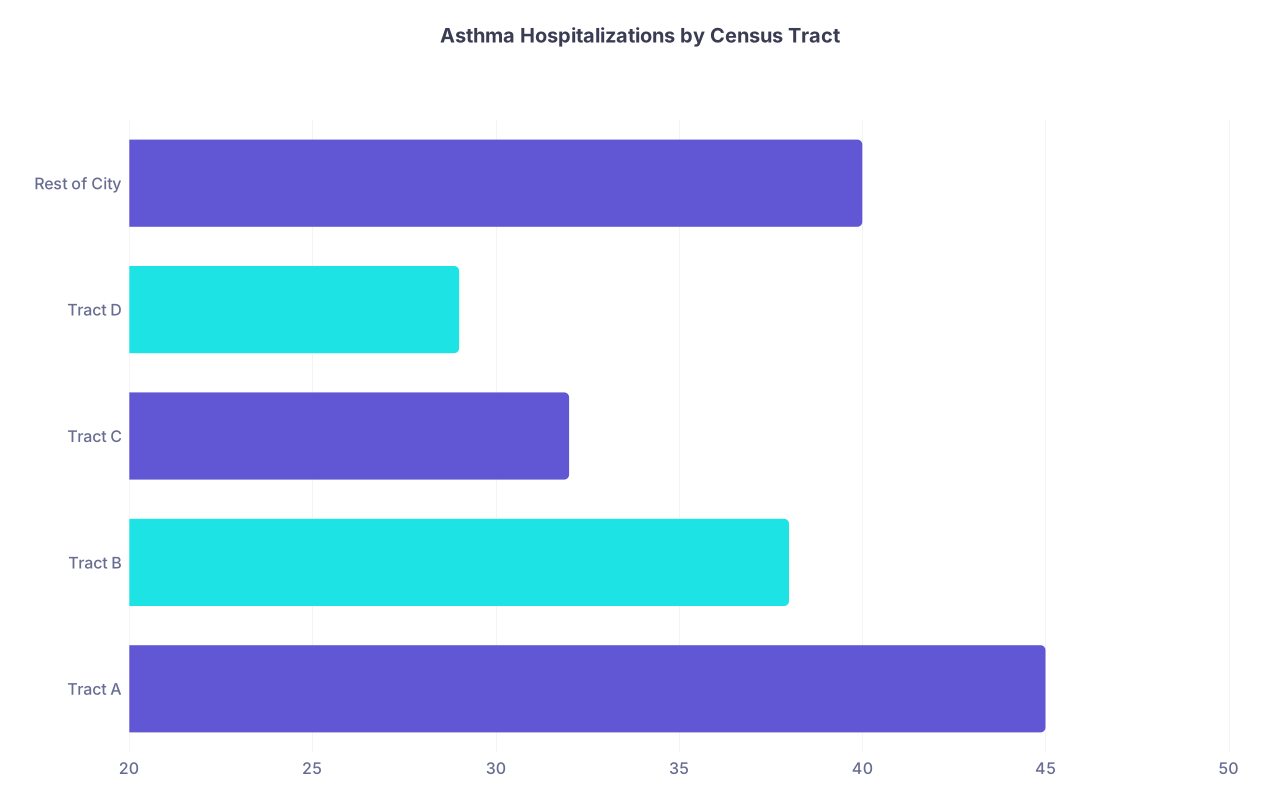
- “Here is the map that shows 70% of pediatric asthma admissions come from 5 census tracts.”
- “Here is the simple, costed-out proposal our coalition is putting in front of you.”
| Category | Value |
|---|---|
| Tract A | 45 |
| Tract B | 38 |
| Tract C | 32 |
| Tract D | 29 |
| Rest of City | 40 |
You do not need a 60-page report. A 2-page brief plus lived experience testimony is usually enough for local-level decisions.
Step 12: Pick 2–3 core tactics and do them well
Examples that I have seen small coalitions use effectively:
Targeted public comment:
10 coalition members show up at one city council hearing, coordinated, each speaking to a different facet of the same demand.Visual, local actions:
A “clinic day of action” where clinicians wear the same sticker (“Asthma is a housing issue”) and hand decision-makers a signed letter from 50 staff.Media amplification:
One strong op-ed + one local TV/radio segment, both anchored by the same patient story and ask.Direct negotiation meetings:
Sit-downs with the specific person who can sign off on the change — always bringing at least one directly affected person and one professional.
You do not need marches of hundreds. You need strategic discomfort for a few key decision-makers.
6. Guard Your Ethics While You Build Power
You are operating at a dangerous intersection: human suffering, political power, institutional reputation, and your own career trajectory. If you do not set some ethical boundaries early, you will cut corners later.
Step 13: Establish a basic ethical framework
Have the coalition explicitly agree on a few non-negotiables:
No tokenism.
Directly affected people are not “story props.” They are co-leaders. They have veto power over how their stories are used.Shared credit.
No institution or leader takes sole credit publicly. Media quotes rotate. Academic publications, if any, include community leads as co-authors.Informed participation.
Everyone understands:- The risks (political, employment, reputational).
- The likely time frame (often slower than people hope).
- The fact that partial wins and compromises are common.
Boundaries on conflict of interest.
If you take funding from the same hospital or city that you are trying to pressure, the coalition decides collectively how to manage that. Not just you and the grant office.
Write these down in one page. Revisit when tensions arise.
Step 14: Protect vulnerable members from institutional retaliation
This is where medical and public health ethics get real, not theoretical.
Concrete steps:
- Offer anonymous or first-name-only participation in some external-facing activities if people fear retaliation.
- If a hospital staff member could face discipline for public advocacy, consider:
- Having them speak in closed-door meetings only.
- Using their data and experience but having someone else present it publicly.
- If tenants fear eviction, ensure:
- Connections with legal aid.
- That your actions do not expose individual addresses unless there is consent and protection.
Ethical rule of thumb: those with the least power should have the most control over exposure, not the least.
7. Make Implementation and Follow-Through Non-Negotiable
Most coalitions die right after the “victory photo.” The ordinance passes, the protocol is signed, the press release goes out — and then nothing changes on the ground.
A small but powerful coalition avoids that by building monitoring into the DNA of the campaign.
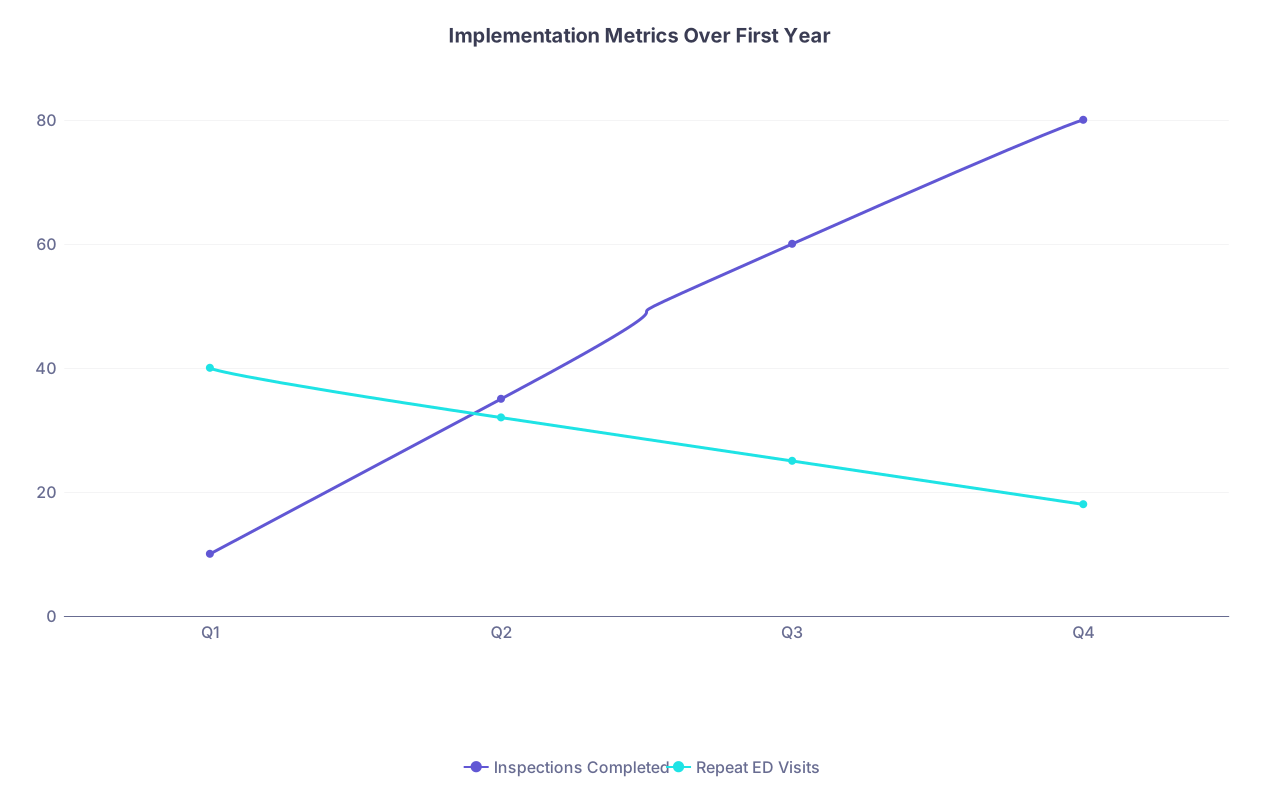
Step 15: Define success metrics you can actually track
Before the policy is adopted, agree internally:
- What 2–4 metrics tell us this is working?
- How often can we realistically track them?
Examples:
- Number of proactive housing inspections actually completed in the target tracts per quarter.
- Number of students referred to counseling vs. suspended for substance use.
- Number of overdose reversals in a given neighborhood after a harm reduction expansion.
| Category | Inspections Completed | Repeat ED Visits |
|---|---|---|
| Q1 | 10 | 40 |
| Q2 | 35 | 32 |
| Q3 | 60 | 25 |
| Q4 | 80 | 18 |
If you cannot get “perfect” data, take what you can and combine with qualitative monitoring:
- “What are school nurses seeing now?”
- “Are CHWs reporting real changes in landlord behavior?”
Step 16: Keep a light but firm structure after the win
Post-win, shift the coalition’s rhythm:
- From monthly strategy meetings → quarterly implementation check-ins
- From public pressure → relationship maintenance and spot-check investigations
- From broad recruitment → deeper leadership development of a few key community members
You can absolutely sunset a coalition once the change is stable. Just do it openly:
- “Our coalition has achieved X, and we see Y and Z in place for sustainability. We are going to shift to a looser network and reconvene if backsliding occurs.”
The unethical move is to disappear without informing the people you mobilized.
8. Protect Yourself from Burnout and Co-optation
Let me be blunt: if you are in medicine or public health, institutions will try to brand your coalition’s work as their “community partnership” for marketing, without changing anything structural. At the same time, the emotional labor and time demands will start to bleed into everything.
You need personal and group guardrails.
Step 17: Make your own role sustainable
Define for yourself, in writing:
- How many hours a month you are willing to spend on this.
- What tasks you will not do (e.g., being the default note-taker, PR person, and data analyst all at once).
- What professional risks you will and will not accept:
- Are you willing to be quoted in the paper criticizing your hospital?
- Are you willing to risk being seen as “political” by your department chair?
You do not need to be a martyr. Burning out helps no one.
Step 18: Resist institutional capture
If a large institution (hospital, university, big nonprofit) comes in with:
- Money
- Staff time
- Branding offers
You should treat it like a high-risk medication: helpful but with clear side effects.
Mitigation steps:
Written agreement that:
- The coalition sets its own agenda.
- Funding does not give veto power over targets or tactics.
- Community co-chairs remain in place regardless of funding.
Explicit red lines:
- “We will not remove [policy X] from our demands because it makes the hospital uncomfortable.”
- “We will not rebrand as a [Hospital Name] initiative.”
If they walk away because of that, you have your answer about their intentions.
9. A Concrete 30-Day Plan to Start Your Coalition
You do not need a perfect roadmap. You need movement in the next month. Here is a bare-bones schedule.
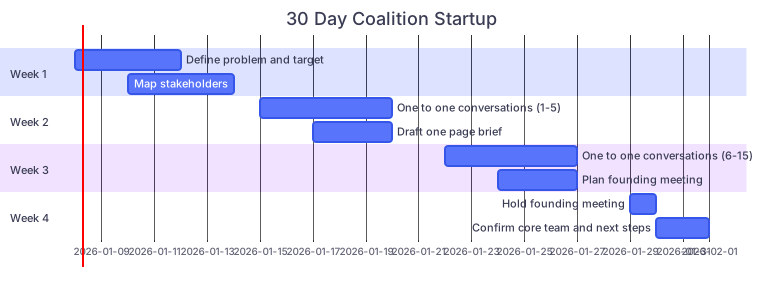
| Task | Details |
|---|---|
| Week 1: Define problem and target | a1, 2026-01-08, 4d |
| Week 1: Map stakeholders | a2, 2026-01-10, 4d |
| Week 2: One to one conversations (1-5) | a3, 2026-01-15, 5d |
| Week 2: Draft one page brief | a4, 2026-01-17, 3d |
| Week 3: One to one conversations (6-15) | a5, 2026-01-22, 5d |
| Week 3: Plan founding meeting | a6, 2026-01-24, 3d |
| Week 4: Hold founding meeting | a7, 2026-01-29, 1d |
| Week 4: Confirm core team and next steps | a8, 2026-01-30, 2d |
You can shift dates, but try not to stretch this beyond 6–8 weeks. Momentum matters.
10. The Real Payoff: Personal Development and Ethical Growth
Building a small but powerful coalition around a local health issue is not just “extracurricular work” or an “advocacy rotation.” It is one of the most intense accelerators of your growth as a clinician and as an ethical actor.
You will:
- See clearly how policy, power, and racism/classism shape the patients you see every day.
- Learn to hold your professional authority lightly and use it strategically.
- Practice moral courage in ways that no bioethics seminar can replicate.
But you will also run into:
- Colleagues who tell you to “stay in your lane.”
- Administrators who praise “your passion” while undercutting your demands.
- Moments where you must choose between being liked and being useful.
If you ground yourself in a clear problem, a concrete win, a small disciplined coalition, and a consistent ethical stance, you will not just “raise awareness.” You will change something real.
Do one thing today: write a single, specific sentence naming the local health harm you want to tackle and the concrete policy or practice change you think would fix one piece of it. Then send that sentence to one person who might join you and ask, “Can we talk about this for 20 minutes this week?”