You are here
You are a tired M2 who just finished a long day in clinic. Your state medical society sent out an email: “Lobby Day at the Capitol – come meet your legislator.” Your classmates are talking about “advocacy” and “health policy” like it is second nature.
You, on the other hand, are picturing yourself sitting across from a state senator, heart pounding, trying not to sound like a complete amateur while explaining Medicaid redeterminations.
You do not know:
- How to set up the meeting
- What you are supposed to say
- What to bring
- How not to waste their time—or yours
Good. This guide is for that exact moment.
You do not need to be a policy wonk to have a powerful meeting with a legislator. You need a clear process, some preparation, and the discipline not to wing it.
Let us walk it step by step.
Step 1: Get clear on your objective (before you email anyone)
Most bad legislator meetings fail here. People show up “to talk about healthcare” with no specific ask. That is useless for lawmakers.
You need one primary goal:
- A specific issue (e.g., prior authorization delays, Medicaid reimbursement for mental health, vaccination policy)
- A specific angle (how this affects your patients, your training, your community)
- A specific ask (what you want them to do)
Examples of good objectives:
- “Ask Senator Lee to co-sponsor SB 214 to expand postpartum Medicaid coverage from 60 days to 12 months.”
- “Ask Representative Gomez to oppose HB 112, which would criminalize evidence-based gender-affirming care for minors.”
- “Ask my state delegate to support increased GME funding for primary care slots.”
If you do not know what is on your state’s agenda, fix that now:
- Check your state medical society or specialty society website: they usually list priority bills.
- Ask your school’s health policy interest group or faculty advisor: “What are the top 1–2 state health bills this session?”
- Use your state legislature website: search “health,” “Medicaid,” “scope of practice,” “GME,” etc.
Then choose one primary ask and at most one backup ask if conversation flows there naturally. Not five. Not “whatever they want to talk about.”
Step 2: Schedule the meeting like a professional
Most students never get to the meeting because they overcomplicate this.
A. Find the right legislator
You want:
- Your own state representative and state senator (they care most about their voters)
- Optionally, the legislator who chairs the relevant health committee
Use your state legislative website:
- Enter your home address (or your school address if you vote there).
- Note:
- Name
- Party
- District
- Office phone
- Staff email (often more important than the legislator’s direct email)
Create a small contact list so you can track this. A simple table works:
| Role | Name | Phone | Staff Email |
|---|---|---|---|
| State Rep | Jane Doe | 555-123-4567 | [email protected] |
| State Senator | John Smith | 555-987-6543 | [email protected] |
| Health Chair | Alex Brown | 555-222-3333 | [email protected] |
B. Email and call (both, not either/or)
You are not a spam bot. You are a constituent and a future physician. Act like it.
- Email template (adapt and send from your school email)
Subject: Meeting request from medical student constituent – [Your Topic]
Body:
Dear [Title] [Last Name],
My name is [Your Name], and I am a medical student at [School] and a constituent from [City/Neighborhood]. I am writing to request a brief meeting (15–20 minutes) with you or a member of your staff to discuss [issue in 1 line – e.g., Medicaid postpartum coverage in our district].
In my clinical rotations, I have seen [very brief hook – e.g., “new mothers losing coverage 60 days after delivery” / “patients waiting months for mental health appointments”]. I would appreciate the opportunity to share these experiences and hear your perspective on current legislation related to this.
I am available [give 3–4 date/time windows over the next 3 weeks], but I am happy to work around your schedule. A virtual meeting would also work well.
Thank you for your time and for your service to our district.
Sincerely,
[Your Full Name]
Medical Student, [School]
[City], [ZIP]
[Phone]
- Call the office (same day as email or next morning)
Keep it short:
“Hello, my name is [Name]. I am a medical student at [School] and a constituent from [City]. I just emailed a request for a short meeting with [Rep/Senator Name] or health staff to discuss [issue]. I wanted to confirm you received it and see what the best next step is to schedule something.”
If they say “submit via web form,” do it. Then email the staffer with “Per phone call with [Staff Name]…” so there is a trail.
C. Be flexible on format
You may get:
- In-person at the Capitol
- In-district office
- Zoom / phone with a health policy staffer
(Spoiler: staff often have more time and more details. Do not treat this as “lesser.”)
Take what you can get. The point of the first meeting is to start a relationship, not get a photo for Instagram.
Step 3: Prepare like this is an OSCE, not a coffee chat
This is where most students either overshoot (60-slide deck) or undershoot (“I’ll just talk about what I’ve seen”). Both fail.
You need three pieces ready:
- Your story
- Your facts
- Your ask
A. Build your 2-minute story
Legislators remember stories, not p-values.
Structure:
- Who you are (10–15 seconds)
- Where you train / who you see (20–30 seconds)
- One concrete example from clinic (60–90 seconds)
- Why this matters in their district (20–30 seconds)
Example:
“I am a third-year medical student at State University, and I live in your district in Westwood. On my OB rotation at County Hospital, I took care of a 28-year-old mom, first pregnancy, complicated by preeclampsia. She did well at delivery, but when I saw her again in clinic at 10 weeks postpartum, she had lost her Medicaid coverage, could not afford her blood pressure medications, and was back in the ER with severe hypertension.
We see versions of this constantly. In our county alone, hundreds of women lose postpartum coverage at 60 days. Many live in ZIP codes you represent. A simple policy change to extend Medicaid postpartum coverage to 12 months would directly reduce readmissions and maternal mortality in your district.”
No identifiers. No drama. Just clean, concrete, and local.
B. Know your facts (on one page, max)
You are not there to recite a systematic review. You are there to show:
- This is real
- This is common
- This is fixable
Create a one-page “leave-behind”:
- Header: Issue, bill number, your name/contact
- 2–3 bullets with key stats (with sources in small font)
- Short story paragraph (from your script)
- Clear “we ask that you…” section
Example bullets:
- “In our state, [X]% of births are covered by Medicaid.”
- “Our maternal mortality rate is [Y] deaths per 100,000, higher than [benchmark].”
- “Extending coverage to 12 months is associated with [Z] reduction in severe maternal morbidity in states that have implemented it.”
Print a few copies. Save a PDF to email afterwards.
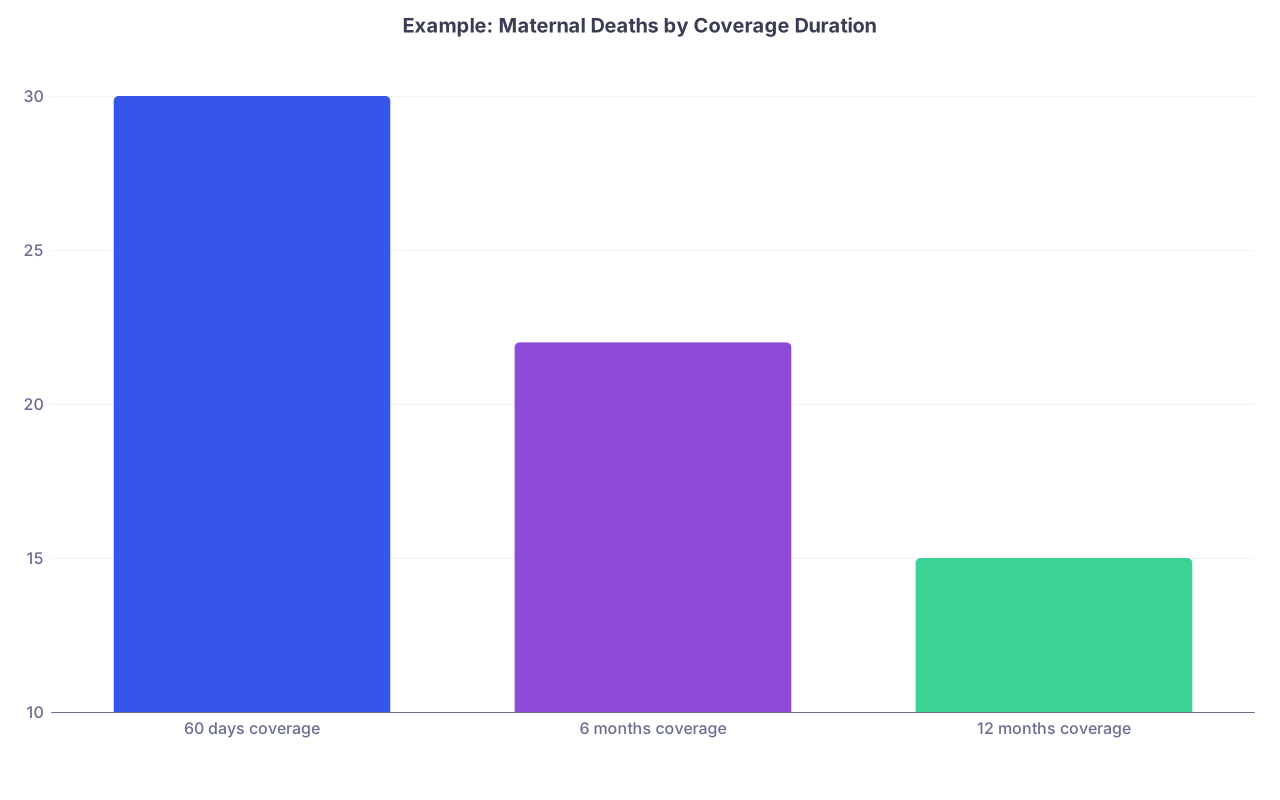
| Category | Value |
|---|---|
| 60 days coverage | 30 |
| 6 months coverage | 22 |
| 12 months coverage | 15 |
(That is a made-up example chart, but you get the idea: simple, visually obvious.)
C. Clarify your specific ask
Translate your objective into an explicit line you can say verbatim:
- “We are asking you to co-sponsor SB 214 and publicly support extending Medicaid postpartum coverage to 12 months.”
- “We are asking you to vote no on HB 112 and protect evidence-based, physician-guided gender-affirming care.”
- “We are asking you to support an additional $X million for GME primary care slots in the budget.”
Write it down. Practice saying it out loud. If you cannot say it in under 10 seconds, it is too vague.
Step 4: Understand the power dynamics (and use them properly)
Here is the reality:
- You have credibility as a future physician who sees real patients.
- You have very little power compared to lobbyists, donors, and party leadership.
- What you do have that most lobbyists do not: you are a constituent and you are not paid. That matters.
You are there to:
- Inform them with frontline clinical reality
- Show that this issue has real people behind it
- Build a long-term relationship (“I’ll be practicing in your district for years”)
You are not there to:
- Threaten
- Grandstand
- Argue ideology
Stay in your lane: patient care, training, community impact. That is where your voice lands hardest.
Step 5: Run the meeting like a short, focused clinical encounter
Imagine an OSCE station, 15 minutes, clear objective. Same discipline applies.
A. Before you walk in / log on
- Dress: neat business or clean white coat over business clothes. No scrubs.
- Bring:
- 2–3 printed one-pagers
- A small notebook and pen
- Your own schedule (so you can commit to follow-up)
- Turn your phone to silent and put it away. No excuses.
Arrive 10–15 minutes early if in person. Security and getting lost always take longer than you think.
B. Open the meeting (first 1–2 minutes)
You set the tone. Something like:
“Thank you for meeting with me. I know your schedule is packed. My name is [Name], I am a [year] medical student at [School] and I live in [neighborhood]. I wanted to share a brief story from clinic and then ask for your help on [issue].”
If staff are present:
- Learn their names and roles.
- Write them down discreetly.
C. Deliver your story + facts + ask (next 5–7 minutes)
Follow your script:
- Who you are
- Clinical example
- Very brief context / stats
- Specific ask
Do not ramble. Stop talking long enough for them to respond.
D. Listen to their response (and respond like a clinician, not an activist)
You will hear variations of:
- “I support this, I am already on that bill.”
- Good. Ask: “Is there anything I or my classmates can do to help you advance it?”
- “I am not familiar with this bill, but I’m interested.”
- Great. “I can send you a short summary and some data later this week.”
- “I have concerns about cost / fraud / personal responsibility.”
- Do not blow up. Acknowledge, then re-anchor in your lane.
Example response:
“I understand the concern about cost. At the bedside, what I see are preventable readmissions that cost the system and patients far more. From a clinical perspective, earlier and continuous coverage actually prevents those higher-cost complications.”
If they are clearly opposed ideologically:
- You will not convert them in 15 minutes.
- Keep it professional. The goal becomes planting doubt or at least humanizing the other side.
Example:
“I know there is strong disagreement on this issue. I appreciate you hearing what we are seeing in clinic. Even if we disagree on policy, I hope we can agree that our patients deserve consistent, evidence-based care.”
You are training in medical ethics. This is exactly where you practice balancing advocacy with respect.
Step 6: Handle hard questions and “I don’t know” moments without panicking
They may ask:
- “How many patients are we talking about?”
- “What does this cost the state budget?”
- “What does the evidence say about long-term outcomes?”
- “What does your medical school teach about this?”
If you know, answer concisely. If you do not, say so like an adult:
“I do not know the exact number off the top of my head, and I do not want to guess. I can send you the data from [source] this week if that would be helpful.”
That line does three things:
- Preserves your credibility
- Sets up a reason to follow up
- Signals that you are data-driven, not just emotional
Do not fake expertise. They hear from actual full-time lobbyists and PhD policy staff all day. Your advantage is honesty plus clinical reality, not pretending to be CBO.
Step 7: Close the meeting with discipline
Most students mumble “thank you” and flee. You are going to do better.
In the last 2–3 minutes:
Restate your ask once
“Just to summarize, we are asking you to [ask] regarding [bill/issue].”Ask about next steps
- “Is there anyone on your team who focuses on health that I should stay in touch with?”
- “Would you be open to visiting our clinic or simulation center to see this issue firsthand?”
Offer yourself as a resource
- “If you ever want a quick sense of what we are seeing on the ground at County Hospital, I am happy to connect you with faculty or other students.”
Thank them properly
- “Thank you again for your time and for listening to your medical student constituents. I will send a short follow-up with those data and the one-pager.”
Then leave. Do not linger. Do not re-open a new topic at the door.
Step 8: Follow up within 48 hours (this is where impact actually happens)
What you do after the meeting often matters more than the meeting itself.
Within 24–48 hours, send an email to:
- The staffer you met with
- The legislator (cc’d)
Structure:
Subject: Thank you and follow-up – [Issue] meeting on [Date]
Dear [Staffer/Rep/Senator Last Name],
Thank you again for taking the time to meet with me on [date] to discuss [issue]. I appreciated hearing your perspective on [specific point they raised].
As promised, I have attached:
– A one-page summary of [issue] with key data and our specific request
– [Any specific data or article you mentioned, with 1-sentence explanation]Please let me know if I can provide any additional clinical context or connect you with faculty at [School/Hospital] who work on this issue. I would be glad to do so.
Sincerely,
[Your Name]
[Year] Medical Student, [School]
[Contact Info]
Attach your one-pager as PDF. If you referenced a key study or state report, either attach it or link it clearly.

| Step | Description |
|---|---|
| Step 1 | Identify issue |
| Step 2 | Find your legislator |
| Step 3 | Request meeting |
| Step 4 | Prepare story and one pager |
| Step 5 | Meet and present ask |
| Step 6 | Follow up by email |
| Step 7 | Ongoing relationship |
Step 9: Turn one meeting into an ongoing relationship
You are not just there for a single transaction. You are building your identity as a physician-citizen.
Here is how you keep the connection alive without being annoying:
Update them when something changes
- Bill advances? Send a short “Thank you for your support on SB 214” note.
- New study from your institution backs your position? Send a 3–4 line email with the link.
Invite them to campus or clinic
- Open house, grand rounds on a hot topic, community health fair.
- Brief subject: “Invitation: See [issue] firsthand at [event].”
-
- Legislators pay attention when they see consistent, well-organized, polite engagement from a group of medical students, not just one person.
Track what you have done. Simple spreadsheet:
- Date
- Legislator/staffer
- Topic
- What you asked
- Their response
- Follow-up date
Over time, this gives you a real advocacy portfolio. It also prevents you from emailing the same thing three times and looking disorganized.
Step 10: Ethical lines you must not cross
You are not just an amateur lobbyist. You are a trainee bound by medical ethics and institutional rules.
Here are the big red flags:
Patient confidentiality
- No names, dates, unique combinations (rare disease in small town).
- Aggregate or generalized stories only.
- When in doubt, blur details further.
Misusing institutional affiliation
- Do not claim to speak on behalf of your medical school or hospital unless you are officially authorized.
- Say: “As a medical student at [School], I see…” not “[School] believes…”
Partisan campaigning
- Advocacy on policy is different from campaigning for a party or candidate.
- On school time/equipment, stick strictly to issue advocacy, not electioneering.
Gifts and conflicts
- Do not bring gifts beyond maybe a school pin or a printed one-pager.
- Do not accept anything that would be unacceptable under your institution’s conflict-of-interest policy.
Respect for professional boundaries
- If a legislator makes a clearly unethical ask (e.g., “Can you get me a letter from your dean saying this?”), your answer is:
“I cannot speak for my institution, but I can connect your staff with the appropriate office if you would like.”
- If a legislator makes a clearly unethical ask (e.g., “Can you get me a letter from your dean saying this?”), your answer is:
Ethics is not an abstract course here. It is the line between legitimate advocacy and being used as a prop.
Step 11: Build this into your development as a physician, not a one-off stunt
You are not doing this for a “cool line on your CV” (though it will be one). You are training to be the physician who does not just complain about bad laws in the workroom but actually engages.
Concrete ways to institutionalize this for yourself:
Set a personal advocacy minimum
Pair it with your rotations
- On psych: meet about mental health access.
- On peds: meet about vaccination, child poverty, or school-based clinics.
- On surgery: meet about trauma, gun violence, or emergency care access.
Track your impact
- Did they co-sponsor the bill?
- Did they reference “doctors at State University” when speaking in committee?
- Did staff come to your campus?
You will not “change the system” alone. But you can absolutely move the needle in a small, specific area if you show up consistently.
Common mistakes to avoid (so you do not waste the opportunity)
I have seen these repeatedly:
Showing up with no specific ask
- “Just wanting to learn about your priorities” is not advocacy. That is a tour.
Talking nonstop
- If you speak for 18 of 20 minutes, you failed. Aim for a real conversation.
Using jargon
- “Social determinants of health” is fine. “MIPS/MACRA/QPP” alphabet soup is not.
Trying to “own” them
- This is not Twitter. You will not score points by humiliating a legislator in their own office. You will just close the door for the next student.
Ghosting on follow-up
- Saying “I will send that data” and then disappearing for 3 months kills your credibility.
If you avoid those, you are already ahead of 80 percent of people who show up on lobby day.
Sample 15-minute meeting flow (minute-by-minute)
Use this as a mental script:
- Minute 0–2 – Introductions, thank them, quick statement of purpose.
- Minute 2–5 – Your story: who you are, specific clinical example, local tie-in.
- Minute 5–7 – Key facts (2–3 data points), then your clear ask.
- Minute 7–12 – Their response, questions, discussion. You listen more than you talk here.
- Minute 12–14 – Restate ask, ask about next steps, offer yourself as resource.
- Minute 14–15 – Thank them, confirm follow-up, exit.
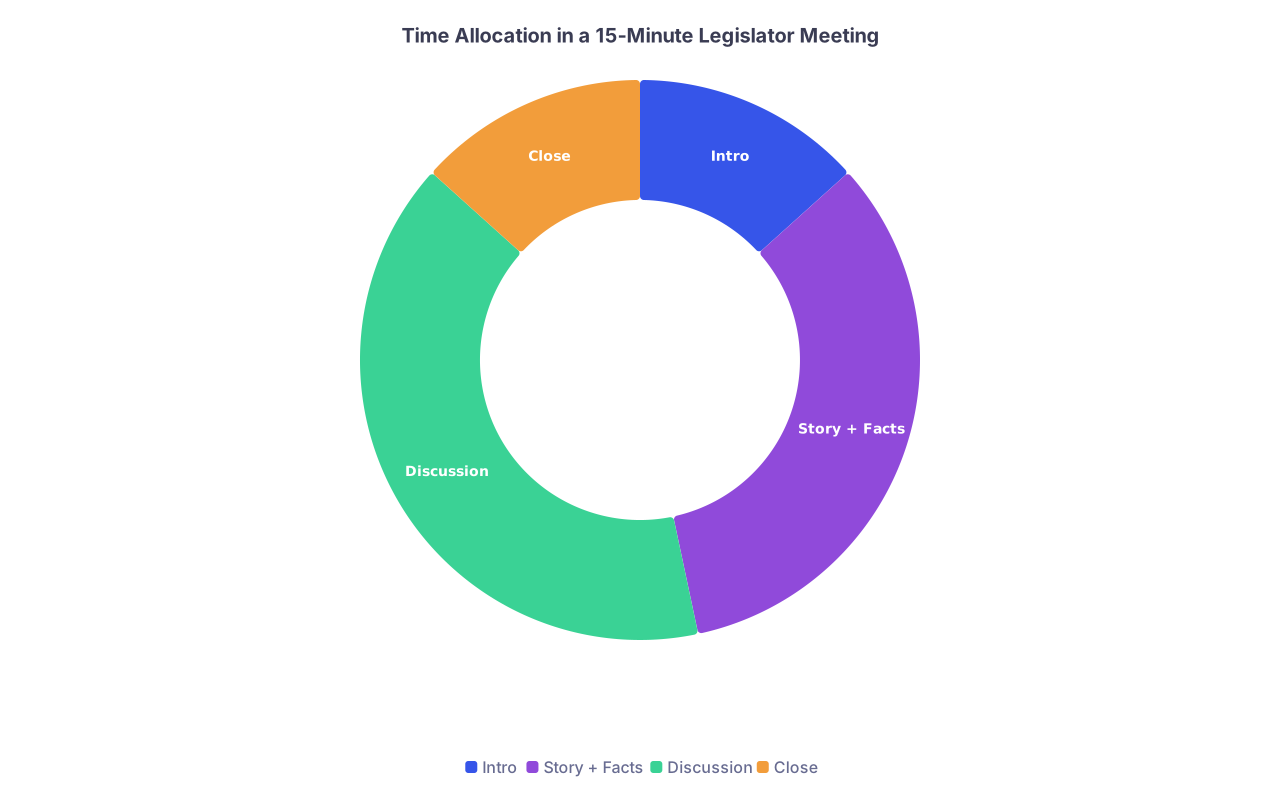
| Category | Value |
|---|---|
| Intro | 2 |
| Story + Facts | 5 |
| Discussion | 6 |
| Close | 2 |
Simple. Controlled. Professional.
How to practice before the real thing
Do not make this meeting the first time you say any of this out loud.
Rehearse with a classmate
One plays legislator, one plays you. Swap. Give each other one rule: no speeches over 90 seconds without interruption.Record yourself on your phone
Watch once. You will see every ramble and filler word instantly. Fix them.Ask a faculty mentor to do a mock meeting
Some will say no. The ones who say yes are usually the ones who have done this in real life and can give focused feedback.
Treat it like a high-stakes patient family meeting. Because effectively, that is what it is—only the “family” controls your entire state.

Final thoughts
Three key points, then you can close this tab:
- Go in with a specific, concrete ask backed by a single patient story and a few hard data points. Vague advocacy does nothing.
- Run the meeting with discipline: short intro, clear story, crisp ask, real listening, and a timely follow-up. Treat it like an OSCE for your policy muscles.
- Play the long game. One meeting is a start. Building an ongoing, ethical relationship with your legislators is part of your job as a physician, whether you like politics or not.
You are going to be practicing under the laws these people write. Spend 15 minutes making sure they at least hear from someone who actually sees the patients. That someone might as well be you.