You are two months into your chief year. Your inbox is a mess of emails about duty hours, schedule swaps, and a resident who is furious about a prior auth denial that delayed chemo. At the same time, your program director just said, “We really should teach advocacy this year. Can you build something?”
No budget. Limited time. Faculty are “supportive in theory” but busy. Residents are burned out and cynical: “Advocacy is nice, but I barely have time to eat.”
You either build something lean and real—or you add another box-checking lecture residents silently ignore.
Here is how you build the first one, not the second.
Step 1: Define What “Advocacy” Actually Means in Your Program
If you skip this, your curriculum will drift into vague “health policy is important” talks that change nothing.
Advocacy in residency should be:
- Concrete
- Local
- Feasible within residency constraints
- Directly tied to patient care or trainee well-being
Use this working definition with your leadership:
“Resident advocacy is the deliberate, skills-based work residents do to change systems that harm patients or trainees—at the bedside, in the hospital, and in the community.”
Then pick a focus. You cannot teach everything.
Pick 1–3 Core Domains
Choose based on your program’s reality, not a textbook list:
- Clinical systems advocacy
- Fixing discharge barriers
- Streamlining prior auth processes
- Improving language access
- Resident and staff advocacy
- Safe scheduling and duty hours
- Lactation space, call room access
- Equity in evaluations and promotions
- Community and policy advocacy
- Local public health issues (housing, overdose prevention)
- State licensure or scope-of-practice regulations
- Medicaid/insurance policies that impact admissions and follow-up
You can cover all three over a year, but each session should clearly land in one domain. Residents need to know: What kind of advocacy skill are we practicing right now?
Step 2: Map a Minimal, High-Yield Structure (12 Months, 6–8 Hours Total)
You are not building a second degree. You are inserting a spine of advocacy training into a packed schedule.
Here is a realistic skeleton for a one-year residency advocacy curriculum that does not implode your schedule.
| Month | Format | Focus |
|---|---|---|
| 1 | 60-min workshop | What is advocacy? Local examples |
| 2 | 30-min | Storytelling and case framing |
| 3 | 60-min | Writing effective emails and letters |
| 5 | 60-min | Working with hospital leadership |
| 7 | 30-min | Using data for change |
| 9 | 60-min | Community / legislative engagement |
| 11 | 30-min | Project check-in and troubleshooting |
| 12 | 60-min | Resident advocacy showcase |
Notice the gaps. That is intentional. Residents use those months to apply skills to small, bounded projects instead of sitting in more sessions.
You can adapt this:
- For a 3-year program: repeat the structure but change complexity by PGY level.
- For a 4-year: year 1 basics, year 2–3 projects, year 4 mentorship and leadership.
Step 3: Get the Minimum Buy-in You Actually Need
You do not need a 15-person committee. You need three types of support.
1. Program Leadership: A Green Light and Protected Time
Ask for three concrete things:
Dedicated calendar slots
- 4–6 one-hour blocks per year, on an existing didactic half-day
- Label them in advance: “Advocacy Skills Session 1–4”
Explicit message from the PD
- Short email or message: “Advocacy is part of your job as physicians. This curriculum is a core part of training, not optional fluff.”
A small win they care about
- Example: “By month 12, we will present 3 resident-led system improvement projects to the Clinical Operations Committee.”
Tie advocacy to ACGME requirements and institutional priorities: health equity, safety, professionalism. Program directors listen when you line things up with their citations and dashboards.
2. Faculty Allies: A Core Micro-Faculty
You do not need an advocacy superstar. You need 2–3 faculty who can:
- Show up to 1–2 sessions per year
- Respond to 2–3 email threads from resident teams
- Open doors (introduce residents to quality, legal, or government relations)
Potential recruits:
- Population health / quality improvement leadership
- Hospital ethics committee members
- Community health / social medicine faculty
- That one hospitalist always complaining about policy but still doing the work
Ask specifically: “Can you co-lead one session and advise 1–2 resident micro-projects this year?”
3. Institutional Partners: One Door Opened
Advocacy dies when everything hits a wall of “legal says no” or “operations is complicated.”
Identify one institutional office you will partner with:
- Government relations / public affairs
- Quality and safety office
- Community benefits / community engagement
- GME office (if they support resident wellness or equity projects)
Ask them for:
- A brief overview talk (20 minutes) at one session
- A named contact person for resident inquiries
- Agreement to review 1–2 resident proposals a year
Step 4: Build Sessions That Teach Real Skills, Not Theory
Here is how to design sessions that residents will actually use.
Session 1: What Is Advocacy and Where Do Residents Already Do It?
Goal: Reframe what residents already do as advocacy and show where new skills fit.
Time: 60 minutes
Structure:
5 min – Quick poll and case
- Ask: “Who here has spent >20 minutes on the phone overturning a denial this month?”
- Present a clinical case where a patient was harmed by a system barrier.
10 min – Short, sharp framing
- 3 levels: bedside – hospital – community.
- Two or three real examples:
- PGY-3 who emailed pharmacy to change the default DVT prophylaxis order
- Resident group who pushed for interpreter access overnight
- Residents who testified about step therapy at state house
20 min – Small groups: “Where are you already pushing back?”
- Residents list:
- Times they had to “work around” the system
- Repeated frustrations on their rotations
- Each group picks one issue that:
- Happens at least weekly
- Harms patients or residents
- Seems somewhat fixable
- Residents list:
15 min – Report out and cluster
- On a whiteboard: cluster issues into:
- Information / communication failures
- Policy problems
- Workflow/design failures
- External payer / law problems
- On a whiteboard: cluster issues into:
10 min – Explain the year plan
- “We will pick 3–5 issues from today and use the next sessions to give you the tools to move them forward.”
You leave with a resident-generated problem list. That becomes the raw material for their projects.
Session 2: Storytelling and Case Framing
Residents are used to H&Ps, not policy narratives. Different skill.
Goal: Teach residents to turn a frustrating clinical case into a persuasive advocacy story for leadership or policymakers.
Time: 30 minutes
Structure:
5 min – Example
- Show a 1-paragraph “bad” case summary (jargon, no human detail).
- Then a “good” one:
- Human, specific, with clear harm + policy link.
10 min – Framework
- Short structure:
- Person: who is affected (1 patient or 1 resident)
- Problem: specific barrier or policy
- Pattern: why this happens again and again
- Proposal: what you want changed
- Short structure:
15 min – Practice
- Residents rewrite real stories from Session 1 using this structure.
- Volunteers read a few aloud.
You want them to walk out with 1–2 polished stories they can use in emails, meetings, or testimony.
Session 3: Writing Effective Emails and Letters That Get Action
Most resident “advocacy emails” die in an inbox because they read like venting. Fix that.
Goal: Teach residents to write concise, action-oriented messages to leadership or external stakeholders.
Time: 60 minutes
Structure:
10 min – Anatomy of a high-impact email
- Subject line that signals action, not feelings:
- “Proposal to reduce discharge delays from 4W” > “Concern about discharges”
- Opening: one-line summary of the problem + desired outcome
- Body:
- 2–3 sentences on impact
- 1–2 bullet proposals
- Close: specific ask (“Can we meet for 20 minutes next month?”)
- Subject line that signals action, not feelings:
20 min – Rewrite exercise
- Give them a real-world “rage email” (de-identified).
- In pairs, rewrite using your structure.
20 min – Draft real emails
- Residents draft one real email based on a Session 1 issue.
- Chiefs/faculty circulate, giving quick edits in real time.
10 min – Send or schedule
- Either send email that day (if ready) or identify who it will go to and by when.
This is the first session where something leaves the room and hits the system.
Session 4: Working with Hospital Leadership Without Getting Stonewalled
Residents often see leadership as a monolith. Teach them how it actually works.
Goal: Demystify hospital structure so residents know whom to talk to, how, and when.
Time: 60 minutes
Bring 1–2 people:
- A department or associate program director
- A quality / operations leader
Structure:
15 min – “How this place really runs”
- Short chalk talk on:
- Chain of command
- Who owns what: clinical ops, finance, risk, HR
- What cannot be changed locally (regulations, payer contracts)
- Short chalk talk on:
15 min – Panel Q&A: “What gets my attention”
- Ask leaders:
- “What makes you take a resident idea seriously?”
- “What makes you ignore it?”
- “Best and worst approaches you have seen from residents?”
- Ask leaders:
20 min – Simulated meetings
- In trios:
- One resident advocate
- One “leader” (faculty/chief playing role)
- One observer
- 5-minute mock meeting using a real issue and a 3-slide or verbal pitch.
- Swap roles once.
- In trios:
10 min – Translate to your projects
- Each advocacy team identifies:
- The one person they must get in front of
- How to request that meeting
- Each advocacy team identifies:
Session 5: Using Data Without Becoming a Statistician
You are not turning residents into analysts. You are teaching them to ask for the right numbers.
Goal: Show residents how minimal, targeted data strengthens their advocacy.
Time: 30 minutes
Structure:
10 min – “Resident-level” data sources
- Simple options:
- Manual 2-week tally on a unit (e.g., number of discharges delayed >4 hours)
- EMR–available wait times, readmission rates
- Existing quality dashboards or incident reports
- Brief one-page survey
- Simple options:
10 min – Before/after logic
- Show one quick example:
- “We tracked 20 discharges. 60% were delayed by missing scripts. After a new checklist, only 25% were delayed.”
- Show one quick example:
10 min – Plan next step for each project
- Each team answers:
- What is 1 measure of harm or delay we can capture?
- Can we track it for 2–4 weeks?
- Each team answers:
Drop perfection. You are aiming for directionally correct data that leadership can understand in one slide.
Session 6: Community and Legislative Engagement (Optional but Powerful)
Once they have basic skills, give them the map for going upstream.
Goal: Show residents where and how to plug into local or state advocacy without reinventing the wheel.
Time: 60 minutes
Structure:
20 min – Local ecosystem overview
- Invite someone from:
- Hospital government relations
- State medical society
- A local community health coalition
- Have them outline:
- Top 2–3 policy issues this year
- How physicians and trainees can engage (legislative visits, testimony, sign-on letters)
- Invite someone from:
20 min – Script and role-play
- Teach a simple script for calling or meeting a legislator:
- Who you are
- Where you work
- One story
- One ask
- Residents practice with each other for 5 minutes each.
- Teach a simple script for calling or meeting a legislator:
20 min – Calendar commitment
- Identify 1–2 advocacy events (lobby day, public health hearing) in the next 6–12 months.
- Ask for volunteers to attend, with call schedules adjusted if possible.
This step converts vague “policy is important” into “Here is the exact person you would talk to and how.”
Step 5: Design Micro-Projects That Actually Fit in Residency
This is where most advocacy curricula fail—they assign massive projects that quietly die.
You want micro-projects:
- 3–6 months
- Team of 2–4 residents
- Scope: one small but real change, or one clear deliverable
Typical residency-friendly projects:
- Standardized script and process for securing outpatient follow-up for uninsured patients on one service
- Simple one-page prior auth toolkit for common meds, co-created with pharmacy
- Improving awareness and use of interpreter services overnight with a quick-access guide in call rooms
- Updating clinic no-show reminder workflows in partnership with scheduling
Your job as chief is to keep these small and bounded.
A Simple 6-Step Project Template
Give residents this template and insist they complete it on one page:
- Problem – One sentence, with population
- Why it matters – Clearly tied to patient harm, safety, or equity
- Current process – 3–5 bullet description
- Proposed change – What they will actually do or test
- Stakeholders – Names/titles of 2–3 key people
- Measure of success – One number or observation
Pair each team with a faculty or chief “sponsor” whose only job is to:
- Stop scope creep
- Approve communications
- Help navigate institutional politics
Step 6: Build a Simple Timeline and Follow-Through System
Residents are busy. If you do not track projects, they evaporate.
Use a basic structure:
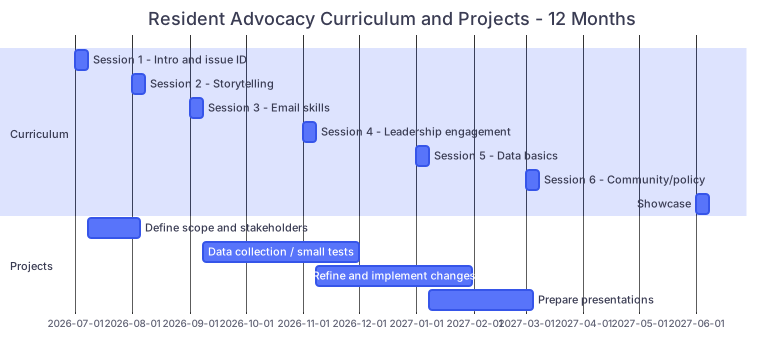
| Task | Details |
|---|---|
| Curriculum: Session 1 - Intro and issue ID | s1, 2026-07, 1w |
| Curriculum: Session 2 - Storytelling | s2, 2026-08, 1w |
| Curriculum: Session 3 - Email skills | s3, 2026-09, 1w |
| Curriculum: Session 4 - Leadership engagement | s4, 2026-11, 1w |
| Curriculum: Session 5 - Data basics | s5, 2027-01, 1w |
| Curriculum: Session 6 - Community/policy | s6, 2027-03, 1w |
| Curriculum: Showcase | show, 2027-06, 1w |
| Projects: Define scope and stakeholders | p1, after s1, 4w |
| Projects: Data collection / small tests | p2, after s3, 12w |
| Projects: Refine and implement changes | p3, after s4, 12w |
| Projects: Prepare presentations | p4, after s5, 8w |
Key operational pieces:
Shared tracker (Google Sheet, whatever) listing:
- Team members
- Project title
- Stakeholder contact
- Next planned step
- Status (green/yellow/red)
Quarterly 20-minute check-ins on an existing conference:
- 2–3 teams give a 3-slide update:
- What we tried
- What happened
- What we will do next quarter
- 2–3 teams give a 3-slide update:
One final showcase session at year-end:
- 5–10 minutes per project
- Invite:
- Program leadership
- Quality / ops leaders
- GME office
Step 7: Protect Residents and Yourself From Common Pitfalls
You will run into resistance. Some of it reasonable. Some not.
Pitfall 1: Leadership Says, “This Is Not a Priority”
Response strategy:
- Anchor in institutional language:
- “This aligns with our hospital’s strategic goal on health equity/patient safety/length of stay.”
- Offer low-cost pilots:
- “We are proposing a 4-week test on one unit, with no budget request.”
- Present data and story together:
- “We had 5 delayed discharges last week on 4W, including Ms. L, who stayed an extra night because her prescriptions were not ready…”
If they still block you, scale down and document. Sometimes the win is spotlighting the problem and training residents, not fixing the whole system that year.
Pitfall 2: Residents Are Burned Out and Cynical
You will hear: “Nothing ever changes.”
Counter with:
- Quick wins early:
- E.g., updated handoff template, clearer prior auth tip sheet, simpler social work paging directory.
- Visible endorsements:
- Have the PD or department chair publicly thank residents by name for specific advocacy contributions.
- Realism:
- Say out loud: “You cannot fix housing policy this year. But you can stop 10 unnecessary extra inpatient nights on our service.”
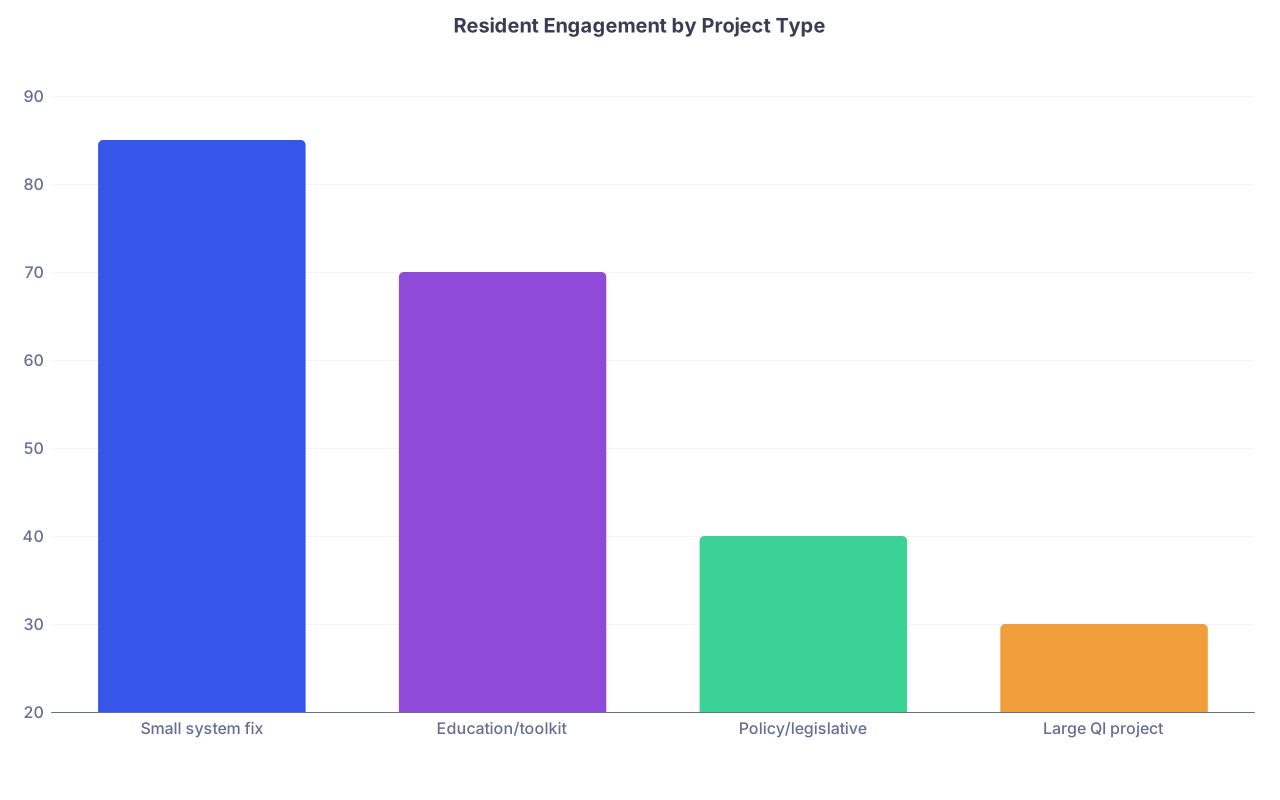
| Category | Value |
|---|---|
| Small system fix | 85 |
| Education/toolkit | 70 |
| Policy/legislative | 40 |
| Large QI project | 30 |
Focus early on projects where you can get that 85% engagement: small system fixes and practical tools.
Pitfall 3: Advocacy Becomes a “Nice-To-Have” Elective For a Few
Your defense against this: build it into required structures.
Concrete moves:
- Integrate one session into orientation or intern boot camp.
- Attach advocacy components to required QI projects (e.g., they must identify a policy or structural contributor to the problem).
- Expect everyone to attend at least the core 3–4 skills sessions.
You can add elective deeper dives, but the spine must be required.
Step 8: Measure Impact Without Drowning in Metrics
You will be asked, “Is this working?” Do not overcomplicate it.
Track three layers:
1. Resident-Level Outcomes
- Pre/post survey (5–7 questions, tops):
- Confidence in:
- Writing an advocacy email
- Presenting an issue to leadership
- Identifying a policy contributing to a clinical problem
- Likert scale; do not chase statistical significance. Look for direction change.
- Confidence in:
2. Project-Level Outcomes
For each micro-project, track:
- 1–2 process or outcome metrics (e.g., delayed discharges, consult completion time, no-show rate)
- Status:
- Proposed → Piloted → Adopted → Abandoned (and why)
3. Institutional-Level Signals
You are not claiming causal links, but you can document:
- Number of resident presentations to:
- Department leadership
- Hospital committees
- Community or legislative bodies
- Concrete institutional changes where residents had a clear role:
- Policy updates
- New workflows
- New educational tools adopted formally
You can summarize once a year in a 1-page impact report. That document is gold for:
- ACGME site visits
- GME funding arguments
- Your own promotion file
Step 9: Make It Sustainable After You Graduate
If the curriculum dies when you leave, you wasted a lot of effort.
Build these into the system:
Clear handoff documents
- Curriculum outline
- Slide decks
- Project templates
- List of institutional contacts and allies
Formal roles
- “Advocacy chief” title or defined portfolio within chief roles
- Resident advocacy committee with PGY-2 and PGY-3 reps
Annual traditions
- Resident advocacy showcase at the same time every year
- A standing spot in orientation for an “Advocacy in Our Program” session
Faculty ownership
- Identify one faculty co-director who stays put when chiefs turn over.
- Give them concrete time credit in their job description if possible.
If this work remains dependent on “the one fired-up chief,” it will disappear. Build scaffolding.
FAQs
1. How do I balance advocacy work with residents already feeling overwhelmed by clinical duties?
You design for their reality, not your ideals. That means:
- Use existing didactic time, do not create a new conference.
- Keep projects micro: one specific change, not a sweeping overhaul.
- Align projects with work they already do:
- Discharge processes
- Clinic follow-up
- Night float pain points
You can also negotiate small schedule tweaks for residents with heavier advocacy roles (e.g., a half-day of admin time during a lighter rotation). But the baseline curriculum should not require huge extra time.
2. What if my hospital leadership is openly hostile to “advocacy”?
Then you rebrand and aim strategically.
Call it:
- “Systems improvement”
- “Patient safety and equity projects”
- “Resident-led clinical operations initiatives”
Focus on:
- Length of stay
- Readmissions
- Patient satisfaction
- Staff retention / burnout metrics
You still teach the same skills—storytelling, email writing, working with leadership, basic data—but you attach them directly to outcomes the C-suite recognizes and rewards. You can still quietly equip residents with the tools to push on more controversial issues when the environment shifts.
3. We are a small community program without a public health or policy department. Is this still realistic?
Yes, and honestly, you may have advantages. Smaller institutions often have:
- Shorter chains of command
- Easier access to the CEO or CMO
- Stronger connections to local government and community organizations
You can:
- Partner with your state medical society for a guest session on legislative advocacy.
- Invite local public health officials or community organizers instead of academic faculty.
- Focus heavily on concrete, local issues:
- Transportation barriers
- Local addiction treatment capacity
- Primary care access
The core remains the same: pick real problems, teach practical skills, run small projects, and connect residents with the actual decision-makers where they work and live.
Bottom line:
- Define advocacy locally and keep it concrete.
- Teach a few high-yield skills and tie them to small, real projects.
- Build just enough structure and buy-in that the work survives when your chief year ends.