
The myth that you are “too busy as a resident” to engage in health policy is convenient—and wrong.
You do not need a fellowship, a second degree, or a sabbatical in DC to shape policy. You need tiny, repeatable behaviors that fit inside a 28‑hour call and still leave your brain functional. Micro‑habits. Systems that run on auto‑pilot even when you are post‑night float and barely remember your own name.
This is how you stay active in health policy without blowing up your residency or your sanity.
Step 1: Redefine What “Being Active in Policy” Actually Means
The first fix is mental: your definition of “policy work” is probably too big.
Most residents picture:
- Testifying at the statehouse
- Co‑authoring white papers
- Leading national advocacy campaigns
All valuable. All unrealistic as a consistent habit during residency.
Here is the more useful definition:
Being active in health policy = maintaining a consistent, structured connection between what you see at the bedside and the systems that shape it.
You can express that connection at three levels:
- Awareness – You understand the policy landscape shaping your daily frustrations.
- Voice – You insert your real‑world experience into conversations, even brief ones.
- Action – You contribute small, concrete outputs that accumulate over time.
Your micro‑habits will sit in those three buckets. Small, low‑friction actions that:
- Take 2–15 minutes
- Can be done while half‑tired
- Are anchored to routines you already have
We are not building a second job. We are installing a background process.
Step 2: Build a 15‑Minute Weekly Policy System
If you cannot protect 15 minutes once a week, you do not have a time problem. You have a boundaries problem.
So we start here: a 15‑minute, non‑negotiable weekly “policy block.” Same day, same time, every week.
Pick a time you’re already semi‑functional:
- Post‑call afternoon before you crash
- Sunday evening before the week starts
- Mid‑week golden hour when you know your service is calmer
Now give that block a simple structure:
- 3 minutes – Quick scan (inputs)
- 7 minutes – One micro‑output
- 5 minutes – Track + plan
I will walk it out.
The Input Micro‑Habit: Curated, Not Drowning
You do not have time to “keep up with everything.” Stop trying.
Your goal is 1–2 high‑yield sources you can skim in 3 minutes.
Make a tight, curated feed:
- One national source
- One specialty‑specific or local source
Examples:
- National:
- Kaiser Health News (KFF Health News)
- The Incidental Economist blog
- Health Affairs “Following the Evidence” blog
- Specialty:
- ACEP, ACP, ACOG, AAP, AAFP, etc. advocacy pages or newsletters
- Your specialty society’s Washington update / Advocacy email
- Local:
- Your state medical society newsletter
- Your hospital’s government relations / advocacy email blasts
Do this once:
- Create a new email folder: “Policy – 15 min”
- Auto‑filter all policy newsletters into that folder
- Bookmark 2–3 high‑yield websites in a folder called “Policy Quick Scan”
During your 3‑minute window:
- Open the email folder or bookmarks
- Skim subject lines / headlines
- Open one piece that intersects your actual patients (Medicaid, prior auths, overdose, maternal mortality, etc.)
- Stop at 3 minutes. You are grazing, not deep‑diving.
Micro‑habit: “Every Sunday at 7 pm, I skim 1–2 policy items for 3 minutes.”
That alone keeps you in the game.
Step 3: Turn Bedside Frustration into Policy Notes (2‑Minute Habit)
Policy relevance starts on rounds, not in DC.
You already encounter policy problems:
- A patient denied a life‑saving med because of prior auth
- A non‑English speaker who gets a 2‑line discharge summary in English
- A woman with postpartum depression who loses insurance at 60 days
- A homeless patient discharged at 2 am with nowhere to go
Most residents just curse and move on. That is wasted data.
Create a system to catch those moments quickly:
- In your phone, create a note called: “Policy / Systems Problems”
- Sections: Insurance, Workforce / Staffing, Social determinants, Regulatory / Charting, Access / Follow‑up
Micro‑habit:
- Immediately after a frustrating case, take 30–60 seconds and write 1–2 bullet points:
- What happened
- Why it felt wrong
- What policy or system lever might fix it (even if you guess)
Examples:
- “ED – 52 y/o uninsured with DKA, no PCP, uses ED as primary care. State Medicaid expansion? FQHC access?”
- “OB – postpartum patient lost Medicaid at 60 days, missed follow‑up. State coverage extension to 12 months.”
- “IM – COPD patient readmitted for lack of home O2 due to coverage gap. DME policies / prior auth issue.”
You are not writing a policy brief. You are building raw material for future emails, op‑eds, testimony, QI projects.
This is the least glamorous but most powerful habit in this entire article.
Step 4: Install Three High‑Yield Micro‑Outputs
You need ways to convert awareness into action that are:
- Fast
- Repeatable
- Noticeable by someone other than you
Here are three that work, even in brutal residencies.
A. The 5‑Minute “Advocacy Email Template”
Legislators do not need your 6‑page essay. They need short, specific stories that connect policy to real humans.
Set this up once:
- Create an email template in your drafts folder with this structure:
Subject: [Constituent physician] on [issue]
I am a resident physician in [your city], training in [specialty].
This week I cared for [brief description – 2–3 sentences, de‑identified, no HIPAA violations] that illustrates [issue].
[1–2 sentences linking to specific policy: bill number, regulation, or general ask if you do not have specifics]
As someone seeing this at the bedside, I urge you to [support / oppose / strengthen] [issue / bill].
I am happy to be a clinical resource on this topic.
Sincerely,
[Name, PGY‑X, program, contact info, city/ZIP]
Micro‑habit:
- Once a month, during your 15‑minute block, send one of these emails.
- Pull a story from your “Policy / Systems Problems” note
- Plug it into the template
- Hit send to your state rep, senator, or member of Congress
This takes 5–7 minutes once you have the template.
Most residents never do this. The bar is low. Well‑written, concise stories from someone in active training are disproportionately powerful.
B. The 10‑Minute “Micro‑Teach” on Rounds or Conference
You are surrounded by people who care about systems but feel powerless. Micro‑teaching creates culture and keeps you engaged.
Here is the move:
- Once every 4–6 weeks, plan a 10‑minute “policy clinical pearl.”
Source:
- Pull a recent headline from your 3‑minute scan
- Connect it to a case from your notes
Format:
- 2 minutes: What the policy is (bill, regulation, guideline, insurer policy)
- 5 minutes: One recent patient who illustrates the impact
- 3 minutes: Concrete ways clinicians can respond (documentation tweaks, referral changes, advocacy steps)
You can:
- Ask your attending if you can use 5–10 minutes of pre‑rounds or noon conference
- Offer it as “brief update on [X] that is affecting our patients already”
Micro‑habit:
- Every month, schedule 10 minutes in your 15‑minute block to outline a micro‑teach. Deliver it within 2 weeks.
This keeps you accountable and signals to your program: “I am that person who thinks about policy and systems.” Doors start opening after that.
C. The 15‑Minute “Policy Reflection” Once a Month
You are in the phase tagged “personal development and medical ethics.” That is not abstract. You are actively building your moral spine.
Block 15 minutes once a month (can piggyback on your weekly block) to do a short reflection with structure:
- Pick one case from your policy note
- Write ~150–250 words answering:
- What ethical problem showed up because of policy / system design?
- What value conflict did I feel (justice vs. autonomy, etc.)?
- How could different policy choices have prevented this?
- If you have energy, send this to:
- Your program director or mentor
- A humanities / ethics conference call for submissions
- A personal folder labeled “Policy + Ethics Reflections”
Over time, this becomes:
- Material for grand rounds, M&M, or ethics conferences
- Personal statements for fellowships, health policy roles, or MPH applications
- A documented track record that you think beyond billing codes
Step 5: Use Existing Structures Instead of Creating New Ones
You do not need to launch a new committee. That’s ego talking, not strategy.
Instead, you piggyback on what already exists:
Plug Into Institutional Channels
Look for:
- GME resident councils
- Hospital ethics committee
- Quality improvement committees
- Diversity, equity, and inclusion groups
- Your hospital’s government relations office
Micro‑habit:
- Once a quarter, send one concise email:
Subject: Resident on [service] interested in policy / systems work
Hi [Name],
I am a PGY‑[X] in [program]. I am seeing [1–2 examples from your note] and would like to plug into any existing efforts on [topic].
I can realistically commit [X hours per month].
Are there meetings I can sit in on or small tasks I could own?
Best,
[You]
Set expectations low. “One small task per month” is honest and sustainable. You become the resident they call when there is a policy‑relevant project.
Use Specialty Societies Efficiently
Most societies bend over backwards to involve trainees. Almost nobody actually raises their hand.
Look for:
- “Trainee liaison” roles in advocacy committees
- Virtual “Hill Day” or state lobby days
- Template letters / toolkits on major policy issues
Micro‑habit:
- At the start of each academic year, spend 20 minutes (one‑time) on your specialty society site:
- Bookmark the advocacy page
- Sign up for advocacy alerts
- Add the date of their main advocacy day to your calendar
Then, your recurring habit:
- If you get an action alert on an issue relevant to your patients, allocate 5 minutes within 24 hours to use the template (email or call).
You will look more “involved in policy” from doing that consistently than from one big photo‑op on Capitol Hill.
Step 6: Layer Micro‑Habits Into Your Week Without Burning Out
Let me make this concrete. Here is how a busy resident week might look when these habits are active.
| Day | Time Slot | Policy Micro-Habit |
|---|---|---|
| Sunday | 15 minutes | Weekly scan + 1 micro-output |
| Monday | 1–2 minutes | Log one policy-relevant patient case |
| Wednesday | 5 minutes | Advocacy email or society action alert |
| Thursday | 1–2 minutes | Update policy notes after tough case |
| Friday | 10 minutes | Prepare or deliver micro-teach |
Does every week look like that? Of course not. Some weeks you are just surviving. That is fine.
The rule I push residents to adopt is this:
No more than two consecutive weeks with zero policy habit.
Miss a week because you were on nights? Accept it. Then the next week, you must do at least one of:
- 3‑minute scan
- 5‑minute advocacy email
- 2‑minute policy note after a key case
That keeps the identity alive: “I am a clinician who also thinks at the systems level.”
Step 7: Use Micro‑Habits to Build Real Policy Outputs Over a Year
You are not doing this for vibes. You want something real to show for it:
- CV lines
- Letters of recommendation that mention policy engagement
- A reputation as “the systems person” in your program
Here is what your micro‑habits can turn into over 12 months.
Articles and Op‑Eds
Your monthly 150–250 word reflections and case notes are basically rough drafts. After 6–12 months you will have:
- A handful of clear, emotionally grounded stories
- Repeated themes (e.g., Medicaid red tape, overdose policy, maternal mortality)
- Early attempts to link cases to policy levers
Take one afternoon on an elective or lighter rotation and:
- Expand one theme into a 700–900 word op‑ed
- Aim for local outlets: city newspaper, state medical society newsletter, hospital blog
Your “busy resident” advantage: you are seeing this in real time. Editors care about that.
Local or National Presentations
From your micro‑teaches:
- Save your slides or outlines in a folder: “Policy Talks – Residency”
- After a few months, you will notice common threads (e.g., prior authorizations, language access, behavioral health access)
Then:
- Pitch a 20–30 minute talk to your department’s noon conference, ethics conference, or grand rounds
- Later, adapt that as an abstract for a specialty society meeting
The heavy lifting was done in those 10‑minute prep blocks throughout the year.
Concrete System Changes
Your policy notes can morph into:
- A QI project proposal
- A small pathway or checklist change
- A pitch to your hospital’s government relations team for legislative priorities
Example trajectory:
- You log six cases of postpartum Medicaid loss over 4 months.
- You email the OB leadership and government relations office with 1‑page summary and literature links.
- You present a 10‑minute overview at OB conference.
- The hospital endorses state legislation for 12‑month postpartum coverage.
That started with 30‑second notes in your phone.
Step 8: Protect Your Ethics and Sanity While Doing This
Engaging with policy as a resident is not just career development. It is moral self‑defense.
Every time you see a preventable harm and do nothing, you take a small ethical hit. Multiply that over 3–7 years and you get the bitter, numb attending who says, “This is just how it is.”
Micro‑habits give you an antidote:
- You still cannot fix everything. But you can say, truthfully:
“I am pushing on the levers I can, consistently, in small ways.”
Two practical safeguards:
Safeguard 1: Boundaries and Scope
Rules I advise residents to adopt:
- No policy work during high‑acuity patient care. Ever.
- No major new commitments (committees, leadership roles) during ICU, ED, or heavy night rotations.
- Cap formal policy time at 1–2 hours per week on average during residency, unless you are on a designated advocacy elective.
Micro‑habits should:
- Reduce moral distress
- Increase meaning
- Not increase guilt or burnout
If a habit starts to feel heavy or guilt‑driven, shrink it. Or pause it for a rotation.
Safeguard 2: Psychological Framing
You will lose some battles. Legislation will fail. Patients will suffer despite your best efforts.
You need a framing that keeps you from despair:
Your job as a resident is not to fix the system.
Your job is to become the kind of physician who is incapable of ignoring the system.
Micro‑habits exist to build that identity. Not to produce instant wins.
When you feel like it is pointless:
- Re‑read one of your monthly reflections
- Look at how many notes you have in your “Policy / Systems Problems” list
- Notice how your language has matured from “This sucks” to “This is where the lever is”
That evolution is the real product.
Step 9: Put This Into Practice Today (Not “Someday After Residency”)
You do not need a grand plan. You need a starting move that takes less than 10 minutes.
Here is a realistic “today” sequence:
Create two notes on your phone:
- “Policy / Systems Problems”
- “Policy Reflections – Residency”
Subscribe to or bookmark 2–3 sources:
- One national health policy outlet
- One specialty society advocacy page
- One local/state medical society or hospital advocacy email
Block 15 minutes this week on your calendar labeled “Policy – 15 minutes.”
- Protect it like a clinic slot. No swapping unless you reschedule, not delete.
Draft your advocacy email template and save it in drafts.
- Takes 5–7 minutes now, saves you 20 minutes later.
Log one case today or tomorrow that had a clear policy or systems failure.
- Even two sentences. Get the habit started.
That is it. You are now, in a very real sense, “active in health policy.”
Later you can add:
- Monthly 150–250 word reflection
- Quarterly email to hospital government relations / ethics committee
- Occasional micro‑teach moment at conference or rounds
But do not try to build the whole system at once. You iterate.
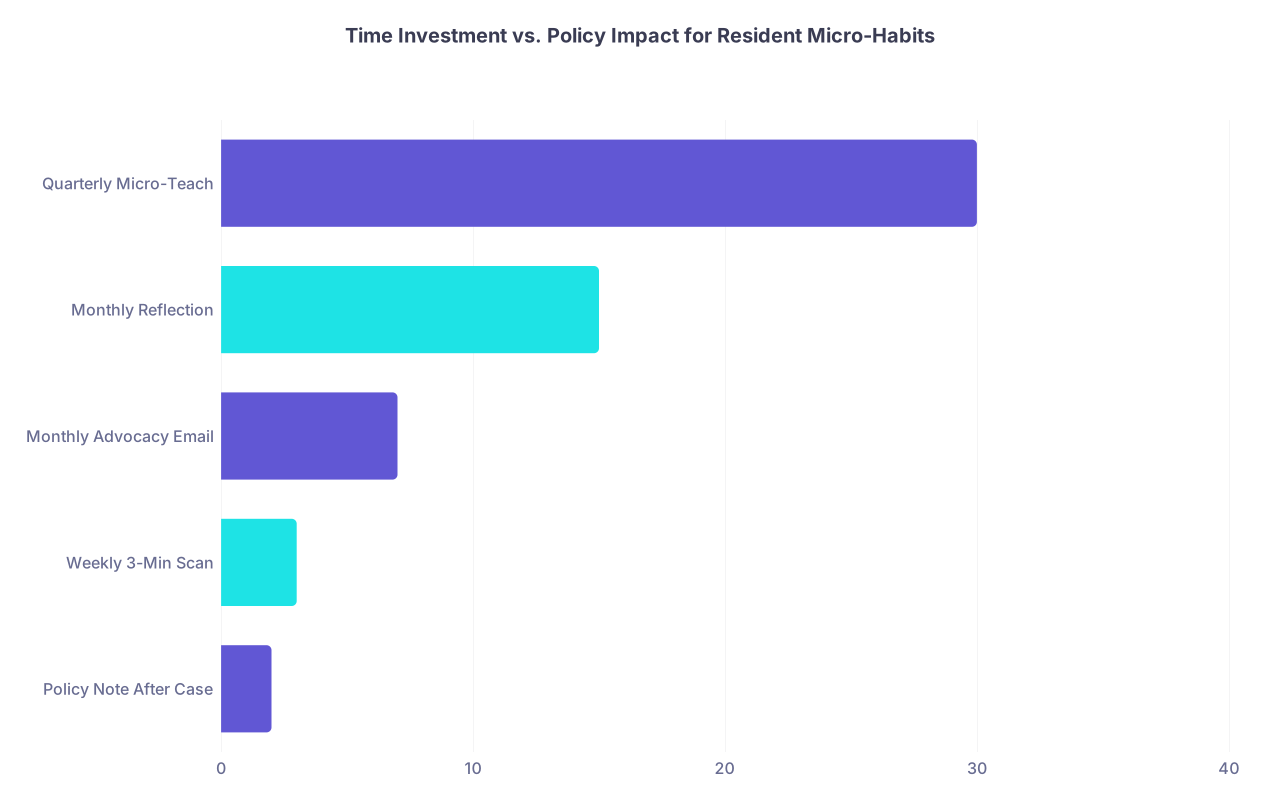
| Category | Value |
|---|---|
| Policy Note After Case | 2 |
| Weekly 3-Min Scan | 3 |
| Monthly Advocacy Email | 7 |
| Monthly Reflection | 15 |
| Quarterly Micro-Teach | 30 |

| Step | Description |
|---|---|
| Step 1 | See policy problem in patient care |
| Step 2 | Log brief note in phone |
| Step 3 | Weekly 15 min policy block |
| Step 4 | Scan 1-2 policy sources |
| Step 5 | Send advocacy email or take small action |
| Step 6 | Plan micro-teach or reflection |
| Step 7 | Deliver micro-teach or write reflection |
| Step 8 | Accumulate stories and insights |
| Step 9 | Create larger outputs - op-eds, talks, projects |
The Bottom Line
Three things you should walk away with:
- You can stay active in health policy as a resident using micro‑habits that fit inside 2–15 minutes. Awareness, voice, and action do not require a fellowship or extra degree.
- Systematic note‑taking on policy‑relevant cases is your secret weapon. Those quick bullets become advocacy emails, talks, QI projects, and op‑eds.
- Your goal is not to fix the system during residency. Your goal is to become the kind of physician who reflexively connects bedside reality to policy levers—and practices acting on that, in small, sustainable ways.