
The average resident QI project dies in a poster session and never touches hospital policy. That is a waste of everyone’s time.
You are not doing a quality project to check a box. You are trying to change how your hospital behaves. That means you must structure the project from day one with policy in mind: who owns the decision, what levers exist, what data they respect, and how you package your results so they are impossible to ignore.
Here is how to do that, step by step.
Step 1: Pick a Problem That Can Actually Become Policy
If you choose the wrong problem, no amount of statistics or passion will get you a policy change.
You want something:
- Frequent or high‑impact enough to matter
- Measurable with data you can reliably get
- Tied to existing regulatory, safety, financial, or reputational pressures
- Owned by a clear group (committee, department, executive), not “everyone”
Skip the vague “improve communication” and “increase awareness” projects. They rarely become policy. Instead, reframe into something specific and auditable.
Concrete examples that lend themselves to policy:
- Standardized handoff checklist for MICU transfers
- Mandatory VTE risk assessment completion on admission in the EHR
- Automatic palliative care consult trigger for repeated ICU admissions
- Hard‑stop EHR alert for weight‑based heparin dosing
- Standard timeout script for central line insertion
If you are not sure whether an issue is “policy‑able”, ask bluntly:
“Is there or could there be a policy, order set, or protocol that controls this behavior?”
If the answer is no or a long confused silence, find a sharper problem.
Use the “Policy Levers” Test
Before committing, identify what specific levers could be pulled if your project works. Examples:
- New or revised hospital policy
- EHR order set / default change
- Credentialing requirement
- Nursing or physician standard work
- Mandatory checklist or form
- Inclusion in resident or nursing orientation
- Inclusion in performance dashboards
If you cannot name at least one realistic lever, this is a publication project at best, not a policy project.
Step 2: Map the Power Structure Before You Start
Residents love starting with a literature search. Leadership cares about something else first: “Who owns this, and who is going to be mad?”
You need a stakeholder map before you write a single PDSA cycle.
Identify the Policy Owners
For a project to influence hospital policy, you must know:
- Which committee can approve a policy change?
- Which executive sponsors that committee?
- Who controls the EHR build, nursing workflows, and clinical protocols?
In practice, for most acute care hospitals, policy often flows through:
| Area | Typical Decision Body |
|---|---|
| Patient safety | Patient Safety / QI Committee |
| Clinical care | Medical Executive Committee |
| Nursing practice | Nursing Practice Council |
| EHR changes | Clinical Informatics / IT |
| Education | GME Committee |
Ask your program director or quality officer:
“Who would have to say yes for this to become a formal policy or protocol?”
Write down names and committee names. Treat that like your target audience list.
Find the People Who Can Quietly Kill Your Project
Policy is not just about “who approves.” It is also about “who can stall this indefinitely.”
Common veto players:
- IT leadership (“this EHR change is too complicated”)
- Nursing leadership (if it adds documentation burden)
- Pharmacy (if it affects formulary or dispensing workflows)
- Finance (if it drives cost without clear savings or risk reduction)
- Risk management (if it creates liability exposure)
You do not wait until the final presentation to discover their concerns. You bring them in early, even if it is for a 15‑minute hallway chat:
- “If we proposed X, what would be your biggest concerns?”
- “Where have similar efforts failed before?”
- “What data would you need to feel comfortable supporting this?”
You are not being political. You are being effective.
Step 3: Frame the Project in the Language of Policy Makers
Leadership does not care that your intervention is “interesting.” They care about:
- Compliance with regulations
- Avoiding serious safety events
- Financial impact (cost savings or revenue protection)
- Reputation (public quality metrics, Leapfrog, CMS, etc.)
- Workforce burden and morale
So you structure your problem statement and aim with that in mind.
Build a Policy‑Grade Problem Statement
A lazy problem statement:
“We have variable adherence to sepsis bundles on the wards.”
A policy‑ready problem statement:
“Only 58% of eligible ward patients at our hospital receive all three core sepsis bundle elements within 3 hours, compared with a state benchmark of 74%. This is associated with higher mortality and exposes the hospital to CMS financial penalties and liability risk.”
See the difference? You are already talking their language: benchmarks, mortality, penalties, risk.
Set an Aim That Looks Like a Policy Target
Your aim should be:
- Specific, numeric, time‑bound
- Linked to an outcome that matters to leadership
- Logically connected to a policy or standard you could write
Good:
“Increase documented VTE risk assessment completion from 62% to 90% of medical inpatients within 6 months by implementing a mandatory EHR risk assessment step in the admission order set.”
Bad:
“Improve resident awareness of VTE risk assessment.”
Policy responds to the first one. No one writes policy to “improve awareness.”
Step 4: Design Methods That Produce Policy‑Friendly Evidence
Hospital policy committees are not asking for an RCT. They want:
- Clear baseline data
- Simple, believable outcome measures
- Demonstrated improvement over time
- Evidence that the change is sustainable and scaleable
- Minimal negative side effects or staff burden
You structure your methods around that.
Choose Outcomes That Tie Directly to Policy Levers
Pick 1–2 primary outcome measures that:
- Are easy to define and extract
- Map directly onto a behavior you can regulate via policy
- Align with external metrics if possible (CMS core measures, etc.)
Examples:
Percentage of central line insertions with documented complete sterile checklist
→ Ties directly to a central line insertion policy.Time from recognition of sepsis to first IV antibiotic
→ Ties to a sepsis protocol and order set.Rate of inappropriate telemetry orders per 100 patient days
→ Ties to telemetry use policy and EHR order restrictions.
Add balancing measures (harm or unintended burden):
- Nursing documentation time
- Alert fatigue (number of EHR alerts per shift)
- Staff satisfaction scores related to the workflow
Policy makers are much more comfortable signing off when you show you have checked for collateral damage.
Use a Simple, Respectable Design
Do not overcomplicate it. For most resident projects:
- Interrupted time series with run charts is fine.
- Pre‑post with multiple PDSA cycles is fine.
- You do not need multivariate regression to get a policy adopted.
What leadership wants is:
- Enough baseline data to show the problem is real
- Several months of post‑intervention data to show stability
- Visuals that show a clear shift, not random noise
A run chart that shows 6–8 consecutive points above the old median is powerful.
Plan for Reliable Data Collection Upfront
Sloppy data ruins your credibility. Build this in from day one:
- Use existing data streams whenever possible (EHR reports, safety events, billing data)
- Define inclusion/exclusion criteria in plain language
- Pre‑test your data pull on 10–20 cases and spot check against charts
- Prefer automated, repeatable queries to manual chart review
If you need manual data collection, keep it lean:
- Sample a fixed number of cases per week (e.g., first 10 eligible admissions)
- Use a one‑page audit tool with binary fields
- Train your data collectors, even briefly, and check interrater agreement
Step 5: Bake Ethics and Professionalism Into the Project
You are not just changing a workflow. You are shaping how clinicians are required to behave. That has ethical weight.
Get the Right Oversight
You do not run to IRB for everything, but you do not ignore them either.
Basic rule of thumb:
- If this is internal QI aimed at local improvement, with minimal risk and no randomization → typically QI, often IRB exempt, but confirm with your institution’s QI/IRB pathway.
- If you are assigning different groups to different interventions, handling sensitive identifiable data, or intending to publish in a way that clearly identifies the institution → you likely need formal IRB review.
Do not guess. Email the IRB or QI office with a one‑paragraph project summary and ask for a determination.
Respect Staff Autonomy and Workload
Policies are blunt instruments. They remove a degree of autonomy or add workload. You must confront that.
So during design, ask frontline staff:
- “If this became mandatory, what would be the biggest pain point?”
- “What parts of this can we automate in the EHR so you are not clicking extra boxes?”
- “Where do you need flexibility or exceptions written into the policy?”
Then reflect that in your proposal:
- Clear exceptions or override conditions
- Time estimates showing minimal additional burden
- Whenever possible, replace two steps with one improved step, instead of just adding
Ethically, you should not design a policy that makes your colleagues’ lives miserable for marginal benefit. And practically, they will fight it.
Center the Patient in Your Narrative
Policies created only to reduce risk or save money are fragile. The ethical anchor is patient benefit.
You structure your narrative around:
- Preventing harm (falls, CLABSI, readmissions, missed sepsis)
- Improving equity (standardizing care that is currently inconsistent)
- Respecting patient preferences (eg, structured goals of care discussions)
Explicitly connect your intervention to patient dignity and safety. Not as a slogan. As a through‑line.
Step 6: Design Interventions That Can Be Written as Policy
This is where many resident projects fall apart. They come up with a clever idea that cannot be expressed as a clear rule or workflow.
Policies and protocols need:
- Clear criteria: when it applies
- Clear actions: what must be done
- Clear ownership: who does it
- Implementation details: tools, forms, EHR elements
So as you design your intervention, keep asking:
“How would this be written on a single‑page policy or embedded in an order set?”
If you cannot answer, trim or sharpen the intervention.
Focus on “Defaulting to the Right Thing”
Policies that work usually:
- Make the desired behavior the easiest option
- Use defaults, checklists, or standard order sets
- Remove or restrict clearly harmful options
Examples:
- Changing default telemetry duration to 24 hours with mandatory renewal → much more enforceable than “order less telemetry.”
- Embedding VTE prophylaxis in every admission order set with forced choice (appropriate prophylaxis vs documented contraindication) → more effective than telling people “remember VTE.”

| Step | Description |
|---|---|
| Step 1 | Identify Problem |
| Step 2 | Map Stakeholders |
| Step 3 | Design Policy Friendly Aim |
| Step 4 | Collect Baseline Data |
| Step 5 | Design Interventions |
| Step 6 | Test with PDSA Cycles |
| Step 7 | Demonstrate Improvement |
| Step 8 | Draft Policy or Order Set |
| Step 9 | Present to Committee |
| Step 10 | Policy Adoption |
| Step 11 | Monitor for Sustainment |
Step 7: Run PDSA Cycles Like a Policy Pilot, Not a Science Fair
Plan‑Do‑Study‑Act cycles are not a formality. They are your rehearsal for hospital‑wide policy.
Treat each cycle as:
- A test of feasibility
- A test of unintended consequences
- A chance to refine what would eventually be written into policy
Start Small, But Start in the Real World
Test in:
- One ward
- One service
- One shift
- One subset of patients
Then watch very closely:
- Did people follow the new process without hand‑holding?
- Where did they experience friction or confusion?
- Did anything scary or risky happen?
Document those lessons brutally honestly. Leadership respects projects that show they have learned and adjusted, not ones pretending the first version was perfect.
Iterate Toward Something Scalable
Do not lock in your first design. Plan 3–5 real cycles:
- Micro‑pilot (1–2 clinicians, 1–2 weeks)
- Single ward for a month
- Multiple wards or services
- Broader roll‑out with less intense support
- Sustainability test (after removing extra reminders)
At each step, simplify the process. The end state must be something that does not depend on a heroic resident reminding everyone at morning report.
Step 8: Package Your Results for Policy Committees, Not Posters
Most residents build a poster and then wonder why policy does not change. Because policy is not made at poster sessions.
You need two things:
- A tight, visual data story.
- A concrete, ready‑to‑adopt policy or protocol draft.
Build a “One‑Page for Leadership”
This is your most important deliverable. One page, front only, that includes:
- Problem statement (with baseline data and external benchmarks)
- Aim (clear, numeric, time‑bound)
- Intervention description in 2–3 bullet points
- Before‑and‑after metrics (preferably in a small chart)
- Balancing measures (showing no significant harm)
- Proposed policy change or EHR change in plain language
- What you need from them: “Approve X”, “Authorize EHR build Y”, “Assign owner Z”
Example structure:
- Header: “Reducing Inappropriate Telemetry on General Medicine”
- 1–2 sentences: Why it matters (wasted beds, cost, alarm fatigue)
- Chart: telemetry use per 100 patient days before and after
- Bullet: Intervention (order set changes, education, daily review)
- Bullet: Outcomes (30% reduction, no increase in RRT or codes)
- Bullet: Requested policy: “Limit telemetry on general medicine to indications A/B/C, with 24‑hour automatic expiration”
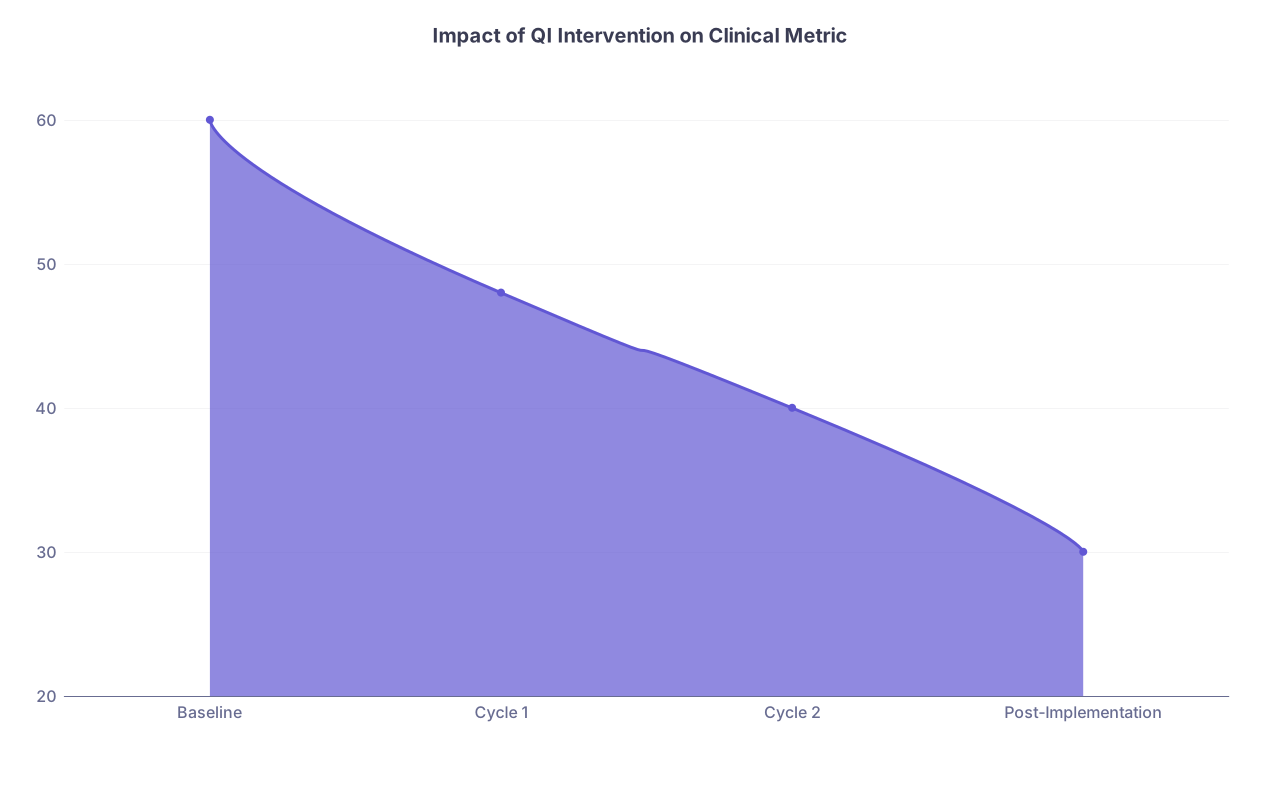
| Category | Value |
|---|---|
| Baseline | 60 |
| Cycle 1 | 48 |
| Cycle 2 | 40 |
| Post-Implementation | 30 |
Bring a Draft Policy, Not Just an Idea
You want the committee to be editing, not inventing. Do their homework for them.
Bring:
- A draft policy document (based on existing hospital policy template)
- Suggested language for the EHR order set or alert
- A brief implementation plan (education, go‑live date, responsibility)
That draft may not be what gets adopted word‑for‑word, but it moves the conversation out of the abstract and into “what exactly will this say?”
Step 9: Work the Process: How to Get On the Agenda and Survive the Room
Policies rarely pass because someone made a persuasive speech out of the blue. They pass because someone did quiet, boring work beforehand.
Get on the Right Agenda
Tactics that work:
- Ask your QI office or patient safety officer to sponsor you. They often have standing spots on key committee agendas.
- Present your work first at a smaller, friendlier venue (department meeting, residency QI forum) and get your attending or program director to co‑sponsor the request to the hospital committee.
- Time it with existing institutional priorities (e.g., before a Joint Commission visit, during a system wide push on sepsis or readmissions).
Do not just email the committee chair a poster and hope.
Pre‑Wire the Leaders
The worst thing you can do is surprise powerful people in a meeting. Before the big committee:
Send your one‑pager to key leaders with a short note:
“Would value your feedback before we present this next month. Are there any major concerns you see?”Schedule 15‑minute touch‑points with:
- Chief medical officer or designee
- Nursing leadership
- IT/informatics lead
- Quality/safety officer
Your goal: walk into the room with no major veto players hearing your idea for the first time.
Handle Pushback Like an Adult
You will get objections. Examples:
- “This will be too much work for nurses.”
- “We tried something like this 5 years ago and it failed.”
- “IT does not have bandwidth for more EHR changes this quarter.”
You do not get defensive. You:
- Acknowledge the concern.
- Reference your pilot data if it addresses it.
- Offer phased implementation or compromise if that keeps the core intact.
Example response:
“I hear the concern about added workload. In our pilot on 3 South, the new checklist added about 30 seconds per central line insertion, which nurses reported as ‘acceptable’ in our debriefs. We also eliminated a redundant form which saved them time elsewhere. I am happy to include a 3‑month review clause in the policy to revisit if the burden is higher than expected.”
That kind of response signals maturity and makes adoption more likely.
Step 10: Lock in Sustainability and Ownership
If your project depends on you as a resident, it will die when you graduate. Policy is how you protect the work from turnover.
But policy alone is not enough. You need:
- A clear owner
- Embedded measurement
- A feedback loop
Assign an Owner in the Policy Itself
Good policies specify:
- Which role or department is responsible for:
- Monitoring compliance
- Addressing noncompliance
- Updating the policy when needed
Do not let that be “residents” or “whoever.” Suggest a realistic owner:
- Unit‑based nursing leadership
- Service line quality lead
- Departmental clinical operations committee
You can write into the policy:
- “The Medicine Quality Committee will review telemetry utilization quarterly and recommend changes as needed.”
Build the Metrics into Existing Dashboards
If your outcome measure is not tracked somewhere regularly, it will fade.
Find an existing structure:
- Unit‑based scorecards
- Hospital quality dashboard
- Monthly service metrics
Ask the quality office:
“Can this specific measure be added to the existing dashboard for at least 12 months post‑implementation?”
That makes backsliding visible.
Plan for Handover
You will leave. The policy must live on.
So before you are done:
- Identify a junior resident or fellow to inherit the “QI champion” role.
- Make a brief “project legacy” document: problem, interventions, policy, key contacts, data sources.
- Email that document to your program, QI office, and the policy owner.
You are not just finishing a project for your CV. You are handing off a clinical and ethical responsibility.
Step 11: Protect Your Professionalism and Ethics Along the Way
Last piece. This is under “personal development and medical ethics” for a reason.
Residents sometimes:
- Inflate their results to impress leadership.
- Gloss over negative balancing measures.
- Frame policy primarily around cost savings.
That is how trust erodes.
Do the opposite:
- Present your data honestly, including limitations.
- Show balancing measures clearly, even if not flattering.
- Explicitly state how patient welfare and equity were central to your design.
If you are ever tempted to fudge or omit, step back. Ask yourself:
“If this policy is adopted for the next 10 years, would I be proud of the way I presented the evidence behind it?”
Your reputation in that hospital system goes further than you think. Protect it.
Key Takeaways
- Start with a problem that can realistically become a clear, enforceable policy or protocol, and map the people who control that decision before you design anything.
- Design your QI project to produce policy‑friendly evidence: clean baselines, simple outcomes tied to behavior, balancing measures, and PDSA cycles that stress‑test the workflow.
- Do the political and ethical work: pre‑wire key stakeholders, bring a draft policy and one‑page summary, handle pushback maturely, and build ownership and measurement into the policy so it survives long after you finish residency.