
The belief that you need years of advocacy to be taken seriously in public health policy is false. You need six focused months and a disciplined plan.
If you are starting with essentially zero advocacy experience, you are not “behind.” You are unfocused. That is fixable. What you cannot do is wander from webinar to webinar and call it advocacy. Programs, mentors, and policymakers can smell that from across the room.
Here is the fix: a six‑month, stepwise plan that turns “no experience” into an actual policy track record.
Step 0: Choose a Problem, Not a Vibe (Week 0–1)
Most people fail at advocacy before they begin because their “issue” is just a vibe: “health equity,” “mental health,” “rural care.” Too broad. Too fuzzy. Impossible to show impact in six months.
You need one concrete problem. With boundaries.
Use this filter:
- It affects a population you can actually reach in six months.
- There is at least one existing organization already working on it.
- You can tie it to a clear policy lever: legislation, reimbursement, regulation, institutional policy, or local governance.
Examples that pass this test:
- Street medicine access for people experiencing homelessness in your city
- Safe staffing ratios on your hospital’s med‑surg floors
- Access to medication‑assisted treatment (MAT) for opioid use disorder in county jails
- Language access (interpreters) in your county’s public clinics
Now, sharpen it further into a working problem statement:
“Within six months, I will contribute to a concrete policy change, policy product, or institutional decision related to [X] for [Y population] in [Z setting].”
You are not “interested in advocacy.” You are working on one problem.
Step 1: Become 70% Literate Fast (Weeks 1–2)
You do not need to become a national expert. You need to be just literate enough that local experts will take you seriously and not have to start from zero when they talk to you.
Your 10‑Day Rapid Background Protocol
For 10 days, spend 60–90 minutes daily. No more, no less.
Read 3 short, high‑yield items:
- CDC, WHO, or NIH overview page on your issue
- 1–2 recent policy briefs (Kaiser Family Foundation, Commonwealth Fund, state health department, or a major nonprofit)
- Your state or city health department page on the topic
Scan the actual policy text:
- One relevant law, regulation, or institutional policy (e.g., state bill on MAT access, hospital policy on interpreter use).
- You do not need to understand every clause. Skim structure, definitions, and enforcement.
Find the players:
- Identify:
- 2–3 local organizations
- 2–3 key government or institutional actors (e.g., county health board member, medical director of a clinic, state legislator with a relevant bill)
- Write down: name, role, and how your issue touches their domain.
- Identify:
You are building a quick mental map:
Who is affected → what is happening now → who is deciding things → who is already working.
At the end of Week 2, you should be able to explain your issue in 90 seconds without sounding lost. If you cannot, you are not ready to “advocate” yet.
Step 2: Attach Yourself to an Existing Engine (Weeks 2–4)
Trying to build your own advocacy initiative from scratch as a beginner is how people waste six months. You need to plug into something already moving.
Target: one real affiliation you can put on a CV and talk about without embarrassment.
Where to Look (Concrete, Not Theoretical)
- Local public health departments (advisory boards, working groups, town halls)
- Hospital committees (ethics, quality improvement, DEI, community benefit)
- Specialty societies (AMA sections, ACP advocacy, AAP chapters, APHA sections)
- Community‑based organizations (harm reduction groups, legal aid clinics, refugee resettlement agencies)
| Option Type | What You Actually Do |
|---|---|
| Local CBO | Outreach, data, testimony help |
| Hospital Committee | Draft policies, implement QI |
| Professional Society | Policy letters, lobby days |
| Public Health Dept | Comment on plans, task forces |
How to Reach Out Without Sounding Clueless
Your email needs three things: humility, specificity, and an offer.
Example:
Subject: Medical student interested in supporting [X issue] work
Dear [Name],
I am a [MS2 / MPH student / resident in X] with a specific interest in [your clearly defined issue]. I have been learning about [1–2 concrete aspects, e.g., recent state bill, local overdose data] and saw that your team is working on [program, campaign, policy].I am looking for a way to contribute in a limited but focused capacity over the next 4–6 months. I can help with [examples: basic data analysis, background research, drafting testimony, preparing educational materials, outreach to clinicians]. I am not seeking credit or authorship; my priority is to learn and be useful.
Would you be open to a 20–30 minute call to discuss whether there is a small project where an extra pair of hands would be helpful?
Best,
[Name, role, institution]
Send 5–10 of these, not one. Expect 2–3 responses. One alignment is enough.
Your goal by end of Month 1:
- One defined role or project with an existing advocacy group or policy body
- At least one real meeting scheduled and completed
If after 3 weeks you have zero traction, your outreach is poor or your ask is too vague. Fix that before you blame “lack of opportunities.”
Step 3: Design a 6‑Month Product, Not Just “Experience” (Weeks 3–4)
You do not just want exposure. You want a deliverable. Something that exists in the world: a policy brief, a testimony script, a data summary that informed a decision, an institutional guideline you helped revise.
In your first conversation with a potential mentor or organization, you ask very specific questions:
- “What decision or policy change are you trying to influence over the next 6–12 months?”
- “Where do you usually get stuck—data, narratives, drafting, logistics?”
- “What small project would you hand to a trainee if you had one today?”
Then you propose ONE concrete, time‑bounded project.
Examples:
- Draft a 3–4 page policy memo summarizing evidence to support a hospital’s new policy on language access.
- Create a 1–2 page evidence summary for a state bill on naloxone availability and help prepare testimony talking points.
- Analyze a de‑identified dataset from a clinic to show readmission patterns before a quality improvement policy decision.
- Develop a brief report and slide deck on interpreter use or restraint use in your hospital to present to an ethics or quality committee.
You make this explicit:
“My goal is that by [Month 6], we have [specific product] that you can actually use in [committee/meeting/legislative process]. I can commit [X] hours per week.”
If they cannot imagine any product you could own, that is not a good first advocacy home. Go find another.
Step 4: The 6‑Month Timeline (Weeks 1–24)
Now we turn it into an actual schedule. No vague “over the next several months.”
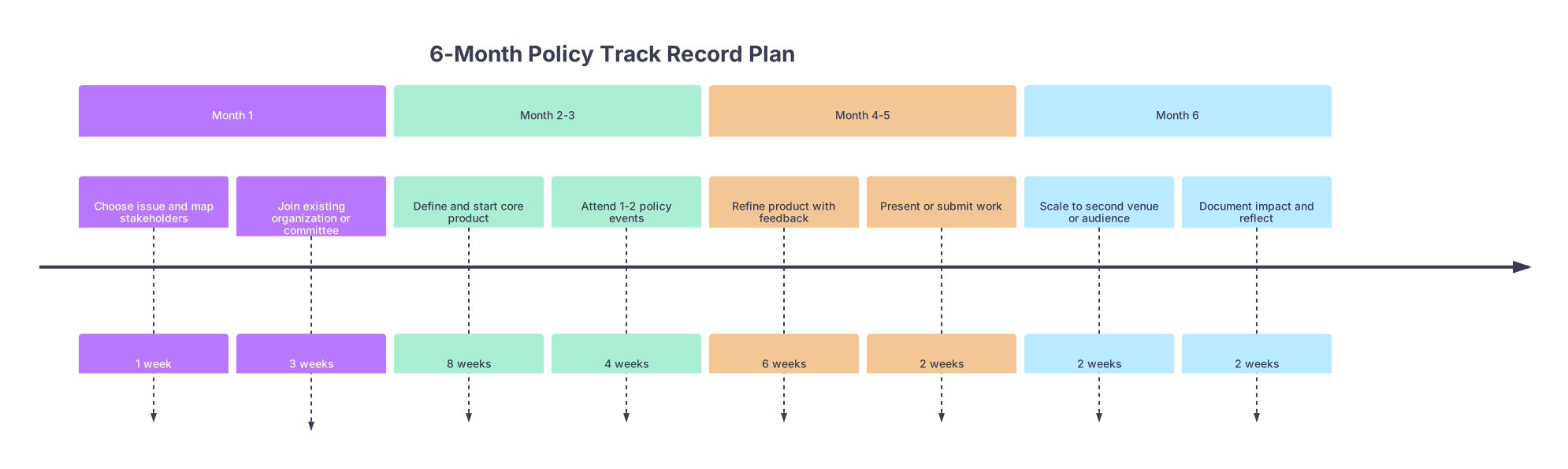
| Period | Event |
|---|---|
| Month 1 - Choose issue and map stakeholders | 1 week |
| Month 1 - Join existing organization or committee | 3 weeks |
| Month 2-3 - Define and start core product | 8 weeks |
| Month 2-3 - Attend 1-2 policy events | 4 weeks |
| Month 4-5 - Refine product with feedback | 6 weeks |
| Month 4-5 - Present or submit work | 2 weeks |
| Month 6 - Scale to second venue or audience | 2 weeks |
| Month 6 - Document impact and reflect | 2 weeks |
Months 1–2: Set Up and Early Work
Weekly target: 3–5 hours.
You are doing:
- Issue reading (done by end of Week 2)
- Outreach and meetings
- Drafting your project scope
- Beginning background research or data work
By end of Month 2, you must be able to say in one sentence what your project is and who it serves:
“I am developing a policy brief for the county health department on expanding MAT access in county jails, using local overdose and recidivism data plus evidence from other states.”
If you cannot say that, your six‑month plan is already at risk.
Months 3–4: Deep Work and First Visibility
This is where you put in real, quiet hours.
Key tasks:
- Collect data (literature, local stats, anecdotal accounts)
- Draft your central product (brief, memo, protocol, testimony, analysis)
- Check in every 2–3 weeks with your mentor or team lead
And you add small visibility moves:
- Attend one public meeting (county board, hospital committee, legislative hearing) where your issue appears
- Submit short written public comment if appropriate (even just 1 page, signed with your role)
- Introduce yourself after a meeting to one additional stakeholder and say exactly what you are working on
You are not grandstanding. You are signaling: “I am here, I am working on this concretely, and I am listening.”
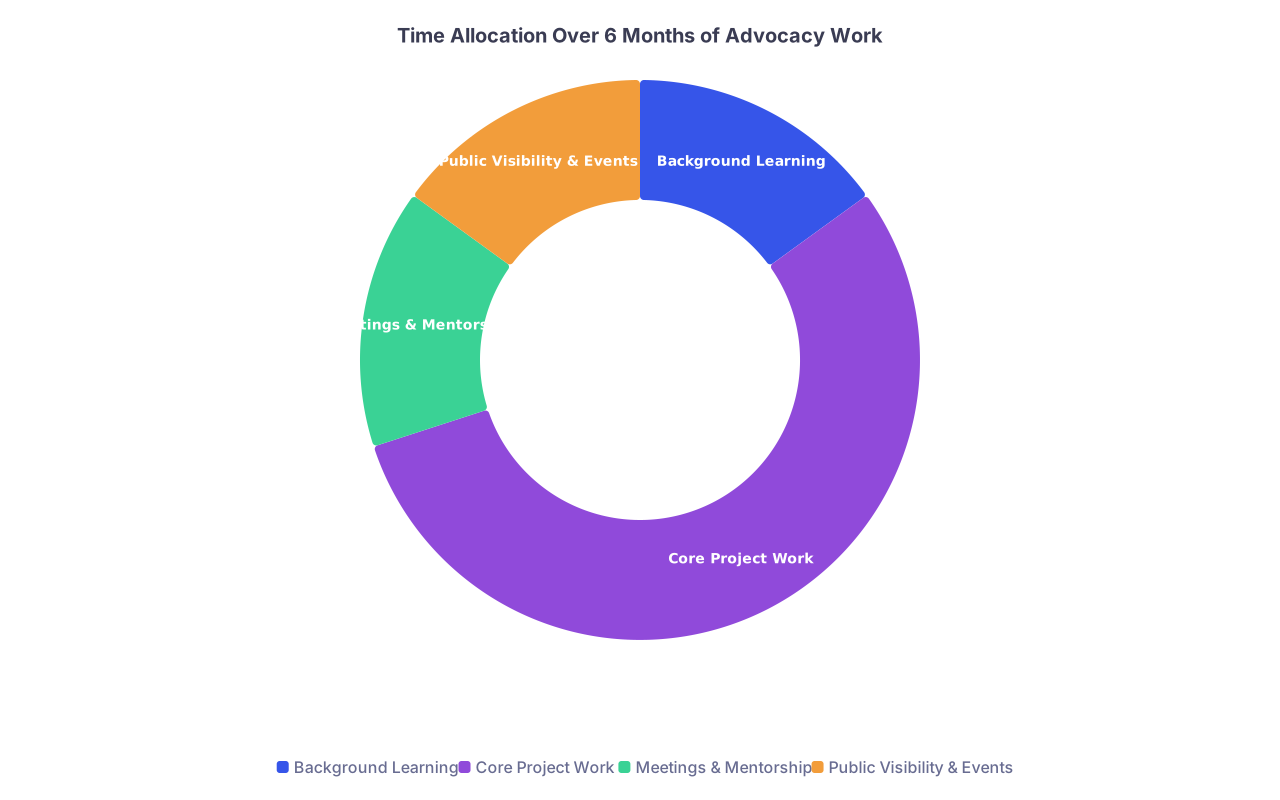
| Category | Value |
|---|---|
| Background Learning | 15 |
| Core Project Work | 55 |
| Meetings & Mentorship | 15 |
| Public Visibility & Events | 15 |
Months 5–6: Deliver, Present, and Multiply
By early Month 5, you should have a functional draft of your product. Imperfect but real.
Your job now:
- Get at least two rounds of feedback from people who will actually use it.
- Revise mercilessly based on their needs, not your ego.
- Push for at least one setting where it is presented, used, or referenced.
Examples of endpoints:
- Your policy memo is presented at a hospital leadership, ethics, or quality meeting.
- Your evidence brief is submitted to legislative staff, included in coalition materials, or cited in testimony.
- Your analysis is used to support a grant application, a program design, or a departmental policy decision.
- You present a short talk at a local or regional meeting (APHA state affiliate, hospital grand rounds, community coalition meeting).
Then, one more step: repurpose.
If you wrote:
- A 4‑page brief → turn it into a 700‑word op‑ed or blog with your organization’s name.
- A data analysis → turn it into a one‑slide visual summary for a committee plus a poster for a small conference.
- Testimony text → convert to a template other colleagues can adapt.
Now you have multiple outputs from one core project. Much more impressive than six disconnected “experiences.”
Ethics: How to Do Advocacy Without Being Performative
You are supposedly in the phase of “personal development and medical ethics.” Good. Then you should care deeply about how not to do advocacy like a tourist.
Here are the rules I have seen broken endlessly:
Do not jump into “speaking for” communities you barely know.
Early on, your job is to amplify, not dominate. Ask: “Who is already speaking about this, and how can I back them up?”Do not harvest stories without consent.
No “I had a patient once who…” in public testimony unless you have explicit permission and the story is de‑identified and ethically shared.Take your own profession’s complicity seriously.
Public health policy often means calling out healthcare systems, not just “the government.” That includes your own institution. You can be tactful without being useless.Avoid savior narratives.
If your story sounds like “I discovered poor people in Month 2 and decided to help” then you have work to do. Center systems, not your heroism.Redirect attention to structure.
Instead of “this tragic individual case,” tie it to reimbursement rules, laws, staffing ratios, zoning, immigration policy, etc. Ethics and policy live there, not in sentiment alone.
Ethical advocacy is slower and less glamorous than what you see on social media. It is also much more sustainable and respected by people who do this for a living.
Concrete Weekly Schedule Template (3–5 Hours/Week)
You probably have exams, call, or rotations. So here is a realistic minimal structure.
| Day | Time Block | Task Type |
|---|---|---|
| Monday | 30–45 min | Reading / evidence search |
| Wednesday | 60 min | Core product drafting |
| Friday | 60–90 min | Data / analysis / revisions |
| Variable | 60 min | Meeting or event (biweekly) |
You protect these like clinic time. No “I will fit it in when I can.” That is how six months vanish.
How to Talk About Your Track Record After 6 Months
At the end of six focused months, you want to be able to say things like this in an interview, personal statement, or networking conversation:
“I worked with [X organization] on [Y issue]. Over six months, I developed [specific product] that was used by [policy body / committee] to [inform / support] [decision or process]. That experience taught me how evidence, stories, and political constraints interact in real policy decisions, and I am now working to expand that project to [new setting].”
Notice the structure:
- Who you worked with
- What you produced
- Where it went
- What it changed or supported
- What it taught you
That is what “track record” sounds like. Not “I attended some advocacy days and I am very passionate about social justice.”
Common Failure Modes (And How to Avoid Them)
I have watched a lot of well‑intentioned people waste their advocacy year. Here is the short list of traps.
1. The Webinar Trap
You sign up for every advocacy webinar. Reproductive rights, climate, housing, gun violence. All good topics. None of them become your actual work. You feel busy. Your track record is zero.
Fix:
Cap yourself at two general webinars. Everything else must tie directly to your chosen project.
2. The Overbuild Trap
You try to start a brand‑new initiative: “National Medical Students Against X.” You make a logo. Instagram account. Slack. No one runs the day‑to‑day. Six months later, you have a dead social media page and no policy impact.
Fix:
For your first six months, you may not found anything. You must embed within existing infrastructure.
3. The Ghosting Trap
You get excited, commit to a project, and then exams or rotations hit. You vanish without communicating. People remember that. It is unprofessional and unethical.
Fix:
- At the start, explicitly state your likely crunch periods.
- Before each exam block or rotation change, email: “For the next 2 weeks, I will be less available; here is what I can realistically do.”
- If life implodes, step down cleanly: “I overcommitted; I need to hand this off. Here is everything organized to make that easier.”
4. The Ego Trap
You start caring more about being seen as “an advocate” than about the boring, incremental work. You post more than you produce. You chase “speaking opportunities” with nothing under them.
Fix:
- Set a rule: you may not post publicly about your advocacy until you have at least one deliverable actually used by someone.
- Ask your mentor periodically: “Where am I being helpful, and where am I just making more work for you?”
Optional: Layer In Medical Ethics Properly
If you want this aligned with “medical ethics” rather than generic activism, you can explicitly frame your project with ethical principles:
- Justice: Who is systematically benefiting or losing from the current policy?
- Autonomy: How does the policy structure real choices for patients or communities?
- Beneficence / Non‑maleficence: Where is harm being created or prevented at a systems level?
- Professional responsibility: What obligations do clinicians have to act beyond the bedside in this specific issue?
You can incorporate that by:
- Including a brief ethics lens section in your policy memo.
- Presenting the project at an ethics grand rounds or committee meeting.
- Co‑authoring a short commentary with an ethicist or faculty member on your case.
That way, your six months show not just activity but thoughtfulness: you are treating policy as an extension of clinical ethics, not a side hobby.
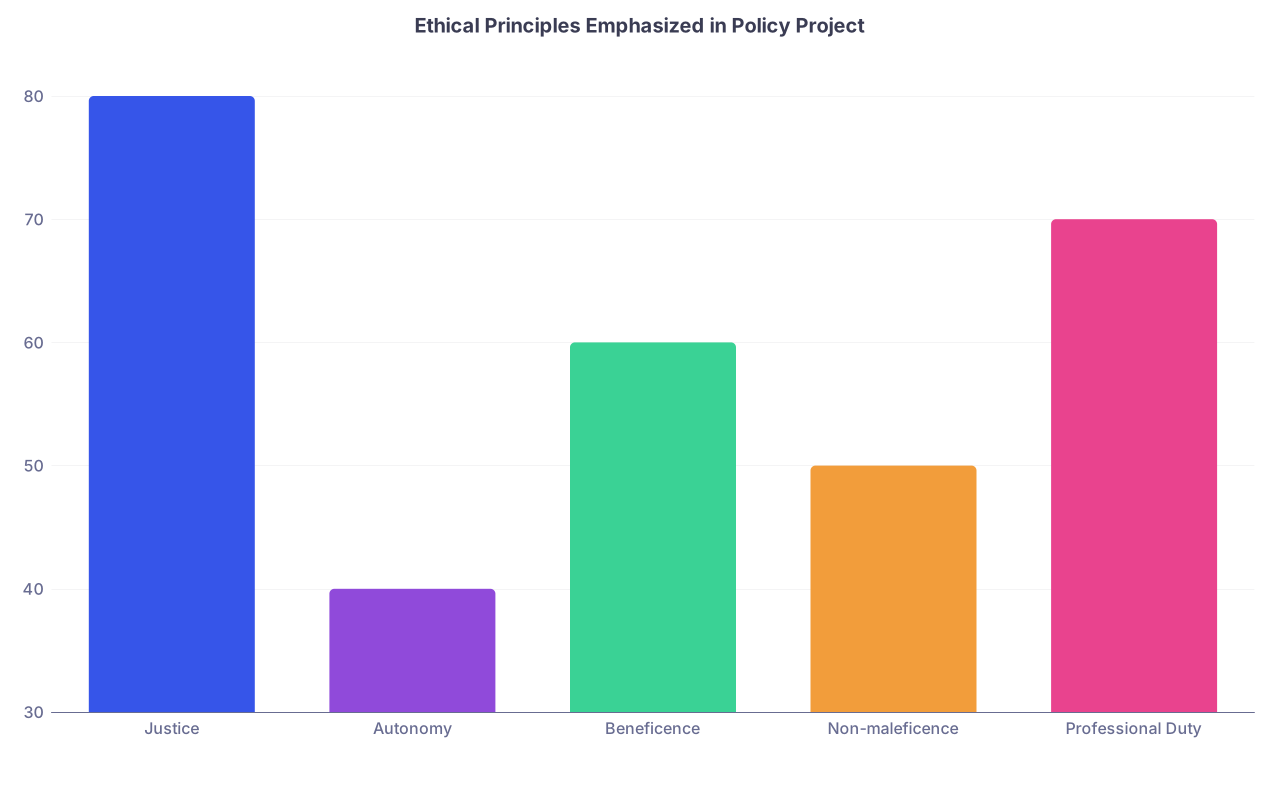
| Category | Value |
|---|---|
| Justice | 80 |
| Autonomy | 40 |
| Beneficence | 60 |
| Non-maleficence | 50 |
| Professional Duty | 70 |
The Bottom Line
You do not need a decade of advocacy to be credible in public health policy. You need:
- A single, sharply defined issue and a 10‑day crash course to become functionally literate.
- One real organizational home and a concrete 6‑month product that others actually use.
- A disciplined weekly schedule and the discipline to show up, revise, and finish.
Do that for six months and you will not be “the person with no advocacy experience” anymore. You will be the person who picked a problem, did the unglamorous work, and left behind something real.