
The way most physicians write their first op-ed on public health is backwards.
They start with what they want to say instead of what the public or policymakers need to hear. That is why smart doctors crank out beautifully written pieces that land nowhere—no editor bites, no policymaker cares, no change happens.
You can fix that. And you can do it with a simple, repeatable template.
I am going to walk you through a concrete structure you can use tomorrow morning to draft a publishable public health op-ed—plus the ethical guardrails that keep you out of trouble.
This is not “how to write better.” This is “how to get a public health op-ed out of your head and into a real outlet, without spending 20 hours lost in drafts.”
Step 1: Pick a Narrow, Actionable Public Health Angle
Most first op-eds die right here. The topic is too broad, vague, or academic.
Bad starting topics I see constantly:
- “We must improve mental health care.”
- “We need to address health inequities.”
- “Climate change is a huge health threat.”
These are conference themes, not op-ed angles.
You need:
- A focused problem.
- A specific audience that can act.
- A realistic, concrete ask.
Think of it as: “This specific group should do this specific thing because of this specific evidence and lived reality.”
Examples of good narrow angles:
- “State legislators should permanently fund telehealth for rural prenatal care beyond the public health emergency.”
- “Hospital credentialing committees must stop using BMI cutoffs that block safe gender-affirming surgery.”
- “City council should approve supervised consumption sites in neighborhoods with documented overdose clusters.”
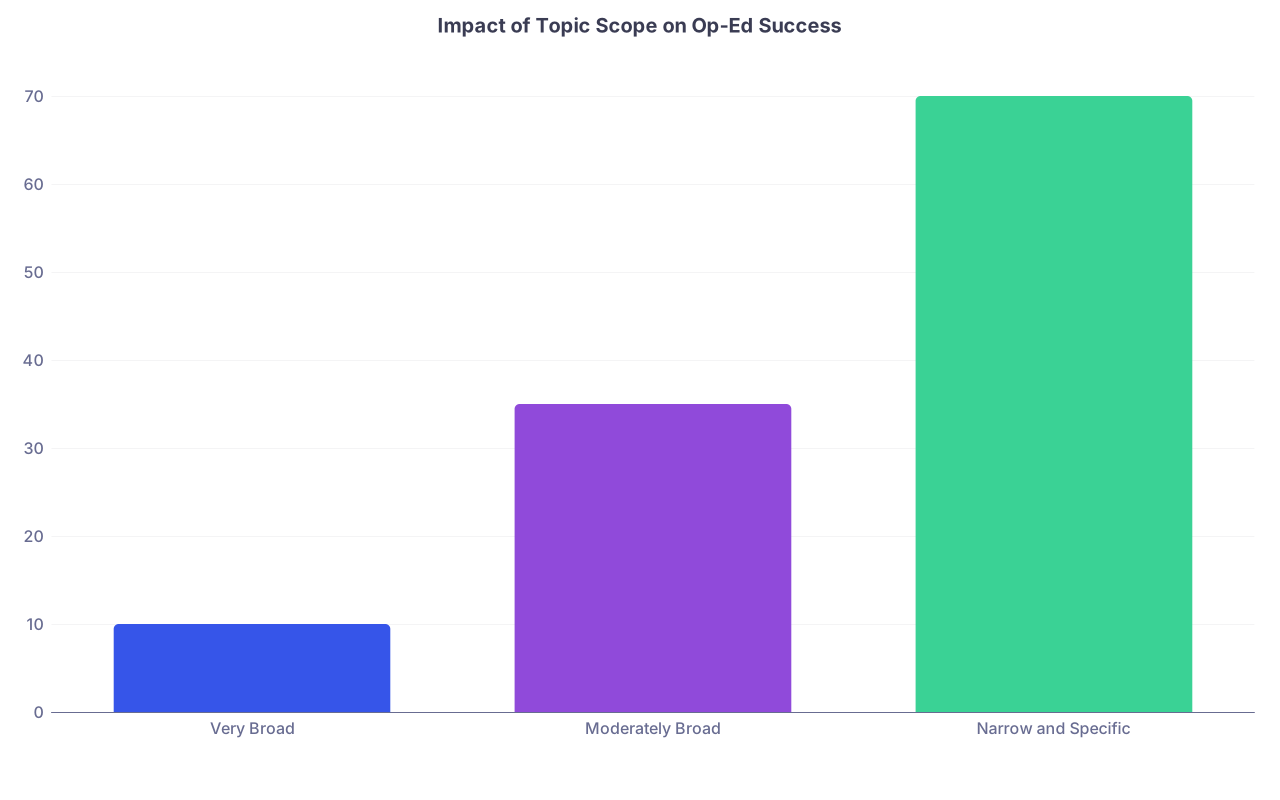
| Category | Value |
|---|---|
| Very Broad | 10 |
| Moderately Broad | 35 |
| Narrow and Specific | 70 |
A quick filter to test your topic
Ask yourself three questions:
Who exactly can fix this?
If the answer is “society,” “everyone,” or “the healthcare system,” your topic is too broad. You want: “state legislature,” “hospital board,” “school district,” “insurer.”What single policy or practice change do I want?
Not “support mental health.” Something like “eliminate prior authorization for buprenorphine for Medicaid patients” or “add air filtration standards to local school building codes.”Can I explain the problem and solution to a bright high school student in 60 seconds?
If not, you are still in seminar mode.
If your answers are fuzzy, narrow the topic until they become sharp. Only then move on.
Step 2: Use a Proven 7-Paragraph Op-Ed Template
You are not writing a textbook chapter. You are writing a 750–900 word guided missile.
Here is the template I give residents and faculty who want to publish fast. It works for public health issues across the board.
The 7-Paragraph Template
Hook + Thesis (2–3 sentences)
- Start with a vivid, specific scene, data point, or jarring contrast.
- Pivot quickly to your thesis: who should do what.
Zoom out: why this matters now (3–5 sentences)
- One short paragraph linking your example to the broader public health problem and current context (law, news, policy window).
Evidence and scope of harm (1–2 paragraphs)
- High-yield data. National or state-level stats plus any strong local data.
- Very selective: 2–4 key numbers, not a literature review.
Your credibility and ethical lens (1 short paragraph)
- One or two sentences on who you are and what you see.
- Connect explicitly to public health ethics: equity, justice, harm reduction, autonomy, etc.
The solution: 2–3 specific actions (1–2 paragraphs)
- Concrete policy or practice changes.
- Name the actors and the steps. No generic “we must raise awareness.”
Address the main objection (1 paragraph)
- Anticipate the strongest pushback and answer it head-on.
Close with urgency and a clear call (1 short paragraph)
- Restate the ask, tie it to values, end on a forward-looking or human image.
A skeleton you can literally paste and fill
You can draft your first version by filling in something like this:
- P1: “Last week in my [clinic/ER/ICU], I saw… [brief story]. This should not still be happening in [city/state/country]. [Actor] can fix this by [main ask].”
- P2: “This is not an isolated case. [Context: law, trend, recent news]. Without action, [consequence].”
- P3–4: “We know [problem] is widespread. [Data point 1]. [Data point 2]. [Local or population-specific data]. The burden falls hardest on [group].”
- P5: “As a [role], I see [x] every week. From a public health ethics perspective, continuing [status quo] trades [value] for [value] in a way that is not defensible.”
- P6–7: “There is a better option. First, [step 1 by actor]. Second, [step 2]. Third, [step 3, if needed]. These steps are [feasible/affordable/already working in place X].”
- P8: “Critics worry that [objection]. But [rebuttal + evidence or example].”
- P9: “We will not solve [big issue] overnight. But we can stop [specific harm] this year if [actor] [primary action]. The patients I see deserve at least that.”
You now have a blueprint. Stop worrying about “flow” until you have each paragraph in ugly draft form.
Step 3: Anchor It in a Real Patient Story—Without Violating Ethics
The public does not care about your regression model. They care about people. You need at least one human anchor story.
But this is also the fastest place to violate patient privacy or wander into emotional manipulation.
How to use a story the right way
Composite, not identifiable
- Combine details from several real patients.
- Change age, neighborhood, job, timing—anything that is not central to the point.
- Avoid rare conditions or extremely unique circumstances.
Keep clinical details minimal and essential
You are not presenting a case at M&M. You are illustrating a harm pathway.- Good: “a 56-year-old bus driver with long-standing diabetes who lost his foot after months of delayed wound care.”
- Bad: A blow-by-blow of labs, imaging, and every treatment decision.
Respect and dignity
The story should highlight system failure, not imply patient blame.
“Despite doing everything the guidelines asked of him…” goes a long way.Consent when appropriate
If a specific patient has publicly advocated on an issue and you want to reference them clearly, ask for explicit permission. Written, not just verbal.
Here is the line I have seen work well in many published pieces:
“Details of this story are drawn from several patients I have cared for; identifying information has been changed to protect privacy.”
Use it. Or your version of it.
Step 4: Decide Who You Are Talking To (Before You Draft)
Most physicians vaguely write “to the public.” That is why the piece ends up talking to no one.
Pick one primary audience, and write as if you are addressing them across the table.
Common audiences for public health op-eds:
- State or local legislators
- City council or mayor
- Hospital or health system leadership
- School boards
- Insurers or Medicaid directors
- Tech companies / employers (for workplace health policies)
- Professional societies

| Step | Description |
|---|---|
| Step 1 | Start |
| Step 2 | Legislature |
| Step 3 | Health system leaders |
| Step 4 | School board |
| Step 5 | Insurer or Medicaid |
| Step 6 | Employers |
| Step 7 | Craft specific ask |
| Step 8 | Who can act directly? |
Then lock in:
- Their power: What lever can they actually pull?
- Their constraints: Budget, politics, timeline, legal.
- Their language: They do not talk about “relative risk reduction.” They talk about costs, voters, safety, liability, efficiency, fairness.
Rewrite your thesis for that audience
Generic:
“We must expand access to medication-assisted treatment for opioid use disorder.”
Targeted to a state legislature:
“State legislators should remove prior authorization requirements for buprenorphine for Medicaid enrollees, so that patients can start life-saving treatment during the visit when they finally ask for help.”
Notice:
- “State legislators” — not “we.”
- “Remove prior authorization requirements” — not “improve access.”
- “Medicaid enrollees” — a real lever jurisdiction.
- “During the visit when they finally ask for help” — a concrete, emotional situation.
Once you run your thesis through that filter, the rest of the piece becomes much clearer.
Step 5: Use Plain Language and 3–4 Killer Data Points
Academic training ruins a lot of physician op-eds. The writing is cautious, jargon-heavy, and obsessed with citation density.
Editors do not want your reference list. They want:
- 2–4 memorable data points.
- Explained in plain language.
- Sourced from credible, recognizable bodies.
How to choose your data
National or global anchor
Something like:- “More than 100,000 Americans died of drug overdoses last year.”
- “Black women are three times more likely to die from pregnancy-related causes than White women.”
- “Heat waves now cause more deaths in the United States than any other weather disaster.”
Local or population-specific stat
- “In our county, the pediatric asthma hospitalization rate is double the state average.”
- “Among Indigenous patients in our health system, wait times for mental health care are three times longer than for non-Indigenous patients.”
A cost or system impact figure (if relevant)
- Hospital bed days.
- Lost work days.
- Direct healthcare spending.
- Cost-effectiveness of your proposed intervention.
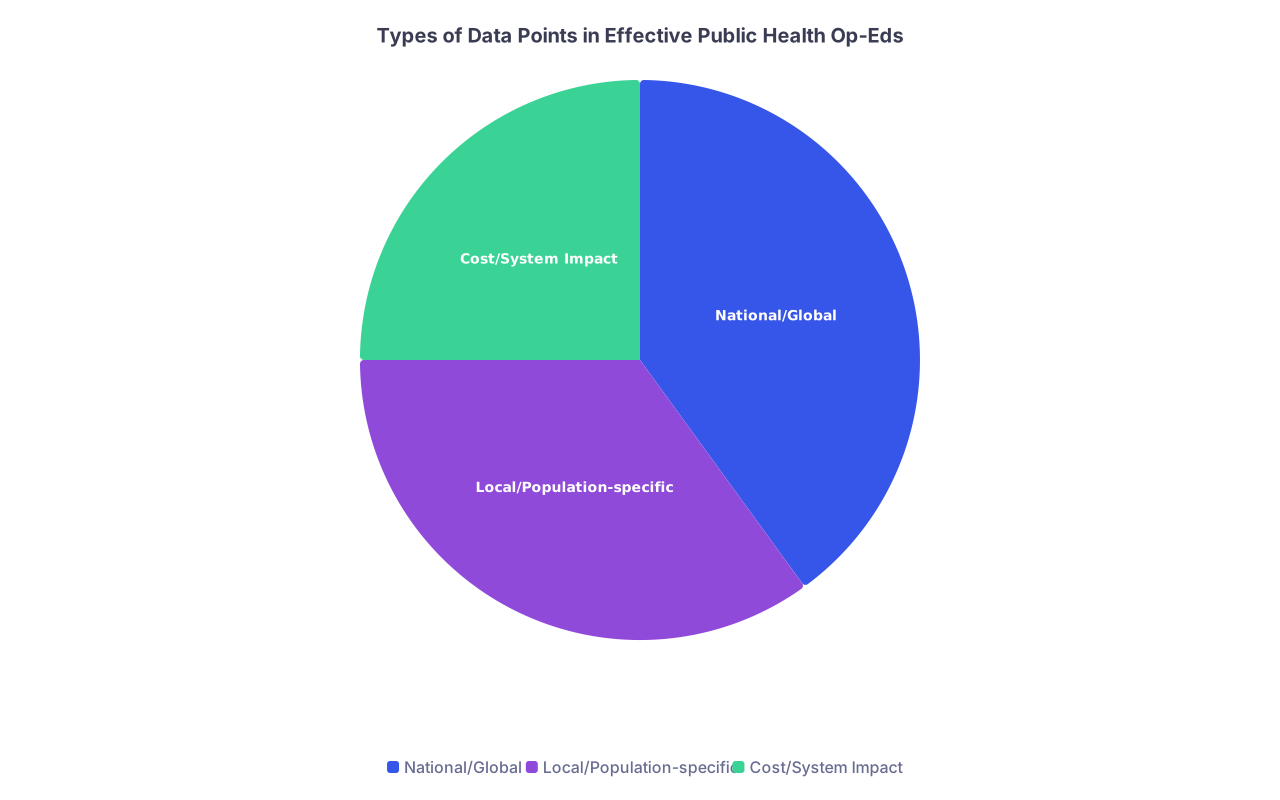
| Category | Value |
|---|---|
| National/Global | 40 |
| Local/Population-specific | 35 |
| Cost/System Impact | 25 |
Translate statistics into human language
You do not write:
“Studies suggest that telehealth interventions may significantly reduce disparities in access to…”
You write:
“When we started allowing telehealth visits, my rural patients no longer had to take an entire day off work and drive 70 miles to see a specialist.”
Then:
“This is not just anecdote. In a recent study, rural patients using telehealth were 30 percent more likely to complete follow-up visits than those who had to travel in person.”
Evidence + lived reality. That combination convinces.
Step 6: Build the Ethical Spine Explicitly
You are not just another columnist. You are a physician writing in the PUBLIC HEALTH POLICY / PERSONAL DEVELOPMENT AND MEDICAL ETHICS space.
Use that.
Your op-ed should quietly answer:
- What ethical principle is at stake?
(Justice, equity, nonmaleficence, beneficence, respect for autonomy, solidarity.) - Who is currently bearing the burden?
- Who is benefiting from the status quo?
Do not turn it into an ethics seminar. One sharp paragraph is enough.
Examples of short ethical framing sentences:
- “We have effectively decided, through inaction, that rural children are worth less than urban children. That is an ethical choice, not just a budget decision.”
- “Public health ethics demands that we protect those who cannot protect themselves. Right now, we are failing that basic test for incarcerated patients with mental illness.”
- “Our current policy shifts the cost of convenience for hospitals onto low-income patients. That violates any reasonable sense of justice.”
Own your role: “As a physician, my ethical duty does not end at the clinic door. When policy choices predictably harm patients, remaining silent is itself a choice.”
That line is uncomfortable for some, but it is true.
Step 7: Turn Your Idea into a Clean Draft in 90 Minutes
This is the part where most people stall for weeks. They “tinker” with outlines and never produce a full draft.
You are going to brute-force a draft using a strict time box.
A 90-minute drafting protocol
15 minutes – Bullet your 7 paragraphs
- One line each: hook, context, data points, your role, 2–3 action steps, main objection, closing line.
- Do not write sentences. Only bullets.
45 minutes – Write without editing
- Set a timer for 45 minutes.
- Write each paragraph roughly in order.
- If you get stuck, drop “[FILL THIS]” and move on.
- No backspacing for style. You are allowed to fix typos and nothing else.
20 minutes – Cut, clarify, and simplify
- Remove jargon: “utilize” becomes “use,” “impactful” becomes “effective,” etc.
- Shorten sentences that run past two lines.
- Kill any clause starting with “While it is complex…” or “It is important…” They waste space.
10 minutes – Ethics and disclosure check
- Is any patient identifiable? If yes, fix it.
- Any conflicts of interest (consulting, grants, board positions) that need a one-line disclosure? Add it at the end of the draft or in the email to the editor.
- Any statements that overreach the evidence? Either support them, or rephrase clearly as opinion.
At the end of 90 minutes, you will have a complete, ethically sound, structurally correct draft. Not perfect. But real.
Perfectionism is how physicians avoid public writing. Do not indulge it.
Step 8: Select the Right Outlet and Match Their Format
You do not submit the same piece to JAMA Viewpoint and the local newspaper.
Different outlets, different rules:
| Outlet Type | Typical Length | Audience Focus |
|---|---|---|
| National Newspapers | 650–900 words | General public |
| Local/Regional Papers | 600–800 words | Local public |
| Major Online Magazines | 800–1200 words | Policy-interested |
| Medical Journals (Viewpoint) | 1200–1500 words | Clinicians/policymakers |
| Specialty Society Blogs | 700–1200 words | Clinicians in field |

How to choose
- If your ask targets state or local policy, local or regional newspapers are often more powerful than national outlets.
- If your ask targets hospital or professional society policy, consider:
- Specialty society blogs.
- Major medical journal Viewpoints or perspectives.
- If your ask is federal policy, a national newspaper or large online magazine is worth trying.
Always, always check:
- Word count limits.
- Whether they want exclusive submissions.
- Their op-ed or “commentary” guidelines page.
Then adapt:
- Cut or expand to their word count.
- Adjust the level of jargon: journals tolerate more technical language; newspapers will not.
- Keep citations minimal. Newspapers may just mention “according to the CDC” in-text; journals will expect numbered references.
Step 9: Send a Tight Pitch Email (And Expect Silence)
Physicians chronically over-write their first email to an editor. They attach a full CV, a bio paragraph, and three paragraphs explaining their noble intentions.
Editors do not care. They want:
- A short subject line.
- Two-sentence pitch.
- One-sentence credibility line.
- The full op-ed pasted below (not just as an attachment).
Basic pitch email template
Subject: Op-ed submission on [specific policy change] in [state/city]
Body:
Dear [Editor name],
I am submitting an 800-word op-ed arguing that [specific actor] should [specific action] to address [concise public health problem], with particular impact on [key group].
I am a [role – e.g., primary care physician / critical care specialist / public health researcher] at [institution], and I care for [brief description of relevant patients or population].
The piece is approximately [X] words and has not been submitted elsewhere. I have pasted it below for your convenience and can adapt it for your audience if you are interested.
Best regards,
[Name, credentials]
[Contact info]
Paste the op-ed text below the signature. Attach as a Word document if their guidelines request it.
Then wait. If you hear nothing in 5–7 days for a news-tied op-ed, or 10–14 days for a more timeless piece, you follow up once with a polite nudge. If still nothing, you move on to a different outlet.
Do not get precious about one publication. Rejection or silence is standard.
Step 10: Guard Your Professionalism and Boundaries
You are entering a public arena. Once your name and opinions are out, they are searchable by patients, colleagues, and employers.
That is not a reason to stay silent. It is a reason to be deliberate.
A few hard rules
No patient-shaming, ever
All blame runs upward—to systems, policies, resource allocation, structural determinants—not downward to individuals with the least power.No unverifiable accusations
Calling a specific hospital or politician “corrupt” without hard evidence is not advocacy. It is defamation risk.Clear about evidence vs. opinion
Phrases like “The evidence shows…” should be reserved for things actually backed by robust data.
For value judgments, own them: “I believe,” “In my view as a physician…”.Know your institutional policies
Most academic centers are fine with faculty writing op-eds, but they may have:- Requirements to state that you speak for yourself, not the institution.
- Media relations offices that help (or interfere).
At minimum, include: “The views expressed are my own and do not represent the official position of [institution].”
Internet pile-ons happen
Controversial topics—guns, abortion, vaccines, policing—draw fire. Decide in advance:- Whether you will engage on social media.
- How you will protect your mental health (muting, logging off, etc.).
- What you will do if a patient brings it up in clinic. (“I am happy to explain how I think about these issues from a medical perspective…” is usually enough.)
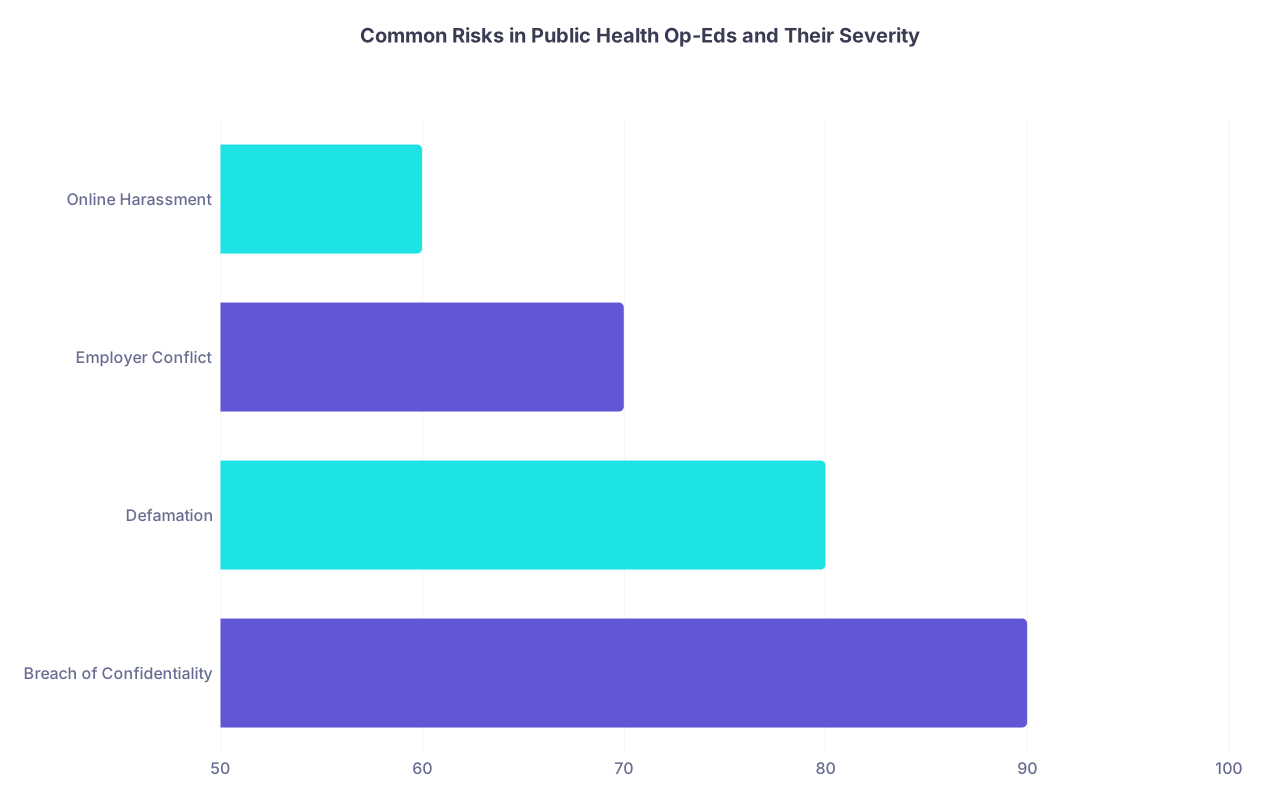
| Category | Value |
|---|---|
| Breach of Confidentiality | 90 |
| Defamation | 80 |
| Employer Conflict | 70 |
| Online Harassment | 60 |
Step 11: Turn One Op-Ed into an Ongoing Ethical Practice
You are not writing just to see your name in print. Or you should not be.
Done well, public health op-eds are part of your ethical duty as a physician—speaking up when structures harm patients.
Here is how to make it a sustainable part of your professional life:
Build a simple tracking system
Nothing fancy. A one-page spreadsheet with:
- Column A: Topic
- Column B: Target audience
- Column C: Core ask in one sentence
- Column D: Outlet submitted
- Column E: Outcome (accepted, rejected, silence)
- Column F: Date
This does three things:
- Forces you to articulate the ask clearly.
- Shows you patterns of what gets picked up.
- Lets you repurpose and update ideas over time.

| Step | Description |
|---|---|
| Step 1 | Clinical or public health observation |
| Step 2 | Identify policy problem |
| Step 3 | Define specific ask and audience |
| Step 4 | Draft op-ed using 7-paragraph template |
| Step 5 | Submit to outlet |
| Step 6 | Share and engage ethically |
| Step 7 | Revise and resubmit elsewhere |
| Step 8 | Reflect and identify next topic |
Debrief each published piece
After publication, take 10 minutes:
- Who reached out? Colleagues, journalists, policymakers, patients?
- Did anyone challenge your framing in a way that sharpened your thinking?
- What would you do differently next time?
This reflection is where “personal development and medical ethics” stop being buzzwords and become practice. You start seeing yourself not only as a technician who treats disease but as a citizen-professional who shapes the conditions that create that disease.
The Core Takeaways
Use structure ruthlessly. A focused topic, defined audience, and a 7-paragraph template will get you to a solid draft much faster than “waiting for inspiration.”
Lead with people, anchor in evidence, and name a specific fix. One composite patient story, 2–4 strong data points, and a clear, feasible policy ask beat a thousand abstract calls to “raise awareness.”
Treat public writing as part of your ethical duty, not a hobby. When policy predictably harms your patients, silence is complicity. A well-aimed op-ed is one of the simplest, most accessible tools you have to push back. Use it.