
You just finished another clinic session where three different parents complained about the same thing: the crosswalk in front of the school is a death trap. No crossing guard. Speeding cars. Near misses every week.
You document the concerns. You mention it to the school nurse. You even fire off an email to some generic “[email protected]” address. Nothing happens. Months go by. And you realize: unless someone pushes this into the policy arena, nothing is going to change.
This is where most physicians stop. They complain in the break room. They vent on group chats. Maybe post a frustrated tweet. Then they go back to work and hope nobody’s kid gets hit.
I want you in a different bucket. The very small group of clinicians who actually move something from “this is unsafe” to “there is now a law/ordinance/procedure that fixes it.”
This roadmap is how you do that. Step by step. No idealism, no fluff—just a practical protocol from complaint to city ordinance.
Step 1: Turn a Vague Complaint into a Precise Problem
Loose complaint: “The streets around the school are dangerous.”
That will die in committee every time. You need a problem that is:
- Specific
- Measurable
- Solvable at the city level
Start with a tight problem statement:
“There is no marked crosswalk or traffic calming on X Street between Y Avenue and Z Avenue, adjacent to ABC Elementary, resulting in high vehicle speeds and repeated near-misses involving children.”
Now build a basic evidence file. Nothing fancy yet. You are trying to transform “anecdotal annoyance” into “documented hazard.”
Do this:
Log cases in your clinical work
- Add a note when injuries are related to the same hazard:
- “Pedestrian struck near ABC Elementary, no crosswalk present.”
- Use a consistent phrase so later you can search your notes or EHR reports.
- Add a note when injuries are related to the same hazard:
Capture simple data points
- Number of related patient encounters over the past 6–12 months
- Severity of outcomes (ER visits, fractures, hospitalizations)
- Days of school/work missed
Get non-clinical information
- Ask the school nurse/principal:
- How often do they see near misses?
- Have they reported it to the city?
- Ask parents (in generic terms, no PHI):
- Are there specific times or locations that feel worst?
- Ask the school nurse/principal:
Take basic field notes
- On a day off, go there. Sit for 20–30 minutes during school drop-off.
- Count:
- Cars passing
- Cars speeding visibly
- Kids crossing without an adult
You are not conducting a research study. You are building a minimal evidence packet that says: this is not just “my impression as a pediatrician.” It is a pattern.
Ethical guardrails:
- Never use identifiable patient information outside appropriate, de-identified aggregate discussion.
- Do not photograph patients or children without proper consent and institutional permission.
- Keep your notes factual, not dramatized.
Your output from Step 1: a one-page “Problem Summary” that you can send, reuse, and speak from.
Step 2: Map Power and Process Before You Start Firing Emails
Physicians are used to clear structures: attending, chief, residency director, etc. City government is not like that. If you do not understand who actually controls what, you waste months talking to the wrong people.
You need to answer three questions:
Who owns this problem?
- Traffic/speeding → Usually Transportation or Public Works
- Zoning/housing → Planning or Zoning Board
- Smoking / vaping → City Council or Board of Health
- Gun safety → State + city, depending on jurisdiction
- Environmental hazards (air, water) → Public Health + Environmental Services
What is the decision-making structure?
- Strong-mayor city: Mayor’s office has outsized influence.
- Council-manager city: City manager + council are key.
- Independent boards: Health, school, transit boards may hold real authority.
How does something become a city ordinance here?
Go to the city website and find:- “City Charter” or “How a bill becomes law” (yes, many cities literally have a version of that)
- Committee structure: Transportation, Public Safety, Health, etc.
- Public hearing rules: sign-up process, time limits, written testimony deadlines.
If you want a quick overview, use something like this structure in your notes:
| Issue Type | Primary Body | Secondary Stakeholders |
|---|---|---|
| Traffic / Crosswalk | Transportation Cmte | School Board, Police |
| Tobacco / Vaping | Health Board | City Council, Schools |
| Housing Code | Housing Dept | Zoning Board, Public Health |
| Noise / Pollution | Environmental Dept | Public Health, Industry |
| Firearm Storage | City Council | Police, Legal Counsel |
Call the city clerk’s office if the website is garbage. Say exactly this:
“I am a local physician working on a public safety issue around the school zone near ABC Elementary. I am trying to understand which city committee or department would handle changes to crosswalks, speed limits, or traffic calming near schools. Who should I be talking to?”
Do not ask for “someone important.” Ask for “someone who actually handles X.” That wording helps.
Your output from Step 2: a short “Power Map” listing:
- Relevant department heads
- Committee chairs
- Your own city councilor
- The procedural steps from idea → proposed ordinance → hearing → vote
Step 3: Translate Clinical Concern into a Concrete Policy Ask
Physicians love talking about “raising awareness.” City officials do not pass “awareness.” They pass ordinances with:
- Specific actions
- Specific locations or populations
- Specific enforcement or implementation mechanisms
You need to move from: “Kids are at risk crossing the street”
To: “I am requesting the City to adopt Ordinance X which would require [specific interventions] at [specific locations] within [specific timeframe].”
Good asks have:
A narrow, realistic scope
- Example: “Install raised crosswalks and a 20 mph school zone on X Street between Y and Z, with flashing beacons during school hours.”
Evidence-based justification
You do not need a massive literature review. But two or three strong points help:- “Raised crosswalks reduce vehicle speeds and pedestrian crashes in school zones by X–Y%” (pull from credible sources: CDC, FHWA, peer-reviewed studies)
- “In our clinic, we have seen Z traffic-related injuries from this corridor over the last 12 months.”
Clear public health framing
- Not just “safety.”
- Tie to health burdens: ER utilization, long-term disability, mental health trauma, missed school days.
This is where you build a 2-page “Policy Brief”:
Page 1: Problem and Evidence
- One paragraph: What is happening.
- Bullet points: Key data (local + research).
Page 2: Proposed Solution and Rationale
- One paragraph: Specific ordinance language concept (lay terms are fine).
- Bullet points: Expected benefits, approximate cost tier (low/moderate/high), implementation partners.
Think of it as your attending’s favorite SOAP note, but for the city:
- S: Complaints & observed issues (parents, school, staff)
- O: Your counts, clinic data, any crash statistics you can find
- A: This is a modifiable hazard with preventable injuries
- P: Specific, named, time-bound actions
Step 4: Build a Small, Focused Coalition (Not a Giant Committee That Never Meets)
You will get exactly nowhere as “lone angry doctor from the hospital.” You need 3–10 aligned people or groups. Not fifty.
Core players to recruit:
1–2 school allies
- Principal, school nurse, PTA/PTO leader.
1–2 community voices directly affected
- Parent who has had a close call.
- Older child/teen who can speak (if they and parents are willing).
1–2 health professionals
- You.
- Maybe an ED colleague or trauma nurse who sees the worst outcomes.
1 local champion with political capital
- Your city councilor or someone on the appropriate committee.
Your goal with this coalition is not to create more meetings. It is to:
- Validate the problem from different angles (school, parent, health).
- Show decision-makers this is not one crank with a pet project.
- Divide tasks so this does not eat your life.
Be explicit:
- “I can provide the clinical perspective and data. I need someone from the school to speak to on-the-ground risks. I need a councilor to help with process and drafting.”
You meet once for 45–60 minutes. On Zoom is fine. Agenda:
- Clarify the specific problem and proposed solution.
- Decide who will:
- Contact which officials
- Handle parent outreach
- Collect letters of support
- Set a rough timeline (e.g., “Aim to get this introduced at the April council meeting.”)
Use simple shared documents (Google Doc is fine) for:
- Draft policy brief
- List of talking points
- List of supporters and groups
Step 5: Prepare Evidence and Story for Maximum Impact
Data moves policy. Story seals it. You need both.
Build your minimal evidence packet
Collect:
- Your 1–2 page policy brief
- A simple one-page “Data Snapshot”:
- Number of related injuries at your clinic/ED in last 12–24 months
- Any available police crash data (many cities have public dashboards)
- One or two key national stats (from CDC, NHTSA, etc.)
A visual always helps. Even a simple chart.
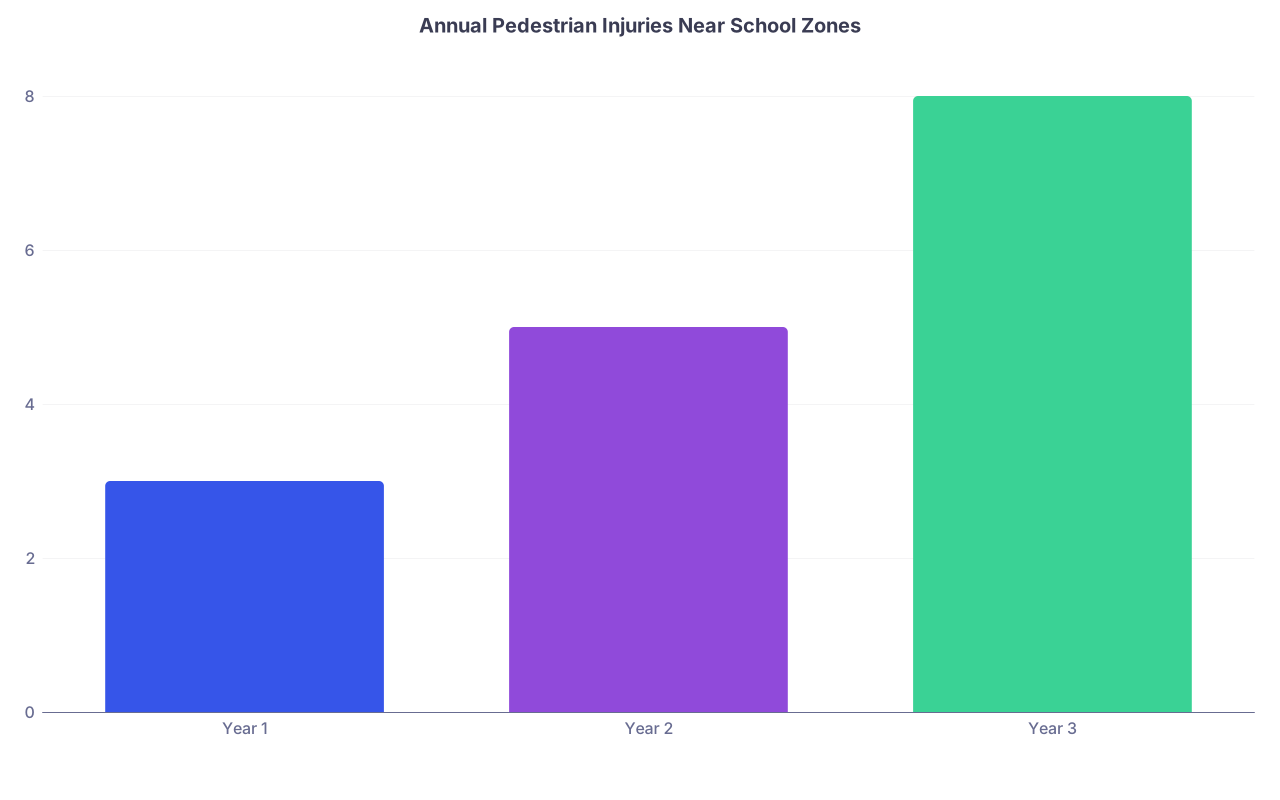
| Category | Value |
|---|---|
| Year 1 | 3 |
| Year 2 | 5 |
| Year 3 | 8 |
You are not claiming causality. You are showing a trend that supports urgency.
Shape your story
Decide in advance what you will say in 2 minutes. Literally time it.
Structure:
Who you are
- “I am Dr. X, a pediatrician at Y Hospital, and I live/work in this city.”
What you see
- “In this past year I have treated multiple children who were struck or nearly struck near school zones, including ABC Elementary.”
Concrete example (de-identified)
- “One child I treated had a femur fracture after being hit crossing in front of their school. They were out of school for weeks and needed surgery.”
The ask
- “I am here to support Ordinance [name/number], which would install raised crosswalks and a 20 mph school zone on X Street. This is a proven, low-cost intervention that will prevent serious injuries.”
The ethical frame
- “From a medical ethics standpoint, when we know there is a preventable harm and we have a feasible solution, inaction becomes a choice. You have the power to prevent these injuries.”
Do not oversell. Do not dramatize beyond the facts. You do not need to. The baseline reality is bad enough.
Step 6: Get a Sponsor and Work the Legislative Process
You now have:
- A clear problem statement
- A specific policy ask
- A small coalition
- Evidence + story
Next move: find a council member (or board member) to carry this as a formal proposal.
How to approach them
Email their office with:
- Concise subject: “Request: School Zone Safety Ordinance near ABC Elementary”
- 2–3 paragraph body:
- Who you are.
- One-sentence problem.
- One-sentence solution.
- Attach brief. Ask for a 20–30 minute meeting.
Sample closing:
“I would like to request a brief meeting to discuss whether you would consider sponsoring an ordinance to address this specific hazard. I can bring data and community members who are directly affected.”
At the meeting:
Bring:
- Your coalition rep (at least one parent or school staff).
- Printed copies of your 2-page brief.
Ask questions directly:
- “What would it take to get this introduced as an ordinance?”
- “Are there process or budget constraints we should be thinking about?”
- “Which committee would likely hear this, and what is the timeline?”
If you sense hesitation, ask:
- “Is there a narrower version of this that you would feel comfortable sponsoring as a first step?”
You want a sponsor, even if the first version is modest. Ordinances evolve.
Once you have a sponsor:
- Confirm when they will introduce it.
- Ask what kind of testimony is most helpful at hearings:
- “Do you want me to focus on data? Or on clinical stories? Or both?”
Your role now shifts from “architect” to “expert witness and organizer.”
Step 7: Testify Effectively Without Burning Yourself Out
Public hearings are where things get real. They are also where many physicians stumble—too long, too technical, too scattered.
Here is a simple structure for written and oral testimony.
Written testimony (1–2 pages)
Sections:
Heading: Your name, credentials, affiliation, city/town
Opening: Clear statement of support:
- “I am writing to strongly support Ordinance XX-123, regarding school zone safety on X Street near ABC Elementary.”
Evidence:
- 2–3 bullets: local cases (aggregated), trends.
- 2–3 bullets: research showing benefit of your proposed interventions.
Ethical anchor:
- “Physicians are obligated to prevent harm when feasible. This ordinance aligns with that duty by addressing a known, modifiable risk.”
Closing:
- “I urge you to vote in favor of this ordinance. I am available to answer questions.”
Submit by the city’s deadline and bring copies to the hearing.
Oral testimony (2–3 minutes)
Use a stripped-down version of what you wrote:
- One sentence of support
- One or two key data points
- One short clinical story
- One sentence about the specific ask
- One sentence connecting this to prevention and ethics
Practice it once or twice. Time yourself. Cut anything not essential.

| Step | Description |
|---|---|
| Step 1 | Identify Problem |
| Step 2 | Gather Basic Data |
| Step 3 | Map City Power |
| Step 4 | Draft Specific Ask |
| Step 5 | Build Small Coalition |
| Step 6 | Find Sponsor |
| Step 7 | Committee Hearing |
| Step 8 | Full Council Vote |
| Step 9 | Implementation Follow up |
You do not have to attend every single meeting. Prioritize:
- The main committee hearing
- The final council vote if your presence could sway undecided members
Step 8: Guard Your Professional Boundaries and Ethics
You are a physician first. Policy advocate second. That hierarchy matters.
A few hard rules that keep you out of trouble:
No patient identifiers, ever
- De-identify stories. No ages + specific dates + locations all at once.
- Aggregate where possible: “In the past year, I have treated several children…” not “Last Tuesday at 8:15…”
Be clear when you are speaking for yourself vs your institution
- Unless your hospital has explicitly endorsed the ordinance, use:
- “I am Dr. X, a pediatrician practicing at Y Hospital, speaking today in my personal capacity.”
- Unless your hospital has explicitly endorsed the ordinance, use:
Disclose conflicts of interest
- If you or your institution stand to gain financially (contracts, funding), disclose that plainly in testimony.
Stay in your lane expertise-wise
- You are strong on:
- Injury mechanisms, health outcomes, developmental impact, trauma.
- You are not the final word on:
- Traffic engineering design, budget specifics, legal nuances.
- You are strong on:
It is perfectly acceptable to say:
- “I defer to traffic engineers on the precise design features; my testimony is about the health impact of inaction.”
- Respect patient trust
- Do not recruit your own patients or families to testify unless:
- They initiate interest,
- They fully understand the risks of public exposure,
- You are not mixing clinical care with advocacy pressure.
- Do not recruit your own patients or families to testify unless:
Better: let a parent-teacher group or a community organizer handle community recruitment.
Step 9: Close the Loop – Implementation and Evaluation
Passing an ordinance is not the finish line. It is halftime. Implementation is where things quietly fail.
Common failure modes:
- The ordinance passes but is unfunded.
- The implementation is delayed indefinitely.
- The intervention is watered down.
You do not need to become a full-time watchdog, but you should:
Calendar check-ins
- 3 months post-vote: Has anything started?
- 6–12 months: Are the physical changes in place? Signs installed? Enforcement started?
Use polite, pointed follow-up
Email your sponsor and relevant department:“As a physician who testified in support of Ordinance XX-123, I am writing to ask about the current implementation status and timeline. Several families have asked whether the new school zone interventions are in place yet.”
Re-measure a few simple things
- Informal observation: speeds, behaviors.
- Any change in injury patterns over 1–2 years (even qualitatively).
Share back with your coalition and the community
- If it worked: circulate a short note or local op-ed showing positive impact.
- If it stalled: decide whether the issue needs another push, or whether the political window is closed for now.
A Quick Example: Turning Vaping Complaints into a Local Ordinance
Let me sketch a second scenario so you see the same pattern in a different context.
You are a family physician. Every week you see teens hooked on vape pens from the gas station across from the high school. You are done watching it.
Apply the steps:
Define the problem
- “High youth access to flavored nicotine products within 500 feet of schools in our city.”
Collect basic data
- Chart how many teens report vaping.
- Document quit attempts, nicotine withdrawal, anxiety.
- Pull national and state data on youth vaping prevalence and harms.
Map power
- City Board of Health may have authority to regulate sales.
- City Council may handle zoning of where these products can be sold.
Craft the ask
- Example ordinance:
- Ban sale of flavored nicotine products within 500 feet of schools.
- Require age verification and license suspension for violations.
- Example ordinance:
Build coalition
- School nurse, principal, a couple of parents, maybe a student group.
- A local pulmonologist or cardiologist for additional medical backup.
Get a sponsor
- Board of Health member or a city councilor on the Health Committee.
Testify
- Clinical stories: teen with panic attacks when unable to vape.
- Data: increased youth nicotine addiction, links to mental health.
Safeguard ethics
- No identifying teen details.
- Explicitly say you are not speaking for your health system unless authorized.
Follow implementation
- Check whether stores comply.
- Report back on shifts in what you see clinically over time.
The overall structure never changes. Only the content does.
Know When to Walk Away
Last piece of realism. Sometimes the politics are rotten. The city attorney says, “We will get sued.” The council is captured by developers or business interests. You will not win every fight.
Signs you are in a dead end for now:
- Your sponsor quietly stops responding.
- The ordinance is never scheduled for hearing.
- You get the same “we’ll look into it” for a year.
You have three options:
Narrow the ask further
- Pilot zone rather than citywide.
- Temporary ordinance or “trial” period.
Escalate to another level
- County or state.
- Professional society (state AAP, ACP, ACEP, etc.).
Bank the work and move on
- Document what you built.
- Hand it to a community group that wants to keep pushing.
- Pick a more winnable target next time.
Advocacy is not martyrdom. It is systems work. Choose battles that can actually shift something in a reasonable timeframe.
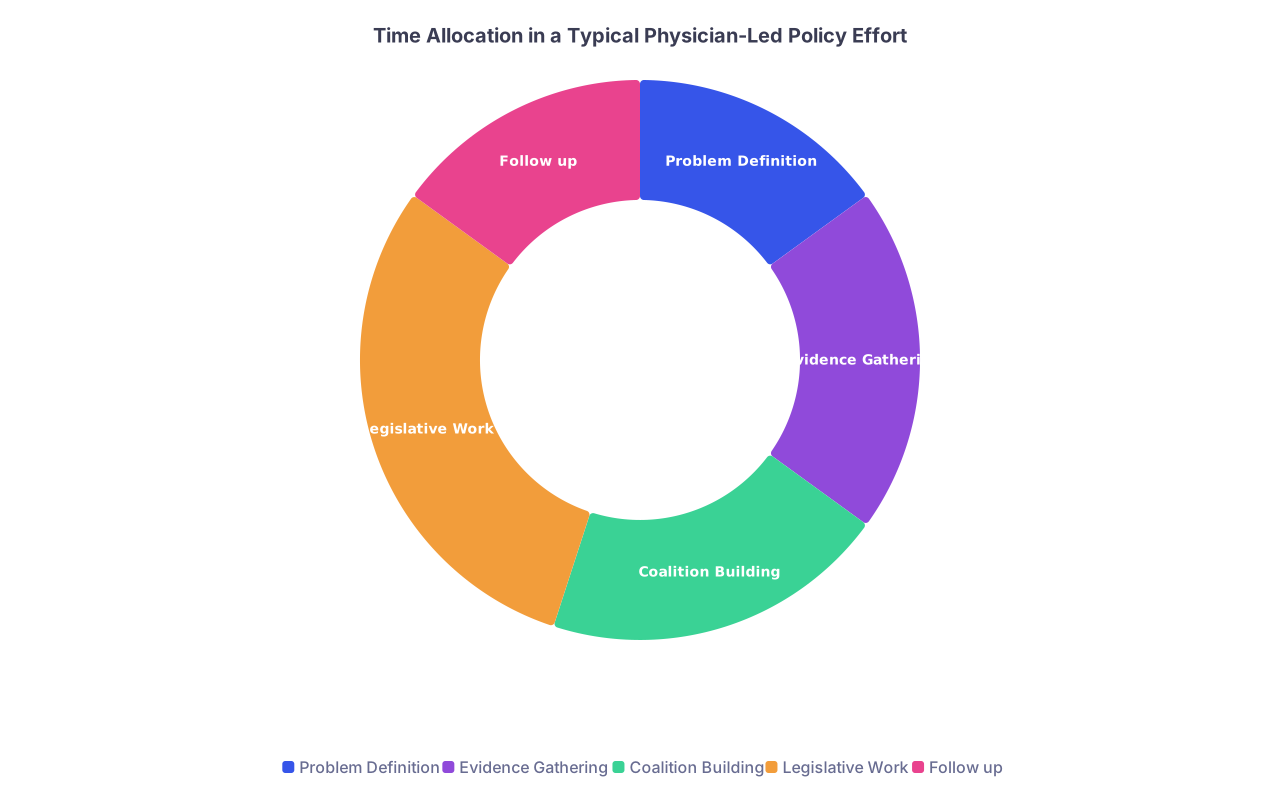
| Category | Value |
|---|---|
| Problem Definition | 15 |
| Evidence Gathering | 20 |
| Coalition Building | 20 |
| Legislative Work | 30 |
| Follow up | 15 |


The Core Takeaways
- Complaints only matter if you convert them into a specific, documented problem with a concrete policy ask.
- You do not need to “become a politician.” You just need to understand the local process, build a small coalition, and show up with evidence and a clean story.
- Your credibility as a physician is powerful in public health policy—if you protect your ethics, your data integrity, and your boundaries.