
The way many physicians email lawmakers quietly sabotages their own credibility.
Not because they are wrong on the issues, but because their words sound emotional, sloppy, or self-serving instead of grounded, clinical, and useful.
If you are a physician writing to legislators about public health or health policy, you are representing more than yourself. You are representing your profession. You either strengthen the “physicians as trusted experts” narrative or you hand ammunition to lobbyists who will gladly paint you as just another angry stakeholder.
Let me walk you through the phrases that quietly undercut you—and what to say instead.
1. The Ego Trap: “As a Highly Trained Expert…” and Other Self‑Inflating Openers
The fastest way to make a legislator stop listening is to sound like you think you are above everyone else.
Phrases that hurt you:
- “As a highly trained medical expert, I know…”
- “I’m on the frontlines and see more than any policymaker ever could…”
- “I’ve dedicated my life to this, unlike many in politics…”
This is the “ego card.” It sounds defensive and condescending. Staffers see it constantly from every field—lawyers, engineers, finance people—and mentally file it under: “Thinks being smart means they are right about policy.”
What to do instead:
- Let your expertise show through your content, not your chest‑beating.
Better lines:
- “In my clinical practice caring for patients with [condition], I have observed…”
- “At our hospital, this policy change would likely result in…”
- “Based on current evidence and national guidelines, I am concerned that…”
You are not writing an application. You are providing data. Act like it.
2. The Emotion Dump: “I Am Outraged / Disgusted / Heartbroken”
You are allowed to feel strongly. But if your email reads like a social media rant, it will be treated like one.
Phrases that undermine you:
- “I am outraged by…”
- “I am frankly disgusted that…”
- “This is absolutely heartbreaking and shocking…”
Legislative staff read hundreds of emotional emails. Your value as a physician is not that you can feel more strongly. It is that you can interpret what those feelings point to in terms of patient harm, safety, and systems impact.
Transform emotion into actionable concern:
Instead of: “I am outraged that this bill will kill patients.”
Use: “This bill, as written, increases the risk of delayed diagnosis and preventable complications for patients with [specific condition].”
Instead of: “This is heartbreaking.”
Use: “We are already seeing [X] consequences when patients lose coverage; this bill would expand those harms to [Y] more individuals.”
Emotion should be the quiet engine under your message, not the headline.
3. The Threat & Ultimatum: “I Will Tell My Patients to Vote You Out”
Empty threats are the hallmark of amateur advocacy.
Weak, credibility‑killing lines:
- “I will make sure my patients know how you voted.”
- “Physicians across this state will remember this on Election Day.”
- “If you support this, you will lose the medical community.”
You are not a political action committee. You are a physician. When you pivot from expert to political enforcer, you lose moral high ground and invite ethics questions.
Worse, some of these lines get dangerously close to implying you will exploit the physician–patient relationship for political revenge. That is a professional hazard you do not want.
Better approach:
- Describe consequences in terms of health outcomes and system strain, not threats.
Example:
- “Support for this bill will likely increase emergency department volume and uncompensated care, especially in rural hospitals.”
- “If this bill passes, it will become harder to recruit and retain specialists in our community, which directly affects access to care for your constituents.”
You are not powerless without threats. Data is your leverage. Use it.
4. The Vague, Hand‑Waving Claim: “Studies Show…” with No Substance
You lose credibility the second you sound like you are bluffing your evidence.
Problematic phrases:
- “Studies show this policy does not work.”
- “Research clearly proves that…”
- “The science says this is dangerous.”
Then… no reference. No hint of what field, what body, what guideline. Just “trust me, bro” in a lab coat.
Lawmakers and staff live in a world where every lobbyist claims “the science” is on their side. If you cannot at least gesture to real sources, your “studies show” line blends right into the noise.
Do not make this mistake. Anchor your claims:
- “Large cohort studies in [journal name] have shown…”
- “Guidelines from the American College of Physicians/ACA/AAP recommend…”
- “Systematic reviews indicate that…”
You do not need full citations in an email. But you must sound like you actually know where your evidence comes from.

5. The Patient Privacy Disaster: “Let Me Tell You About Mrs. S…”
This one is not just a credibility problem. It is a professionalism and ethics problem.
Risky lines:
- “I have a 38‑year‑old patient, a single mother of three, who…”
- “One of my patients, a teacher at the local middle school, recently…”
- “A patient at [named clinic/hospital] attempted suicide after…”
Even “de‑identified” stories are rarely as anonymous as you think. In small communities, specifics make patients easily recognizable. You risk privacy, trust, and potentially regulatory trouble.
Red flags that your anecdote is too specific:
- Small town or unique situation
- Rare diagnosis + detailed demographics
- Local institution named + identifiable event
You can still use stories—just do it right:
- Generalize specifics: “A young adult patient with type 1 diabetes…”
- Remove geographic anchors if not essential.
- Focus on pattern, not drama: “I have seen multiple patients who…”
Safe structure:
- Set up the type of patient, not the person.
- Explain the barrier or harm.
- Connect it directly to the policy.
Example:
- “Patients with chronic mental health conditions in our community already face 3–4 month wait times for outpatient care. A reduction in coverage would further delay treatment and increase emergency department utilization.”
If your story feels “juicy,” it is probably too detailed.
6. The Conspiracy Tone: “Big Pharma / Hospital Administrators / Politicians Just Want…”
Nothing destroys professional credibility faster than sounding like a YouTube comment section.
Phrases that make you sound unhinged:
- “This bill is clearly bought and paid for by pharmaceutical companies.”
- “Hospital administrators only care about profits, not patients.”
- “Politicians just want to control physicians and patients.”
Is there sometimes undue influence? Of course. But once you move into accusatory, speculative motives, you have left the realm of physician‑advocate and entered the realm of internet ranter.
Instead, stick to:
- Conflicts of interest you can actually document.
- Structural incentives with real evidence.
- Concrete mechanisms.
Examples:
- “This proposal aligns closely with talking points from [identified lobbying group], which has disclosed spending [X] on this issue.”
- “Current reimbursement structures already incentivize [behavior]. This bill would further strengthen that misalignment.”
Do not guess about motives. Describe incentives and outcomes. That is where your authority lives.
7. The Scope Creep: Pretending To Be a Policy, Legal, or Economic Expert
You are a physician. Unless you have formal training and can back it up, writing like you are also a constitutional lawyer, health economist, and political strategist is a credibility leak.
Risk‑laden lines:
- “This bill is clearly unconstitutional.”
- “This will destroy our state’s economy.”
- “This policy is a violation of basic human rights and international law.”
You may believe all of that. You might even be right. But these are not your lanes unless you have demonstrated dual expertise. Lawmakers already get this language from lawyers, think tanks, and advocacy orgs.
Your comparative advantage is clinical and public health impact. Do not dilute it.
Convert overreach into disciplined commentary:
- “Clinicians will face conflicting obligations between this statute and existing medical standards of care.”
- “This bill would likely increase preventable hospitalizations and long‑term disability claims, which carry substantial downstream costs.”
- “Professional societies and public health organizations have raised serious ethical concerns about policies that [specific impact].”
Stay in the zone where nobody in that building knows more than you do. That is where you are most persuasive.
8. The Zero‑Solution Complaint: “This Is Terrible” with No Alternative
Legislators are drowning in outrage and very short on workable solutions. If you only add to the first category, you blend in with the noise.
Weak phrases:
- “This bill is terrible and should be thrown out.”
- “Doing this will be a disaster.”
- “I strongly oppose this and urge you to vote no.” (and then… nothing)
You must not stop at “no.” If you want to be taken seriously, you have to offer at least one concrete, realistic alternative—an amendment, a pilot, a phased implementation, a narrower target.
Stronger approach:
- Oppose → Specify → Propose.
Example:
- “I urge you to oppose Section 3, which allows [specific problem]. A better approach would be to limit this provision to [defined population] and require [safeguard], as recommended by [relevant body].”
- “If the goal is to reduce costs, increasing access to [preventive service] has stronger evidence of effectiveness than [punitive measure] and does not compromise patient safety.”
You do not need a full policy paper. One or two specific alternatives put you in a different category: someone who is trying to fix, not just vent.
9. The “Dear Sir” Problem: Sloppy, Generic, or Mass‑Forward Style
You would be shocked how many physician emails to lawmakers look like chain letters from 2007.
Credibility‑killing formats:
- Generic address: “To whom it may concern” or “Dear Sir or Madam”
- Forwarded template with “Fwd: Fwd: Fwd:” still in the subject line
- ALL CAPS emphasis, multiple exclamation marks, or bolded rants
- Walls of unbroken text
If your message looks lazy, your expertise will be assumed lazy too.
Basic standards that are not optional:
- Use the correct form of address (“Senator [Name],” “Representative [Name]”).
- One clear subject line: “Opposition to HB 132: Impact on Rural Emergency Care.”
- Short, structured paragraphs—ideally no more than 3–5 sentences each.
- One screen long if possible; two max.

You are trying to make a staffer’s job easier, not harder. They are the gatekeepers. Respect their time and cognitive load.
10. The Professionalism Slip: “You Clearly Don’t Care About Patients”
You might think you are “speaking truth to power.” What you are actually doing is shutting down the only people who can vote your way.
Phrases that poison the well:
- “You clearly do not care about patients.”
- “If you vote for this, you have blood on your hands.”
- “You should be ashamed.”
These are ad hominem attacks dressed up as advocacy. Staffers will flag these as unprofessional, sometimes even as “hostile constituent.” Your future emails will be pre‑screened or mentally discounted.
Aim for firm, not personal:
- “Supporting this bill would harm many of your constituents with [condition] by…”
- “I am asking you not to support a measure that increases patient harm and clinician moral distress.”
- “Physicians in your district will be forced to choose between legal compliance and clinical best practice.”
Critique the policy. Do not psychoanalyze the person.
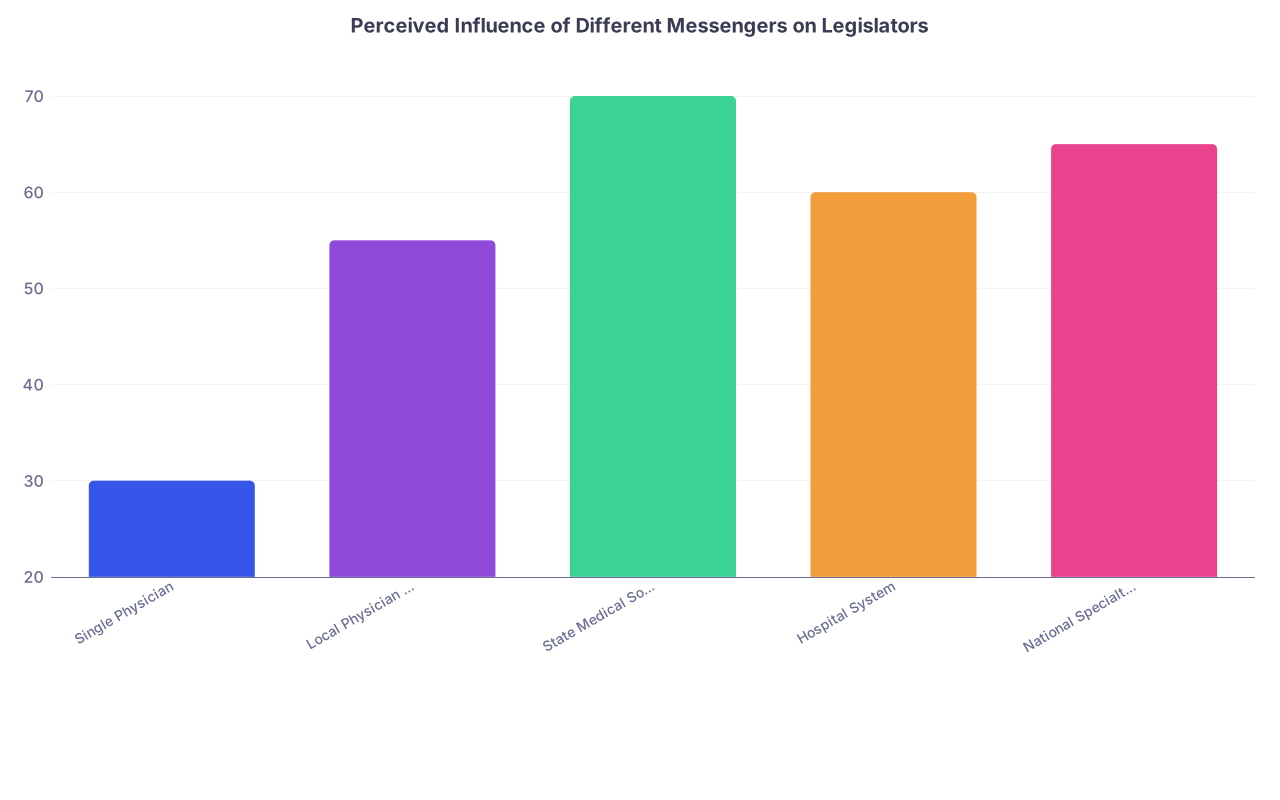
11. The “Single Doctor vs. the World” Email: Ignoring Coalition Power
Another subtle credibility mistake: writing entirely as an isolated individual, when lawmakers respond much more strongly to organized, aligned voices.
Noisy but weak format:
- “I, Dr. X, am writing to you as a solo practitioner in [town] to say…”
Better structure:
- “I am one of [X] physicians in your district caring for [population].”
- “This concern is shared by colleagues across [hospital/clinic/network].”
- “Professional societies including [A, B, C] have taken positions aligned with this request.”
You do not have to pretend to speak for everyone. You should, however, situate yourself in a recognizable ecosystem: hospital, health system, specialty society, county medical society.
| Category | Value |
|---|---|
| Single Physician | 30 |
| Local Physician Group | 55 |
| State Medical Society | 70 |
| Hospital System | 60 |
| National Specialty Org | 65 |
Lawmakers respond to numbers. Not just vote numbers—stakeholder numbers too.
12. What Strong, Credible Physician Emails Actually Sound Like
To make this concrete, here is a simplified contrast.
| Situation | Weak Phrase | Strong Phrase |
|---|---|---|
| Referencing expertise | “As a highly trained expert, I know…” | “In my practice caring for patients with…” |
| Showing emotion | “I am outraged by this bill.” | “This bill would increase preventable complications by…” |
| Invoking evidence | “Studies show this does not work.” | “Guidelines from [org] and data from [journal] indicate…” |
| Opposing policy | “This is terrible and must be stopped.” | “I urge you to oppose Section 4 and instead consider…” |
| Addressing legislator | “You should be ashamed.” | “Supporting this measure would place your constituents at risk of…” |
You will notice a pattern:
- Less ego, more evidence.
- Less emotion, more outcomes.
- Less accusation, more specific asks.
That is what staff remember and reuse in briefing memos. That is how you shift votes.
A Simple, Safe Structure You Can Reuse
If you want a “don’t‑mess‑this‑up” template, keep it to this rough flow:
Who you are (1–2 sentences).
Role + setting + district link. Do not oversell.What you are writing about (1 sentence).
Bill number, regulation, or issue, clearly named.What you see clinically (2–4 sentences).
Pattern of harm or benefit, not a single dramatic story.What the evidence says (2–3 sentences).
Guidelines, large studies, or consensus statements.What you are asking for (1–3 sentences).
Oppose/support, specific amendment, or preferred alternative.Close professionally (1–2 sentences).
Offer to be a resource, express willingness to clarify.
That is it. Do not turn it into an essay. Do not attach 17 PDFs. Staff will not read them.

| Step | Description |
|---|---|
| Step 1 | Identify Yourself |
| Step 2 | State the Issue |
| Step 3 | Describe Clinical Impact |
| Step 4 | Reference Evidence |
| Step 5 | Make Specific Ask |
| Step 6 | Professional Close |
FAQ (Exactly 4 Questions)
1. Is it ever appropriate to show strong emotion in an email to a lawmaker?
Yes, but it must be tightly controlled and paired with substance. One or two sentences expressing distress or moral concern are fine if they immediately transition into concrete clinical or public health implications. If the emotion becomes the main content, you lose your advantage as a physician and sound like every other angry constituent.
2. Can I mention that I am part of a political or advocacy organization in my email?
You can, but do not hide your physician identity behind advocacy branding. Lead with your clinical role and your connection to the district, then mention any relevant advocacy groups second. If the entire email is obviously a copy‑paste from an advocacy blast, staff will treat it as such. Slightly customizing and adding your own data or experience is essential.
3. How many patient details are safe to include in an anecdote?
Much fewer than most physicians think. Strip every detail that is not necessary for the policy point: age range instead of exact age, general role (“teacher”) instead of school name, “small community hospital” instead of exact facility if it is identifiable. If you are in a small town or describing a rare condition, be even more conservative. When in doubt, convert the anecdote into a pattern: “Patients in this situation often…” instead of “One particular patient…”
4. Should I send long, heavily referenced letters to show I have done my homework?
No. Long, dense emails are usually counterproductive. Staff do not have time for a mini‑review article in their inbox. A concise, structured page with 1–3 specific, clearly sourced points is far more influential. If you have extensive data, mention that you are happy to provide additional references or meet with the office to discuss details. Let them invite more, rather than forcing it on them.
Remember these core points.
First, your power as a physician in health policy comes from clarity, evidence, and professionalism—not ego, emotion, or threats. Second, specific, concrete language about patient outcomes carries far more weight than vague outrage or grand political claims. Speak like the grounded clinician you are, and your emails will stop undermining you and start moving votes.