
The old idea that “real scholarship” in public health policy only means R01s and big journal articles is outdated—and if your promotion committee still acts like that, they’re behind.
Here’s the real answer: in public health policy, scholarly work is any systematic, intellectually rigorous activity that creates, applies, or critically evaluates knowledge in a way that others can review, reuse, or build on—and that you can document and defend as scholarly.
If you want promotion, your job is to:
- Know what your institution counts as scholarly,
- Map your work to those categories,
- Present it in a way that looks deliberate, cumulative, and peer‑validated.
Let’s break that down.
The Core Framework: What “Scholarly” Really Means
Before we talk examples, you need a filter. Otherwise every committee member will use their own gut feeling.
Most serious institutions are implicitly or explicitly using some version of Ernest Boyer’s four scholarships:
- Discovery – generating new knowledge (classic research).
- Integration – synthesizing and making sense of knowledge across fields.
- Application (or Engagement) – using expertise to address real-world problems, in a rigorous way.
- Teaching – systematically improving and studying how we teach.
Translate that into public health policy language:
Scholarly work usually has these features:
- It’s systematic (not a one-off opinion, but designed, planned, or methodologically sound).
- It’s public (shared beyond your inbox—journal, website, public report, testimony transcript).
- It’s reviewable (could be critiqued by peers: methods, logic, impact).
- It’s repeatable or generalizable (others could learn from it or adapt it).
- It builds a coherent narrative over time (not random one-offs).
If something you do in policy work hits those marks—and you can document it—you can usually argue it counts as scholarly. The question is: will your promotion committee agree?
That’s where categories matter.
Category 1: Traditional Research Outputs (Still the Backbone)
Like it or not, most promotion committees still anchor on this bucket. You don’t get to ignore it.
What clearly counts as scholarly here:
- Peer‑reviewed journal articles in public health, health policy, or related disciplines.
- Funded research with clear products (not just “I was on the grant”).
Types of work that absolutely count:
Empirical research articles
- Policy impact evaluations (e.g., effect of Medicaid expansion on preventive care).
- Natural experiments, quasi-experimental designs, policy time-series analyses.
- Implementation studies of policy roll‑outs.
Methods or measurement papers
- New frameworks for evaluating policy implementation.
- New indicators or composite indices for measuring health equity impact of policy.
Systematic or scoping reviews
- Synthesizing evidence on, say, firearm policy impacts, sugar tax outcomes, or housing interventions.
Policy modeling and simulation
- Microsimulation models, agent-based models, or cost-effectiveness analyses used to inform policy.
If you’re light here and heavy on practice, you’re not doomed—but you need to show how your “nontraditional” outputs meet similar standards of rigor and peer recognition.
Category 2: Policy-Facing Scholarship (Beyond Journals, Still Real Scholarship)
This is where public health policy folks often do the work but undersell it. A lot of what you’re already doing can count as scholarship if you shape and document it properly.
Things that often qualify as scholarly (assuming rigor and transparency):
Policy briefs and white papers
- Commissioned by state health departments, WHO, CDC, foundations, or think tanks.
- Include data, methods, citations, and clear analytic logic.
- Publicly accessible (website, repository) and citable.
Technical reports and evidence reviews for agencies
- Evidence syntheses for legislative committees.
- Options analyses for city or state health departments.
- Multi-method reports on policy options (e.g., overdose prevention sites, soda taxes).
Modeling and scenario analyses delivered to policymakers
- COVID transmission models for school reopening.
- Budget impact analyses for new health coverage expansions.
- As long as the model, assumptions, and methods are clearly documented and shareable.
Guidelines or standards development
- Serving on panels to develop screening guidelines or public health practice standards.
- If you contribute in a way that uses your scholarly expertise and produces a formal, referenced, widely shared document.
These things don’t always go through traditional peer review, but they’re usually expert reviewed. That still counts—especially in schools or departments that explicitly value “scholarship of application” or “engaged scholarship.”
To make these clearly scholarly, do two things:
- Make them findable and citable (stable URLs, DOIs if possible, archived PDFs).
- Link them to your conceptual or methodological contributions, not just “I did a service report.”
Category 3: Practice-Based and Community-Engaged Scholarship
This is where a lot of policy and public health people live—and where promotion standards get fuzzy, fast.
Community-engaged or practice-based work can be scholarly if:
- The work is guided by theory or evidence.
- You use systematic methods (qualitative, quantitative, mixed).
- You reflect, evaluate, and share what you did and what you learned.
What often counts:
Community-based participatory research (CBPR)
- Long-term collaborations with communities or coalitions on policy campaigns.
- If you produce:
- Co-authored manuscripts with community partners.
- Toolkits, frameworks, or models for others.
- Evaluations of the partnership or campaign that are publicly shared.
Policy implementation projects with rigorous evaluation
- Example: implementing a new housing voucher policy with built‑in evaluation of health outcomes.
- You frame the work around explicit research questions, collect and analyze data, and share results beyond the local team.
Community reports that are methodologically solid
- Equity impact assessments.
- Community health needs assessments (CHNAs) with original data, rigorous analysis, and a clear methodological write‑up.
- If these are archived, citable, and clearly authored, they’re defensible as scholarly outputs.
Co-created tools and frameworks
- Decision aids for local governments.
- Participatory budgeting frameworks evaluated and refined over time.
- Cross-site learning guides based on structured reflection and evaluation.
The trap: a ton of this work gets filed mentally as “service” because nobody writes it up as scholarship. If you never capture methods, outcomes, and reflections, your committee has nothing scholarly to grab onto.
Category 4: Educational and Training Scholarship in Policy
If you spend real time training the next generation in public health policy, this can count—if it extends beyond “I teach a class.”
What’s clearly scholarly:
Curriculum design with evaluation
- Designing a new policy lab course that places students in health departments, and systematically studying the outcomes (skills gained, policy products created).
- Publishing or presenting about that design and its evaluation.
Simulation and experiential learning innovations
- Legislative simulations, mock health department task forces, real-time policy-response exercises.
- Again, the key: you systematically design, evaluate, and share what you did.
Widely used teaching materials
- Case studies adopted across programs or institutions.
- Open educational resources (OERs), policy teaching modules, or online courses (MOOCs) that are peer-reviewed or broadly adopted.
Mentored scholarly products
- Student or trainee policy research that results in peer-reviewed publications, major reports, or high-impact policy outputs where your mentorship and intellectual leadership are clear.
Most committees don’t care that you “taught a lot.” They care that you advanced how we train people in public health policy—and that you can show impact beyond your classroom.
Category 5: “Gray Zone” Outputs—When Do They Count?
These are the things everyone argues about at promotion time. They can absolutely count—but only under certain conditions and usually only as part of your portfolio, not the center of it.
| Output Type | Usually Scholarly On Its Own? | Needs Extra Framing to Count |
|---|---|---|
| Peer-reviewed research article | Yes | No |
| Commissioned evidence-based report | Often | Sometimes |
| Policy brief with rigorous analysis | Often | Sometimes |
| Legislative testimony | Rarely | Often |
| Op-ed / media commentary | Rarely | Often |
| Blog posts or newsletters | No | Usually |
Where committees often disagree:
Legislative testimony / invited briefings
- Raw testimony = not inherently scholarly.
- It becomes scholarly when:
- It’s grounded in your research or systematic synthesis.
- You preserve and present a written evidence-based brief, with methods/references.
- It’s one of several outputs from a coherent program of policy work.
Op-eds, blogs, podcasts, media work
- These are knowledge translation and visibility, not core scholarship.
- But they support your scholarly narrative if:
- They’re clearly anchored in your research.
- They follow from real analytic or empirical work.
- You’re known as a go-to expert because of your scholarly outputs.
Advisory boards, task forces, committees
- Service on its own, not scholarship.
- It edges into scholarship if:
- You shape frameworks, metrics, or guidelines.
- There are substantial written products with clear authorship and methodology.
- You can point to ways your intellectual contributions shaped policy or practice, and you document that.
Internal policy memos and behind-the-scenes work
- This is the most dangerous category—easy to sink time into, hard to get credit for.
- To convert it to scholarship:
- Turn internal analyses into anonymized case studies or methods papers.
- Publish reflections on the process (frameworks for rapid policy response, stakeholder engagement models).
- Negotiate from the start: can I use de-identified data and process descriptions in external scholarship?
How Promotion Committees Actually Judge This Stuff
Let me be blunt: your interpretation of what’s scholarly doesn’t matter unless your institution agrees.
You need three things:
Your institution’s written criteria
- Pull the official promotion guidelines for your school/department.
- Look for keywords: “engaged scholarship,” “practice-based scholarship,” “policy impact,” “community-based research,” “scholarship of application.”
- If they exist, highlight and quote them in your personal statement and CV annotations.
Departmental culture and precedent
- Who recently got promoted doing policy-heavy or practice‑heavy work?
- What did their CVs and personal statements look like? (People will often share these if you ask directly.)
- Which titles did they use for reports, briefs, and community outputs? (Language matters.)
External letters
- Choose referees who understand public health policy and nontraditional scholarship.
- You want people who can say, credibly, “Yes, this kind of policy report/CBPR/policylab teaching is considered substantial scholarly contribution in our field.”
You’re not just doing scholarship—you’re teaching your committee how to read it.
How to Present Your Policy Work as Scholarly
You can have great work and still get dinged if your CV and narrative are a mess. Don’t make your committee do interpretive dance to understand your impact.
Do this:
Organize your CV into clear scholarly buckets
- Peer-reviewed articles.
- Reports, policy briefs, and commissioned analyses (separate section, not buried under “other”).
- Community-engaged scholarship.
- Educational scholarship.
Add one-line descriptors that emphasize rigor
- “Commissioned evidence review for [Agency]; systematic search and synthesis of 150+ studies informing state legislation on X.”
- “Mixed-methods evaluation of [Policy] implementation across 8 counties; led design and analysis.”
Use your personal statement to explain your scholarly arc
- Show how your work fits into a coherent agenda:
- “My scholarship centers on evaluating and informing [area X] policy through [methods Y], with outputs designed to directly shape public health decision-making.”
- Explicitly connect nontraditional outputs to recognized scholarship categories (discovery, application, teaching).
- Show how your work fits into a coherent agenda:
Quantify and contextualize impact when you can
- Citations for papers.
- Geographic reach of reports (e.g., adopted in X jurisdictions).
- Downloads, adoptions, or formal references to your tools/briefs in policy documents.
Quick Reality Check: What Doesn’t Count Well (On Its Own)
You’re going to be tempted to inflate these. Don’t.
These are weak as stand‑alone scholarship:
- Endless committee membership with no concrete products.
- One-off, unstructured community talks with no evaluation or follow‑up.
- Routine teaching with no innovation, evaluation, or dissemination.
- Media presence unconnected to a real body of scholarly work.
- Internal work that you never wrote up, archived, or shared beyond your organization.
You can still include them, but they’re supporting actors. Not the lead.
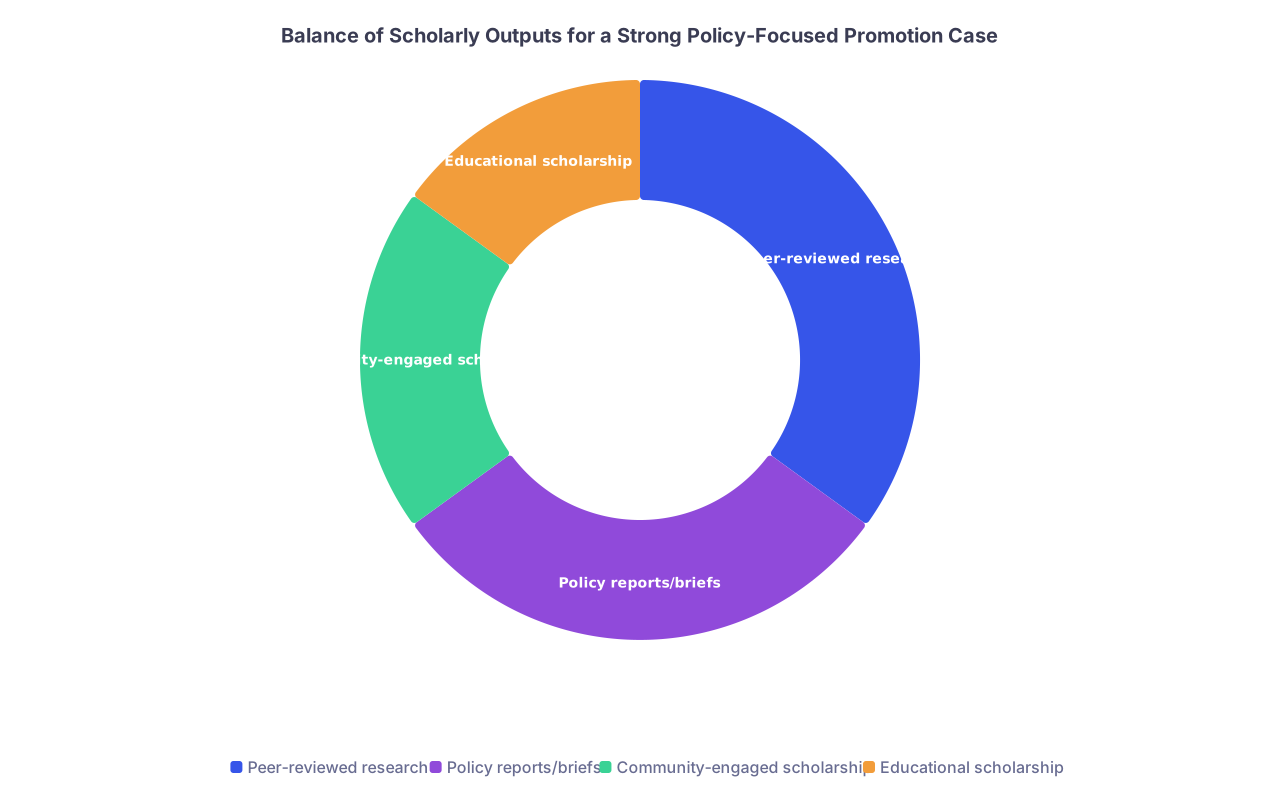
| Category | Value |
|---|---|
| Peer-reviewed research | 35 |
| Policy reports/briefs | 30 |
| Community-engaged scholarship | 20 |
| Educational scholarship | 15 |

| Step | Description |
|---|---|
| Step 1 | Policy-related activity |
| Step 2 | Service or advocacy |
| Step 3 | Consider writing it up |
| Step 4 | Knowledge translation |
| Step 5 | Scholarly work - include in promotion case |
| Step 6 | Systematic and rigorous? |
| Step 7 | Publicly accessible product? |
| Step 8 | Reviewable by peers? |


The Bottom Line
Three things to keep front and center:
Scholarly work in public health policy is broader than just RCTs and R01s—but not everything you do is scholarly. It has to be systematic, public, reviewable, and part of a coherent agenda.
Policy briefs, commissioned reports, community-engaged projects, and educational innovations can absolutely count as scholarship—if they’re rigorous, citable, and framed correctly in your dossier.
Promotion is as much about translation as production. Your job isn’t just to do the work; it’s to package it so your department, dean, and external reviewers can see it as a legitimate, cumulative body of scholarly contribution to public health policy.