
You’re staring at ERAS. You’ve got your clerkship grades, some research, a couple of leadership roles. And then there’s this pile of stuff that doesn’t fit neatly: working with a local harm reduction group, testifying at a city council hearing, writing policy briefs on housing and health, organizing white coat protests.
You’re asking yourself:
“Does any of this belong on my residency application… or is it going to look political, controversial, or irrelevant?”
Here’s the answer you’re looking for: yes, you should list advocacy and policy work on your residency application — if you frame it correctly and strategically. Let’s walk through how.
1. Should you list advocacy and policy work at all?
Short answer: yes, almost always.
The only times I’d even consider leaving it off:
- It’s directly tied to discriminatory or hateful messaging (rare, but then it’s a professionalism problem, not an “is this relevant” problem).
- You can’t discuss it professionally or without attacking people who disagree.
- You did essentially nothing and are trying to inflate a 1‑hour march into “major advocacy leadership.”
Otherwise? List it.
Residency programs increasingly care about:
- Health equity
- Systems thinking
- Interprofessional collaboration
- Physicians who can work beyond the exam room
Good advocacy and policy work screams all of that.
Where students get burned is how they list it, not that they list it.
2. Where to put advocacy and policy on ERAS
You have a few slots to play with. Use them strategically.

Here’s how I’d structure it.
Work/Activities section
This is your primary home for advocacy and policy.
Put it here if:
- You held an official role (committee member, coordinator, chair, policy fellow)
- You did longitudinal work (months to years)
- You had measurable outputs (legislation, institutional changes, reports, ongoing programs)
Good examples:
- “Student Representative, Hospital DEI Committee”
- “Policy Intern, State Health Department – Tobacco Control”
- “Organizer, Medical Students for Immigrant Health”
Research section
Use this if your policy work had a scholarly component:
- Policy analyses
- White papers for an institution or government body
- Health services or implementation research feeding into policy
You’re not gaming the system here; just don’t call an op-ed “research.”
Volunteer experiences
Put it here if:
- You were doing community organizing, education, or outreach without formal academic or job structure
- It was more service-oriented than analytical
Things like:
- Voter registration in clinic for Medicaid expansion
- Street medicine with a housing justice angle
- Community naloxone training programs
Personal statement
Use your advocacy/policy work selectively here.
You don’t need to rehash what’s already in the activities section. Use the personal statement if:
- Advocacy explains your “why” for your specialty.
- It shows your core values: justice, integrity, courage, humility.
- It shows you can reflect ethically, not just rant.
Bad personal statement: “The system is broken and I’m angry.”
Good personal statement: “Working with tenants facing eviction taught me how housing policy shows up as shortness of breath in the ED at 2 a.m.”
3. How to frame advocacy so programs see value, not politics
This is where people screw it up. They make three mistakes:
- They sound like activists first, physicians second.
- They lead with ideology instead of impact.
- They use jargon that turns off clinicians who already feel overwhelmed.
You need a different frame:
Policy as a tool for patient care, not an identity or party.
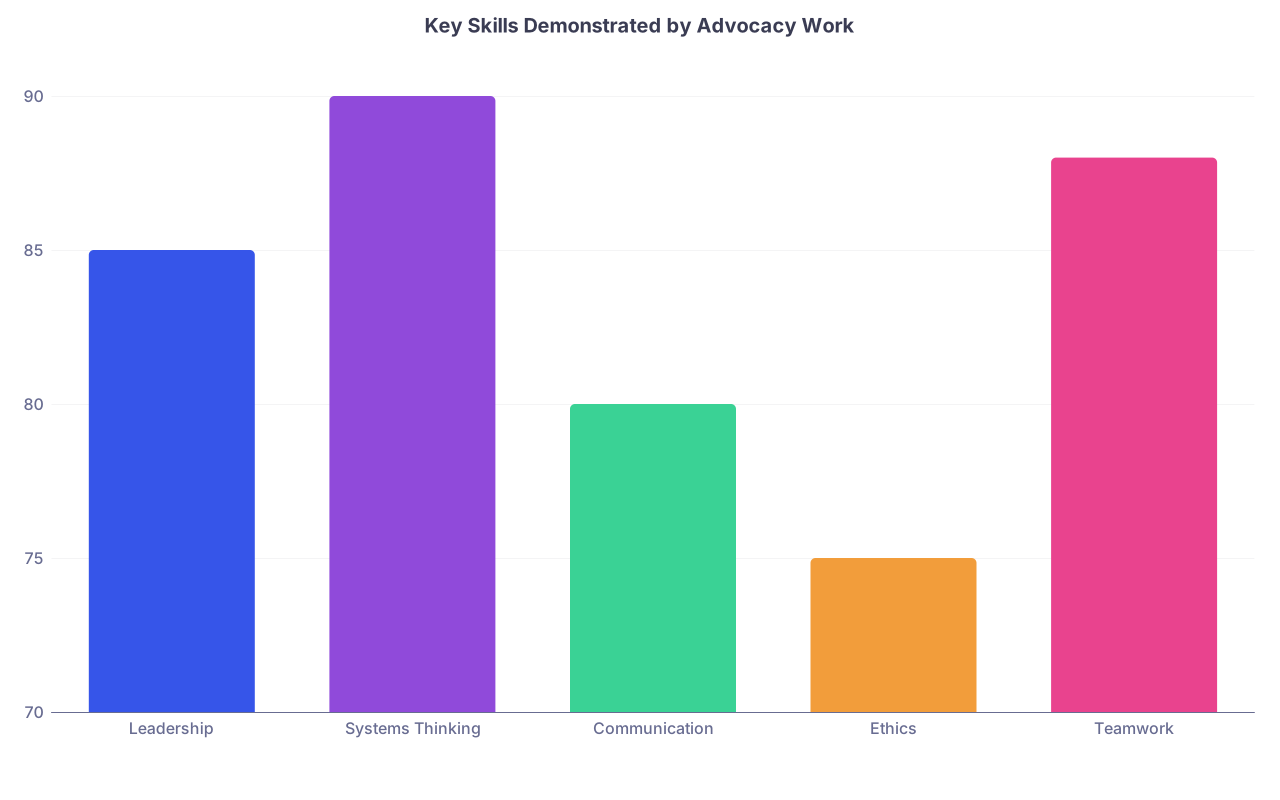
| Category | Value |
|---|---|
| Leadership | 85 |
| Systems Thinking | 90 |
| Communication | 80 |
| Ethics | 75 |
| Teamwork | 88 |
Use this 4-part structure in your description
For each activity, think:
- Context – What was the problem?
- Role – What exactly did you do?
- Impact – What changed?
- Skills – What did you learn that matters for residency?
Example (ERAS description style):
“Worked with a multidisciplinary team (community organizers, social workers, physicians) to address high asthma readmission rates in a low-income neighborhood. Led a medical student group conducting home visit surveys, presented findings to the city council, and contributed to a proposal to expand housing inspection for mold and pests. Learned to connect individual patient stories with population-level data and practice concise, persuasive communication with non-clinical stakeholders.”
Notice:
No party labels. No slogans. Zero culture-war buzzwords. Very clear patient-centered impact.
4. What programs actually think when they see advocacy
Let me be blunt: not every program will drool over your policy work. Some reactions you’ll trigger:
- Academic, university-based, safety-net, and strong primary care programs: usually positive to very positive.
- Highly procedural, old-school, or purely community private practice programs: more “meh” unless you connect it to concrete patient care or QI.
- Programs under intense political pressure locally: cautious, but still often interested if they trust your professionalism.
| Program Type | Likely Reaction to Advocacy Work |
|---|---|
| Academic safety-net IM | Strong positive, seen as mission-fit |
| University EM or Peds | Positive, especially for equity work |
| Community FM with FQHC ties | Very positive if locally relevant |
| Community Surgery | Neutral unless clearly tied to QI |
| Highly competitive procedural | Mixed; fine but not a primary selling pt |
The programs that don’t value any form of advocacy, systems thinking, or ethics? You probably don’t want to spend 3+ years there anyway, especially if you care enough about this to be reading this.
Your job is to:
- Show maturity
- Show balance (you’re not going to skip call to go to a protest)
- Connect advocacy to being a better intern
If your application sounds like you want to be in Congress more than in clinic, that’s a red flag. You can be both policy-engaged and clinically serious. You just need to show it.
5. Handling “controversial” topics without torpedoing your app
You’re worried about listing:
- Reproductive justice work
- Immigrant rights and sanctuary policies
- Police violence and health
- Transgender healthcare policy
- Harm reduction and safe injection sites
These are reality in medicine, not fringe hobbies. But yes, some interviewers may bristle.
Here’s the rule: frame by patient population and health outcomes, not ideology.
Bad:
“Organized protests against racist policing policies.”
Better:
“Collaborated with community groups and local officials to address the health consequences of community violence and high incarceration rates, including access to trauma-informed primary care and continuity of medications after release.”
Same work. Different frame. One is a slogan. The other is systems-aware medicine.

What about during interviews?
If they ask about it, answer like this:
- Stick to what you did.
- Connect to what you learned that helps you as a resident.
- Acknowledge complexity where it exists. Nuance is your friend.
Example:
“Yes, reproductive health policy is politically charged, but for me the work was grounded in making sure patients had clear, evidence-based counseling and safe clinical options. Working with both clinicians and community leaders taught me how to communicate across differences and keep the focus on patient safety and autonomy, which I think is essential in residency when emotions run high on the wards.”
You’re not there to convert your interviewer. You’re there to show judgment, professionalism, and clarity about your role.
6. Ethics: what this says about you as a future physician
This category you gave — PERSONAL DEVELOPMENT AND MEDICAL ETHICS — actually matters here.
Advocacy and policy work can showcase:
- Respect for patient autonomy (e.g., consent laws, language access)
- Justice (e.g., addressing structural barriers to care)
- Beneficence/non-maleficence (e.g., harm reduction, safe prescribing policies)
- Professional responsibility (e.g., speaking up about unsafe systems)
If all your advocacy is basically self-promotion (“I got to be on TV”), it looks hollow. If it’s grounded in:
- Specific patient stories that changed how you think
- Data that made you uncomfortable and then you acted
- Owning mistakes (“I realized we weren’t listening enough to the community”)
…then it reads as ethical growth, not a side hustle.
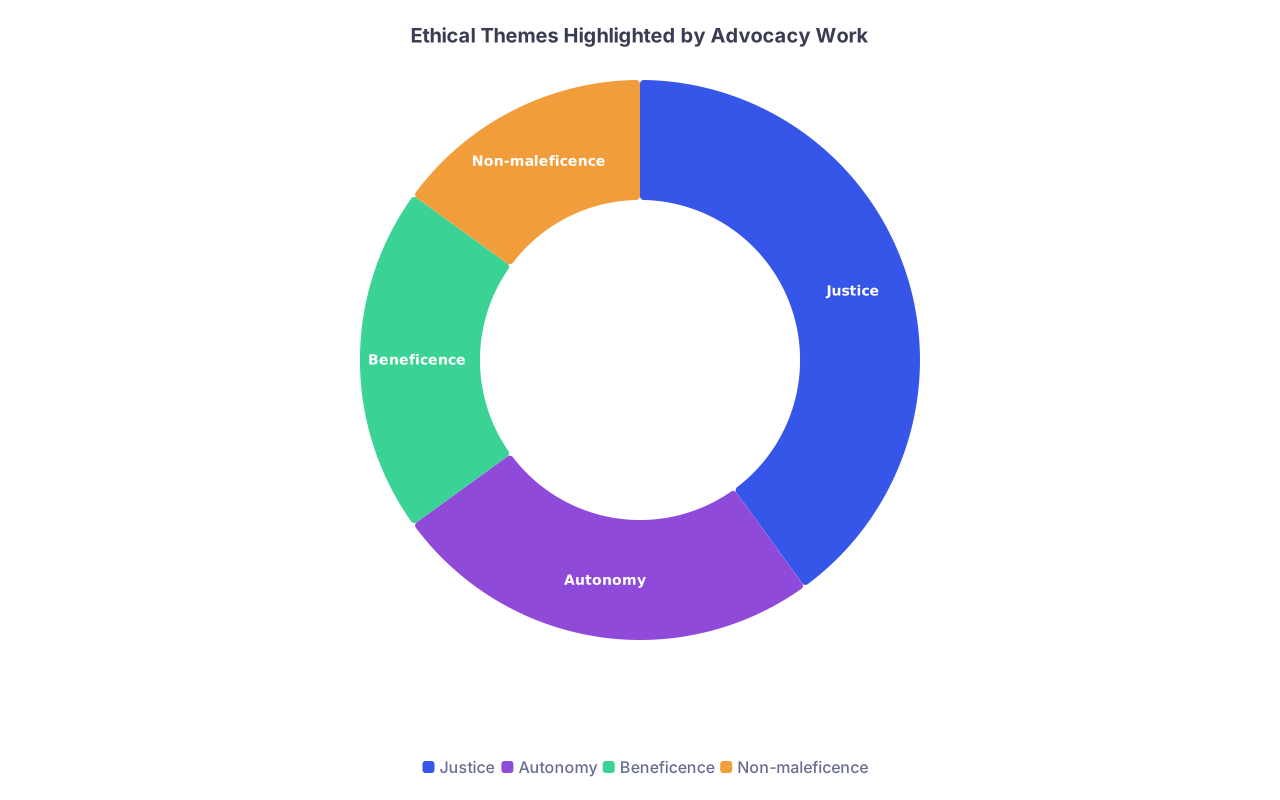
| Category | Value |
|---|---|
| Justice | 40 |
| Autonomy | 25 |
| Beneficence | 20 |
| Non-maleficence | 15 |
You can be very direct about this in your descriptions:
“Working on overdose prevention policy forced me to confront my own biases about substance use and rethink what non-maleficence looks like when the status quo is already harming people.”
That’s the kind of line that makes a PD think, “This person has actually thought about medicine beyond buzzwords.”
7. Red flags and mistakes to avoid
I’ve seen people tank otherwise strong applications with how they present this stuff. Avoid these:
Inflation.
“Led a national movement” = you reposted things on Instagram. Don’t do that. Program directors can smell exaggeration.Aggressive tone.
If your description sounds like you’re lecturing the reader (“Physicians have been complicit in oppressive systems and anyone not actively dismantling them is harmful”), you’ve lost half the interviewers in the first sentence.No clinical connection.
If nothing about your advocacy ever touches patients or systems of care, you start to look like you’d rather be in a policy school.Time management concerns.
If you list 20 heavy advocacy roles with huge time demands on top of med school, people start wondering if you’re realistic about bandwidth. Be honest about scope.Confidentiality/oversharing.
Don’t name specific patients, share protected info, or bash particular faculty or institutions by name.

8. Quick decision guide: should this specific activity be listed?
Use this mental flowchart:

| Step | Description |
|---|---|
| Step 1 | Advocacy or policy activity |
| Step 2 | Skip or brief mention |
| Step 3 | Reframe or omit |
| Step 4 | List on ERAS with patient-centered framing |
| Step 5 | Substantive involvement? |
| Step 6 | At least a few weeks of work or clear product? |
| Step 7 | Would you be OK discussing it with a politically opposite PD? |
| Step 8 | Demonstrates skills or ethics relevant to residency? |
If you can talk about it:
- Calmly
- With respect for people who disagree
- In terms of patient care and systems
…you can list it.
9. A concrete example: from raw experience to ERAS-ready
Let’s take a messy, real-world thing and clean it up.
Raw experience:
- You helped plan a white coat protest about police violence.
- You wrote an op-ed about racism as a public health crisis.
- You joined meetings with hospital leadership about security policies.
Bad ERAS entry: “Organized protests against racist policing and hospital complicity in systemic violence. Demanded institutional change.”
Good ERAS entry: “Collaborated with fellow students, faculty, and community advocates to address the health impact of community violence and law enforcement encounters on our patient population. Helped plan a clinician-led event highlighting local data on injuries and mental health outcomes, co-authored an op-ed emphasizing the role of healthcare institutions in promoting safe and dignified care for all patients, and participated in meetings with hospital leadership regarding de-escalation training and security procedures. Gained experience in presenting sensitive data respectfully and working with diverse stakeholders who held different views on solutions.”
Same work. Completely different signal.
FAQ (exactly 5 questions)
1. Will listing advocacy or policy work hurt me at more conservative programs?
It might, depending on how you frame it and how far out on the political limb you go. But the bigger point: if a program is turned off by carefully framed, patient-centered advocacy, they’re probably not a good fit for you. You don’t need to sanitize your values, but you do need to speak in professional, patient-focused language rather than slogans.
2. What if my advocacy is only social media–based?
If it’s just reposts and occasional commentary, don’t list it. If you ran a large, organized campaign with measurable outcomes (organized events, built educational resources, coordinated volunteers, partnered with institutions), then you can list it, but be precise. “Coordinated an online campaign that recruited 200 volunteers for community vaccination drives” is fine. “Advocacy influencer on Instagram” is not.
3. Can I tailor how much advocacy I show based on the program?
Yes, and you should. You can have different personal statements and even different emphasis in how you talk during interviews. You don’t need to change your story, but you can highlight different aspects. For a county program, lean into equity and systems change. For a community program, emphasize communication skills, trust-building, and practical improvements in care delivery.
4. How do I talk about advocacy if my Step scores or grades aren’t great?
Do not use advocacy as an excuse for poor performance (“I was too busy saving the world to study”). Terrible look. Instead, show that you can balance commitments now: “Earlier in med school, I took on too many roles and my exam performance suffered. I’ve since scaled back, improved my study approach, and my later rotations reflect that. I still care deeply about policy, but I’ve learned how to protect the time needed to be a safe, effective clinician first.”
5. What’s one sentence I can use to tie advocacy to residency in interviews?
Use something like: “My advocacy work has always been about removing barriers that keep patients from benefiting from the care we’re trying to provide. Residency is where I want to get as strong as possible clinically, so that my future policy or systems work is grounded in real experience at the bedside.”
Today, do this: open your ERAS activities list and pick one advocacy or policy experience. Rewrite its description using the 4-part structure — context, role, impact, skills — and make sure every sentence could be read by someone who disagrees with your politics but still respects your professionalism.